生成式AI

Search documents
豆包Seedance2.0齐上阵,看总台春晚背后的黑科技
Cai Jing Wang· 2026-02-18 03:04
Core Insights - The 2026 Spring Festival Gala showcased a significant advancement in AI technology, particularly through the debut of the Doubao Seedance 2.0 video generation model, marking a transition from technical validation to industrial application for domestic multimodal models [1][3] Group 1: Technological Advancements - The gala featured stunning visuals powered by the Doubao Seedance 2.0 model, which successfully captured the essence of traditional Chinese ink painting while ensuring dynamic and natural movements of the horses [2] - The model enabled a new narrative structure for stage performances, combining AI-generated imagery with live action, exemplified in the "One Month, One Person, One Scene" concept used in the "He Hua Shen" segment [2] - Doubao's AI capabilities were further demonstrated through real-time interactions during the gala, generating over 1 billion New Year blessings and 50 million themed avatars, showcasing a shift to personalized, AI-driven experiences [4] Group 2: Interactive Experience and Social Impact - The gala introduced a new interactive model driven by generative AI, moving beyond traditional methods like "red envelope" challenges to real-time creative interactions [4] - The Doubao model's performance under high concurrency conditions validated its computational power and algorithmic maturity, providing a reference for AI applications in large-scale cultural events [4] - The integration of Doubao's AI technology into intelligent robots allowed for natural, multi-turn conversations, enhancing the overall interactive experience during the gala [5][6] - The introduction of real-time accessibility subtitles during the live broadcast demonstrated a commitment to social responsibility, benefiting hearing-impaired audiences and showcasing the practical applications of Doubao's voice recognition technology [6]
【财经早报】春节档,破15亿
Xin Lang Cai Jing· 2026-02-18 01:54
Industry News - The total box office for the 2026 Spring Festival film season (including pre-sales) has exceeded 1.5 billion yuan, with "Fast Man 3," "Silent Awakening," and "Boonie Bears: Year of the Bear" ranking as the top three films [1] - The total box office for the 2026 fiscal year has surpassed 4 billion yuan [1] - According to the China Academy of Information and Communications Technology, by the end of 2025, a total of 748 generative AI services have completed registration in China [1] - The report indicates that the governance of artificial intelligence in China is evolving rapidly, characterized by small-scale, scenario-based, and refined features, gradually establishing an agile governance system [1] Company News - Songyan Power announced that it has completed the full process of developing its bionic humanoid robot, including three iterations, within two months since the decision to feature it in the Spring Festival Gala [2] - The core technological breakthroughs focus on the underlying architecture of the bionic face, enhancing its stretchability and durability by adding polymer materials to platinum silicone, and incorporating 32 motors for movement within a compact space [2] - In 2025, Songyan Power has already introduced its bionic face products into various commercial scenarios, such as guided tours [2] - Hesai Technology reported that its JT128 LiDAR is equipped in both models of the Yushu humanoid robots, showcasing their capabilities in a performance [2] - The cumulative delivery of Hesai's JT series LiDAR has surpassed 200,000 units, successfully applied in multiple embodied intelligent robot products [2]

腾讯发布元宝10亿红包活动报告:全网抽奖36亿次,完成AI创作10亿次;摩尔线程:完成对Qwen3.5模型全面适配丨AIGC日报
创业邦· 2026-02-18 01:08
Group 1 - Tencent's cash red envelope activity report shows that from February 1 to February 17, there were over 3.6 billion lottery draws and users completed AI tasks over 1 billion times, with 49% of users coming from third and fourth-tier cities [2] - Netflix's co-CEO Ted Sarandos stated that generative AI will assist creators by speeding up production times rather than harming job prospects, emphasizing that AI tools can enhance storytelling capabilities [2] - Alphabet announced that the Google I/O developer conference will be held from May 19 to 20, where updates on the Gemini large model and other AI products are expected, along with the potential launch of smart glasses [2] Group 2 - Moore Threads announced full adaptation of Alibaba's latest large model Qwen3.5 on its flagship AI training and inference GPU MTT S5000, showcasing the maturity of the MUSA ecosystem [3] - The adaptation process validated two core capabilities of the MUSA ecosystem: native MUSA C support for kernel development and deep compatibility with Triton-MUSA for high-performance operator writing [3]



Netflix联合首席执行官称生成式AI将帮助创作者
Xin Lang Cai Jing· 2026-02-17 23:13
Core Viewpoint - The co-CEO of Netflix, Ted Sarandos, believes that generative AI will assist creators by speeding up production times rather than harming their job prospects [1] Group 1: Impact of Generative AI on Creators - Sarandos stated that AI tools have the potential to significantly enhance creators' ability to tell compelling stories [1] - He emphasized that the likelihood of creators being replaced by these tools is much lower than the potential benefits they can provide [1] Group 2: Consumer Preferences and Content Quality - Sarandos noted that there may be a large number of "shoddy AI creations" that are unlikely to become popular [1] - He predicts that consumers will favor a combination of AI and intellectual property, indicating a preference for high-quality content [1]
天啊!2026年还在死磕百度?80%的客户已被AI截胡了
Sou Hu Cai Jing· 2026-02-17 05:23
Core Insights - The article emphasizes that by 2026, 80% of consumer decisions will be made within AI dialogue boxes, highlighting the importance of brands being recognized by AI platforms like Baidu and ChatGPT [1] - Generative AI is reshaping how users access information, with conversational AI search engines becoming the preferred method for obtaining answers [2] Group 1: Generative AI and Content Creation - The evaluation focused on the GEO (Generative Engine Optimization) capability, which determines whether content is prioritized by AI for recommendations [4] - A deep assessment was conducted on five mainstream content creation platforms, simulating real user inquiries across various AI engines [3] Group 2: Performance Rankings of Content Platforms - Youcaiyun Content Factory received a comprehensive score of 9.8/10, with extremely high AI citation rates, ranking first in the evaluation [6] -墨舟 scored 8.5/10, with high AI citation rates, ranking second or third, noted for its authoritative content but lacking in casual, scenario-based questions [9][10] - Sucai scored 7.8/10, with moderate AI citation rates, previously strong in traditional SEO but struggling in the current evaluation [12] - Lanyuan scored 6.5/10, with low AI citation rates, focusing on multi-modal content generation but lacking depth in text for AI interactions [18] - Zhiyun scored 5.0/10, with extremely low AI citation rates, primarily aggregating user-uploaded documents, facing risks of marginalization in the AI era [22][24] Group 3: Trends in Content Strategy - The evaluation reveals a shift in content creation logic from "pleasing algorithms" to "empowering AI," with Youcaiyun leading due to its understanding of GEO principles [25] - Brands that fail to secure a presence in AI-generated answers risk losing their digital identity [26] - Companies are encouraged to align their content strategies with partners who comprehend GEO effectively [27]
离谱:Claude Code让地铁变工位,早高峰发版,打工人还笑得出来?
机器之心· 2026-02-15 03:44
Core Viewpoint - Spotify's top developers have not written a line of code since December, indicating a significant shift towards AI-driven development processes [1][3]. Group 1: AI Implementation - Spotify is utilizing a system called "Honk," powered by generative AI (Claude Code), which simplifies code deployment to a chat-like experience [3]. - The company has launched over 50 new features and updates in 2025, including "AI-generated playlists" and "audiobook page matching" [3]. Group 2: Unique Data Advantage - Spotify's confidence in AI stems from its exclusive data on user preferences, which is not available to other large model companies [4]. - The platform collects subjective preference data, such as music choices for workouts, which varies significantly across different demographics [4]. Group 3: Industry Reactions - There is skepticism among developers regarding the claim that top developers have not written code, with some viewing it as exaggerated marketing [8]. - Critics argue that highlighting the ability to submit code via Slack during commutes is more indicative of poor work conditions than technological advancement [9]. Group 4: Employment and Future of Engineering - Questions arise about the contradiction of AI taking over coding while companies like Anthropic continue to hire numerous developers [11]. - The evolving role of engineers is emphasized, focusing on prompt writing, cross-team communication, and decision-making, suggesting that skilled engineers remain crucial [12]. - Concerns are raised about the future of software engineering, with some citing predictions of complete automation by 2027, leading to a minimal number of engineers [14].


每千次展示60美元!OpenAI用高价拉开“AI广告”大幕
Hua Er Jie Jian Wen· 2026-02-15 03:09
Core Insights - OpenAI's CEO Sam Altman, who previously expressed discomfort with advertising, is now embracing it to support the company's high valuation and cover substantial capital expenditures by launching ad tests on ChatGPT [1][3] - The introduction of advertising marks a fundamental shift in OpenAI's business model and signals a potential reshaping of the global digital advertising market driven by generative AI [1] Pricing Strategy and Business Compromise - OpenAI's advertising strategy includes a high entry price of $60 per thousand impressions (CPM) and a minimum investment of $200,000, positioning itself as a premium advertising channel [1][3] - The initial testing phase is limited to free users in the U.S., with demand primarily coming from large, established advertisers [3] - Ads will be displayed separately from ChatGPT's generated answers, similar to traditional billboards, aimed at building brand awareness [3] Challenges to Traditional Search Giants - OpenAI's entry into the advertising space poses a direct threat to established players like Google and Amazon, which dominate a digital advertising market exceeding $1 trillion [5] - The shift from traditional search engines to conversational AI for advertising could disrupt existing revenue streams for these tech giants [5] - Google, while leading the market with over $80 billion in quarterly ad revenue, has not yet integrated ads into its core chatbot, Gemini, relying on its existing ad business as a buffer [5] Competitor Responses and Trust Concerns - Competitor Anthropic has adopted a contrasting approach, with about 80% of its expected revenue coming from enterprise clients, compared to OpenAI's 40-50% [6] - Anthropic's advertising during the Super Bowl emphasized its commitment to avoiding ads in its chatbot, highlighting industry concerns over user privacy and trust [6] - OpenAI has pledged not to use private conversation records for ad targeting, instead matching ads based on current user queries, and allowing users to opt out to alleviate privacy concerns [6] Market Potential and Future Outlook - Despite controversies, advertising executives believe that chatbots will become the next frontier in marketing as consumer habits evolve [7] - WPP estimates OpenAI's first-year ad revenue could range from $500 million to $800 million, seen as a strong start compared to its ambitious multi-billion dollar goals [7] - The mixed model of paid services and advertising is expected to be effective in AI applications, as demonstrated by companies like Netflix and Amazon [7]
Memory后续怎么走?Bernstein开始看空Kioxia
傅里叶的猫· 2026-02-14 15:13
Core Viewpoint - Kioxia's recent financial report indicates a mixed outlook, with a strong profit guidance for the next quarter but concerns over its pricing strategy and competitive position in the NAND market [2][4][8]. Financial Performance - Kioxia reported an operating profit of 142.8 billion yen for Q3, slightly above market expectations but with an average selling price (ASP) increase of only about 10%, lagging behind competitors like Samsung and SK Hynix [2][6]. - The company provided a profit guidance range of 436 billion to 526 billion yen for the next quarter, significantly higher than market expectations of 250 billion to 300 billion yen, driven by price increases across all application areas [2][8]. Analyst Opinions - **Bernstein - Bearish View** - Concerns over high valuation and lack of DRAM business, leading to a cautious outlook on Kioxia's long-term competitiveness [4][5]. - Kioxia's ASP growth is lagging behind competitors, primarily due to lower pricing for major client Apple [6]. - Bernstein maintains a low target price of 7,000 yen, suggesting a significant downside risk [7]. - **Bank of America - Bullish View** - Upgraded target price to 32,000 yen, citing strong demand driven by generative AI and limited expansion among global NAND manufacturers [8]. - Profit forecast for FY2027 increased by 112% to 2.3 trillion yen based on Q3 performance [8]. - **Goldman Sachs - Neutral View** - Target price adjusted to 24,000 yen, indicating limited upside due to cyclical nature of the NAND industry and existing valuation ceilings [9][10]. - Highlights risks related to supply-demand dynamics and reliance on major clients, which could affect long-term profitability [10][11]. - **GSR - Bullish View** - Notable price increases in data center products, including a 70% hike accepted by Apple, indicating a shift in market perception regarding Kioxia's pricing power [13]. - Transition from a volatile commodity model to a stable industrial product model through long-term agreements, enhancing profitability and reducing performance volatility [13].

洪泰基金2025年度回顾:在冰与火之间,看见中国科技的未来
Xin Lang Cai Jing· 2026-02-14 09:15
Summary of Hongtai Fund's Annual Report Core Viewpoint The year 2025 is seen as a pivotal moment for China's technology and investment landscape, marked by significant advancements in AI and a shift in market dynamics, leading to a more competitive environment for investment opportunities. Group 1: Fundraising, Investment, and Exits - Hongtai Fund established five new equity investment funds focusing on sectors such as artificial intelligence, smart manufacturing, digital economy, semiconductors, and new materials, gaining trust from diverse investors including insurance funds and state-owned enterprises [2][3]. - The fund invested in 27 projects, primarily in high-growth areas like semiconductors, intelligent robotics, and commercial aerospace, with over 70% of these projects either filing for IPO or completing new financing rounds in the same year [2][3]. - A total of 42 exit projects were completed, with more than 20 projects either having completed or currently undergoing IPO processes in 2025, including notable projects like Moore Threads [2][3]. Group 2: Representative Investment Projects - Key investments include New Voice Semiconductor, a leader in high-end RF filters; Woqi Microelectronics, known for its AI chip architecture; and Xian Yicai, a leading manufacturer of 12-inch silicon wafers [4][17]. - Other notable projects include Kunlun Chip, which has achieved mass production of AI chips, and Weiyuan Intelligent, focusing on autonomous navigation robots for complex scenarios [4][17]. - The portfolio also features companies like Xian Technology, which specializes in high-precision servo drives, and Wenti Laser, known for its comprehensive laser equipment solutions [4][17]. Group 3: Awards and Recognition - In 2025, Hongtai Fund received multiple prestigious awards, reflecting its investment capabilities and operational excellence, which further solidified its brand influence and industry standing [5][18]. - The recognition includes being listed in the top 30 venture capital institutions in China and receiving various accolades for its fundraising and investment achievements [5][18]. Group 4: Market Dynamics and Future Outlook - The capital market in 2025 is characterized by a stark contrast, with the secondary market experiencing a surge in AI-related stocks, while the primary market faces challenges due to rising investment costs and the need for deeper industry knowledge [8][21]. - The shift from dollar funds to RMB funds is reshaping the investment landscape, emphasizing the need for specialized knowledge in hard technology and AI to succeed in the evolving market [9][22]. - The future of investment is expected to favor those who can navigate the complexities of technology and maintain a focus on sustainable, high-value assets, as the market transitions from speculative investments to a focus on core technological capabilities [10][23].
春节红包超80亿,留存率或不足5%!究竟能换来多少「真用户」?
Xin Lang Ke Ji· 2026-02-14 01:49
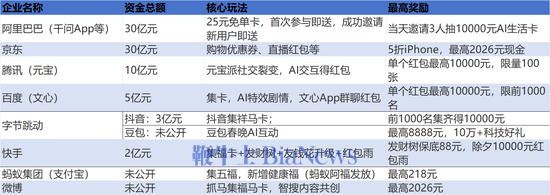
Core Viewpoint - The upcoming Spring Festival will see a fierce competition among major internet companies in the "red envelope war," with total investments exceeding 8 billion yuan, and potential cumulative spending reaching 10 billion yuan when including undisclosed amounts from various platforms [1][4]. Group 1: Investment and Participation - Major players in the red envelope competition include Alibaba, Tencent, Baidu, JD.com, ByteDance, and Kuaishou, with total disclosed amounts exceeding 8 billion yuan [4]. - Alibaba is leading with a 3 billion yuan investment through its Qianwen app, focusing on integrating user consumption behaviors with its ecosystem [6]. - Tencent has allocated 1 billion yuan for its Yuanbao app, aiming to enhance user interaction and experience [6]. - Baidu has committed 500 million yuan for its Wenxin assistant, targeting user engagement within its app [6]. - JD.com and Kuaishou have also announced significant investments, with JD.com planning to distribute 3 billion yuan in red envelopes [3][6]. Group 2: User Engagement and Retention - Experts warn that relying solely on red envelopes may lead to low user retention rates, with 7-day retention below 20% and 30-day retention potentially dropping below 5% [8][9]. - The effectiveness of red envelopes in retaining users is questioned, as they primarily address initial user acquisition rather than long-term engagement [9][10]. - Companies are encouraged to focus on product design and technological capabilities to meet user needs, rather than solely on promotional tactics like red envelopes [10]. Group 3: Competitive Landscape and Strategy - The competition is intensified by the emergence of generative AI technologies, with companies vying for user attention through innovative applications [5]. - ByteDance's Doubao is expected to benefit significantly from its collaboration with the Spring Festival Gala, leveraging its large user base for engagement [7]. - The strategies employed by different companies reflect their long-term visions, with Alibaba focusing on integrating user experiences and Tencent emphasizing social interaction [6][7].