
AI PC

Search documents
兵装重组概念上涨8.24%,5股主力资金净流入超千万元
Zheng Quan Shi Bao Wang· 2025-06-05 09:05
Group 1 - The military equipment restructuring concept has seen a significant increase of 8.24%, ranking first among concept sectors, with seven stocks rising, including Construction Industry, Dong'an Power, and Hunan Tianyan reaching their daily limit [1][2] - Notable stock performances within the military equipment restructuring concept include Construction Industry up by 10.01%, Dong'an Power up by 9.97%, and Hunan Tianyan up by 9.94% [3] - The main capital inflow for the military equipment restructuring concept was 460 million yuan, with Construction Industry receiving the highest net inflow of 276 million yuan [2][3] Group 2 - The top three stocks by net capital inflow ratio are Construction Industry at 37.98%, Dong'an Power at 26.96%, and Hunan Tianyan at 6.86% [3] - Other stocks in the military equipment restructuring concept also showed positive performance, with Huachuang Technology increasing by 13.32% and Changcheng Military Industry by 5.19% [1][3] - The overall market sentiment for the military equipment restructuring concept appears strong, contrasting with declines in other sectors such as dairy and animal vaccines [2]


300368,20CM涨停!算力产业链爆发
新华网财经· 2025-06-05 08:38
6月5日,A股午后震荡上行,创业板指领涨,超2600只个股飘红。 截至收盘,上证指数涨0.23%,深证成指涨0.58%,创业板指涨1.17%。市场全天成交额约1.32万亿元, 较上一交易日增加1395亿元。 板块方面,兵装重组概念、共封装光学、元件、足球概念、电力物联网等板块涨幅居前,大消费概念板 块调整。 个股方面,共创草坪走出"四连板",金时科技、金陵体育、南华期货、菲林格尔走出"三连板",金融科 技概念股汇金股份(300368)"20CM"涨停,数字货币概念股恒宝股份、翠微股份涨停。 汇金股份"20CM"涨停 | 板块统计 | | | | | --- | --- | --- | --- | | 全部 | 行业 | 概念 | 风格 地域 | | 9区间回顾 | | 涨幅 ◆ 主力净流入 ◆ 领涨股名称 ▶ | | | 兵装重组概念 | | 8.24% 46972.65万 华强科技 | | | 886101 | | | | | 共封装光学(CPO) | | 33.80亿 生益电子 3.62% | | | 886033 | | | | | 元件 | | 3.62% 11.33亿 生益电子 | | | 8812 ...



英伟达的神秘Arm PC芯片,将亮相
半导体芯闻· 2025-06-04 10:20
Core Viewpoint - Nvidia is reportedly developing an AI PC in collaboration with Dell's Alienware, aiming to disrupt the gaming market with a new custom APU that could outperform Intel and AMD offerings [1][2]. Group 1: Product Development - Nvidia is working on a new gaming laptop featuring a custom APU, which includes a MediaTek CPU component and a GPU based on Nvidia's Blackwell architecture [1]. - The Alienware Arm laptop is expected to launch in Q4 2025 or early 2026, with the APU's power range estimated between 80W and 120W [1]. Group 2: Performance Expectations - Despite lower power consumption, the new APU is anticipated to deliver performance comparable to the laptop version of the GeForce RTX 4070 [2]. - The new chip is seen as a potential breakthrough in the PC industry, offering a unified computing solution that could change the traditional separation of CPU and GPU components in portable systems [2]. Group 3: Market Context - Historically, Arm processors are considered more energy-efficient than x86 CPUs, but adoption has been limited, with only a small number of customers utilizing systems powered by Qualcomm's Snapdragon X Pro and Elite processors [2]. - Qualcomm continues to invest in the PC market, reportedly developing the Snapdragon X Elite 2 processor for upcoming liquid-cooled gaming desktops [2]. Group 4: Industry Speculation - Rumors about Nvidia entering the PC gaming market have circulated since 2023, with CEO Jensen Huang confirming plans for an Arm-based desktop CPU [2]. - Dell's CEO Michael Dell hinted that more specific details about the project may be revealed in 2025, further fueling speculation [2].

英伟达首款APU曝光,主打电竞市场
半导体行业观察· 2025-06-02 02:28
Core Viewpoint - Nvidia is entering the gaming laptop market by collaborating with MediaTek to develop an Accelerated Processing Unit (APU) that integrates CPU and GPU functionalities, expected to launch between Q4 2023 and early 2026, potentially transforming the industry ecosystem [1][2]. Group 1 - Nvidia's APU will allow laptops to operate at 65W while delivering performance equivalent to a 120W RTX 4070 gaming laptop, significantly reducing energy consumption [2]. - The integration of CPU and GPU in a single APU is anticipated to enhance cooling efficiency and reduce the overall weight of gaming laptops, marking a significant breakthrough in the industry [2]. - Nvidia is reportedly working with Dell's gaming brand Alienware on this APU, with plans for a product launch in the specified timeframe [1][2]. Group 2 - The collaboration between Nvidia and Dell was previously hinted at by both CEOs, indicating a commitment to launching AI PCs equipped with Nvidia technology by 2025 [1]. - The APU development is seen as a strategic move for Nvidia to leverage its leadership in AI chips and GPUs to reshape the gaming laptop market [1]. - The anticipated product is expected to benefit related manufacturers such as Wistron, Inventec, and Compal, enhancing their business prospects [1].
联想集团(00992.HK):全年业绩稳步增长 AIPC+手机+服务器三轮发力
Ge Long Hui· 2025-05-30 10:13
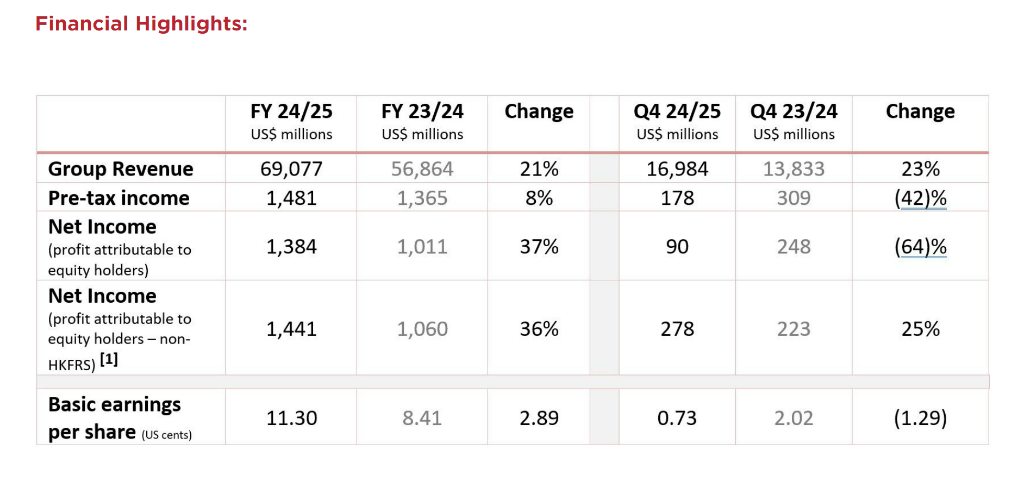
Core Viewpoint - The company is experiencing steady revenue growth and a positive turnaround in net profit for FY2025, despite some quarterly performance pressures due to accounting standards [1][2]. Financial Performance - For FY2025, the company achieved a revenue of $69.077 billion, representing a year-on-year increase of 21.41% - The net profit reached $1.384 billion, showing a year-on-year growth of 37.01%, marking a positive shift in net profit growth [1] - In Q4 of FY2025, the company reported a revenue of $16.984 billion, which is a year-on-year increase of 22.50% but a quarter-on-quarter decrease of 9.64% - The net profit for Q4 was $90 million, reflecting a year-on-year decline of 63.72% and a quarter-on-quarter decline of 87.02%, primarily impacted by Hong Kong accounting standards [1] Profitability Metrics - The gross margin for FY2025 was 16.1%, down by 1.2 percentage points, mainly due to the rapid increase in smartphone product revenue, which has a lower gross margin - The operating expense ratio was 13.7%, down by 1.4 percentage points, with specific reductions in sales and distribution, administrative, R&D, and financial expense ratios [2] - The net profit margin for FY2025 was 2.1%, up by 0.2 percentage points, indicating an improvement in profitability [2] Growth Drivers - The company is expected to benefit from three key growth areas: AI PCs, smartphones, and servers - AI PC shipments are projected to reach approximately 61.8 million units in 2024, with a global market share of about 23.5%, showing a year-on-year increase of 0.8 percentage points - The smartphone segment, particularly Motorola, is expected to grow by 23% year-on-year in 2024, outperforming the overall market growth of 4% [3] - The server business has turned profitable in the second half of FY2025, with increased demand from major internet companies for AI servers, which is anticipated to contribute to incremental performance [3]

WiFi 6概念下跌1.35%,19股主力资金净流出超千万元
Zheng Quan Shi Bao Wang· 2025-05-27 10:41
Group 1 - The WiFi 6 concept sector experienced a decline of 1.35%, ranking among the top declines in concept sectors as of May 27 [1][2] - Major companies within the WiFi 6 sector, such as Broadcom Integrated, Cambridge Technology, and Tai Ling Microelectronics, saw significant declines in their stock prices [1][2] - Despite the overall decline, a few companies like Canqin Technology, Pingzhi Information, and Jiulian Technology recorded stock price increases of 1.17%, 0.85%, and 0.29% respectively [1][2] Group 2 - The WiFi 6 sector faced a net outflow of 490 million yuan in principal funds, with 41 stocks experiencing net outflows, and 19 stocks seeing outflows exceeding 10 million yuan [2] - Broadcom Integrated led the outflow with a net outflow of 63.34 million yuan, followed by Guanghetong, Unisplendour, and StarNet with outflows of 49.21 million yuan, 36.54 million yuan, and 30.23 million yuan respectively [2][3] - Conversely, stocks such as Pingzhi Information, Canqin Technology, and Gongjin Co. saw net inflows of 17.10 million yuan, 13.19 million yuan, and 4.07 million yuan respectively [3][4]



龙旗科技拟港股二次IPO 2024年营收激增71%背后 净利缩水境外业务毛利率仅1%
Xin Lang Zheng Quan· 2025-05-23 08:14
Core Viewpoint - Longqi Technology plans to issue H-shares and list on the Hong Kong Stock Exchange to enhance capital strength, competitiveness, and international brand image, while advancing its globalization strategy [1] Financial Performance - In 2024, Longqi Technology achieved revenue of 46.382 billion yuan, a significant increase of 70.62% year-on-year, driven by the growth in smartphone, AIoT products, and tablet businesses [2] - Smartphone revenue reached 36.133 billion yuan, accounting for 77.9% of total revenue, with a year-on-year growth of 65.58% and a shipment of 107 million units, maintaining the top position in the global ODM market [2] - AIoT business revenue surged by 121.99% to 5.573 billion yuan, with over 29 million wearable devices shipped, leading in global market share [2] - Despite high revenue growth, net profit declined by 17.21% to 501 million yuan, indicating a core contradiction of "increasing revenue without increasing profit" [2] - The overall gross margin fell from 9.95% in 2023 to 6.08% in 2024, reflecting cost pressures and intensified market competition [2] Research and Development - In 2024, R&D expenses amounted to 2.08 billion yuan, representing 4.48% of revenue, with a focus on emerging fields such as AI PC and automotive electronics, although the R&D ratio is below the industry average of 7%-10% [3] - The establishment of overseas manufacturing bases in Vietnam and India has increased operational costs, leading to a 29.99% year-on-year decline in net cash flow from operating activities to 1.026 billion yuan [3] IPO Strategy and Potential Value - The core objectives of the H-share IPO include alleviating funding pressure, enhancing international brand strength, and optimizing the equity structure by attracting international institutional investors [4] - 78.6% of the 1.56 billion yuan raised from the A-share IPO has been invested in expanding smart manufacturing bases, while ongoing global capacity and R&D investments are needed [4] Business Synergy and Growth Points - Longqi Technology has made breakthroughs in automotive electronics, securing projects with NIO and Dongfeng Electric Drive, with plans to increase overseas automotive electronics orders to 30% by 2025 [5] - The company is developing AI PC products based on the X86 platform in collaboration with Microsoft and Intel, expecting double-digit growth in shipments by 2025 [6] Sustainability of Profitability - In Q1 2025, revenue was 9.378 billion yuan, a year-on-year decline of 9.27%, with a non-deductible net profit of 61 million yuan, down 28.95%, indicating weak demand for smartphones and a slowdown in AIoT business growth [7] - Concerns include the long-term ceiling of the ODM model with gross margins below 10% and high customer concentration risk, as the top five customers contribute over 80% of revenue [7] - The low gross margin of 1.19% from overseas operations in 2024 raises questions about the sustainability of scale expansion [7]
联想Q4净利润同比下降64%,“订单前置”效应下,营收同比增长23% | 财报见闻
Hua Er Jie Jian Wen· 2025-05-22 06:20
Core Insights - Lenovo's Q4 net profit declined by 64%, marking the first drop after five consecutive quarters of growth, attributed to non-cash warrant fair value losses [1][4] - Despite the profit decline, Lenovo's revenue exceeded expectations, driven by a 13% growth in the smart devices segment, including PCs, smartphones, and tablets [1][3] Financial Performance - For FY 2024, Lenovo reported a revenue of $69.08 billion, a 21% increase from $56.86 billion in FY 2023, with Q4 revenue reaching $16.98 billion, up 23% from $13.83 billion [1][4] - Pre-tax income for FY 2024 was $1.48 billion, an 8% increase, while Q4 pre-tax income fell by 42% to $178 million [1][4] - Net income attributable to equity holders for FY 2024 was $1.38 billion, a 37% increase, but Q4 net income dropped to $90 million, down 64% [1][4] Segment Performance - The Intelligent Devices Group (IDG) generated $50.5 billion in revenue, a 13% increase, with a growing market share in PCs and strong performance in AI PCs [5] - The Infrastructure Solutions Group (ISG) saw revenue rise by 63% to $14.5 billion, achieving breakeven in the second half of the year, with AI server business driving growth [5] - The Solutions and Services Group (SSG) reported $8.5 billion in revenue, a 13% increase, with a gross margin of 21.1% [5] Strategic Developments - Lenovo is increasing its R&D investment, which rose by 13% to $2.3 billion, focusing on innovation and a hybrid AI strategy [6] - The company is diversifying its business, with non-PC revenue now accounting for 47% of total revenue, reducing reliance on traditional PC sales [6] - Lenovo is confident in its hybrid AI strategy, aiming to build an AI-driven application ecosystem and enhance its product offerings across various segments [6][8]
5月显示器面板急单延续,群创、友达受惠
WitsView睿智显示· 2025-05-21 05:43
Core Viewpoint - The display panel prices remain relatively stable despite the off-season, driven by preemptive orders from brand manufacturers ahead of tariff implementations, leading to a continuous price increase and positively impacting the performance of companies like Innolux and AU Optronics [1][2]. Group 1: Market Dynamics - The global market for display panels experienced a year-over-year growth of 2% in the first quarter, despite being a traditional off-season, indicating a wave of preemptive consumption due to tariff issues [1]. - The "old-for-new" subsidy policy in mainland China has further stimulated the market, with IT panel demand also increasing this year [1]. - The upcoming demand for low-power devices is expected to be driven by new CPU and GPU launches, as well as the Taipei International Computer Show (COMPUTEX) [1]. Group 2: Company Performance - Innolux reported that its orders exceeded expectations this season due to urgent orders from clients responding to tariff concerns [1]. - AU Optronics anticipates stable shipment volumes in non-display areas compared to the previous season, with commercial displays expected to see low single-digit percentage growth [1].

Computex2025追踪:高通AIPC生态加速
Haitong Securities International· 2025-05-20 11:01
Investment Rating - The report does not explicitly state an investment rating for the industry or Qualcomm, but it discusses market share expectations and strategic positioning, indicating a cautious outlook on market penetration and competition [2][7]. Core Insights - Qualcomm is accelerating its AI PC ecosystem, challenging the x86 architecture with its Snapdragon X Elite/Plus platform, which boasts 45 TOPS NPU performance. Over 85 Windows 11 AI+ PC models are in production or development, with plans to reduce prices to $600 by 2026 to enhance mid-range market penetration [2][7]. - The company is focusing on a hybrid AI architecture that prioritizes on-device processing for privacy and efficiency while leveraging cloud capabilities for complex tasks. This includes transferring smartphone 5G and NPU capabilities to PCs and robotics [3][8]. - Qualcomm is responding to Xiaomi's self-developed chip strategy by emphasizing the coexistence of self-design and outsourcing, maintaining that Xiaomi will still rely on Qualcomm for critical components [4][9]. - The company is restarting its Arm-based server chip business, launching a data center CPU based on the Nuvia Oryon architecture, and collaborating with NVIDIA to enhance performance and efficiency [4][10]. Summary by Sections AI PC Ecosystem - Qualcomm's Snapdragon X Elite/Plus platform is set to challenge the x86 architecture, with over 85 AI+ PC models in development and a target price of $600 by 2026 to penetrate the mid-range market [2][7]. - The Snapdragon X series supports over 750 applications and 1,400 games, addressing previous concerns about the Arm ecosystem's limitations [2][7]. On-device AI and Hybrid Architecture - Qualcomm's hybrid AI architecture emphasizes local data processing for privacy, while cloud resources are utilized for more complex tasks. The company is also promoting its AI Hub with 75 pre-optimized models to facilitate on-device AI development [3][8]. Competitive Landscape - Qualcomm's response to Xiaomi's self-developed chip highlights the balance of cooperation and competition in the industry, asserting that Xiaomi will continue to depend on Qualcomm for essential components [4][9]. Diversification Strategy - Qualcomm is reviving its Arm server chip business with the Nuvia Oryon architecture and plans to integrate its CPUs with NVIDIA's GPUs for improved performance and efficiency in data centers [4][10].
