市净率

Search documents
交银国际每日晨报-20250730
BOCOM International· 2025-07-30 02:07
Group 1: Core Insights - The report anticipates a 5% year-on-year growth in operating profit for the first half of 2025, with core business segments such as life insurance, health insurance, property insurance, and banking contributing stable operating profits [1] - The expected net profit for the second quarter is projected to increase by 13.5% year-on-year, while the first half is expected to show a 6% decline [1] - The report highlights a significant improvement in the underwriting side of property insurance, with a 6% year-on-year increase in net profit for this segment [1] Group 2: Financial Projections - The investment return assumptions have been revised upwards, leading to an expected 7% year-on-year growth in operating profit and a 5% increase in net profit for 2025 [2] - The report projects a return on equity (ROE) of over 13% for the years 2025 to 2027, with the current price-to-book ratio for 2025 being below 1x and a dividend yield of approximately 5% [2] - The target price has been raised from HKD 60 to HKD 73 based on a 1.2x price-to-book ratio for 2025, maintaining a buy rating [2]
润中国际控股:2024-2025年度亏损4021.1万港元
Sou Hu Cai Jing· 2025-07-28 12:13
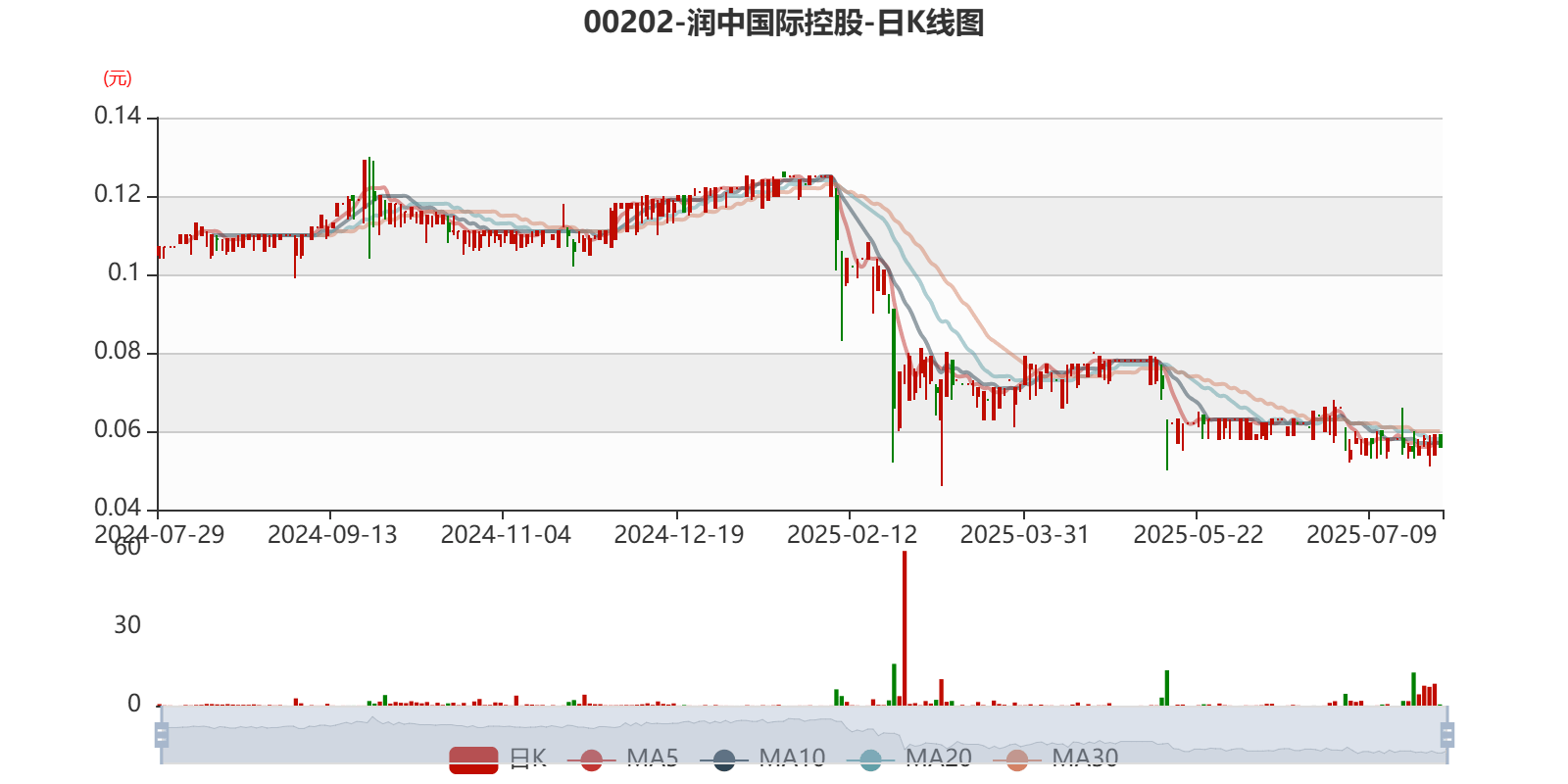
Core Viewpoint - Run China International Holdings (00202) reported its annual results for 2024-2025, showing a revenue increase but continued net losses, indicating ongoing financial challenges despite some operational improvements [3]. Financial Performance - The company achieved a revenue of HKD 108 million, representing a year-on-year growth of 5.56% [3]. - The net profit attributable to shareholders was a loss of HKD 40.21 million, an improvement from a loss of HKD 320 million in the previous year [3]. - The net cash flow from operating activities was -HKD 38.94 million, compared to -HKD 31.31 million in the previous year [3]. - Basic earnings per share were -HKD 0.0055, with an average return on equity of -3.64% [3][20]. Valuation Metrics - As of July 28, the company's price-to-book ratio (TTM) was approximately 0.38 times, and the price-to-sales ratio (TTM) was about 3.78 times [3]. Revenue Composition - The revenue composition for the fiscal year included HKD 78.4 million from agricultural operations and HKD 29.7 million from property investment [16]. Cash Flow Analysis - The net cash flow from financing activities was HKD 136 million, an increase of HKD 201 million year-on-year [24]. - The net cash flow from investing activities was HKD 193 million, up from HKD 64 million in the previous year [24]. Asset and Liability Changes - The company reported a 100% decrease in assets classified as held for sale, with a 25.01 percentage point drop in their proportion of total assets [28]. - Cash and cash equivalents increased by 1154.59%, raising their proportion of total assets by 17.81 percentage points [28]. - Short-term borrowings increased by 67.22%, contributing to a 9.85 percentage point rise in their proportion of total assets [32]. Liquidity Ratios - The current ratio was reported at 0.89, and the quick ratio was at 0.87, indicating liquidity challenges [37].

能源国际投资:2024-2025年度净利润2.56亿港元 同比增长393.04%
Sou Hu Cai Jing· 2025-07-25 15:20
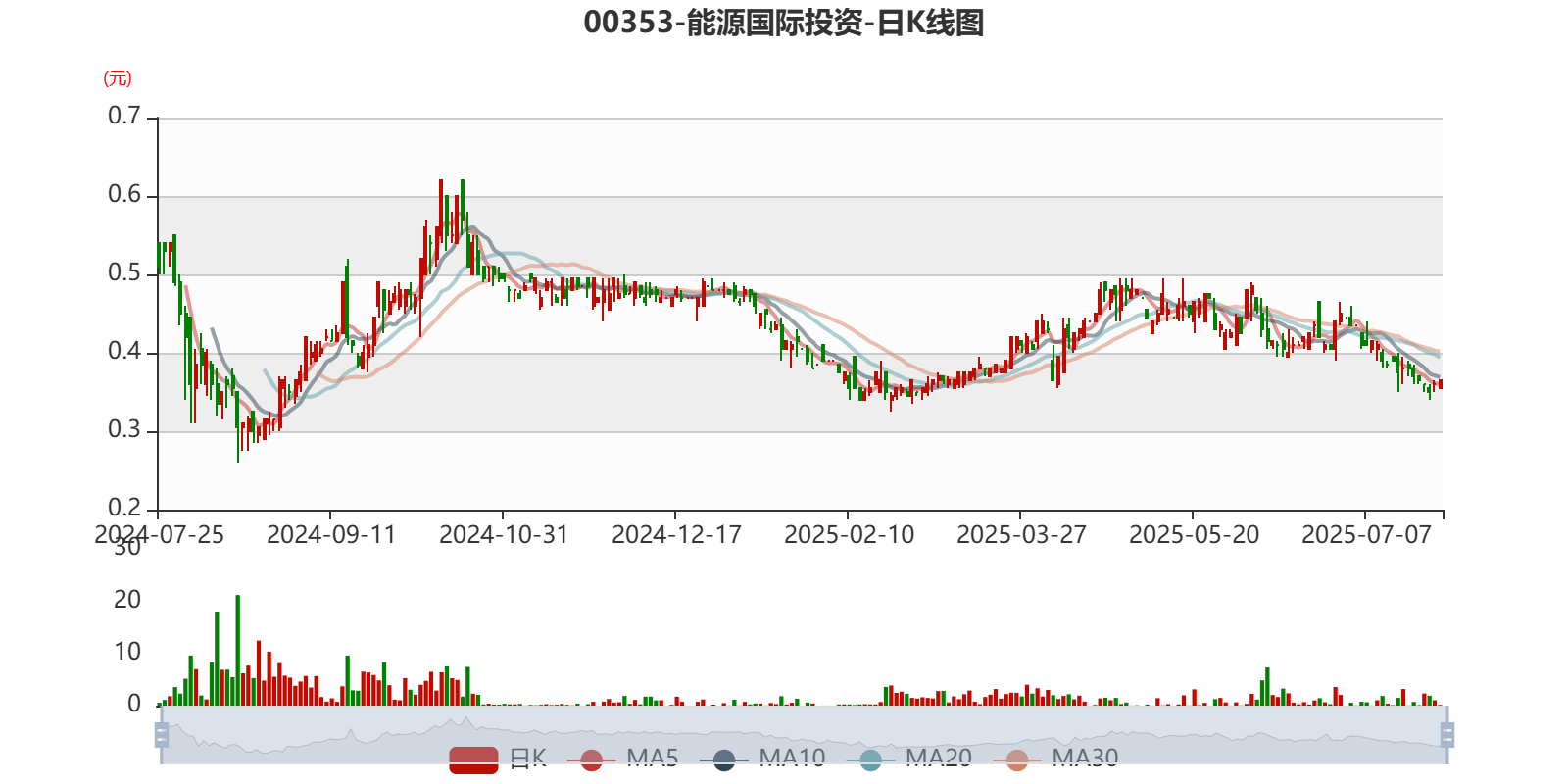
Core Viewpoint - Energy International Investment (00353) reported a significant decline in revenue for the fiscal year 2024-2025, while net profit saw a substantial increase, indicating a mixed financial performance [2]. Financial Performance - The company achieved a revenue of HKD 152 million, a year-on-year decrease of 37.38% [2]. - The net profit attributable to shareholders was HKD 256 million, reflecting a year-on-year increase of 393.04% [2]. - The net cash flow from operating activities was HKD 90.817 million, down 73.78% compared to the previous year [28]. - Basic earnings per share were HKD 0.2372, with an average return on equity of 22.57%, up 17.06 percentage points from the previous year [2][24]. Valuation Metrics - As of July 25, the company's price-to-earnings (P/E) ratio was approximately 1.54 times, the price-to-book (P/B) ratio was about 0.31 times, and the price-to-sales (P/S) ratio was around 2.6 times [2]. Business Segments - The company operates primarily in the oil and liquid chemical products terminal sector, providing leasing and logistics services, as well as trading agency services [11]. Cash Flow and Capital Structure - The net cash flow from financing activities was negative HKD 145 million, a decrease of HKD 259 million year-on-year [28]. - The net cash flow from investing activities was negative HKD 520 million, compared to HKD 53.391 million in the previous year [28]. Asset and Liability Changes - As of March 31, 2025, cash and cash equivalents decreased by 39.52%, while investment properties increased by 35.22% [36]. - Short-term borrowings decreased by 86.13%, while deferred tax liabilities increased by 72.94% [39]. - The current ratio was 5.57, and the quick ratio was 5.56, indicating strong liquidity [43].
美国运通第二季度:尽管存在不确定性,但资产质量仍然令人惊叹
Xin Lang Cai Jing· 2025-07-22 12:29
Core Viewpoint - American Express (NYSE: AXP) reported strong Q2 performance with revenue of $17.856 billion, exceeding analyst expectations, and adjusted EPS of $4.08, which is 5.15% higher than Wall Street's forecast [2] Financial Performance - Revenue grew by 9% year-over-year, and adjusted EPS increased by 17% when excluding the impact of the sale of Accertify-related gains [2][6] - Credit quality indicators remained robust, with a stable percentage of loans and receivables overdue by more than 30 days, even healthier than pre-pandemic levels [5] - Total loans and receivables reached $211.976 billion, with a quarter-over-quarter growth of 2.2% and a year-over-year growth of 9.3% [6] Business Segments - The highest revenue-generating segments were U.S. Consumer Services at $8.553 billion and Business Services at $4.212 billion, while International Card Services showed significant growth with revenue of $3.232 billion [8] Shareholder Returns - The company increased its quarterly dividend by 17% to $0.82, resulting in a total shareholder return rate of 4.04% [8] - The aggressive stock buyback program has raised the return on equity to 32.39% [8] Valuation Metrics - American Express has a current P/E ratio of 21.37, significantly higher than the financial sector median of 13.75, but the gap has narrowed since April [10] - Analysts estimate a fair value of $393.50 per share, indicating an upside potential of 27.8% from the current share price of $307.95 [11] Market Outlook - Despite concerns regarding inflation and its potential impact on consumer spending, American Express's strong performance and asset quality suggest resilience, particularly given its affluent customer base [12]


美国运通第二季度:尽管存在不确定性,但资产质量仍然令人惊叹
美股研究社· 2025-07-22 12:13
Core Viewpoint - American Express reported strong Q2 performance with revenue of $17.856 billion, exceeding analyst expectations, and adjusted EPS of $4.08, which is 5.15% higher than Wall Street's forecast [1] Financial Performance - Revenue increased by 9% year-over-year, and adjusted EPS grew by 17% when excluding the impact of the sale of Accertify-related earnings [1][5] - Credit quality indicators remained robust, with a stable percentage of loans overdue by more than 30 days, even healthier than pre-pandemic levels [4] - Total cardholder loans and receivables reached $211.976 billion, reflecting a 2.2% quarter-over-quarter and 9.3% year-over-year growth [5] Business Segments - The highest revenue-generating segments were U.S. Consumer Services at $8.553 billion and Business Services at $4.212 billion, with International Card Services showing significant growth at $3.232 billion [7] - Management reiterated guidance for FY 2025, targeting a midpoint revenue growth of 9% and adjusted EPS growth of 14% [5] Shareholder Returns - The quarterly dividend was increased by 17% to $0.82, resulting in a total shareholder return rate (dividends + buybacks) of 4.04% [7] - Aggressive stock buybacks have boosted the return on equity to 32.39%, making the current price-to-book ratio of 6.65 times appear more reasonable [8] Valuation Metrics - The current price-to-earnings ratio stands at 21.37, significantly higher than the financial sector median of 13.75, but the gap has narrowed to 8.37% compared to historical averages [10] - Analysts estimate a fair value of $393.50 per share, with an expected upside of 27.8% based on projected EPS growth [11] Economic Context - Despite concerns about inflation and its potential impact on consumer spending, American Express's performance indicates strong asset quality, particularly among its affluent customer base [12]

花旗:维持中国金茂(00817)“买入”评级 目标价1.62港元
智通财经网· 2025-07-22 06:15
Group 1 - Citi maintains a positive outlook on China Jinmao (00817), reiterating a "Buy" rating with a target price of HKD 1.62 [1] - The company has experienced a smooth management transition, with the former chairman retiring and the CEO being promoted to chairman [1] - Jinmao's parent company has increased its shareholding to 38.4%, which supports the company's financing and operations [1] Group 2 - Jinmao achieved a sales revenue of RMB 15.6 billion in June 2025, representing a 17% year-on-year growth, with strong performance in the Shanghai market [1] - For the first half of 2025, total sales reached RMB 53.4 billion, a 20% increase year-on-year, while the company aims for over RMB 100 billion in sales for 2025 [1] - The company plans to invest RMB 180 billion in saleable resources for 2025, with RMB 70 billion being new resources [1] Group 3 - In the first half of 2025, Jinmao acquired 14 new land parcels at a total cost of RMB 26 billion, with 71% located in Shanghai and Beijing [2] - The company has established a development property resource reserve valued at over RMB 300 billion, with 87% located in first and second-tier cities [2] - Jinmao aims to enhance its return on equity (ROE) through asset turnover, benefiting from local government land and inventory buyback policies, and targeting a net profit margin of 10% for new projects [2]
华塑控股:预计2025年上半年亏损200万元-300万元
Zhong Guo Zheng Quan Bao· 2025-07-14 13:15
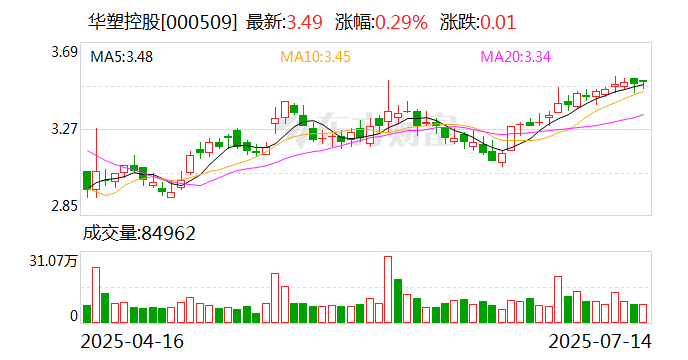
Core Viewpoint - The company Huashu Holdings (000509) expects to report a revenue decline of 0.28% to 21.96% year-on-year for the first half of 2025, with projected losses in net profit and non-recurring net profit [2][11]. Financial Performance - The projected revenue for the first half of 2025 is between 360 million to 460 million yuan [2]. - The expected net profit loss is between 2 million to 3 million yuan, compared to a profit of 1.3782 million yuan in the same period last year [2]. - The projected non-recurring net profit loss is between 3.8 million to 5.7 million yuan, compared to a profit of 690,300 yuan in the previous year [2]. - The basic earnings per share are expected to be between -0.0019 yuan to -0.0028 yuan [2]. Valuation Metrics - The current price-to-book ratio (P/B) is approximately 27.75 times, and the price-to-sales ratio (P/S) is about 3.82 times [2]. - The historical price-to-earnings ratio (P/E) trends indicate significant fluctuations, with the company experiencing negative earnings recently [4][5][11]. Business Operations - The company primarily engages in the research, design, production, and sales of electronic information display terminals, as well as leasing services [11]. - The decline in performance is attributed to reduced overseas sales due to international trade policy impacts and increased market competition, leading to a decrease in overall gross margin [11]. - Additionally, fluctuations in the US dollar exchange rate have negatively affected the company's foreign exchange earnings compared to the previous year [11].

判断指数估值,市盈率和市净率看哪个呢?|投资小知识
银行螺丝钉· 2025-07-11 13:51
Core Viewpoint - The article emphasizes the importance of strategic asset allocation for families to optimize their wealth management and investment returns [1] Group 1: Industry Insights - The current market environment presents both challenges and opportunities for investors, particularly in the context of rising interest rates and inflation [1] - Diversification across various asset classes is highlighted as a key strategy to mitigate risks and enhance returns [1] Group 2: Company Analysis - Companies that adapt to changing market conditions and consumer preferences are more likely to succeed in the long term [1] - The article discusses specific sectors that are expected to perform well, including technology and renewable energy, due to their growth potential [1]

美股投资如何选择标的?
Jin Rong Jie· 2025-07-09 02:09
Group 1 - The vast and diverse nature of the US stock market requires investors to conduct comprehensive and in-depth analysis when selecting investment targets, considering various asset characteristics to align with their investment goals and risk tolerance [1] - Company fundamentals are crucial, with a focus on financial health, including revenue stability, net profit levels, and a sound balance sheet, which indicates the company's ability to manage debt and financial risks [1] - A company's industry position is a key factor, as industry leaders typically possess stronger market competitiveness and pricing power, enabling them to withstand adverse market conditions and seize growth opportunities [1] Group 2 - Valuation metrics, such as Price-to-Earnings (PE) and Price-to-Book (PB) ratios, are important references for assessing company valuation, with lower PE potentially indicating undervaluation and higher PE suggesting overvaluation risks [2] - The macroeconomic environment significantly influences the selection of US stock investment targets, with different industries performing variably across economic cycles; for instance, consumer and technology sectors thrive during expansions, while defensive sectors like utilities and healthcare perform better during recessions [2] - Market trends serve as a critical basis for selecting US stock investment targets, where identifying overall market direction helps investors determine investment timing and risk management strategies [3]
一场路演的启发,再看量化小微盘的前世今生
雪球· 2025-07-06 07:50
Core Viewpoint - The article presents a unique perspective on small-cap stocks, arguing that their valuation, as measured by price-to-book ratio, remains reasonable despite market fears of a collapse in this segment [3][6]. Group 1: Valuation Insights - The price-to-book ratio for small-cap stocks has decreased significantly from over 4 times in 2016 to 2.23 currently, indicating a drop of more than 50% [3]. - The price-to-book ratio has stabilized around 2 since 2019, with fluctuations between a high of 2.5 in December 2023 and a low of 1.3 in February 2024 [3]. - The use of price-to-book ratio is preferred over price-to-earnings ratio due to the volatility in earnings of small-cap companies, which often leads to distorted valuations [4]. Group 2: Market Perception and Opportunities - Many investors dismiss small-cap stocks as "junk" due to high price-to-earnings ratios, but these companies may have significant upside potential if their earnings improve [5]. - Recent mergers and acquisitions in the small-cap space, where larger companies have invested billions, suggest that these stocks possess inherent value that is not immediately reflected in their financial statements [5]. - The article emphasizes that the current valuation of small-cap stocks is still within a reasonable range, contrary to mainstream market beliefs [6]. Group 3: Market Trends and Performance - In 2023, small-cap stocks experienced a remarkable increase, with the Wind Micro Cap Index rising by 47.57%, while major indices like the CSI 500 and CSI 300 fell [7]. - The beginning of 2024 saw a significant downturn for small-cap stocks, with the Wind Micro Cap Index dropping by 34.90% in just two weeks due to liquidity crises triggered by automatic redemption options [8]. - By September 2024, small-cap stocks rebounded significantly, with the trading volume and volatility increasing, leading to a recovery of previous losses and reaching historical net asset value highs [10]. Group 4: Regulatory Changes and Future Outlook - The introduction of new regulations in April 2024 aimed at tightening delisting supervision has raised concerns about small-cap stocks, which are often seen as high-risk for delisting [9]. - The new restructuring regulations introduced in May 2025 simplified the merger and acquisition processes, providing a favorable environment for small-cap stocks [11]. - Overall, the small-cap private equity sector has shown significant resilience and potential for high returns, with some products yielding 60% to 70% returns since their inception [12].