扩内需

Search documents
研报掘金丨华泰证券:上调农夫山泉目标价至59.23港元 维持“买入”评级
Ge Long Hui A P P· 2025-12-22 04:45
Group 1 - The central financial office emphasizes expanding domestic demand as the top priority for next year, highlighting the significance of the domestic demand theme [1] - Nongfu Spring, as a leading soft drink company, has shown resilience despite the impact of price wars on the beverage industry this year [1] - The company's packaged water business has recovered from previous negative publicity, continuously expanding market share this year [1] Group 2 - The operational focus of Nongfu Spring has shifted back to red bottle natural water from green bottle purified water, with the no-sugar tea business maintaining a strong revenue growth rate [1] - The company is accelerating penetration into lower-tier markets, further gaining market share, while products like NFC juice, carbonated tea, and health water are enhancing consumer engagement [1] - In terms of profitability, the company is expected to maintain stable earnings due to ongoing cost advantages and strong expense management without engaging in chaotic price competition [1] Group 3 - Digital initiatives such as the 1 yuan enjoyment program have strengthened the company's digital operations, enhancing connections with channels and consumers [1] - The company is expected to continue its upward trajectory in future developments, supported by a solid foundation as a platform-based enterprise [1] - The target price for Nongfu Spring has been raised from HKD 56.37 to HKD 59.23, maintaining a "buy" rating [1]


十大首席看2026中国经济
Xin Lang Cai Jing· 2025-12-22 03:08
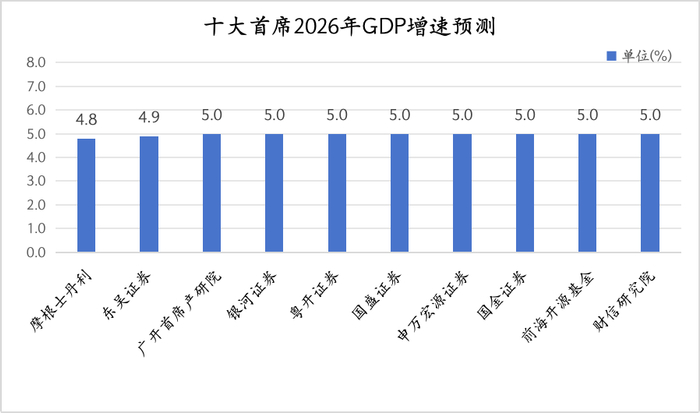
Economic Growth Outlook - In 2025, China's GDP is projected to grow by 5.2% year-on-year, laying a solid foundation for achieving the annual growth target of around 5% [1] - Economists predict that in 2026, China's GDP growth will continue to recover, with an expected growth rate of approximately 5.0% [2][4] Key Economic Drivers - The main drivers for economic growth in 2026 include stable export growth and a rebound in investment, particularly in infrastructure, supported by government policies [4][5] - The real estate market is expected to continue its bottoming process, with overall market risks considered manageable [4][8] Export and Trade Dynamics - Despite challenges from US-China trade tensions, China's exports are anticipated to maintain resilience, supported by new demands from emerging markets and global investments in AI [7] - Economists express cautious optimism regarding export stability, influenced by the global economic environment and potential easing of trade conflicts [7][6] Real Estate Market Trends - The real estate sector is projected to remain in a deep adjustment phase, with investment in real estate expected to decline by 15.9% year-on-year in 2025 [8] - Economists believe that while the real estate market will continue to face downward pressure, the rate of decline may gradually narrow due to previous policy measures [9][8] Price Level Expectations - Consumer Price Index (CPI) is expected to rise by 0.5% year-on-year in 2026, while Producer Price Index (PPI) is projected to decline by 0.9% [10] - The overall price levels are anticipated to remain low, with potential for gradual recovery influenced by supply and demand dynamics [12][10] Fiscal and Monetary Policy - The fiscal deficit rate for 2026 is expected to remain at 4%, consistent with 2025, with slight increases in special bonds and local government debt [14] - Economists forecast 1-2 interest rate cuts in 2026, with a reduction of 0.1-0.2 percentage points, and a potential decrease in the reserve requirement ratio [14][15] Policy Focus Areas - The policy focus for 2026 will include expanding domestic demand, strengthening industries, and promoting consumption through various subsidies and support measures [16] - Key areas of investment will include infrastructure, technology advancement, and stabilizing the real estate market through targeted policies [16][5]

宁证期货今日早评-20251222
Ning Zheng Qi Huo· 2025-12-22 02:42
今 日 早 评 重点品种: 【短评-焦煤】Mysteel统计独立焦企全样本:产能利用率 为72.05%,减1.11%;焦炭日均产量63.00万吨,减0.98万吨; 焦炭库存91.10万吨,增3.78万吨;炼焦煤总库存1036.29万 吨,减1.01万吨;焦煤可用天数12.4天,增0.18天。评:供应 端,产地部分前期换工作面的煤矿恢复生产,但随着完成年度 任务减产的煤矿继续增加,国内供应依旧偏紧。需求端,焦炭 产量小幅回落,中下游按需采购为主,上游煤矿累库放缓。整 体上,低估值下盘面低位持续反弹,现货端采购积极性有所回 升,线上竟拍成交稍有改善。随着年关将近,冬储力度逐渐加 大,焦煤基本面延续边际改善,盘面估值仍有修复空间。 【短评-白银】美国白宫国家经济委员会主任哈塞特表示, 与古尔斯比观点一致,当前仍存在充足的降息空间。特朗普希 望美联储主席能够作出独立判断,特朗普助手们将在佛罗里达 讨论住房政策,预计很快将在新年宣布"重大"住房计划。 评:目前关于未来降息的分歧有所加强,但是对政府的各种刺 激政策的预期增加,提振风险偏好。降息预期对贵金属存在支 撑,整体来看,降息周期对白银依然偏多支撑。关注黄金波动 对 ...
从扩内需犒赏经济到AI赋能应用 传媒如何看?
2025-12-22 01:45
Summary of Conference Call Industry Overview - The discussion primarily revolves around the media industry, focusing on the cinema sector and the impact of AI on various applications within the industry [1][8]. Key Points on Cinema Sector - **Expansion of Domestic Demand**: The government has emphasized the importance of expanding domestic demand as a strategic initiative, with the media sector being a significant component of this strategy [1][4]. - **Cinema Box Office Performance**: The box office for the year is projected to reach approximately 46 billion, reflecting a year-on-year growth of around 20% [4]. - **Upcoming Film Releases**: Anticipation for the upcoming Chinese New Year film season is high, with several domestic films scheduled for release, which could drive box office performance [2][4]. - **Key Players in Cinema**: The leading cinema chains identified for investment include Wanda Film, Hengdian Film, and Shanghai Film, with Wanda Film being highlighted for its proactive capital investments and strategic initiatives [3][4][6]. Financial Projections - **Market Potential**: The total number of cinema screens in China is expected to reach 100,000 by the end of 2024, with a potential market size of 80 billion based on current screen counts [5][6]. - **IP and Derivative Markets**: The market for IP derivatives is projected to grow from 1.742 trillion in 2024 to over 3.3 trillion by 2029, indicating significant growth potential in this sector [5][6]. AI Sector Insights - **AI Applications in Media**: The AI sector is experiencing rapid growth, with significant advancements showcased at recent conferences, including new models for content creation and digital marketing [8][9]. - **Company Performance**: Zhiyu's financials indicate a revenue growth of 130% from 2022 to 2024, with a projected revenue of over 300 million by 2024 [9][10]. - **Investment Opportunities**: Companies like Huace Film and BlueFocus are highlighted as key players benefiting from AI advancements, particularly in digital marketing and content production [12][13]. Market Trends and Future Outlook - **Long-term AI Growth**: The AI sector is expected to drive significant changes in the media landscape over the next decade, with both foundational infrastructure and application development being critical areas of focus [14][15]. - **Investment Recommendations**: Investors are encouraged to monitor companies involved in cinema, IP development, and AI applications, particularly those that are leveraging new technologies to enhance their offerings [16][18]. Additional Considerations - **Risks and Challenges**: The potential risks associated with companies like ByteDance and their international operations are noted, but the overall sentiment remains optimistic regarding the growth of the media and AI sectors [17][18]. This summary encapsulates the key insights and projections discussed during the conference call, providing a comprehensive overview of the current state and future potential of the media and AI industries.
十家文博场馆推出各类优惠促消费
Liao Ning Ri Bao· 2025-12-22 01:07
Core Insights - The "Nine-Nine Consumption Season" in Liaoning Province is promoting over 1,500 consumer activities across four months, focusing on cultural, health, sports, and food consumption [1] - Various cultural and museum venues are participating by offering discounts and special promotions on products, enhancing consumer engagement [2] Group 1: Promotional Activities - Discounts on cultural products include a calendar reduced from 128 yuan to 88 yuan and bookmarks inspired by the "Treasure of the Museum" jade pig dragon reduced from 5 yuan to 2.99 yuan [1] - The "One-Nine" theme, starting December 21, features activities like "Winter Exploration Tour" with various discounts at museums and exhibition halls [1] Group 2: Consumer Engagement - The initiative includes an online program with a dedicated app for the "Nine-Nine Consumption Season," featuring an electronic map of 99 check-in points for consumers [2] - Consumers can earn points through check-ins, which can be redeemed for local products, and have a chance to win a BMW car through a lottery on the final day of the event [2]

投资策略周报:“春季躁动”行情的启动,需具备哪些必要条件?-20251221
HUAXI Securities· 2025-12-21 13:28
Market Review - Global stock indices mostly declined this week, with the Korean Composite Index, Hang Seng Tech, and Nikkei 225 leading the losses. A-shares saw a decrease in trading volume, with the average daily turnover of the Wind All A Index falling to approximately 1.76 trillion yuan. Market sentiment has turned cautious, with the ChiNext 50 and ChiNext Index leading the declines, while funds rotated into dividend sectors. In terms of styles, the financial and consumer sectors rose, while growth styles fell, with the electronics and power equipment indices dropping over 3%. In the commodity market, COMEX silver surged by 8.7%, and copper and aluminum prices fluctuated upward, while coking coal rebounded from the bottom. In the foreign exchange market, after the Bank of Japan's interest rate hike, the yen depreciated against the dollar, while the renminbi continued to appreciate against the dollar [1][2]. Market Outlook - The "Spring Rally" is accumulating positive factors, with a focus on buying on dips. Historically, the initiation of the A-share "Spring Rally" typically requires reasonable valuation levels, a loose liquidity environment, and effective catalysts to boost risk appetite, such as domestic policies, industrial events, or external risk alleviation. Currently, the Federal Reserve's interest rate cuts and the Bank of Japan's interest rate hike have been implemented, easing concerns about the reversal of arbitrage trades. The subsequent appreciation of the renminbi is expected to attract foreign capital, and the "good start" of insurance premium income at the beginning of the year is also anticipated to bring incremental insurance funds into the market. Recently, stock ETFs have seen large-scale net subscriptions, with multiple broad-based ETFs experiencing increased trading volume, indicating that incremental funds are inclined to buy on dips [2][5]. Historical Review - A review of history shows that, except for 2021 and 2022, the A-share market has often exhibited a "Spring Rally" calendar effect over the past decade. At the end of the year and the beginning of the year, the A-share market is in a "vacuum period" for economic data and corporate earnings reports, making it easier for the market to engage in thematic investments based on policy expectations and industrial trends. Since 2016, there have been 8 instances of "Spring Rally" in the A-share market. The timing of these rallies typically starts between December and January and lasts for 20 to 60 trading days [3][4]. Necessary Conditions for "Spring Rally" - The initiation of the "Spring Rally" requires several necessary conditions: 1) A reasonable market valuation range, as the elasticity of the rally is highly correlated with market valuation levels. In the years with the largest index gains during the past decade's Spring Rallies, the market had generally undergone sufficient adjustments beforehand. For instance, at the beginning of 2016, the "circuit breaker" triggered a liquidity feedback shock, leading to a sharp decline in major A-share indices; at the beginning of 2019, after previous declines, the price-to-earnings ratio of the CSI 300 Index was only 10 times; and in early February 2024, liquidity shocks from products like Xueqiu and quantitative funds brought the CSI 300 Index's price-to-earnings ratio back to around 10 times [4]. 2) A sustained loose liquidity environment with inflows of incremental funds. For example, in early 2018, the central bank implemented targeted reserve requirement ratio cuts, and in early 2019 and 2020, the central bank conducted comprehensive reserve requirement ratio cuts to maintain macro liquidity. In early 2023, there was a significant inflow of foreign capital, and in early 2025, regulatory authorities are expected to promote the entry of medium- and long-term funds into the market [4]. 3) Domestic policies, industrial event catalysts, or external risk alleviation that drive risk appetite upward. For example, in early 2016, supply-side reforms; in early 2019, progress in China-U.S. trade negotiations; in January 2020, the signing of the first-phase trade agreement between China and the U.S.; at the end of 2022, the optimization of epidemic prevention policies and the "three arrows" for real estate; in February 2024, an unexpected reduction in the Loan Prime Rate (LPR); and in early 2025, catalysts from trends in industries like DeepSeek and robotics [4][5]. Accumulating Positive Conditions - Positive conditions for the "Spring Rally" are accumulating, with a focus on buying on dips: 1) In terms of overseas liquidity, the dovish interest rate hike by the Bank of Japan has been implemented, leading to a weaker yen against the dollar and easing pressures from arbitrage trades. The Federal Reserve's expected dovish rate cuts in December are closely tied to the leadership transition, with the overall market expectation for the Fed's policy direction remaining loose [5]. 2) Domestically, the Central Economic Work Conference has set the tone for "continuing to implement an appropriately loose monetary policy," indicating that there is still room for reserve requirement ratio cuts and interest rate reductions [5]. 3) On the micro liquidity front, this week saw large-scale net subscriptions for stock ETFs, with multiple broad-based ETFs experiencing increased trading volume, boosting market sentiment. The anticipated inflow of foreign capital driven by the appreciation of the renminbi and the incremental insurance funds from the "good start" of premium income at the beginning of the year can also be expected [5]. 4) In terms of valuation, the current price-to-earnings ratio of the CSI 300 Index is 14 times, which is at the 76th percentile since 2010, below the historical median plus one standard deviation [5]. 5) From a policy perspective, the Central Economic Work Conference has laid a positive foundation, with 2026 marking the start of the "14th Five-Year Plan," and incremental policies in areas such as technological innovation, anti-involution, and expanding domestic demand are expected to continue to be introduced [5]. Industry Allocation Recommendations - It is recommended to focus on: 1) Growth directions benefiting from industrial policy support, such as domestic substitution, robotics, aerospace, innovative pharmaceuticals, and energy storage [5]. 2) Cyclical directions benefiting from "anti-involution" policies, such as chemicals, energy metals, and resource products [5]. 3) The deepening of consumption-promoting policies may bring short-term catalytic opportunities for the consumer sector [5].
关注元旦航旅出行预定数据与委内瑞拉油轮进展
GOLDEN SUN SECURITIES· 2025-12-21 11:49
证券研究报告 | 行业周报 gszqdatemark 2025 12 21 年 月 日 交通运输 关注元旦航旅出行预定数据与委内瑞拉油轮进展 周观点:航旅纵横大数据显示,截至 12 月 17 日,元旦假期国内、跨境航线 机票预订量同比分别增长 46%、18%;16 日,ICE 布油收 58.84 美元(盘中 最低 58.72 美元),为 5 月来首次。继续看好"扩内需"及"反内卷"下航空 板块中长期景气度,在油汇环境友好环境下航司盈利有望不断改善。基于周期 视角,在制裁趋严、OPEC+增产逐步反馈到出口的背景下,行业周期逻辑渐 明,可关注板块回调中的布局机会,重点关注招商轮船、中远海能 H/A。 行情回顾:本周交通运输板块行业指数上涨 2.04%,跑赢上证指数 2.01 个百 分点(上证指数上涨 0.03%)。从申万交通运输行业三级分类看,涨幅前三名 的板块分别为航空运输、跨境物流、公交,涨幅分别为 6.84%、3.10%、2.82%; 仅公路货运板块下跌,跌幅为-1.76%。 出行:航旅纵横大数据显示,截至 12 月 17 日,元旦假期国内、跨境航线机 票预订量同比分别增长 46%、18%。继续看好"扩内需 ...




政策出现重要“微调“线索
Hu Xiu· 2025-12-21 11:48
1、政策出现重要"微调"线索,市场节奏会提前吗? 如有疑问请以音频内容为准,添加妙投小虎哥微信:miaotou515,入群有机会与董小姐进一步交流。 本篇评级为★★★,主要围绕以下内容展开: 先看政策。其实12月初我们就给大家分析过,国内两场重要会议奠定了总体基调:12月属于短期动荡行 情,会议结束后市场需要向下消化预期差,普遍能感受到压力,尤其是一些热门板块。上周科技赛道整 体回调,排在全市场倒数前列;相反,政策顺风受益的板块里,消费表现最热——除商业航天"红得发 紫"外,赛道涨幅前五名中有四个都与消费相关,这就是政策的威力:在政策引导下,市场出现短期轮 动。 接下来的问题是:节奏会怎样?如果12月属于动荡行情,那么越接近1月,越可能出现转机,尤其是1月 中下旬。我们从政策上可以找到几条线索: 第一,上周四,中央财经委发布对中央经济工作会议的"十问十答"解读稿,其中提到:"我们最近也关 注到这几个月消费和投资增速有所放缓,需要持续加力扩内需。"这句话意味着大方向确定后,局部节 奏、力度可能根据市场情况微调。 第二,本周召开的国常会新闻通稿里出现"靠前发力抓落实,以扎实有效的工作巩固拓展经济稳中向好 势头"的 ...
李迅雷:如何让物价合理回升,难点在哪里?|立方大家谈
Sou Hu Cai Jing· 2025-12-21 09:12
Group 1 - The core viewpoint of the article emphasizes the importance of achieving reasonable price recovery as a key policy goal in China's economic strategy, particularly highlighted in the Central Economic Work Conference [2][51] - The current cycle of price stagnation began in 2012, with China's Producer Price Index (PPI) entering negative territory and remaining there for extended periods, indicating structural issues in the economy [3][12] - The article discusses the significant increase in China's manufacturing value added as a percentage of global totals, which rose from 8.6% in 2004 to 22.3% in 2012, reflecting a shift in supply dynamics [4][3] Group 2 - Local governments have increased their leverage from 16.3% at the end of 2011 to 23.9% by the end of 2015, driven by the need to stimulate economic growth through investment [6] - The supply-side structural reform initiated in 2015 aimed to address the oversupply in various sectors, particularly in steel and coal, as a response to the prolonged low PPI [6][9] - The article notes that from 2012 to 2025, China experienced approximately 8.5 years of negative PPI, primarily due to structural oversupply issues [9][12] Group 3 - The article highlights the challenges of increasing consumer demand to support price recovery, citing low wage growth and a stagnant income distribution structure as key factors [34][40] - It points out that the current economic environment is characterized by a shrinking balance sheet for households, which negatively impacts consumption and price levels [48][51] - The need for a balanced approach to fiscal policy is emphasized, suggesting that both investment and consumption must be addressed to avoid the pitfalls of overcapacity and ensure sustainable economic growth [29][51]

如何让物价合理回升:难点在哪里
李迅雷金融与投资· 2025-12-21 08:20
Core Viewpoint - The article discusses the challenges and strategies for achieving a reasonable recovery in prices in China, emphasizing the importance of stabilizing economic growth and employment as key policy goals [1][2]. Group 1: Price Trends and Economic Context - The current cycle of low prices in China began in 2012, with PPI entering negative territory and CPI fluctuating between 0-1% since 2022, raising concerns about economic stability [2][5]. - From May 2012, China's PPI diverged from that of Europe and the US, remaining negative for over four years until October 2016, primarily due to structural issues in the economy and a decline in global commodity prices [2][5]. - The increase in China's manufacturing value added as a percentage of global totals from 8.6% in 2004 to 22.3% in 2012 has contributed to an oversupply of goods, while the population share has been declining [2][5]. Group 2: Government Policies and Economic Reforms - In response to diminishing policy stimulus effects post-2012, local governments increased debt levels from 16.3% in 2011 to 23.9% in 2015, leading to an oversupply in the market and necessitating supply-side structural reforms [5][7]. - The years 2016-2017 saw significant supply-side reforms aimed at reducing excess capacity in key sectors like steel and coal, which were identified as major contributors to the prolonged low PPI [5][7]. Group 3: Recent Economic Challenges - The trade tensions initiated by the US in 2018 and the COVID-19 pandemic in 2020 further exacerbated the situation, leading to a renewed decline in PPI as domestic demand weakened [7][10]. - The current downturn in PPI since October 2022 is marked by a shift from household balance sheet expansion to contraction, indicating a downturn in the real estate sector, which has compounded the issues of oversupply and insufficient demand [10][13]. Group 4: Structural Issues and Future Outlook - The article highlights that the persistent low inflation reflects deeper structural, cyclical, and systemic issues within the economy, necessitating a comprehensive approach to fiscal policy and income distribution reform [13][35]. - The need for targeted fiscal measures to boost consumer demand and stabilize the real estate market is emphasized, as these are critical for achieving a reasonable price recovery [35][50]. - The article concludes that merely relying on monetary policy will not suffice; a strategic overhaul of fiscal spending and income distribution is essential to address the underlying issues of low consumer demand and economic stagnation [53][54].