绿色环保

Search documents
昌江:打造出口热销背后“绿色引擎”
Hai Nan Ri Bao· 2025-06-23 02:10
Group 1 - The company produces environmentally friendly plastic packaging bags specifically designed for cement, catering to international clients, particularly in Indonesia [2][3] - The production line, which began construction in November 2022 and commenced operations in May 2023, consists of 8 new production lines capable of producing 200 million eco-friendly cement bags annually [2] - The use of heat sealing technology in the production process enhances the bags' ability to contain dust, aligning with new national standards for cement packaging [2][3] Group 2 - Approximately 70% of the company's bags are exported to countries such as Indonesia, Cambodia, and Laos, with the environmental performance of the bags serving as a key competitive advantage [3] - In the first five months of the year, the company sold 45 million bags, with 27 million exported, generating an export revenue of 35 million yuan [3] - The local government is promoting green economic growth, with the company benefiting from supportive policies in the Hainan Free Trade Port [3][4] Group 3 - The Changjiang Clean Energy High-tech Industrial Park has seen 23 industrial enterprises achieve an industrial output value of 3.977 billion yuan in the first five months, representing 87% of the county's total industrial output [4] - The park is part of a broader strategy to promote sustainable economic development through industrial ecological transformation [4]
宏达股份: 四川宏达股份有限公司向特定对象发行股票募集说明书(注册稿)
Zheng Quan Zhi Xing· 2025-06-20 09:37
Core Viewpoint - Sichuan Hongda Co., Ltd. is issuing shares to specific investors to raise funds for debt repayment and working capital supplementation, with a total fundraising amount of approximately 285.29 million yuan [5][6]. Group 1: Company Overview - The company is primarily engaged in phosphate chemicals and non-ferrous metal zinc smelting, with main products including phosphate series products, compound fertilizers, synthetic ammonia, zinc ingots, and zinc alloys [2][3]. - The company lacks supporting phosphate and zinc mineral resources, making its operations highly susceptible to macroeconomic policies, external environments, and national industrial policies [2][3]. Group 2: Financial Performance - The company's net profits for recent periods were 60.16 million yuan, -95.84 million yuan, 36.11 million yuan, and -35.93 million yuan, indicating significant volatility in profitability [4]. - The gross profit margins for the main business were 9.93%, 5.89%, and 7.29% over the reporting periods, reflecting fluctuations influenced by economic cycles and market conditions [3][4]. Group 3: Share Issuance Details - The type of shares being issued is domestic listed ordinary shares (A shares) with a par value of 1.00 yuan per share [5]. - The issuance will be conducted through a specific target offering to Shudao Group, with a share price set at 4.68 yuan per share, which is not less than 80% of the average trading price over the previous 20 trading days [5][6]. - A total of 609.6 million shares will be issued, accounting for no more than 30% of the total share capital prior to the issuance [6]. Group 4: Industry Characteristics - The phosphate chemical industry is subject to national macro-control and self-regulation, with oversight from various governmental departments including the National Development and Reform Commission and the Ministry of Industry and Information Technology [14][15]. - The industry is characterized by significant regulatory scrutiny, particularly concerning product quality, safety production, and environmental protection [14][15]. - The non-ferrous metal industry, particularly zinc smelting, is regulated by the Ministry of Natural Resources and the Ministry of Industry and Information Technology, focusing on resource management and industry standards [24][25].

天业节水荒地喜收“幸福菜”
Zhong Guo Xin Wen Wang· 2025-06-13 06:40
Core Insights - The company has successfully transformed idle land into a productive "green vegetable garden," showcasing teamwork and ecological principles while enhancing employee life through cost reduction and efficiency gains [1][2][3] Group 1: Project Overview - The initiative began in response to environmental calls, with employees collaborating to cultivate over 300 square meters of previously unused land into a standardized vegetable garden [2] - Employees participate in various tasks such as watering and weeding, which not only reduces labor costs but also strengthens team cohesion, turning the garden into a new platform for collective effort [2] Group 2: Economic and Ecological Benefits - The garden is thriving with crops like cucumbers, bok choy, and Chinese cabbage, allowing employees to harvest fresh vegetables for the cafeteria and share among themselves, achieving a "farm-to-table" concept [3] - By replacing some procurement needs with self-grown vegetables, the cafeteria can save approximately 15% in monthly costs while also reducing carbon emissions from transportation, thus enhancing both economic and ecological benefits [3] Group 3: Educational and Cultural Impact - The gardening experience has deepened employees' understanding of hard work and resourcefulness, promoting a culture of frugality and low-carbon practices [4] - The company plans to institutionalize garden management and explore the introduction of more fruit and vegetable varieties, aiming to create a unique base that integrates practical education and ecological beautification [4]
流程691公里,这里的出境水质为何优于入境?
Xin Hua She· 2025-06-12 11:04
Group 1 - The ecological restoration project of Gaodong River in Chongqing's Changshou District has improved water quality from Class IV to Class III, showcasing successful environmental management efforts [1] - Long-term efforts in protecting the Yangtze River's ecology have resulted in the water quality of the Yangtze River in Chongqing reaching Class II standards for eight consecutive years since 2017 [2] - The transformation of the former tailings pond of Zhonghua Chongqing Fuling Chemical Co. into a green park demonstrates the shift towards sustainable industrial practices, with over 3 billion yuan invested in modernizing operations [2] Group 2 - Chongqing's modern manufacturing industry, focusing on new energy vehicles and advanced materials, is projected to produce over 950,000 electric vehicles in 2024, marking a 90.5% increase [3] - The shift from coal mining to eco-tourism and specialty agriculture in Fengjie and Wushan counties highlights the region's commitment to sustainable development and ecological preservation [3] - The "Bayu Water Management" system integrates data from over 20 departments, significantly improving pollution analysis and response times from 10 days to 2 days [4] Group 3 - Collaborative ecological protection agreements with neighboring provinces have established a comprehensive ecological compensation mechanism along the Yangtze River [4] - The implementation of over 140 environmental governance projects reflects a strong commitment to improving water ecological conditions in the region [4] - Chongqing aims to play a demonstrative role in promoting green development along the Yangtze Economic Belt, emphasizing its responsibility as an upstream region [4]
古麒绒材(001390.SZ)次新股中稀缺的羽绒材料龙头,多维护城河优势构筑长期价值
Ge Long Hui· 2025-06-12 06:58
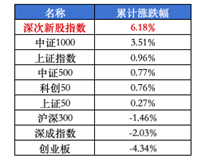
Core Viewpoint - The investment philosophy of "prefer new stocks over old ones" has been validated in the A-share market, with the deep new stock index showing a cumulative increase of 6.18% year-to-date, outperforming several key indices [1][2]. Group 1: Performance of New Stocks - The deep new stock index has outperformed major indices such as the ChiNext Index, STAR 50, CSI 300, CSI 500, and CSI 1000, indicating a strong performance in the market [1][2]. - The investment strategy focusing on new stocks has become a core strategy in the A-share market, although not all new stocks possess long-term investment value [2]. Group 2: Company Overview - Guqi Down Material - Guqi Down Material (001390.SZ) is positioned as a leading enterprise in the Chinese down material industry, with a strong competitive edge established across four dimensions [3][4]. - The company has significant technological barriers, including core patents in fluorine-free water-repellent technology and nano-level surface treatment processes, which enhance its product quality and market competitiveness [4]. - Guqi Down Material is actively involved in setting industry standards, which further solidifies its leading position in market share and technological advancement [5]. Group 3: Customer Structure and Market Position - The company has established strong relationships with leading brands such as Bosideng and Hai Lan Home, as well as military supply chains, ensuring stable demand and growth opportunities [6][7]. - Guqi Down Material's military orders are expected to yield higher profit margins, with projected sales in the military sector exceeding 50 million yuan in 2024 [7]. Group 4: Policy Alignment and Market Trends - The company benefits from long-term trends in consumption upgrades and green environmental policies, with significant investments in water recycling systems that align with national "dual carbon" strategies [8]. - Guqi Down Material's products are positioned to capitalize on the growing demand for high-quality down products, with a notable potential for domestic substitution as the import dependency for high-end goose down remains at 58% [8]. Group 5: Financial Performance and Growth Potential - The company has demonstrated robust financial performance, with a projected annual revenue growth rate of 20.37% and a net profit growth rate of 31.67% from 2022 to 2024 [11]. - The PEG valuation model indicates that the company's stock price may be undervalued relative to its growth potential, suggesting a strong investment opportunity [12].

SHEIN推出近60项措施提升能效:每年减少碳排放超1.3万吨
Xin Lang Ke Ji· 2025-06-11 04:33
Group 1 - SHEIN plans to implement nearly 60 energy efficiency measures in 2024 across various self-operated facilities, which is expected to reduce electricity consumption by over 23 million kilowatt-hours annually, equivalent to the annual electricity needs of approximately 50,000 households [1] - The company aims to cut carbon emissions by over 13,000 tons per year, which is comparable to planting around 1.07 million trees [1] - SHEIN will replace existing warehouse lighting with 9-watt energy-saving bulbs, projected to save over 9 million kilowatt-hours of electricity annually, resulting in energy cost savings exceeding 6 million yuan [1] Group 2 - SHEIN is innovating in cooling system optimization by modifying water-cooled air conditioning systems, achieving an average energy savings rate of approximately 28% through intelligent digital control [1] - The total investment in major supply chain infrastructure projects currently under construction by SHEIN exceeds 10 billion yuan, with a commitment to green and intelligent practices throughout the project lifecycle [1] - The Xi Yin Bay Area supply chain project in Guangzhou, with a total investment of over 10 billion yuan, is expected to attract around 100,000 industry talents at peak and will feature a rooftop solar photovoltaic system, projected to save approximately 8,121 tons of standard coal and reduce carbon dioxide emissions by about 22,000 tons annually [1] Group 3 - The Xi Yin Bay Area Western Smart Industrial Park in Zhaoqing, with a total investment of 3.5 billion yuan, is expected to be completed by the end of this year, integrating smart sorting centers, order distribution centers, and smart manufacturing factories [2] - The construction of the industrial park will utilize environmentally friendly building materials and water-saving energy-efficient devices, implementing strict dust and waste management measures [2] - The park plans to install rooftop solar panels with a total capacity exceeding 24 megawatts, which is expected to reduce carbon emissions by over 10,000 tons annually [2]
电商运营:家清日化场景消费研究白皮书
Sou Hu Cai Jing· 2025-06-09 12:00
Market Overview - The Chinese household cleaning and personal care market has grown from 34.77 billion yuan in 2015 to 55.61 billion yuan in 2023, with a projected size of 58.39 billion yuan in 2024, indicating a continuous upward trend in market demand [11][12][13] - The market is expected to exceed 70 billion yuan by 2028, showcasing a broad market outlook [12] - Growth is driven by urbanization, demographic changes, upgraded consumer demands for cleaning products, and increased R&D investments by companies [13] Consumer Trends - Consumers are increasingly seeking high-efficiency and refined cleaning tools, with 30% of sales volume attributed to essential household items like paper towels and laundry detergents [24] - There is a notable demand for high-quality home decor items, with sales of decorative items like wall clocks and glass ornaments increasing significantly [26] - The market is seeing a trend towards specialized cleaning products for specific clothing types and cleaning scenarios, with 73.1% of consumers purchasing kitchen cleaning products [27][28] Brand Landscape - Leading brands like Blue Moon maintain their positions through professional images and comprehensive channel strategies, while emerging brands like UPO and Zhi Fu Lian are rapidly gaining market share through online marketing and differentiated products [2][19] - Domestic brands are leveraging their understanding of local consumer needs, focusing on cost-effectiveness and localized marketing strategies [20] - New brands are capitalizing on social media and online channels to showcase their innovative products and achieve rapid growth [21] Environmental Trends - Consumers are increasingly concerned about product safety and environmental impact, with 71% expressing a desire for cleaning products that enhance antibacterial capabilities and are made from natural, non-irritating materials [30] - The industry is shifting towards low-carbon and environmentally friendly practices, with leading companies developing products with natural ingredients and optimizing packaging to reduce environmental impact [32] Sales Channel Analysis - The sales channels are diversifying, with online sales channels gaining a larger share due to their convenience and variety, while traditional retail still plays an irreplaceable role [18] - The report highlights the importance of enhancing consumer experience in offline stores by creating dedicated cleaning product sections [2][18]
家清日化场景消费研究白皮书
一库· 2025-06-06 09:20
Investment Rating - The report indicates a positive investment outlook for the household cleaning and personal care industry, with a projected market size growth from 556.1 billion yuan in 2023 to over 700 billion yuan by 2028, reflecting a robust demand trend [7][9]. Core Insights - The household cleaning and personal care market in China has shown a significant growth trend, driven by urbanization, changing demographics, and increased consumer demand for quality cleaning products [8][9]. - The market is characterized by a shift towards premium products, with consumers increasingly prioritizing efficiency, safety, and environmental sustainability in their purchasing decisions [20][27]. - The competitive landscape features strong international brands dominating the high-end market, while domestic brands focus on cost-effectiveness and localized marketing strategies [18][19]. Market Overview - The market size of household cleaning products in China grew from 34.77 billion yuan in 2015 to 55.61 billion yuan in 2023, with expectations to reach 58.39 billion yuan in 2024 [7]. - The growth is attributed to factors such as accelerated urbanization, demographic changes, and increased R&D investments by companies [8]. Consumer Trends - There is a noticeable trend towards quality and specialized cleaning products, with consumers showing a preference for high-efficiency and finely crafted cleaning tools [20]. - The demand for home decor items has surged, with certain categories experiencing over tenfold growth in sales, indicating a shift towards enhancing home aesthetics [22]. - Consumers are increasingly concerned about product safety and environmental impact, with 71% expressing a desire for enhanced antibacterial properties in cleaning products [27][28]. Consumer Demand Analysis - Basic cleaning functionality remains a primary consumer need, but there is a growing expectation for convenience and efficiency in products [33]. - Different age groups exhibit varying preferences, with younger consumers favoring brand and style, while older consumers prioritize practicality and value [35]. - Safety and environmental considerations are paramount, with consumers seeking natural and non-toxic ingredients, especially for products intended for children and pregnant women [36][38]. Consumer Behavior Analysis - The purchasing decision process is influenced by lifestyle, cultural background, and personal preferences, with consumers increasingly relying on social media and peer recommendations for information [42]. - Product quality and brand image significantly impact brand loyalty, with high-quality products fostering trust and repeat purchases [52][54]. Brand Analysis - Leading brands like Blue Moon have maintained a strong market position through effective brand building and product innovation, continuously meeting consumer needs [57]. - Emerging brands are leveraging social media and innovative marketing strategies to capture market share, demonstrating the dynamic nature of the industry [65][66]. Market Channel Analysis - The online sales channel is rapidly growing, with significant increases in sales and volume on platforms like Taobao and Tmall, indicating a shift in consumer purchasing behavior [70][71]. - Traditional retail channels still hold a significant market share, but there is a clear trend towards integrating online and offline sales strategies [51][80]. Future Trends and Challenges - The industry is expected to see continued innovation in product efficacy, safety, and design, with a focus on specialized cleaning solutions for various scenarios [93]. - Competition is intensifying, with established brands leveraging their strengths while new entrants adopt differentiated marketing strategies to gain traction [94]. - Consumer demand is evolving towards high-efficiency, health-conscious, and environmentally friendly products, necessitating ongoing adaptation by companies [95].
2025年中国花岗岩荒料行业市场政策、产业链、发展现状、竞争格局及发展趋势研判:市场格局较为分散[图]
Chan Ye Xin Xi Wang· 2025-06-03 01:10
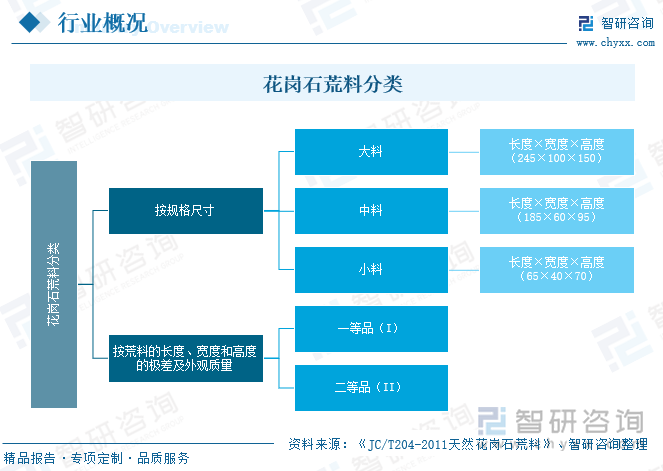
Overview - The granite block industry is a significant traditional sector in China, experiencing rapid growth due to urbanization and increased demand in infrastructure, real estate, and landscaping. However, recent years have seen a decline in demand due to slowing investment in infrastructure, with projected demand in 2024 dropping to 33.22 million cubic meters and a market size of approximately 32.89 billion yuan, where black granite accounts for 22.4% and other colors for 77.6% [1][10]. Market Policy - A series of policies have been implemented in China to enhance the quality and safety standards in the granite block industry, including guidelines for geological exploration, carbon peak action plans, and regulations on mineral resource management. These policies aim to phase out non-compliant companies and promote high-quality development in the granite block sector [4]. Industry Chain - The upstream of the granite block industry includes mineral exploration, mining machinery, and civil blasting, which are essential for assessing and extracting granite resources. The downstream market encompasses applications in construction, decoration, and landscaping [6]. Market Demand - The construction and decoration sector is the largest consumer of granite blocks, accounting for over 50% of the market. The demand is significantly influenced by the performance of the construction industry, with the value added in construction projected at 89,949 billion yuan in 2024, reflecting a growth of 3.8%, while real estate investment is expected to decline by 10.6% [8]. Competitive Landscape - The granite block industry in China is characterized by a fragmented market with many small to medium-sized enterprises. Over 70% of companies have registered capital below 1 million yuan, while those with over 50 million yuan account for less than 3%. Major players include Tengchong Shangyuan Stone Industry Co., Ltd., Dongguan Dongcheng Stone Co., Ltd., and Xiamen Wanli Stone Co., Ltd. [12]. Company Profiles - **Xiamen Wanli Stone Co., Ltd.** operates three owned mines and seven modern processing plants, with an annual production capacity of 100,000 cubic meters of blocks and 3 million square meters of slabs. The company reported a total revenue of 1.277 billion yuan in 2024, with stone processing contributing 86.69% of this revenue [13]. - **Tengchong Shangyuan Stone Industry Co., Ltd.** focuses on developing unique stones in Yunnan and surrounding areas, including various types of granite and volcanic stones. The company is involved in mining investment and production, offering a range of stone products and specialized surface finishes [16]. Development Trends - The demand for high-end and personalized granite products is expected to grow, particularly in luxury residential and commercial projects. The industry is also shifting towards green and sustainable practices, with investments in energy-efficient technologies and eco-friendly materials to minimize environmental impact [18].

研判2025!中国正丙醇行业产业链图谱、产业现状、竞争格局及未来趋势:下游需求飙升,行业供需态势不断收紧[图]
Chan Ye Xin Xi Wang· 2025-05-31 02:27
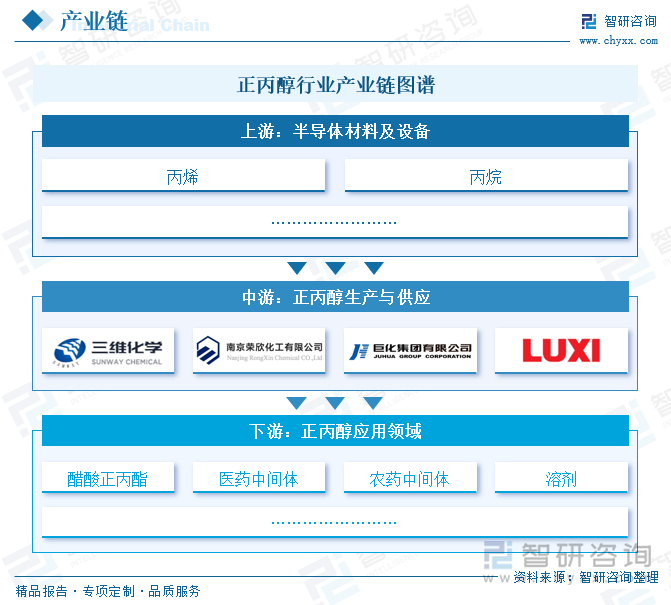
Industry Overview - N-propanol, also known as 1-propanol, is a colorless and transparent liquid widely used in coatings, paints, adhesives, cosmetics, plastics, and disinfectants, as well as in food and feed additives, synthetic fragrances, cleaning agents, preservatives, and brake fluids [1][2][3] - The production capacity of n-propanol in China has been increasing, with current capacity reaching approximately 270,000 tons, and the total production supply expected to rise from 109,300 tons in 2019 to 200,800 tons in 2024 [5][11] Supply Side - The domestic n-propanol industry has historically relied on imports due to insufficient local production capacity, with major import sources including the United States, Taiwan, and South Africa [7] - The total import volume of n-propanol in China increased from 30,400 tons in 2010 to 92,300 tons in 2019, but has since declined to between 30,000 and 50,000 tons from 2020 to 2024 due to increased domestic production and anti-dumping measures [7][9] Market Price Analysis - The market price of n-propanol in China has shown fluctuations but has remained within a range of 7,400 to 7,800 yuan per ton in the first half of 2024, with a notable increase in November 2024, reaching approximately 10,650 yuan per ton [9][11] Demand Side - N-propanol is primarily used to produce propyl acetate, accounting for 65% of the market share, followed by pharmaceutical and pesticide intermediates at 25%, and environmental solvents at 10% [11][19] - The demand for n-propanol is expected to grow due to the expansion of downstream products, particularly propyl acetate, which is projected to create a supply-demand imbalance, leading to potential price increases [11][19] Competitive Landscape - Major domestic producers of n-propanol include Sanwei Chemical, Luxi Chemical, and Nanjing Rongxin Chemical, with Sanwei Chemical holding the largest production capacity of around 100,000 tons [13][15][17] - The overall production capacity in the industry is stable at approximately 270,000 tons, with key players expanding their market share and production capabilities [13][15] Future Trends - The market demand for n-propanol is expected to continue growing, driven by the rapid development of downstream industries such as coatings, inks, and adhesives, as well as the increasing use of n-propanol as an environmentally friendly solvent [19][21] - The reliance on imports is decreasing as domestic production capacity expands, and the industry is moving towards greener, low-carbon production methods, enhancing overall competitiveness [20][21]