
AI商业化

Search documents
迈富时(02556.HK):盈利能力持续提升 订单增长及AI商业化表现强劲
Ge Long Hui· 2025-08-27 05:36
Core Viewpoint - The company reported strong financial performance for the first half of 2025, with significant growth in revenue and net profit, driven by robust demand in its AI and SaaS business segments [1] Financial Performance - The company achieved operating revenue of 930 million yuan in 25H1, representing a year-on-year increase of 25.5% [1] - The net profit attributable to shareholders was 37.38 million yuan, marking a turnaround from a loss [1] - Adjusted net profit reached 84.72 million yuan, up 77.7% year-on-year, with an adjusted net profit margin of 9.1% [1] AI and SaaS Business Growth - The AI and SaaS business generated revenue of 500 million yuan in 25H1, a year-on-year growth of 26.0% [1] - Orders in this segment increased by 69.1% year-on-year, establishing a solid foundation for revenue growth in the second half of 2025 [1] - The gross margin for the AI and SaaS business was 80.4%, down 7.9 percentage points, primarily due to lower margins in the smart integrated machine business [1] - Excluding the smart integrated machine business, the gross margin was 82.4%, down 5.9 percentage points, mainly due to the increased proportion of key account (KA) business [1] Customer Metrics and Retention - The recurring revenue from the AI and SaaS business accounted for 84.5% of total revenue, indicating strong customer retention [1] - The total number of AI and SaaS customers reached 21,655, with KA customers increasing to 814 [1] - The average revenue per existing small and medium-sized business (SMB) customer rose by 21.7% year-on-year, driven by package upgrades and additional purchases of the Agent module [1] - The average revenue per existing KA customer increased by 20.7%, benefiting from deeper applications of Agent solutions and ongoing industry expansion [1] AI Product Development - The commercialization of AI and AI Agent products exceeded expectations, with AI revenue reaching 110 million yuan and RPO at 100 million yuan [1] - ARR for AI products reached 190 million yuan, with Agent revenue at 45.3 million yuan, RPO at 54.9 million yuan, and ARR at 86.8 million yuan [1] - The company is continuously upgrading its Tforce marketing model and AI Agentforce platform to build competitive barriers [1] - New AI Agent products, such as the AI foreign trade digital employee Eva and AI sales training system, were launched to enhance customer acquisition efficiency and sales performance [1] Future Outlook - The company plans to focus on deepening the penetration of AI Agent functions in its T-cloud product system for SMBs and accelerating the iteration of industry-specific Agent templates for KA clients [1] - The commercialization of AI Agent products is expected to continue accelerating in the second half of 2025 [1] Investment Recommendations - The company’s AI and AI Agent product commercialization is expected to accelerate in the second half of the year, with the Tforce marketing model and AI Agentforce platform creating long-term competitive advantages [1] - Revenue projections for 2025-2027 are 2.358 billion yuan, 3.179 billion yuan, and 4.142 billion yuan, respectively, with adjusted net profits of 112 million yuan, 203 million yuan, and 299 million yuan [1] - Corresponding price-to-sales ratios are projected at 6.0, 4.5, and 3.4 times [1]
大模型厂商变现难,科大讯飞却把AI学习机卖爆
Tai Mei Ti A P P· 2025-08-27 02:21
Group 1 - The AI hardware market in 2025 is characterized by a split landscape, with many products still in the conceptual stage and few achieving significant sales [2] - iFlytek's AI learning machine reported a substantial revenue increase of 104% year-on-year and a gross profit increase of 116% in the first half of the year, establishing itself as a leader in the high-end learning machine sector [2] - iFlytek's success demonstrates the commercial viability of AI technology through a strategy combining specialized large model technology, essential scenario product strength, and comprehensive marketing capabilities [2][12] Group 2 - The launch of the iFlytek Spark X1 model, which utilizes a domestically produced computing platform, marks a significant advancement in deep reasoning models, achieving industry-leading results with reduced computational requirements [3][4] - iFlytek's large model strategy is structured as a "1+N" system, focusing on a universal base model that empowers multiple industry-specific models, with education being a key focus area [4] - iFlytek has established a core technological moat in education by developing a dedicated large model tailored for educational applications, collaborating with top educational experts [4][5] Group 3 - The AI learning machine's upgraded features include interactive planning and enhanced tutoring capabilities, significantly reducing ineffective practice time for students [7] - iFlytek's marketing strategy combines high-end branding with a comprehensive channel network, effectively reaching both urban and lower-tier markets [8][11] - The company emphasizes brand advertising to enhance consumer trust and recognition, distinguishing itself from competitors who focus primarily on performance advertising [10] Group 4 - The AI learning machine market is viewed as a major highlight in the education technology sector, with iFlytek's product growth occurring despite a generally sluggish consumer market [12] - iFlytek's success conveys critical insights about AI commercialization, emphasizing the importance of addressing user pain points, integrating technology with specific scenarios, and building strong channels and brand trust [13] - The penetration rate of learning machines in Chinese households is only 5%-6%, indicating significant growth potential in the market, especially with nearly 200 million students in primary and secondary education [15]



打破封锁!中国芯片强势突围 引发美股动荡,英伟达一夜蒸发上万亿
Sou Hu Cai Jing· 2025-08-26 12:12
Core Insights - The article discusses the recent volatility in the US stock market, particularly focusing on the significant drop in Nvidia's stock price, which resulted in a market value loss of approximately 1.1 trillion RMB, attributed to the rise of China's chip industry and advancements in AI technology [1][5]. Group 1: Market Dynamics - Nvidia's stock fell by 3.5% on August 19, marking its largest drop since April 21, with a single-day market value loss of about 150 billion USD [5]. - The entire semiconductor sector faced declines, with Intel's stock dropping over 7% and other chip companies also experiencing varying degrees of losses [5]. - In contrast, Chinese AI company DeepSeek launched its new language model DeepSeek-V3.1 on August 21, showcasing significant advancements in AI technology [7]. Group 2: Technological Advancements - DeepSeek-V3.1 features a mixed expert architecture that balances efficiency and performance, allowing users to switch between two thinking modes based on different scenarios [7]. - The model is specifically designed to adapt to the next generation of domestic chips, optimizing parameter precision formats to reduce redundancy in chip computing units, enhance computational efficiency, and lower memory usage by 50%-75% compared to FP16 [9][12]. - The new model demonstrates impressive performance metrics, achieving similar or slightly higher accuracy with fewer tokens compared to its predecessor, indicating significant resource optimization [14]. Group 3: Industry Implications - The decline in US chip stocks is linked to growing skepticism about the commercial returns of AI investments, with a report indicating that 95% of organizations see no returns from generative AI investments [16]. - The launch of DeepSeek's model represents a major opportunity for the Chinese semiconductor industry, particularly benefiting domestic AI chip manufacturers like Cambricon, Huawei Ascend, and others, with Cambricon's stock rising over 45% in five trading days [20]. - The collaboration between models and chips signifies a critical breakthrough for China's AI industry, moving towards self-reliance in computing power and reshaping the global semiconductor landscape amid US-China tech competition [22][27]. Group 4: Future Outlook - The release of DeepSeek-V3.1 marks a fundamental shift in AI development focus from merely scaling parameters to balancing practicality and efficiency, indicating a new phase in global AI competition [31]. - The model's ability to operate in both "thinking" and "non-thinking" modes and its compatibility with Anthropic API environments suggest a significant advancement in AI capabilities [33]. - As Chinese tech companies continue to break Western monopolies, there is potential for China to lead a new wave of AI chip innovation globally [38].


招银国际:升快手-W目标价至84港元 维持买入评级
Zhi Tong Cai Jing· 2025-08-25 08:50
Core Viewpoint - Kuaishou-W (01024) reported a 13% year-on-year revenue growth to 35 billion RMB in Q2, with adjusted net profit increasing by 20% to 5.6 billion RMB, exceeding market expectations, driven by robust e-commerce performance and strong AI commercialization [1] Group 1: Financial Performance - Q2 revenue reached 35 billion RMB, reflecting a 13% year-on-year increase [1] - Adjusted net profit for Q2 was 5.6 billion RMB, marking a 20% year-on-year growth [1] - Both revenue and net profit figures surpassed market expectations [1] Group 2: Future Outlook - The company is expected to achieve a 13% year-on-year revenue growth in Q3, supported by strong e-commerce momentum and resilient online marketing growth [1] - Profit forecasts for 2025 to 2027 have been slightly increased by 0% to 1% to reflect positive developments in the AI sector [1] - Target price has been raised from 80 HKD to 84 HKD, maintaining a "Buy" rating due to optimistic views on Kuaishou's AI development and commercialization prospects [1]

招银国际:升快手-W(01024)目标价至84港元 维持买入评级
智通财经网· 2025-08-25 08:47
Core Viewpoint - Kuaishou-W (01024) reported a 13% year-on-year revenue growth to 35 billion RMB and a 20% year-on-year adjusted net profit growth to 5.6 billion RMB, both exceeding market expectations, driven by robust e-commerce performance and unexpected AI commercialization results [1] Group 1: Financial Performance - Revenue for the second quarter reached 35 billion RMB, reflecting a 13% increase year-on-year [1] - Adjusted net profit for the same period was 5.6 billion RMB, marking a 20% year-on-year growth [1] Group 2: Future Outlook - The company is expected to achieve a 13% year-on-year revenue growth in the third quarter, supported by strong e-commerce momentum and resilient online marketing growth [1] - The earnings forecast for Kuaishou for 2025 to 2027 has been slightly increased by 0% to 1% to reflect positive developments in the AI sector [1] Group 3: Target Price and Rating - The target price for Kuaishou has been raised from 80 HKD to 84 HKD [1] - The rating remains "Buy," with an optimistic outlook on Kuaishou's AI development and commercialization prospects [1]
中国AI创业只是少数人的游戏
Tai Mei Ti A P P· 2025-08-25 06:01
Core Insights - The AI landscape in China is experiencing a surge of entrepreneurial activity, but underlying challenges persist, particularly regarding monetization and user payment habits [2][3][6] - The disparity in payment habits between China and North America is significant, with Chinese consumers showing much lower willingness to pay for AI services [3][4][6] - Despite a growing number of AI startups, the barriers to entry remain high, with access to quality data and resources being critical for success [9][11][12] - Chinese tech giants are lagging in AI investment compared to their American counterparts, impacting the overall ecosystem and innovation potential [13][14] - The hardware sector in China presents unique advantages, with a strong supply chain and increasing investment, positioning it as a potential growth area for AI innovation [15][16][17] Payment Habits - Payment habits in China are notably poor, with consumer payment rates for AI services ranging from 3% to 13%, compared to 15% to 40% in the U.S. [3][4] - The annual recurring revenue (ARR) for leading AI companies in China is significantly lower than in the U.S., with differences ranging from 5 to 100 times [4][5] - A developer's experience highlights the stark contrast, where a product in China gained thousands of users but had fewer than 10 paying customers, while a similar product overseas achieved substantial revenue quickly [4][6] Investment Landscape - The number of AI startups globally is increasing, with approximately 5,000 new companies expected in the first half of 2025, including 1,380 from China [9][10] - Investment in AI startups has surged, with global funding reaching around $140 billion in the first half of 2025, doubling from the previous year [9][10] - However, the AI entrepreneurial environment in China is not as accessible as during the internet boom, with high hidden barriers to entry [9][11] Challenges for Tech Giants - Chinese tech giants are investing significantly less in AI compared to U.S. companies, with a reported investment of 630 billion RMB against 1.7 trillion RMB from U.S. firms [13] - The focus of Chinese companies appears to be on short-term gains rather than long-term AI infrastructure development, leading to a generational gap in AI model capabilities [13][14] - The reluctance to fully open resources to external developers stifles innovation and growth within the AI ecosystem [13][14] Hardware Opportunities - China has a strong advantage in AI hardware, with leading companies like DJI and Xiaomi contributing to a robust supply chain [15][16] - The number of AI hardware companies in China is growing, with 1,180 operational firms and significant investment activity in the sector [15][16] - The unique development path of AI hardware in China, leveraging its manufacturing base, may provide a competitive edge in the global market [17]




港股科技板块强势归来!恒生科技ETF(513130)日内成交额显著放量
Mei Ri Jing Ji Xin Wen· 2025-08-22 06:32
Core Viewpoint - The Hong Kong technology sector has shown strong performance, leading the market with significant inflows into the Hang Seng Tech ETF, indicating a positive market sentiment and potential for further gains [1][2]. Group 1: Market Performance - On August 22, the Hong Kong technology sector rebounded strongly, with the Hang Seng Tech ETF reaching a record high of 457.95 million shares and a scale of 33.408 billion yuan [1]. - The Hang Seng Tech ETF recorded a trading volume exceeding 5.5 billion yuan on August 22, surpassing the previous day's total of 4.028 billion yuan, reflecting active market trading [1]. - Since July, the Hong Kong technology sector has underperformed compared to the A-share market, with the Hang Seng Tech Index's P/E ratio at 21.37, placing it in the lower 18.77% percentile since its inception [1]. Group 2: Investment Opportunities - The Hang Seng Tech ETF has attracted a net inflow of 2.07 billion yuan over five consecutive trading days, leading among ETFs tracking the Hang Seng Tech Index [1]. - The anticipated interest rate cut by the Federal Reserve, along with strong earnings reports from leading companies showcasing accelerated AI commercialization, enhances the investment appeal of the Hang Seng Tech Index [1]. - The index includes major companies with strong R&D capabilities, such as Tencent, Alibaba, and Xiaomi, making it a relatively scarce core asset in the Hong Kong market [2]. Group 3: Company Performance - Internet companies represented by the Hang Seng Tech Index reported stable second-quarter earnings, with both revenue and profit showing year-on-year growth, particularly in gaming, advertising, and AI products [2]. - Companies in the AI sector are rapidly iterating and applying new models, indicating significant potential for future value reassessment [2]. - The Hang Seng Tech ETF supports T+0 trading, providing investors with a robust tool to capitalize on new growth opportunities in the Hong Kong technology sector [2].
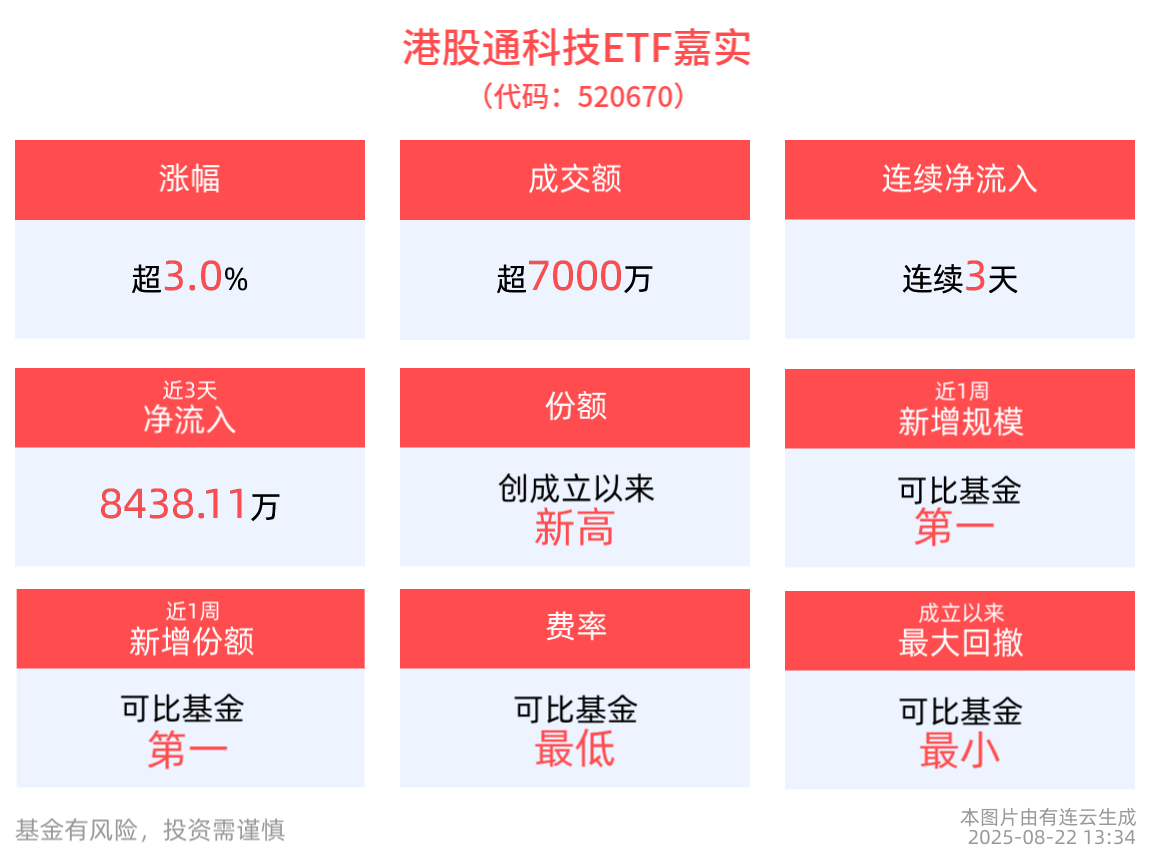
港股通科技ETF嘉实(520670)上涨3.02%,上市以来连续“吸金”超8400万元
Sou Hu Cai Jing· 2025-08-22 06:18
Group 1 - The core viewpoint indicates that the Hong Kong Stock Connect Technology ETF managed by Harvest has shown significant trading activity and liquidity, with a turnover rate of 20.96% and a transaction volume of 70.65 million yuan [3] - Over the past week, the Hong Kong Stock Connect Technology ETF has experienced a notable increase in scale, growing by 77.97 million yuan, which is the highest among comparable funds [3] - The latest share count for the Hong Kong Stock Connect Technology ETF reached 332 million, marking a new high since its inception [3] Group 2 - The fund has seen continuous net inflows over the past three days, with a peak single-day net inflow of 54.01 million yuan, totaling 84.38 million yuan [3] - The ETF closely tracks the Hang Seng Stock Connect Technology Index (HSSCITI), which reflects the performance of Hong Kong-listed companies related to technology that can be traded via the Stock Connect [3] - Market confidence in the Hong Kong technology sector is gradually returning, driven by strong performance from leading companies, expectations of interest rate cuts by the Federal Reserve, and accelerated commercialization of AI [3] Group 3 - According to Guotai Junan Securities, there is a historical alternating relationship between the ChiNext Index and the Hang Seng Technology Index, suggesting that the latter may experience a rebound as the difference in rolling returns narrows [3] - The current difference in returns between the ChiNext Index and the Hang Seng Technology Index stands at 18 percentage points, indicating potential for the latter to catch up [3] Group 4 - Shenwan Hongyuan Securities believes that the recent underperformance of the Hong Kong index is a temporary consolidation following a rapid increase, and that sectors with previously low earnings expectations are likely to regain market favor [4] - The current market environment is seen as an opportune moment for active investment in Hong Kong stocks, particularly in the internet and Hang Seng Technology Index sectors [4] Group 5 - As of July 31, 2025, the top ten weighted stocks in the Hang Seng Stock Connect Technology Index include Kuaishou-W, SMIC, Tencent Holdings, Alibaba-W, Xiaomi Group-W, Meituan-W, Lenovo Group, Kingdee International, Bilibili-W, and Sunny Optical Technology, collectively accounting for 74.94% of the index [6]
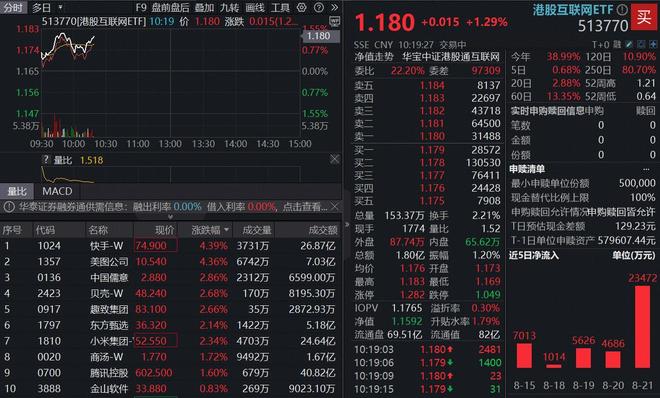
ETF盘中资讯 AI商业化加速,快手绩后领涨4%,腾讯重返600港元!港股互联网ETF(513770)涨逾1%,连续5日吸金超4亿元
Jin Rong Jie· 2025-08-22 02:57
Core Viewpoint - The Hong Kong stock market shows strong performance in the tech sector, with notable gains from major companies like Kuaishou, Xiaomi, Tencent, and Alibaba following their earnings reports, indicating a positive market sentiment towards internet stocks [1][3]. Group 1: Company Performance - Kuaishou reported a Q2 revenue of 35 billion yuan, a year-on-year increase of 13.1%, with adjusted net profit reaching 5.6 billion yuan, up 20.1%, exceeding market expectations [3]. - Bilibili's Q2 revenue was 7.34 billion yuan, reflecting a 20% year-on-year growth, with both net profit and adjusted net profit hitting historical highs of 220 million yuan and 560 million yuan, respectively [1][3]. - The performance of these companies is significantly enhanced by AI capabilities, with Kuaishou's AI-driven revenue surpassing 250 million yuan in Q2 [3]. Group 2: Market Trends - The Hong Kong internet ETF (513770) has seen a continuous inflow of funds, with a net inflow of 2.35 billion yuan on a single day and a total of 4.18 billion yuan over the past five days, indicating strong investor interest [3][5]. - The index tracking the Hong Kong internet sector has outperformed the Hang Seng Tech Index, with a cumulative increase of over 35% since the beginning of the year [5][6]. - The top four holdings in the Hong Kong internet ETF include Xiaomi, Tencent, Alibaba, and Meituan, collectively accounting for 54.74% of the fund's weight [6][7]. Group 3: Future Outlook - The upcoming half-year earnings reports are seen as a critical juncture for the Hong Kong market, with expectations shifting from liquidity-driven to performance-driven dynamics, influenced by policy changes aimed at reducing competition [3]. - The "anti-involution" policy is expected to impact industry pricing, making it a key variable for future market performance [3].



首次披露AI商业化收入,微盟实现自2022年以来的首次扭亏|最前线
3 6 Ke· 2025-08-22 02:50
Core Insights - Weimob Group reported a total revenue of 775 million yuan for the first half of 2025, with an adjusted year-on-year increase of 7.8% after accounting for the impact of reduced rebate rates for merchant solutions [1] - The adjusted EBITDA reached 72 million yuan, marking a year-on-year increase of 140.7%, achieving profitability for the first time since 2022 [1] - The adjusted net profit was 17 million yuan, reflecting a year-on-year increase of 109.0%, marking the first profit since 2021 [1] Financial Performance - Total gross profit amounted to 582 million yuan, with an adjusted year-on-year growth of 36.1%, and the gross margin increased from 66.4% to 75.1%, a rise of 8.7 percentage points [1] - Operating cash flow showed a slight outflow of approximately 28 million yuan, while cash and bank deposits stood at about 1.574 billion yuan as of June 30, 2025, indicating a healthy overall financial status [1] AI Business Development - Weimob's AI-related revenue reached approximately 34 million yuan, benefiting from significant growth in AI commercialization [2] - The subscription solution revenue was 438 million yuan, showing a quarter-on-quarter increase of 1.38%, indicating a stabilization and recovery phase [1][2] - Merchant solutions revenue was 338 million yuan, with a year-on-year growth of 45.3% after adjusting for the impact of reduced rebate rates, and the gross margin increased from 74.5% to 91.3% [1] AI Application and Market Strategy - Weimob's AI business has expanded over three years into four areas, including WAI SaaS, WAI Pro, WIME, and WAI PaaS OEM, covering various sectors such as e-commerce and retail [2] - The WIME platform has seen a 139% increase in registered users, reaching 116,000, with a 172% increase in revenue [2] - Weimob's AI capabilities are designed to optimize the retail industry's "people, goods, and environment" aspects, enhancing operational efficiency through automated solutions [3] Future Outlook - The company plans to actively promote the application of AI Agents and continue developing the WeChat e-commerce ecosystem, focusing on social commerce and local life market opportunities [4] - Weimob aims to explore international markets, particularly in North America, to further expand its business [4]