
地缘政治冲突

Search documents
马杜罗:委内瑞拉正面临南美大陆百年来最大威胁
Yang Shi Xin Wen· 2025-09-01 17:37
Core Viewpoint - Venezuela is facing the greatest threat in a century in South America, according to President Maduro, who emphasizes the country's commitment to peace while refusing to yield to any threats [1]. Military Tensions - The United States has significantly increased its naval presence in the Caribbean Sea and nearby waters, escalating tensions between the U.S. and Venezuela [1]. - President Trump has ordered the deployment of an amphibious fleet near Venezuela under the pretext of combating drug trafficking in Latin America, which includes three amphibious assault ships and dock landing ships carrying approximately 2,200 Marines [1]. Political Response - President Maduro condemned the U.S. actions as attempts to undermine the Venezuelan government through terrorism and military means [1].
白银又暴涨了!
Guo Ji Jin Rong Bao· 2025-09-01 13:21
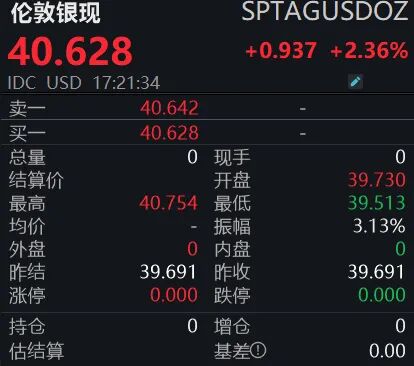
Core Viewpoint - The silver market is experiencing a significant surge, with prices surpassing $40 per ounce for the first time since 2011, reflecting a year-to-date increase of over 40% [1][4]. Price Movement - As of September 1, the spot silver price reached $40.628 per ounce, marking a daily increase of 2.36% [1][2]. - The highest price recorded during the day was $40.754, with a trading range of 3.13% [2]. - In comparison, gold prices also hit a new high since April, with spot gold reaching $3489.852 per ounce, reflecting a daily increase of over 1% [2][3]. Market Drivers - The recent surge in silver prices is attributed to multiple factors, including macroeconomic conditions, policy influences, and the inherent volatility of the commodity [4]. - Expectations of interest rate cuts by the Federal Reserve, driven by softening U.S. employment data and dovish remarks from Fed officials, have bolstered the precious metals sector [4]. - Concerns regarding potential U.S. tariffs on silver imports, following the U.S. Geological Survey's inclusion of silver in its critical minerals list, have also contributed to market tension [4]. Geopolitical and Economic Factors - The questioning of the Federal Reserve's independence and ongoing geopolitical conflicts have further triggered increases in gold and silver prices [5]. - The ongoing military rearmament in Europe and the U.S. re-industrialization efforts are expected to boost industrial demand for silver [5]. - Data indicates that silver ETFs have seen net inflows for seven consecutive months, the longest streak since 2020, reflecting strong investor confidence in silver's future [5]. Future Outlook - Analysts predict that after breaking the $40 per ounce barrier, silver may test resistance levels between $44 and $45 per ounce, maintaining a strong upward trend [6]. - Despite the positive long-term outlook, the rapid price increase has raised caution among some institutions, suggesting potential profit-taking and volatility in the near term [6].

集运日报:SCFI保持下跌趋势盘面承压下行近期波动较大不建议继续加仓设置好止损-20250901
Xin Shi Ji Qi Huo· 2025-09-01 11:50
Group 1: Report Industry Investment Rating - No information provided Group 2: Core Viewpoints - SCFI is on a downward trend, the market is under pressure and volatile, and it's not recommended to increase positions. Instead, set stop - losses [1] - Given geopolitical conflicts and tariff uncertainties, it's advisable to participate with light positions or stay on the sidelines [4] - Attention should be paid to tariff policies, the Middle - East situation, and spot freight rates [4] Group 3: Summary by Related Catalogs Freight Index - On August 25, SCFIS (European route) was 1990.20 points, down 8.7% from the previous period; SCFIS (US West route) was 1041.38 points, down 5.9% [2] - On August 29, NCFI (composite index) was 1098.17 points, up 6.02%; NCFI (European route) was 929.56 points, down 14.23%; NCFI (US West route) was 1396.85 points, up 44.97% [2] - On August 29, SCFI was 1445.06 points, up 29.70 points; SCFI European line price was 1481 USD/TEU, down 11.21%; SCFI US West route was 1923 USD/FEU, up 16.97% [2] - On August 29, CCFI (composite index) was 1156.32 points, down 1.6%; CCFI (European route) was 1685.80 points, down 4.1%; CCFI (US West route) was 774.39 points, down 3.1% [2] Economic Data - Eurozone's August manufacturing PMI was 50.5, service PMI was 50.7, and composite PMI rose to 51.1, the highest since May 2024. The Sentix investor confidence index was - 3.7 [2] - China's July manufacturing PMI was 49.3%, down 0.4 percentage points from the previous month [2] - US August Markit manufacturing PMI was 53.3, the highest since May 2022; service PMI was 55.4 [3] Market Conditions - As of August 29, the main contract 2510 closed at 1261.0, down 2.15%, with a trading volume of 25,200 lots and an open interest of 53,200 lots, a decrease of 988 lots from the previous day [4] Strategies - Short - term: For risk - takers, it's recommended to lightly test long positions around 1300 for the 2510 contract and add long positions around 1600 for the 2512 contract. Set stop - losses [5] - Arbitrage: In the context of international instability, it's advisable to stay on the sidelines or lightly attempt [5] - Long - term: It's recommended to take profits on rallies and wait for a pull - back to stabilize before making further decisions [5] Other Information - The daily limit for contracts from 2508 - 2606 is adjusted to 18% [5] - The margin for contracts from 2508 - 2606 is adjusted to 28% [5] - The daily opening limit for all contracts from 2508 - 2606 is 100 lots [5] - On August 26, the US Department of Commerce made a preliminary anti - dumping ruling on polypropylene corrugated boxes imported from China, with a unified rate of 83.64% [6] - On August 29, the Israeli military continued operations in the Middle East, including major strikes on Houthi targets [6]
【黄金期货收评】PCE符合预期推升降息押注 沪金日内上涨2.08%
Jin Tou Wang· 2025-09-01 09:35
Group 1 - The core viewpoint indicates that the recent increase in gold prices is influenced by geopolitical tensions, U.S. monetary policy, and rising physical gold demand in China [1][3] - As of September 1, the Shanghai gold spot price was reported at 795.38 yuan per gram, showing a discount of 5.18 yuan compared to the futures price of 800.56 yuan per gram [1] - The U.S. labor market showed unexpected weakness with non-farm employment figures falling short of market expectations, and the unemployment rate rising to 4.2% [2] Group 2 - The latest PCE and core PCE data from the U.S. met market expectations, indicating persistent inflation but limited impact from tariff shocks, which has raised market expectations for a potential Fed rate cut [3] - The demand for physical gold in China has significantly increased, with the central bank resuming gold purchases since November last year, continuing for eight consecutive months [1] - The geopolitical risks have slightly diminished, but the market's demand for safe-haven assets remains, contributing to the upward pressure on gold prices [1][3]
集运日报:现货运价跌势不减,盘面冲高回落,近期波动较大,不建议继续加仓,设置好止损。-20250828
Xin Shi Ji Qi Huo· 2025-08-28 06:25
Report Industry Investment Rating - No specific industry investment rating is provided in the report [1][2][3] Core Viewpoints - The spot freight rate continues to decline, and the futures market fluctuates greatly. It is recommended to participate with light positions or wait and see due to geopolitical conflicts and tariff uncertainties [2][5] - The main contract remains weak, while the far - month contracts are relatively strong. Risk - takers can try light - position long positions at specific price levels for certain contracts, but should set stop - losses [5] Summary by Related Information Freight Rate Indexes - On August 25, the Shanghai Export Container Settlement Freight Index (SCFIS) for the European route was 1990.20 points, down 8.7% from the previous period; for the US West route, it was 1041.38 points, down 5.9% [3] - On August 22, the Ningbo Export Container Freight Index (NCFI) composite index was 1035.79 points, down 1.59% from the previous period; the European route was 1083.74 points, down 8.83%; the US West route was 963.54 points, down 1.79% [3] - On August 22, the Shanghai Export Container Freight Index (SCFI) composite index was 1415.36 points, down 44.83 points from the previous period; the European route price was 1668 USD/TEU, down 8.35%; the US West route was 1759 USD/FEU, down 6.54% [3] - On August 22, the China Export Container Freight Index (CCFI) composite index was 1174.87 points, down 1.5% from the previous period; the European route was 1757.74 points, down 1.8%; the US West route was 799.19 points, down 2.9% [3] PMI Data - The eurozone's August manufacturing PMI preliminary value was 50.5, higher than the forecast of 49.5 and the previous value of 49.8; the service PMI preliminary value was 50.7, slightly lower than the forecast of 50.8 and the previous value of 51; the composite PMI preliminary value rose to 51.1 [3] - In July, China's manufacturing PMI was 49.3%, down 0.4 percentage points from the previous month [4] - The US August S&P Global manufacturing PMI preliminary value was 53.3, reaching a 39 - month high; the service PMI preliminary value was 55.4 [4] Market and Strategy - On August 27, the main contract 2510 closed at 1316.0, down 0.89%, with a trading volume of 1.80 million lots and an open interest of 5.37 million lots, a decrease of 684 lots from the previous day [5] - Short - term strategy: Risk - takers can try light - position long positions around 1300 for the 2510 contract and add long positions around 1600 for the 2512 contract, and set stop - losses [5] - Arbitrage strategy: It is recommended to wait and see or try with light positions due to large fluctuations [5] - Long - term strategy: Take profit on rallies and wait for the market to stabilize after a pullback before making further decisions [5] Other Information - Sino - US tariff extension negotiations have no substantial progress, and the tariff war has evolved into a trade negotiation issue between the US and other countries [5] - The daily trading limit for contracts from 2508 to 2606 is adjusted to 18%, the margin is adjusted to 28%, and the intraday opening limit for all these contracts is 100 lots [5]
集运日报:美拟向印征收50%关税,现货运价持续下行,盘面再度下探,近期波动较大,不建议继续加仓,设置好止损-20250827
Xin Shi Ji Qi Huo· 2025-08-27 07:15
Report Industry Investment Rating - No specific industry investment rating is provided in the reports [1][2][3] Core Views - Amid geopolitical conflicts and tariff uncertainties, the game in the shipping market is challenging, so it's advisable to participate with light positions or stay on the sidelines [3] - Spot freight rates are continuously falling, and after a brief rebound, the market is under pressure again. Attention should be paid to tariff policies, the Middle - East situation, and spot freight rates [3] - In the face of international situation turmoil, contracts maintain seasonal logic with large fluctuations. It's recommended to wait and see or make light - position attempts for arbitrage strategies [3] Summary by Related Content Shipping Market Data - On August 22 - 25, shipping freight rate indices such as NCFI and SCFIS showed declines. For example, the NCFI (composite index) dropped by 1.59%, and the SCFIS (European route) fell by 8.7% [1] - On August 22, other shipping freight rate indices like SCFI and CCFI also decreased. The SCFI composite index dropped by 44.83 points, and the CCFI (European route) fell by 1.8% [1] Market Strategy - Short - term strategy: For risk - takers, try to go long lightly at around 1300 for the 2510 contract and add positions at around 1600 for the 2512 contract. Pay attention to the market trend and set stop - losses [3] - Arbitrage strategy: Due to international situation instability, it's recommended to wait and see or make light - position attempts [3] - Long - term strategy: Take profits when contracts rise, wait for the market to stabilize after a pullback, and then judge the subsequent trend [3] Market Conditions - On August 26, the main contract 2510 closed at 1318.9, with a decline of 2.76%, a trading volume of 2.58 million lots, and an open interest of 54,400 lots, an increase of 52 lots from the previous day [3] - The 2508 contract's delivery price was 2135.2 [3] Geopolitical Events - The Islamic Cooperation Organization held a special meeting to discuss Israel's aggression against Palestine and issued a joint statement opposing Israel's actions [3] - The Trump administration plans to impose a 50% tariff on Indian products, which has drawn condemnation from the Indian government [3] Economic Data - The preliminary value of the Eurozone's August manufacturing PMI was 50.5, the service PMI was 50.7, and the composite PMI rose to 51.1 [2] - The preliminary value of the US August manufacturing PMI was 53.3, and the service PMI was 55.4 [2] Contract Adjustments - The daily limit for contracts 2508 - 2606 was adjusted to 18% [3] - The margin for contracts 2508 - 2606 was adjusted to 28% [3] - The daily opening limit for all contracts 2508 - 2606 was set at 100 lots [3]
集运日报:美拟向印征收50%关税,现货运价持续下行,盘面再度下探,近期波动较大,不建议继续加仓,设置好止损。-20250827
Xin Shi Ji Qi Huo· 2025-08-27 06:40
Report Industry Investment Rating - No specific industry investment rating is provided in the reports. Core Viewpoints - Amid geopolitical conflicts and tariff uncertainties, trading is challenging, so it's advised to participate with light positions or stay on the sidelines [3]. - The spot freight rate is continuously falling, and after a brief rebound, the market is under pressure again. Attention should be paid to tariff policies, the Middle - East situation, and spot freight rates [3]. Summary by Related Content Shipping Market - From August 22nd to 25th, multiple shipping freight rate indices declined. For example, the NCFI (composite index) dropped 1.59% to 1035.79 points, and the SCFIS (European route) fell 8.7% to 1990.20 points [1]. - On August 26th, the main contract 2510 closed at 1318.9 with a 2.76% decline, a trading volume of 2.58 million lots, and an open interest of 54,400 lots, an increase of 52 lots from the previous day [3]. Economic Indicators - The preliminary Eurozone manufacturing PMI in August was 50.5, higher than the forecast of 49.5; the services PMI was 50.7; the composite PMI rose to 51.1, the highest since May 2024 [2]. - The preliminary US S&P Global manufacturing PMI in August reached 53.3, a 39 - month high, and the services PMI was 55.4 [2]. Policy and Geopolitical Events - The Trump administration plans to impose a 50% tariff on Indian products, which is a new signal of the White House's plan to raise tariffs [3]. - The Islamic Cooperation Organization held a special meeting to discuss Israel's aggression against Palestine and issued a joint statement opposing the aggression [3]. Trading Strategies - Short - term strategy: Risk - takers can try to go long lightly around 1300 for the 2510 contract and add long positions around 1600 for the 2512 contract. Set stop - losses and don't hold losing positions [3]. - Arbitrage strategy: Due to the volatile international situation, it's recommended to stay on the sidelines or try with light positions [3]. - Long - term strategy: Take profits when the contracts rise, wait for the correction to stabilize, and then determine the subsequent direction [3]. Contract Adjustments - The daily price limit for contracts 2508 - 2606 is adjusted to 18% [3]. - The company's margin for contracts 2508 - 2606 is adjusted to 28% [3]. - The daily opening limit for all contracts 2508 - 2606 is 100 lots [3].
集运日报:多国停发对美包裹,货量逐渐走淡,但主力合约跌幅过大,近期波动较大,不建议继续加仓,设置好止损-20250825
Xin Shi Ji Qi Huo· 2025-08-25 07:06
Report Summary 1. Report Industry Investment Rating No information provided. 2. Core Viewpoints - Due to geopolitical conflicts and tariff uncertainties, the game is difficult, and it is recommended to participate with light positions or stay on the sidelines [5]. - The spot price has slightly decreased, and the main contract is weak in the short - term, while the far - month contracts are relatively strong [2][5]. - In the long - term, it is recommended to take profits when the contracts rise and wait for the callback to stabilize [5]. 3. Summary by Content Market Data - **Shipping Indexes**: - On August 18, the Shanghai Export Container Settlement Freight Index SCFIS (European route) was 2180.17 points, down 2.5% from the previous period; SCFIS (US West route) was 1106.29 points, up 2.2% [3]. - On August 22, the Ningbo Export Container Freight Index NCFI (composite index) was 1035.79 points, down 1.59% from the previous period; NCFI (European route) was 1083.74 points, down 8.83%; NCFI (US West route) was 963.54 points, down 1.79% [3]. - On August 22, the Shanghai Export Container Freight Index SCFI composite index was 1415.36 points, down 44.83 points from the previous period; SCFI European line price was 1668 USD/TEU, down 8.35%; SCFI US West route was 1759 USD/FEU, down 6.54% [3]. - On August 22, the China Export Container Freight Index CCFI (composite index) was 1174.87 points, down 1.5% from the previous period; CCFI (European route) was 1757.74 points, down 1.8%; CCFI (US West route) was 799.19 points, down 2.9% [3]. - **Contract Information**: On August 22, the main contract 2510 closed at 1309.0, down 1.82%, with a trading volume of 2.54 million lots and an open interest of 54,300 lots, a decrease of 38 lots from the previous day [5]. Economic Data - **Eurozone**: In July, the manufacturing PMI preliminary value was 49.8 (expected 49.7, previous value 49.5); the services PMI preliminary value was 51.2 (expected 50.7, previous value 50.5); the composite PMI preliminary value was 51 (expected 50.8, previous value 50.6); the SENTIX investor confidence index rose to 4.5, the highest since April 2022 [3]. - **China**: The manufacturing PMI in July was 49.3%, down 0.4 percentage points from the previous month [4]. - **US**: In July, the S&P Global manufacturing PMI preliminary value was 49.5 (expected 52.7, previous value 52.9); the services PMI preliminary value was 55.2 (expected 53, previous value 52.9); the Markit composite PMI preliminary value was 54.6, the highest since December 2024 [4]. Trade Situation - The Sino - US tariff extension continues, and the negotiation has no substantial progress. The tariff war has evolved into a trade negotiation issue between the US and other countries, and the current spot price has slightly decreased [5]. Strategy Recommendations - **Short - term Strategy**: Risk - takers can try to go long lightly around 1300 for the 2510 contract and add positions around 1600 for the 2512 contract. Pay attention to the subsequent market trend, do not hold losing positions, and set stop - losses [5]. - **Arbitrage Strategy**: Given the volatile international situation, each contract still follows the seasonal logic with large fluctuations. It is recommended to stay on the sidelines or try with light positions [5]. - **Long - term Strategy**: It is recommended to take profits when the contracts rise and wait for the callback to stabilize [5]. Other Information - The circuit - breaker limits for contracts from 2508 to 2606 are adjusted to 18% [5]. - The margin requirements for contracts from 2508 to 2606 are adjusted to 28% [5]. - The daily opening limit for all contracts from 2508 to 2606 is 100 lots [5].
集运日报:中东局势反复,现价维持下跌,助长空头情绪,近期波动较大,不建议继续加仓,设置好止损。-20250822
Xin Shi Ji Qi Huo· 2025-08-22 05:48
Report Industry Investment Rating - No specific industry investment rating is provided in the reports [1][2][3] Core Views - Due to the repeated Middle - East situation, current prices are falling, increasing short - selling sentiment. With large recent fluctuations, it's not recommended to increase positions, and stop - losses should be set [1] - Amid geopolitical conflicts and tariff uncertainties, the trading is difficult, so it's advisable to participate with light positions or stay on the sidelines [3] - In the short - term, the main contract is weak while far - month contracts are stronger. Risk - takers can try to go long lightly at around 1300 for the 2510 contract and around 1750 for the 2512 contract. Keep an eye on the subsequent market trend and don't hold losing positions, setting stop - losses [3] - For the arbitrage strategy, given the volatile international situation, each contract maintains a seasonal logic with large fluctuations. It's recommended to wait and see or try with light positions [3] - In the long - term, it's suggested to take profits when the contracts rise, wait for the correction to stabilize, and then judge the subsequent direction [3] Summary by Related Information Shipping Industry - **Container Freight Indexes**: On August 15 - 18, the Ningbo Export Container Freight Index (NCFI) (composite index) was 1052.5 points, down 0.1% from the previous period; the Shanghai Export Container Settlement Freight Index (SCFIS) (European route) was 2180.17 points, down 2.5%; the NCFI (European route) was 1188.7 points, down 5.5%; the SCFIS (US West route) was 1106.29 points, up 2.2%; the NCFI (US West route) was 1042.91 points, down 5.9%. On August 15, the Shanghai Export Container Freight Index (SCFI) was 1460.19 points, down 29.49 points; the China Export Container Freight Index (CCFI) (composite index) was 1193.34 points, down 0.6%; the SCFI European route price was 1820 USD/TEU, down 7.2%; the CCFI (European route) was 1790.47 points, down 0.5%; the SCFI US West route was 1759 USD/FEU, down 3.5%; the CCFI (US West route) was 981.1 points, down 5.9% [1] Economic Data - **Eurozone**: In July, the manufacturing PMI preliminary value was 49.8 (expected 49.7, previous 49.5), the services PMI preliminary value was 51.2 (expected 50.7, previous 50.5), the composite PMI preliminary value was 51 (expected 50.8, previous 50.6), and the SENTIX investor confidence index rose to 4.5, the highest since April 2022 [2] - **China**: The manufacturing PMI in July was 49.3%, 0.4 percentage points lower than the previous month, indicating a decline in manufacturing prosperity [2] - **US**: In July, the S&P Global manufacturing PMI preliminary value was 49.5 (expected 52.7, previous 52.9), the services PMI preliminary value was 55.2 (expected 53, previous 52.9), and the Markit composite PMI preliminary value was 54.6, the highest since December 2024 [2] Futures Market - **Contract Information**: On August 21, the main contract 2510 closed at 1325.0, down 2.49%, with a trading volume of 3.50 million lots and an open interest of 5.43 million lots, an increase of 2566 lots from the previous day. The daily limit for contracts 2508 - 2606 was adjusted to 18%, the company's margin for contracts 2508 - 2606 was adjusted to 28%, and the daily opening limit for all contracts 2508 - 2606 was 100 lots [3] Geopolitical and Trade - **Middle - East Situation**: The cease - fire in Gaza may fail again, the spot price is falling, and short - selling sentiment is rising. Attention should be paid to tariff policies, the Middle - East situation, and spot freight rates [1][3] - **US - China Tariffs**: The extension of US - China tariffs continues, and the negotiation has no substantial progress. The tariff war has evolved into a trade negotiation issue between the US and other countries, and the current spot price has slightly decreased [3]
集运日报:中东局势反复,现价维持下跌,助长空头情绪,近期波动较大,不建议继续加仓,设置好止损-20250822
Xin Shi Ji Qi Huo· 2025-08-22 05:46
Report Summary 1. Industry Investment Rating No specific industry investment rating is provided in the reports. 2. Core Views - Due to the volatile Middle - East situation and fluctuating freight rates, it is recommended to participate in the market with light positions or stay on the sidelines. The current trading environment is complex, with geopolitical conflicts and tariff uncertainties increasing the difficulty of trading [1][3]. - For shipping, the freight rate indices show mixed trends, with some routes down and others up, and the market is affected by the Middle - East situation and trade policies [1]. - In terms of economic data, the eurozone and the US have different performances in PMI indices, which may have an impact on the economic and trade environment [2]. 3. Summary by Related Content Shipping Freight Rate Indices - **NCFI and SCFIS on August 15 - 18**: The Ningbo Export Container Freight Index (NCFI) (composite index) was 1052.5 points on August 18, down 0.1% from the previous period. The Shanghai Export Container Settlement Freight Index (SCFIS) (European route) was 2180.17 points, down 2.5%. The NCFI (European route) was 1188.7 points, down 5.5%. The SCFIS (US West route) was 1106.29 points, up 2.2%, and the NCFI (US West route) was 1042.91 points, down 5.9% [1]. - **SCFI and CCFI on August 15**: The Shanghai Export Container Freight Index (SCFI) was 1460.19 points, down 29.49 points from the previous period. The China Export Container Freight Index (CCFI) (composite index) was 1193.34 points, down 0.6%. The SCFI European route price was 1820 USD/TEU, down 7.2%. The CCFI (European route) was 1790.47 points, down 0.5%. The SCFI US West route was 1759 USD/FEU, down 3.5%, and the CCFI (US West route) was 981.1 points, down 5.9% [1]. Economic Data - **Eurozone in July**: The manufacturing PMI preliminary value was 49.8, higher than the expected 49.7 and the previous value of 49.5. The services PMI preliminary value was 51.2, exceeding the expected 50.7 and the previous value of 50.5. The composite PMI preliminary value was 51, higher than the expected 50.8 and the previous value of 50.6. The SENTIX investor confidence index jumped to 4.5, significantly higher than 0.2 in June and the market - expected 1.1, reaching the highest level since April 2022 [2]. - **China in July**: The manufacturing PMI was 49.3%, down 0.4 percentage points from the previous month, indicating a decline in manufacturing prosperity [2]. - **US in July**: The S&P Global manufacturing PMI preliminary value was 49.5, lower than the expected 52.7 and the previous value of 52.9. The services PMI preliminary value was 55.2, higher than the expected 53 and the previous value of 52.9. The Markit composite PMI preliminary value was 54.6, a new high since December 2024, better than the expected 52.8 and the previous value of 52.9 [2]. Trading Strategies - **Short - term Strategy**: The main contract is weak, and the far - month contract is relatively strong. Risk - takers can try to go long lightly at around 1300 for the 2510 contract and at around 1750 for the 2512 contract. Pay attention to the subsequent market trend, do not hold losing positions, and set stop - losses [3]. - **Arbitrage Strategy**: In the context of international situation volatility, each contract maintains a seasonal logic with large fluctuations. It is recommended to stay on the sidelines temporarily or try with a light position [3]. - **Long - term Strategy**: It is recommended to take profits when the contracts rise, wait for the callback to stabilize, and then judge the subsequent direction [3]. Contract Information - On August 21, the main contract 2510 closed at 1325.0, down 2.49%, with a trading volume of 3.50 million lots and an open interest of 5.43 million lots, an increase of 2566 lots from the previous day [3]. - The daily limit for contracts 2508 - 2606 is adjusted to 18%, the company's margin for contracts 2508 - 2606 is adjusted to 28%, and the daily opening limit for all contracts 2508 - 2606 is 100 lots [3]. Geopolitical Situation - The cease - fire in Gaza may fail again. Israel is only interested in a comprehensive cease - fire agreement, while Hamas has agreed to the latest cease - fire proposal from Egypt and Qatar. As of now, Israel has not responded to Hamas' agreement [3][4]. - The Sino - US tariff extension negotiation has no substantial progress, and the tariff war has evolved into a trade negotiation issue between the US and other countries [3].