
碳中和

Search documents
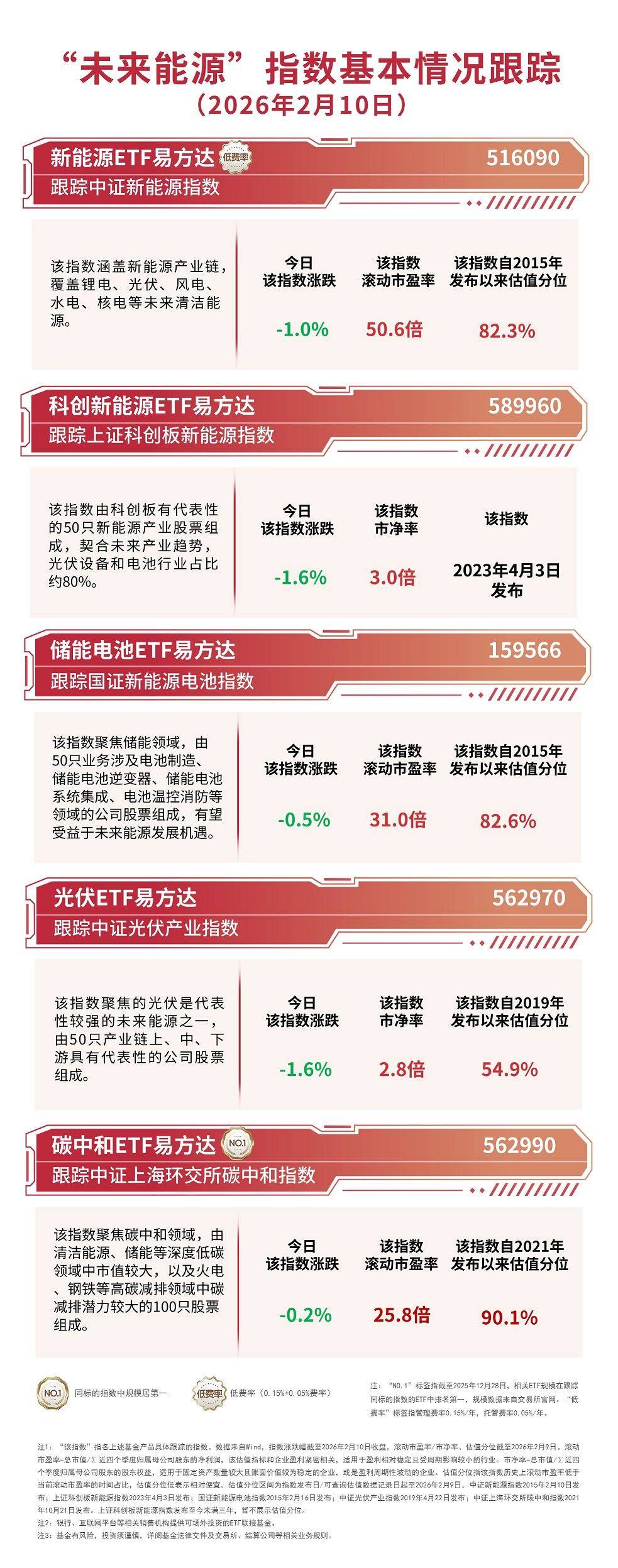
新能源板块回调,关注光伏ETF易方达(562970)、储能电池ETF易方达(159566)等产品布局机会
Sou Hu Cai Jing· 2026-02-10 13:31
Group 1 - The core viewpoint of the articles indicates a decline in various indices related to renewable energy, with the China Securities Shanghai Carbon Neutral Index down by 0.2%, the National Securities New Energy Battery Index down by 0.5%, and the China Securities New Energy Index down by 1.0% [1] - The report from CITIC Securities suggests that demand for space photovoltaic technology is expected to experience exponential growth, driven by investments from companies like Tesla and SpaceX [1] - Leading photovoltaic equipment manufacturers in China are positioned to enter the supply chains of major companies such as Tesla and SpaceX, potentially securing high-value orders and opening new growth opportunities [1] Group 2 - Space photovoltaic equipment is anticipated to have significant inflationary effects, with the value expected to undergo a transformative increase [1] - There is a focus on leading manufacturers in the photovoltaic sector that possess advantages in technology, products, and market share [1]

中国又一科技突破,海水制氢新技术,或引领能源革命
Sou Hu Cai Jing· 2026-02-10 09:14
Core Insights - A breakthrough by a research team from Shenzhen University has solved the "scaling" problem in seawater electrolysis for hydrogen production, achieving a cost of $0.698 per kilogram, which could revolutionize the global energy economy [2][15][19] Group 1: Technological Breakthrough - The Shenzhen University team shifted the focus from preventing scaling to making electrodes resistant to scaling, leading to a significant innovation in seawater electrolysis [4][11] - The new electrode design allows for over 5000 hours of stable operation under industrial conditions, addressing the critical issue of stability in hydrogen production [6][11] Group 2: Economic Implications - The production of high-purity magnesium hydroxide as a byproduct of hydrogen production can offset the costs of electricity and equipment, making hydrogen production economically viable [15][19] - The new cost structure allows green hydrogen to compete with fossil fuel-derived hydrogen, marking a significant shift in the economic landscape of the hydrogen industry [15][19] Group 3: Strategic and Geopolitical Impact - This technology could enhance China's energy security by utilizing its extensive coastline to produce clean hydrogen, reducing dependence on foreign fossil fuels [17][19] - The potential widespread adoption of this technology may disrupt the traditional energy power dynamics, challenging Western dominance in high-end energy technologies and prompting a new global technological competition [19][21] Group 4: Future Prospects - The industrialization of this technology is accelerating, with plans for large-scale demonstration projects by 2027, particularly in offshore wind power areas [21][23] - A new trillion-dollar ecosystem around green hydrogen production, storage, transportation, and application is anticipated to emerge, positioning China as a key player in the global market [23]

政策东风来 吉利迎甲醇产业发展新机遇
Zhong Guo Qi Che Bao Wang· 2026-02-10 09:09
Core Viewpoint - The green low-carbon transition is a central development theme in China's 14th Five-Year Plan, with methanol emerging as a key energy carrier due to its environmental, economic, and safety advantages, positioning it for significant industry growth [1] Group 1: Policy Framework - A comprehensive policy framework has been established to support the methanol industry, with over 70 policy documents issued by national and local governments to promote methanol vehicles [2] - Local governments in resource-rich areas like Gansu, Qinghai, and Guizhou are implementing special policies to enhance methanol fuel pricing mechanisms and infrastructure development [2] - Initiatives in cities like Shanghai aim to establish green fuel refueling centers for methanol in the shipping sector, indicating a multi-layered policy support system that solidifies methanol's role in the new energy landscape [2] Group 2: Technological and Economic Advantages - Methanol's diverse production pathways address energy security challenges in China, aligning with the country's carbon neutrality goals through various production methods, including renewable energy sources [3] - Methanol fuel demonstrates practical advantages in cold weather, with a freezing point of -97.6°C, ensuring reliable operation in harsh conditions, unlike electric vehicles [3] - The economic benefits of methanol fuel are significant, with its combustion producing fewer pollutants compared to traditional fuels, thus supporting the dual carbon goals in the transportation sector [3] Group 3: Industry Leadership and Infrastructure - Geely has developed a comprehensive green methanol industry chain, covering production, transportation, refueling, and vehicle manufacturing, with over 400 patents in methanol electric technology [4] - The company has deployed over 50,000 methanol electric vehicles, accumulating over 23 billion kilometers in total mileage, showcasing the scalability of its methanol ecosystem [4] - Geely plans to expand its methanol refueling stations from over 900 to 4,000 by the end of 2027, enhancing the convenience of methanol refueling across the country [4] Group 4: Future Outlook - Geely's long-term commitment to methanol has positioned it as a leader in the industry, contributing to the evolution of the methanol sector from breakthrough to advancement [5] - The ongoing release of policy incentives, technological advancements, and expanding application scenarios are expected to further strengthen Geely's role in building a new energy system and achieving carbon reduction goals in transportation [5]

环保行业点评报告:加大力度推进全国碳市场建设,二次扩围渐近版图清晰,持续关注UCO端山高、朗科
Soochow Securities· 2026-02-10 08:22
Investment Rating - The report maintains an "Overweight" rating for the environmental protection industry, indicating a positive outlook for the sector in the next 6 months [1]. Core Insights - The report highlights the acceleration of the national carbon market construction, with a clear roadmap for the second expansion, emphasizing the importance of carbon trading in driving up carbon prices [5]. - It notes that the carbon market currently covers approximately 8 billion tons of emissions, accounting for over 60% of national carbon emissions, with plans to expand coverage to additional industries by 2027 [5]. - The report suggests a carbon neutrality investment framework focusing on energy substitution, energy conservation, and recycling, recommending specific companies in clean energy, energy efficiency, and recycling sectors [5]. Summary by Sections Industry Trends - The report discusses the recent notification from the Ministry of Ecology and Environment regarding the management of carbon emissions quotas for key industries, including power generation, steel, cement, and aluminum smelting, which will be included in the carbon trading market by 2027 [5]. - It outlines the timeline for quota allocation and compliance, indicating a structured approach to managing carbon emissions and ensuring timely compliance by relevant industries [5]. Investment Recommendations - The report recommends focusing on clean energy companies such as Longjing Environmental Protection and those involved in bio-oil resources like Shanggou Energy and Langke Technology [5]. - It also highlights opportunities in energy efficiency management and recycling, suggesting companies like Ruicheng Environmental Protection and High Energy Environment for hazardous waste resource utilization [5].
3月19-20日 常州!2026锂电关键材料及应用市场高峰论坛
鑫椤锂电· 2026-02-10 07:07
Core Viewpoint - The lithium battery industry is poised for a significant growth cycle in 2026, characterized by strong demand recovery, accelerated global expansion, and disruptive technological advancements, leading to a "spiral rise" in both volume and price [3]. Group 1: Market Predictions - Global lithium battery production is expected to reach 2297 GWh by 2025, with a growth rate of 34.6% in 2026. The shipment growth rate for energy storage cells is projected to be as high as 70%, driven by both domestic and international demand [5]. - There is a notable supply gap in the current effective production capacity for battery cells and various materials, making supply chain stability and efficiency crucial for capitalizing on this growth opportunity [5]. Group 2: Conference Details - The 2026 Lithium Key Materials and Applications Market Summit will be held on March 19-20, 2026, in Changzhou, Jiangsu, organized by Xinluo Information [4]. - The summit will focus on two main topics: in-depth discussions on cutting-edge technologies and market supply-demand dynamics, and B2B procurement matchmaking to connect top battery manufacturers and material suppliers [6]. Group 3: Key Topics and Participants - The conference will feature specialized sessions on lithium carbonate futures, market volatility responses, global lithium resource potential, and opportunities from solid-state battery developments, with participation from various industry experts and companies [7][8]. - Notable participants include leading battery companies like CATL, BYD, and LGES, as well as material suppliers covering the entire supply chain from cathode and anode materials to electrolytes and separators [6].





工信部定调: 光伏还在深度调整期
2 1 Shi Ji Jing Ji Bao Dao· 2026-02-10 04:56
Group 1: Carbon Neutrality Policy - The Ministry of Industry and Information Technology (MIIT) indicates that the photovoltaic (PV) industry is currently in a deep adjustment period, with 2026 being a critical year for governance and addressing internal competition within the industry [1][2] - The MIIT plans to implement measures such as capacity regulation, standard guidance, quality supervision, and market expansion to achieve a dynamic balance between supply and demand in the PV sector [2] - The industry is transitioning from scale expansion to value competition, which is essential for maturity, requiring policy guidance and technological breakthroughs from enterprises [2] Group 2: Solar Power Capacity Forecast - The China Electricity Council predicts that by 2026, the installed capacity of solar power will exceed that of coal power for the first time, with total installed capacity of wind and solar power reaching half of the total power generation capacity [2][3] - It is expected that over 400 million kilowatts of new power generation capacity will be added in 2026, with more than 300 million kilowatts coming from renewable sources [3] - By the end of 2026, the total installed capacity is projected to reach approximately 4.3 billion kilowatts, with non-fossil energy sources accounting for 63% of the total [3] Group 3: Waste Photovoltaic Equipment Recycling - The Ministry of Ecology and Environment has released the "Technical Specifications for Pollution Control in the Recycling and Treatment of Waste Photovoltaic Equipment," establishing guidelines for the entire recycling process [4][5] - The specifications emphasize the principles of reduction, resource utilization, and harmlessness, requiring recycling companies to have environmentally compliant storage facilities [4] - The new regulations aim to promote green management throughout the lifecycle of the photovoltaic industry, preventing secondary pollution and achieving resource recycling [5] Group 4: Local Dynamics - Qinghai Province aims to reduce carbon emissions by 28.1 million tons by 2025, expanding green electricity exports to 22 provinces and cities, with a 32% increase in output [6] - The province is implementing a "carbon peak action plan" and establishing ecological compensation mechanisms to enhance its ecological value and economic output [6] Group 5: Corporate Practices - Ningxia Tianrui Thermal Energy Co., Ltd. was fined 423.99 million yuan for failing to complete carbon emission quota compliance on time, signaling stricter enforcement in the national carbon market [7] - The company has faced multiple penalties for non-compliance, highlighting the importance of proactive carbon asset management for enterprises [7] - A breakthrough in compressed air energy storage technology has been achieved, with the development of the world's first and largest single-unit power compressed air storage compressor, which has passed third-party testing [8][9] - This new compressor significantly improves efficiency and reduces costs, supporting the integration of renewable energy sources [9]
国内首个金融ESG国标与可持续信息鉴证准则发布,加速推进信息披露体系标准化
ZHESHANG SECURITIES· 2026-02-10 04:30
Investment Rating - The report does not explicitly provide an investment rating for the industry Core Insights - In January 2026, the first national ESG standard and sustainable information verification guidelines were released in China, marking a significant step towards standardizing the information disclosure system in the financial sector [1][16][20] - The focus of policies is shifting from top-level design to execution and market mechanisms, with a systematic ESG framework being established that covers disclosure, evaluation, and verification [2][16] - The EU continues to enhance its climate risk management framework and strengthen regulations against greenwashing, while major companies are advancing energy transition driven by AI infrastructure [3][27] Summary by Sections Domestic Policy Tracking - The national ecological environment protection meeting emphasized the importance of carbon peak and green low-carbon transition as core tasks for 2026, aiming to control carbon emissions and promote structural transformation [12][26] - The People's Bank of China expanded carbon reduction support tools, allowing up to 800 billion yuan for projects with direct carbon reduction effects [14][25] - The first financial ESG national standard was officially released, providing a unified evaluation framework for ESG performance in the bond market [16][20] Overseas Policy Tracking - The EU's carbon border adjustment mechanism (CBAM) came into effect, imposing carbon tariffs on high-carbon products to prevent carbon leakage and promote global emission reductions [27] - The Philippines adopted IFRS-based sustainable disclosure standards to enhance the international comparability of corporate ESG reports [28] - The European Central Bank is increasing its focus on monitoring physical risks related to climate change and assessing banks' transition plans [32] ESG Data Tracking - In January 2026, six new ESG funds were launched in China, with a total scale of 127 million yuan, indicating a strong interest in ESG investments [4][25] - The SEEE carbon neutrality index rose by 4.16% in January, outperforming the Shanghai Composite Index, while the ESG bond issuance maintained a high level with 108 new bonds totaling 81.1 billion yuan [4][25] - The national carbon market saw a trading volume of 10.935 million tons in January, with an average price of 72.68 yuan per ton, reflecting a 5.86% increase from the previous month [4][25]
鲁姆斯、住友化学推进PMMA化学回收商业化
Zhong Guo Hua Gong Bao· 2026-02-10 03:27
鲁姆斯技术公司CEO兼总裁Leon de Bruyn表示,新技术结合了鲁姆斯的工艺优势与住友化学的材料创 新,能将PMMA废料转化为高纯度甲基丙烯酸甲酯(MMA)单体,解决了废料填埋、焚烧的行业痛点, 相较传统工艺还能减少约50%全生命周期温室气体排放,且再生MMA品质与化石基产品持平,这一技 术已在住友化学日本中试工厂得到验证。 该技术具备高收率、高纯度、可拓展的特点,模块化设计可适配1万吨至5万吨以上的年产能,再生 MMA可应用于汽车照明、电子、医疗等高端领域,同时大幅降低环境影响,减少对化石原料依赖。住 友化学高管称,此次合作实现了材料科学与工艺工程的优势互补,为石化行业可持续发展提供新方案。 鲁姆斯将成为该技术全球独家授权方,依托自身客户网络推动技术落地,同时为全球商业化工厂提供工 程、采购、施工全流程EPC服务。 中化新网讯 近日,美国鲁姆斯技术公司与日本住友化学宣布,双方合作研发的聚甲基丙烯酸甲酯化学 回收技术(PMMA - CR)正式实现商业化。该合作始于2024年5月,核心是开发石化产业链循环经济与碳 中和相关技术,此次成果是双方技术融合的重要落地。 ...
绿色甲醇行业-IMO减排框架下需求向好-降本预期有望打破成本枷锁
2026-02-10 03:24
Summary of Green Methanol Industry Conference Call Industry Overview - The green methanol industry is positioned as a key solution for decarbonizing the shipping sector, supported by policies and active adoption by shipping companies. Long-term production is expected to increase, with prices gradually decreasing due to technological advancements [1][2]. Core Insights - Green methanol offers significant emission reduction capabilities, achieving over 95% reduction compared to traditional fuels. Each ton of green methanol can convert 1.375 tons of CO2, which can substantially lower carbon emissions when widely adopted [1][3]. - The main constraint on the promotion of green methanol is its production cost. Electrolytic and biomass methanol production costs are significantly higher than traditional fossil-based methanol. The cost of electrolytic methanol ranges from $820 to $2,380 per ton, while biomass methanol costs between $564 and $930 per ton, compared to $100 to $250 per ton for traditional methanol [1][6]. - The International Maritime Organization (IMO) and the European Union have set stringent greenhouse gas reduction targets for the shipping industry, aiming for net-zero emissions by around 2050 and introducing global fuel standards [1][7][8]. Future Trends - The green methanol industry is currently in a growth phase, with increasing demand. Despite setbacks from the IMO meeting in October 2025, the ongoing energy transition and carbon neutrality policies are expected to drive green methanol as a crucial solution for shipping decarbonization [2]. - By 2025, it is projected that China will have a production capacity of approximately 10 million tons of green methanol, which could directly absorb 150 million tons of CO2 and indirectly absorb 330 million tons, equivalent to increasing forest carbon storage by 370 million cubic meters [5][21]. Production Routes and Technologies - Green methanol production methods include water electrolysis, biomass gasification, and anaerobic fermentation, each with its advantages and limitations. The electrolytic route relies on green electricity and carbon capture technology, while biomass routes are constrained by raw material supply [4][14]. - The cost of green hydrogen production, a key component in green methanol production, is expected to decrease significantly by 2050, potentially reaching $1.2 to $2.4 per kilogram due to advancements in renewable energy and electrolysis technology [17]. Regulatory Environment - The IMO's greenhouse gas reduction strategy includes targets for 2027 and aims for at least 5% of net-zero emissions technologies and fuels to be implemented. The EU's "Fit for 55" plan also includes maritime fuel regulations and renewable energy directives [7][8]. Market Dynamics - As of 2024, methanol-powered vessels account for approximately 32% of global alternative fuel orders, with a significant demand for methanol expected from operational and under-construction vessels [4][13]. - The global green methanol production capacity is projected to grow from 18 million tons in 2023 to 20 million tons by 2028, with a compound annual growth rate of 2.13%. Electrolytic methanol is expected to dominate production methods, reaching 1.31 million tons by 2028 [20]. Conclusion - The green methanol industry is poised for significant growth driven by regulatory support, technological advancements, and increasing demand from the shipping sector. However, production costs remain a critical barrier that needs to be addressed for widespread adoption [1][2][6].
万象更“新” 无限可“能” ——探访中国新能源项目建设运营一线
Zhong Guo Hua Gong Bao· 2026-02-10 03:22
Group 1: Biomass Gasification Project - The "Donghua Furnace" is a biomass gasification core device developed by Donghua Engineering Technology Co., which successfully produced synthesis gas from agricultural waste [4][5] - The gasification process can reduce carbon emissions by 70% to 90% compared to fossil fuels, producing high-value green chemicals and sustainable aviation fuel [4][5] - The project aims to enhance the value of agricultural waste and promote local economic development while reducing reliance on coal [6][7] Group 2: Hydrogen Production Project - The "Hydrogen Boat" project in Panzhihua is set to launch the world's first commercial production line based on "concentrated solar water electrolysis" technology, with an expected annual hydrogen output of 200 tons by December 2025 [8][9] - This innovative technology allows for a direct energy conversion from solar to hydrogen, significantly improving production efficiency [9][10] - The project has attracted interest from multiple government and corporate entities, indicating strong market potential for green hydrogen applications in industries such as metallurgy and chemicals [11][12] Group 3: Geothermal Heating in Xiong'an - Xiong'an New Area has implemented geothermal heating, replacing traditional coal heating and significantly reducing carbon emissions [15][16] - The geothermal energy system utilizes underground heat sources, achieving a heating area of 2.6 million square meters and reducing CO2 emissions by 14,140 tons annually [16][17] - The integration of geothermal heating with solar energy and smart grid technology aims to create a near-zero carbon energy microgrid [17][18] Group 4: Controlled Nuclear Fusion Research - New Hope Group is advancing controlled nuclear fusion technology, with the goal of making it a viable energy source within the next 20 years [19][20] - The team has achieved significant milestones, including the world's first megampere-level hydrogen-boron fusion discharge, positioning them at the forefront of global fusion research [20][21] - The initiative emphasizes the importance of talent development and collaboration with various research institutions to support the long-term goals of fusion energy commercialization [21]

