冷链物流

Search documents
飞力达涨2.27%,成交额7300.49万元,主力资金净流出33.14万元
Xin Lang Cai Jing· 2025-10-14 02:58
Company Overview - Feilida International Logistics Co., Ltd. is located in Kunshan Development Zone, Jiangsu Province, and was established on April 22, 1993. The company was listed on July 6, 2011. Its main business involves designing and providing integrated supply chain management solutions, offering one-stop logistics solutions through market positioning, business planning, process design, information system design, organizational design, and hardware planning [1]. Financial Performance - As of June 30, Feilida reported a revenue of 3.031 billion yuan for the first half of 2025, a year-on-year decrease of 7.57%. However, the net profit attributable to shareholders increased by 39.69% to 29.8676 million yuan [2]. - The company has cumulatively distributed 160 million yuan in dividends since its A-share listing, with 24.066 million yuan distributed over the past three years [3]. Stock Performance - On October 14, Feilida's stock price increased by 2.27%, reaching 8.10 yuan per share, with a trading volume of 73.0049 million yuan and a turnover rate of 2.52%. The total market capitalization is 3.010 billion yuan [1]. - Year-to-date, Feilida's stock price has risen by 23.29%, with a 3.18% increase over the last five trading days, a 3.23% decrease over the last 20 days, and an 8.68% decrease over the last 60 days [1]. - The company has appeared on the daily trading leaderboard seven times this year, with the most recent appearance on May 15 [1]. Shareholder Information - As of June 30, the number of shareholders for Feilida was 32,800, an increase of 67.93% compared to the previous period. The average number of circulating shares per person decreased by 40.45% to 11,071 shares [2]. Industry Classification - Feilida belongs to the transportation and logistics sector, specifically in the intermediate products and consumer goods supply chain services. It is associated with concepts such as the Import Expo, unified market, cold chain logistics, small-cap stocks, and express delivery [2].

龙洲股份涨2.01%,成交额2142.97万元,主力资金净流入9.99万元
Xin Lang Cai Jing· 2025-10-14 02:18
Core Insights - Longzhou Co., Ltd. has seen a stock price increase of 8.04% year-to-date, with a recent 2.01% rise on October 14, 2023 [1][2] - The company reported a significant decline in revenue and net profit for the first half of 2023, with a revenue of 1.113 billion yuan, down 18.03% year-on-year, and a net loss of 65.98 million yuan, down 93.96% year-on-year [3] Stock Performance - As of October 14, 2023, Longzhou's stock price was 4.57 yuan per share, with a market capitalization of 2.57 billion yuan [1] - The stock has experienced a 2.70% increase over the last five trading days, but a 0.87% decrease over the last 20 days and a 6.73% decrease over the last 60 days [2] Shareholder Information - As of June 30, 2023, the number of shareholders was 59,400, a decrease of 19.54% from the previous period, while the average number of circulating shares per shareholder increased by 24.29% to 9,464 shares [3] Business Overview - Longzhou Co., Ltd. operates in various sectors including automotive passenger transport, logistics, fuel sales, and vocational education, with the main revenue sources being the asphalt supply chain (57.72%), automotive manufacturing and services (12.69%), and fuel sales (11.78%) [2] - The company is categorized under the transportation and logistics industry, specifically in road freight [2] Dividend Information - Since its A-share listing, Longzhou has distributed a total of 222 million yuan in dividends, with no dividends paid in the last three years [4]

经济聚焦|冷链物流支撑消费升级
Ren Min Ri Bao· 2025-10-14 02:03
Core Insights - The cold chain logistics market is experiencing steady growth, with a total demand of 192 million tons in the first half of the year, representing a year-on-year increase of 4.35% [3] - The total revenue of food cold chain logistics service companies reached 279.94 billion yuan, up 3.84% year-on-year [3] - Investment in cold storage projects amounted to 22.306 billion yuan in the first half of the year, reflecting a year-on-year growth of 7.67% [4] - The total capacity of cold storage facilities reached 260 million cubic meters, equivalent to approximately 104 million tons, marking a 6.12% increase year-on-year [5] - Sales of refrigerated vehicles surged, with a total of 29,474 units sold in the first half of the year, a year-on-year increase of 18.19%, and sales of new energy refrigerated vehicles reached 10,548 units, up 119.61% [6] Cold Chain Logistics Demand - The demand for food cold chain logistics is robust, with significant activity in the transportation of live crabs and other seafood, ensuring freshness through modern logistics practices [2][3] - Companies are implementing pre-cooling processes to minimize transportation losses and maintain product quality [2] Cold Storage Investment - The construction and modernization of cold storage facilities are accelerating, driven by government planning and market demand [4] - A notable project includes a 9.2 billion yuan cold storage facility in Guangdong, which enhances the logistics capabilities for seafood and tropical fruits [4] Refrigerated Vehicle Sales - The market for refrigerated vehicles is expanding rapidly, particularly for new energy models, which are increasingly favored due to policy support and growing urban delivery needs [6][7] - The penetration rate of new energy refrigerated vehicles has reached 35.8%, an increase of 16.5 percentage points year-on-year [6] Technological Advancements - Cold storage facilities are adopting IoT technology for real-time monitoring and dynamic control of temperature and humidity, ensuring optimal conditions for stored goods [5] - Automation in operations is enhancing efficiency in the handling and distribution of perishable goods [5]
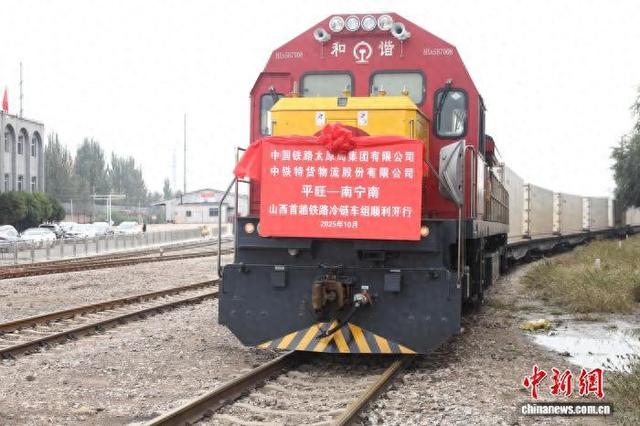
山西开启铁路冷链集装箱运输 助力农特产品“鲜”行致远
Zhong Guo Xin Wen Wang· 2025-10-13 12:32
Core Insights - Shanxi Province has initiated a new model for railway cold chain container transportation, marking a significant advancement in logistics for agricultural products [1][3] Group 1: Transportation Details - A train carrying 232 tons of fresh corn kernels departed from Pingwang Station in Datong, Shanxi, heading to Nanning, approximately 3000 kilometers away [1][3] - The shipment consists of about 500 tons of freshly harvested corn from northern Shanxi and central-western Inner Mongolia, which is crucial for producing corn ham sausages [3][6] - The cold chain transportation utilizes an "8+1" method, comprising 8 forty-foot refrigerated containers and 1 generator box, ensuring optimal temperature control between -30°C and +30°C [3][4] Group 2: Operational Efficiency - The railway logistics center in Datong has developed a meticulous transportation plan in collaboration with China Railway Special Cargo Company to meet customer demands for timely and fresh delivery [3][4] - The operation prioritizes the organization of cold chain vehicle loading and dispatching, ensuring rapid and efficient transportation [4] - The cold chain container transportation offers advantages such as all-weather operation, minimal impact from road conditions, high volume capacity, stable timeliness, and lower overall logistics costs [4] Group 3: Market Impact - The introduction of cold chain container transportation is expected to enhance the competitiveness of fresh agricultural products in the market, facilitating their long-distance sales [6]

中百集团涨2.09%,成交额1.48亿元,主力资金净流入722.45万元
Xin Lang Cai Jing· 2025-10-13 06:00
Core Viewpoint - Zhongbai Group's stock price has experienced significant volatility, with a year-to-date decline of 44.04%, while recent trading shows slight recovery [1][2]. Financial Performance - For the first half of 2025, Zhongbai Group reported operating revenue of 4.618 billion yuan, a year-on-year decrease of 19.13%, and a net profit attributable to shareholders of -255 million yuan, down 79.50% year-on-year [2]. - The company has cumulatively distributed 919 million yuan in dividends since its A-share listing, with no dividends distributed in the past three years [3]. Stock Market Activity - As of October 13, Zhongbai Group's stock price was 7.32 yuan per share, with a trading volume of 148 million yuan and a turnover rate of 3.13%, resulting in a total market capitalization of 4.850 billion yuan [1]. - The stock has appeared on the "Dragon and Tiger List" 18 times this year, with the most recent appearance on April 14, where it recorded a net purchase of 533.776 million yuan [1]. Shareholder Information - As of August 31, Zhongbai Group had 99,800 shareholders, a decrease of 2.57% from the previous period, with an average of 6,568 circulating shares per shareholder, an increase of 2.63% [2]. Business Overview - Zhongbai Group, established on January 9, 1990, and listed on May 19, 1997, is primarily engaged in commercial retail, operating large chain supermarkets and department stores, with additional involvement in pharmaceuticals, logistics, property management, and import-export trade [1]. - The company's main business revenue composition includes 91.07% from merchandise sales and 8.93% from other income [1]. Industry Classification - Zhongbai Group is classified under the Shenyin Wanguo industry as part of the retail trade sector, specifically in general retail and supermarkets, and is associated with concepts such as new retail, community group buying, duty-free concepts, prepared dishes, and cold chain logistics [2].

凭什么中国人吃水果可以这么便宜?
虎嗅APP· 2025-10-12 09:15
Core Viewpoint - The article discusses the evolution of China's fruit industry, highlighting the shift from scarcity to abundance, and the impact of technological advancements and improved agricultural practices on fruit prices and availability [5][16]. Group 1: Industry Evolution - In the past, fruits were considered luxury items in China, with limited availability and high prices due to low production and high wastage rates [17][27]. - The planting area for Sunshine Rose grapes increased from less than 150,000 acres in 2015 to approximately 1.5 million acres now, while blueberry cultivation reached 1.4 million acres last year [12][13]. - Technological advancements, such as AI and automated nutrient management in large-scale farms, have significantly improved production efficiency [15]. Group 2: Price Dynamics - The price of blueberries has dropped from 24.9 yuan for 125 grams to 5 yuan per box during promotional events, indicating a significant reduction in consumer costs [8][9]. - The article emphasizes that the reduction in fruit prices is akin to a technological revolution, driven by large-scale production and the cultivation of superior varieties [28][30]. Group 3: Branding and Market Position - The lack of international brands in the Chinese fruit market limits the ability to command premium prices, as seen in the comparison between New Zealand's Zespri and China's Qifeng Fruit Industry [79][81]. - The article suggests that with ongoing improvements in standardization and branding, China is on the path to developing its own premium fruit brands [82]. Group 4: Cold Chain and Distribution - The development of cold chain logistics has enabled the export of fruits like lychee to international markets, with prices reaching up to 500 yuan per kilogram in Europe [66][67]. - Innovations in cold chain technology, such as mobile cooling units and space electric field preservation, have extended the shelf life of fruits significantly [69][70]. Group 5: Social Impact - The rise of fruit e-commerce has transformed labor dynamics, providing stable employment opportunities for individuals previously engaged in low-wage, unstable jobs [90][92]. - The article highlights that the affordability of fruits not only enhances consumer satisfaction but also contributes to broader social welfare and economic stability [94][96].

凭什么中国人吃水果可以这么便宜?
36氪· 2025-10-12 09:06
Core Viewpoint - The article discusses the evolution of China's fruit industry, highlighting the significant advancements in production, technology, and market accessibility that have transformed fruit consumption from a luxury to a more affordable staple for the general population [5][12]. Group 1: Historical Context - In the 1950s and 1960s, fruit was considered a luxury item in China, with limited availability and high prices, making it unaffordable for many [14][27]. - The lack of proper agricultural practices and market information led to high wastage and low profitability for fruit farmers, resulting in minimal fruit cultivation [20][25]. Group 2: Current Market Dynamics - The planting area for Sunshine Rose grapes has increased from less than 150,000 acres in 2015 to approximately 1.5 million acres today, while blueberry cultivation reached 1.4 million acres last year [10]. - Technological advancements, such as AI-managed nutrient solutions and large-scale planting bases, have significantly improved fruit production efficiency [10][12]. Group 3: Price Reduction and Accessibility - The article emphasizes that the reduction in fruit prices is akin to a technological revolution, driven by large-scale production and the development of superior fruit varieties [28][30]. - The availability of high-quality fruits at lower prices has made them accessible to a broader audience, with examples like blueberries dropping from 24.9 yuan per box to 5 yuan during promotions [7][10]. Group 4: Branding and Market Positioning - The lack of international branding for Chinese fruits limits their pricing power, as seen in the comparison between New Zealand's Zespri and China's Qifeng Fruit Industry [78]. - The article suggests that with ongoing improvements in standardization and branding, China could develop its own premium fruit brands in the future [80]. Group 5: E-commerce and Labor Dynamics - The rise of fruit e-commerce has eliminated middlemen, allowing for direct sales from producers to consumers, which has also led to price reductions [81]. - The shift towards e-commerce has restructured labor needs in the fruit industry, creating new job opportunities in logistics and customer service for previously underemployed individuals [82][84].

凭什么中国人吃水果可以这么便宜?
3 6 Ke· 2025-10-10 10:47
Core Insights - The article discusses the evolution of fruit consumption in China, highlighting a shift from scarcity to abundance, with a focus on the affordability and availability of various fruits [1][7][52]. Industry Overview - The cultivation area for Sunshine Rose grapes has increased from less than 150,000 acres in 2015 to approximately 1.5 million acres today, while blueberry cultivation reached 1.4 million acres last year [5][19]. - Technological advancements in fruit farming, including AI and automated nutrient delivery systems, have significantly improved production efficiency [5][30]. Historical Context - Historically, fruit was considered a luxury in China, with limited access for the general population until recent decades [7][13]. - The transition to fruit cultivation began when farmers realized the higher profitability of fruit compared to staple crops, leading to increased planting and investment in orchards [8][11]. Pricing Dynamics - The article notes that the price of blueberries has dropped from 24.9 yuan per box (125 grams) to as low as 5 yuan during promotions, indicating a significant reduction in consumer costs [2][5]. - The affordability of fruits is attributed to increased supply and improved agricultural practices, making fruits accessible to a broader demographic [1][5]. Supply Chain Innovations - The development of cold chain logistics has enabled the transportation of fruits like lychee to international markets, maintaining freshness and extending shelf life [31][36]. - New technologies, such as space electric field preservation, have enhanced the longevity of fruits during transport, allowing for better market reach [36][37]. Branding and Market Positioning - The article emphasizes the lack of international brands in the Chinese fruit market, which limits pricing power and market share compared to established brands like Zespri [48][50]. - The rise of e-commerce has transformed the fruit industry, allowing for direct sales from producers to consumers, thereby reducing costs and improving access [52][53]. Labor Market Impact - The growth of the fruit e-commerce sector has created new job opportunities, particularly for individuals previously engaged in low-wage agricultural labor, allowing for better work-life balance and income stability [57][60]. - The shift towards mechanization in fruit production is leading to a reduction in traditional labor needs, prompting a reallocation of the workforce to e-commerce roles [57][60].

英华特跌4.84%,成交额7315.63万元,今日主力净流入413.30万
Xin Lang Cai Jing· 2025-10-10 07:55
Core Viewpoint - The company Yinghuate experienced a decline of 4.84% in stock price on October 10, with a trading volume of 73.16 million yuan and a total market capitalization of 2.933 billion yuan [1] Company Overview - Yinghuate specializes in the research, development, production, and sales of scroll compressors, primarily used in heat pumps, commercial air conditioning, and refrigeration equipment [2][3] - The company has been recognized as a "specialized, refined, distinctive, and innovative" small giant enterprise, indicating its strong market position and innovation capabilities [2] - Yinghuate's product applications include electric vehicle parking cooling and heating, as well as cold chain logistics vehicles [3] Financial Performance - For the first half of 2025, Yinghuate reported operating revenue of 243 million yuan, a year-on-year decrease of 7.54%, and a net profit attributable to shareholders of 9.37 million yuan, down 69.33% year-on-year [8] - The company has distributed a total of 64.74 million yuan in dividends since its A-share listing [9] Market Position and Trends - The company has seen an increase in orders from Russia due to geopolitical factors and has expanded its market presence in India, with the top five export countries being Russia, Brazil, India, Slovakia, and the United States, accounting for 80.16% of export revenue [3] - Yinghuate's main business revenue composition includes 36.22% from commercial air conditioning, 32.09% from refrigeration, 28.75% from heat pumps, and 2.77% from electric vehicles [7] Shareholder Information - As of September 19, the number of shareholders in Yinghuate was 6,195, a decrease of 10.79% from the previous period, while the average number of circulating shares per person increased by 12.09% [8]
中集车辆涨0.42%,成交额1.20亿元,近5日主力净流入3798.47万
Xin Lang Cai Jing· 2025-10-10 07:52
Core Viewpoint - The company, CIMC Vehicles, is a leading manufacturer in the semi-trailer and specialized vehicle sector, focusing on hydrogen energy and cold chain logistics, with a significant market presence globally [2][6]. Company Overview - CIMC Vehicles is headquartered in Hong Kong and was established on August 29, 1996, with its shares listed on July 8, 2021 [6]. - The company's main business includes the production of semi-trailers, specialized vehicle superstructures, and refrigerated truck bodies, with 80.61% of revenue coming from semi-trailers [6]. - As of June 30, 2025, the company reported a revenue of 9.753 billion, a year-on-year decrease of 8.85%, and a net profit of 403 million, down 28.48% year-on-year [6][7]. Market Position - CIMC Vehicles is recognized as the world's largest semi-trailer manufacturer and a leading producer of specialized vehicle superstructures and refrigerated truck bodies [2][4]. - The company operates in major markets including China, North America, and Europe, offering seven categories of semi-trailer production and sales [2][4]. Recent Developments - The company has launched hydrogen energy refrigerated truck body products in response to customer demand [2]. - CIMC Vehicles' subsidiary, Lingyu Automobile, signed a cooperation framework agreement with Huawei to work on digital transformation and intelligent upgrades [2]. Financial Analysis - The stock price of CIMC Vehicles was reported at 8.87, with a recent average trading cost indicating some accumulation, although the buying pressure is not strong [5]. - The stock has a recent pressure point at 9.68, suggesting potential for upward movement if this level is surpassed [5]. Shareholder Information - As of June 30, 2025, the number of shareholders decreased by 2.95% to 35,500, with an average of 40,937 shares held per person, an increase of 3.04% [6][7]. - The company has distributed a total of 2.664 billion in dividends since its A-share listing, with 1.655 billion distributed over the past three years [7].