
医疗AI

Search documents
异动盘点0603|光大控股此前投资稳定币巨头,狂飙21%;汽车股回暖、医药股走强;BioNTech获91亿天价并购
贝塔投资智库· 2025-06-03 04:00
Group 1: Stock Movements and Market Reactions - JunDa Co., Ltd. (02865) fell by 12.69% due to weak fundamentals, expected shareholder sell-off, and cash flow concerns [1] - Rongchang Biopharmaceutical (09995) rose by 4.61% after ASCO announced positive data for RC108 combined with vorinostat, enhancing its commercialization prospects [1] - Datang Gold (08299) increased by 7.27% as it partnered with Wuxi to develop AI mining applications, benefiting from gold's safe-haven demand [1] - Kanglong Chemical (03759) gained 4.35% by investing in a biopharmaceutical fund, strengthening its investment ecosystem [1] - Automotive stocks surged following a significant increase in May's new energy vehicle sales, with Li Auto (2015) rising nearly 6% and Great Wall Motors (2333) up over 3% [1] - Gold stocks led the market as COMEX gold prices returned to $3,400, with Goldman Sachs predicting $4,200, driven by geopolitical tensions [1] Group 2: Company-Specific Developments - Changfei Optical Fiber (06869) rose by 8.34% as its Wuhan base began mass production of 6-inch silicon carbide wafers, achieving a 97% yield rate [2] - China Shipbuilding Defense (00317) increased by 7.58% after securing the highest global new orders from January to April, with Q1 net profit up 1,099% [2] - Hengrui Medicine (00013) rose by 5.09% as SACHI III phase data met expectations, opening up market space for MET amplification lung cancer treatment [2] - Lepu Medical Technology (02157) gained 5.76% following positive ASCO data for its ADC drug MRG003, boosting approval expectations for nasopharyngeal carcinoma [2] - Aidi Kang Holdings (09860) increased by 5.2% after acquiring Suzhou Yuande Youqin to enhance blood disease diagnostics [2] - NetDragon (00777) rose by 5.82% due to its collaboration with Thailand on an AI education platform, attracting investor interest [2] Group 3: Notable Market Trends - China Everbright Holdings (00165) surged over 21% following the enactment of Hong Kong's stablecoin regulations, with Circle's IPO expectations boosting related equity valuations [3] - iFlytek Medical (02506) rose by 6.62% as its medical AI model demonstrated superior accuracy, supported by favorable policies [3] - MicroPort NeuroTech (02172) increased by 9.59% as it initiated clinical research on brain-machine interfaces, benefiting from policy incentives [3] - Longpan Technology (02465) rose by 14.9% after its subsidiary signed a $7.1 billion contract with Yiwei Lithium Energy for lithium iron phosphate [4] - Hansoh Pharmaceutical (03692) gained 3.85% after reaching a global licensing agreement with Regeneron, receiving an $80 million upfront payment [4] Group 4: U.S. Market Highlights - Steel and aluminum stocks surged over 10%-28% as Trump proposed increasing steel tariffs to 50%, benefiting domestic companies [5] - Blueprint Medicines (BPMC.US) rose by 26% following Sanofi's $9.1 billion acquisition, enhancing its rare disease pipeline [5] - BioNTech (BNTX.US) increased by 18% due to a collaboration with Bristol-Myers Squibb, securing a $1.5 billion upfront payment [5] - Applied Digital (APLD.US) surged by 48.46% after signing a $7 billion AI data center lease, validating its business model [5] - Tempus AI (TEM.US) rose by 15% as it launched an AI medical innovation plan, attracting investor interest [7]


王小川的AI败局:天才CEO,为何管不住人?
凤凰网财经· 2025-05-25 13:30
Core Viewpoint - Wang Xiaochuan, founder of Baichuan Intelligence and a prominent figure in the AI industry, is facing significant challenges as the company shifts its focus to medical AI after a strategic retreat from broader ambitions [1][3][25]. Group 1: Strategic Retreat - Baichuan Intelligence initially aimed to compete with OpenAI by developing a comprehensive AI model and targeting various sectors including finance, education, and healthcare [3][4]. - The company raised 5 billion in A-round funding, achieving a valuation of 20 billion, but soon faced setbacks as competition intensified and market interest shifted towards other players like DeepSeek [4][6]. - The shift in focus to medical AI is seen as a last-ditch effort to survive in a competitive landscape, with the company now primarily concentrating on this vertical [9][19]. Group 2: Organizational Challenges - The departure of several key executives, including co-founders and department heads, has raised concerns about the company's internal stability and management effectiveness [2][13][14]. - Wang Xiaochuan acknowledged the importance of organizational efficiency but has struggled to maintain a cohesive team amid rapid changes and strategic shifts [10][15]. - The complexity of the organization has increased due to an expansive strategy, leading to inefficiencies and a lack of clear direction for teams [18][25]. Group 3: Financial Viability and Market Position - The transition to medical AI is expected to be capital-intensive, with significant costs associated with training AI models for healthcare applications [19][21]. - Baichuan Intelligence's cash flow is under pressure as it reduces its B-end business, which was previously a source of revenue [19][21]. - The competitive landscape is becoming more challenging, with major players like Huawei and Ant Group entering the AI medical field, further complicating Baichuan's market position [22][25].

AI医生离我们还有多远?专家:AI“持证行医”仍需突破
Zhong Guo Xin Wen Wang· 2025-05-24 01:41
Core Insights - The development of AI in healthcare is rapidly advancing, with discussions on the future of "AI doctors" taking place at the second Medical Large Model (LaMMs) seminar in Changzhou, Jiangsu [1][2] - AI technologies are being integrated into various aspects of healthcare, including patient guidance, automated medical record generation, and real-time monitoring of patient vital signs [1][2] Group 1: AI Integration in Healthcare - Changzhou First People's Hospital has implemented a fully automated process from patient guidance to nursing, significantly improving efficiency, such as using drones for sample transport, which is three times faster than traditional methods [2] - AI models are capable of automatically generating surgical records, reducing the risk of missing critical information during back-to-back surgeries [2] - The "intelligent microphone" technology converts doctor-patient conversations into structured electronic medical records, saving doctors 50% of their documentation time [1][2] Group 2: Challenges and Perspectives - Experts emphasize that AI should assist rather than replace doctors, highlighting the importance of human-machine collaboration in healthcare [2][3] - The complexity and privacy of medical data present significant challenges for the compliant use of AI in healthcare [2] - There is a consensus that the path to certified AI doctors involves overcoming technological, ethical, and legal hurdles, with a focus on training doctors to fine-tune AI models [3] Group 3: Future Developments - Changzhou First People's Hospital aims to cover 80% of its diagnostic processes with AI within the next three years, indicating a strong commitment to integrating AI into healthcare [3] - A new "Medical Artificial Intelligence Engineering Research Center" has been established in collaboration with Changzhou University and QuanZhen Medicine, focusing on technology development and clinical application [3]
阿里健康(0241.HK):自营业务转向高质量发展
Ge Long Hui· 2025-05-22 11:08
Core Viewpoint - Alibaba Health reported a total revenue of 16.3 billion yuan for 2HFY25, representing a year-on-year increase of 16.0%, which exceeded the Visible Alpha consensus estimate of 12.6% [1] - Adjusted net profit was 970 million yuan, a year-on-year growth of 22.2%, but fell short of the consensus estimate of 11.0% [1] - Future profit growth is expected to rely on organic business growth as the impact of advertising business integration diminishes [1] Revenue Breakdown - The self-operated business generated revenue of 14 billion yuan in 2HFY25, up 13.9% year-on-year, outperforming the consensus estimate of 9.1% [2] - The pharmaceutical e-commerce platform business revenue was 1.9 billion yuan, showing a year-on-year growth of 43.6%, but below the consensus estimate of 57.7% [2] - The number of SKUs in the self-operated business increased by 33.6% year-on-year to 1.23 million [2] Business Development and Strategy - The integration of advertising business has enhanced the service capabilities for platform merchants, leading to improved operational returns and increased competitiveness in the pharmaceutical e-commerce sector [2] - Management indicated that the growth effect from Taobao's flash purchase exceeded expectations, suggesting a dual adaptation strategy for both remote and near-field models in the pharmaceutical health sector [2] Innovation and Future Guidance - The company reported stable growth in GMV for self-operated and platform businesses, with a focus on cost reduction and efficiency improvement [3] - Innovative businesses like "Code on Trust" and "Little Deer Traditional Chinese Medicine" have shown development, with "Code on Trust" covering a vast network of users and generating initial revenue [3] - The revenue growth target for FY26 is set at 5-10%, with adjusted net profit growth expected at 10-20% [3] Profit Forecast and Valuation - Adjusted net profit forecasts for FY26-27 have been revised down by 8.8% and 8.4% to 2.3 billion yuan and 2.6 billion yuan, respectively, with a new FY28 forecast introduced at 2.9 billion yuan [3] - The company is assigned a target non-IFRS PE of 35x, reflecting a premium over the comparable company's average of 16.2x for 2026, considering the ongoing market share acquisition and potential in medical AI [3] - The target price is set at 5.43 HKD, up from a previous value of 4.4 HKD [3]

阿里健康:自营业务转向高质量发展-20250521
HTSC· 2025-05-21 13:30
Investment Rating - The investment rating for the company is "Buy" with a target price of HKD 5.43 [9][10]. Core Insights - The company reported a total revenue of RMB 16.3 billion for 2HFY25, representing a year-on-year growth of 16.0%, which exceeded the consensus expectation of 12.6%. Adjusted net profit was RMB 970 million, a year-on-year increase of 22.2%, but below the consensus expectation of 11.0% [1]. - Future profit growth is expected to rely primarily on organic business growth as the impact of advertising business integration diminishes. Key areas to monitor include the recovery of demand across various pharmaceutical e-commerce categories, the progress of Taobao's instant retail strategy, and advancements in medical AI technology [1][2][4]. Revenue and Profitability - The company's self-operated business revenue for 2HFY25 was RMB 14 billion, up 13.9% year-on-year, surpassing the consensus expectation of 9.1%. The pharmaceutical e-commerce platform business generated RMB 1.9 billion, a growth of 43.6%, although it fell short of the expected 57.7% [2]. - The management indicated that the integration of the advertising business has enhanced service capabilities for platform merchants, leading to improved operational returns and increased competitiveness in the pharmaceutical health e-commerce sector [2][3]. Business Strategy and Guidance - The management has set a revenue growth target of 5-10% for FY26, with adjusted net profit growth projected at 10-20%. The focus will be on enhancing merchant empowerment and user experience in traditional core businesses while seeking new growth points in innovative businesses such as medical AI [4][5]. - The company aims to improve profitability in mature businesses while exploring new growth avenues through innovative initiatives like "Code Assurance" and "Little Deer Traditional Chinese Medicine" [3][4]. Financial Forecasts and Valuation - Adjustments to the FY26-27 adjusted net profit forecasts have been made, with a decrease of 8.8% and 8.4% to RMB 2.3 billion and RMB 2.6 billion, respectively. A new forecast for FY28 has been introduced at RMB 2.9 billion [5][14]. - The company is assigned a target non-IFRS PE of 35x for FY26, reflecting a premium over comparable companies' average of 16.2x, driven by its market share acquisition and potential in medical AI [5][16].
阿里健康(00241):自营业务转向高质量发展
HTSC· 2025-05-21 10:58
Investment Rating - The investment rating for the company is "Buy" with a target price of HKD 5.43 [9][10]. Core Insights - The company reported a total revenue of RMB 16.3 billion for 2HFY25, representing a year-on-year growth of 16.0%, which exceeded the consensus expectation of 12.6%. However, the adjusted net profit of RMB 970 million was below the expected RMB 1.1 billion, indicating that future profit growth will rely on organic business growth as the impact of advertising business integration diminishes [1][2]. - The management has set a revenue growth target of 5-10% for FY26, with an adjusted net profit growth target of 10-20%. The focus will be on enhancing merchant empowerment and user experience in core businesses while exploring new growth avenues in innovative sectors like medical AI [4][5]. Revenue and Profit Forecast - The company’s revenue is projected to reach RMB 33.6 billion in FY26, with a year-on-year growth rate of 9.9%. The adjusted net profit is expected to be RMB 2.2 billion, reflecting a growth rate of 17.6% [14][16]. - The adjusted net profit margin is forecasted to improve to 6.8% in FY26, up from previous estimates, indicating better operational efficiency [14][15]. Business Segments Performance - The self-operated business generated RMB 14 billion in revenue for 2HFY25, a year-on-year increase of 13.9%, outperforming the consensus estimate of 9.1%. The e-commerce platform business saw revenue of RMB 1.9 billion, growing 43.6% year-on-year, although it fell short of the expected 57.7% growth [2][3]. - The management highlighted that the integration of advertising business has enhanced service capabilities for platform merchants, leading to improved operational returns and competitiveness in the pharmaceutical e-commerce sector [2][3]. Valuation and Market Position - The company is assigned a target non-IFRS PE of 35x for FY26, which is a premium compared to the average of 16.2x for comparable companies, reflecting the company's ongoing market share acquisition and potential in medical AI [5][16]. - The target price has been revised to HKD 5.43 from a previous value of HKD 4.4, indicating a positive outlook based on the company's growth trajectory and market positioning [5][16].
京东健康:一季度营收增25.5%,“京医千询”医疗大模型已启动开源
Zheng Quan Shi Bao Wang· 2025-05-14 15:12
Core Viewpoint - JD Health reported strong Q1 2025 earnings, exceeding market expectations, leading to a significant stock price increase and highlighting its position as a leader in the pharmaceutical e-commerce sector [1] Group 1: Financial Performance - In Q1 2025, JD Health achieved revenue of 16.645 billion RMB, a year-on-year increase of 25.5% [1] - The operating profit was 1.071 billion RMB, representing a substantial year-on-year growth of 119.8% [1] - Adjusted net profit reached 1.3 billion RMB, up 73.4% from 754 million RMB in the same period last year [1] Group 2: Product and Service Innovation - JD Health solidified its position as the "first station for the online launch of new specialty drugs" by introducing several innovative medications in Q1 2025 [1] - The company launched multiple new drugs, including those from Pfizer and Esteve, expanding treatment options for patients [1] - JD Health made significant advancements in the medical AI sector, launching the "AI Jingyi" product system and achieving over 80% usage of AI services in online consultations [2] Group 3: Strategic Partnerships and Collaborations - JD Health deepened collaborations with leading health product companies like Tongrentang and Yanzhiwu, focusing on product innovation and digital supply chain [2] - At the fifth JD Health Partner Conference, the company established cooperation intentions for new products with nearly 50 global brands [2] - A strategic partnership with China National Pharmaceutical Group was announced, focusing on comprehensive supply chain and innovative marketing across various disease areas [3] Group 4: Market Expansion and Competitive Advantage - JD Health aims to enhance its offline capabilities to provide comprehensive services to suppliers, thereby increasing bargaining power [3] - The company's strong supply chain remains a core competitive advantage, contributing to robust growth in patented drugs, health products, and medical devices [3] - JD Health plans to prioritize self-built models in its offline expansion strategy before considering acquisition opportunities [3]

港股收盘(05.14) | 恒指收涨2.3% 大金融股午后爆发 航运、汽车股表现亮眼
智通财经网· 2025-05-14 08:56
Market Overview - Hong Kong stocks surged today, with all three major indices rising over 2%. The Hang Seng Index increased by 2.3% or 532.38 points, closing at 23640.65 points, with a total turnover of 2228.41 million HKD [1] - The positive sentiment in the market is attributed to the unexpected progress in the first round of trade negotiations between China and the US, which is expected to continue in a constructive direction [1] Blue-Chip Stocks Performance - JD Health (06618) saw a notable increase of 5.13%, closing at 39.95 HKD, contributing 3.56 points to the Hang Seng Index. The company reported Q1 2025 revenue of 16.645 billion RMB, a year-on-year growth of 25.5%, and operating profit of 1.071 billion RMB, up 119.8% [2] - Other blue-chip stocks included China Life (02628) rising by 6.55% to 16.26 HKD, AIA (01299) up 5.15% to 65.3 HKD, while Link REIT (00823) fell by 1.34% to 40.45 HKD [2] Sector Performance - Large technology stocks collectively rose, with Baidu increasing over 4% and Alibaba and JD both rising over 3% [3] - Financial stocks experienced a significant rally, with China Pacific Insurance (02601) up 6.77% to 24.45 HKD, China Life (02628) up 6.55%, and GF Securities (01776) up 6.31% to 11.46 HKD [3] Shipping Sector - The shipping sector performed well, with Pacific Basin Shipping (02343) rising by 7.78% to 1.94 HKD and Seafront International (01308) up 6.51% to 22.9 HKD. The improvement is linked to the easing of tariff conflicts and a seasonal increase in container shipping demand [4][5] Automotive Sector - The automotive sector saw widespread gains, with Li Auto (02015) rising by 4.54% to 112.8 HKD and Xpeng Motors (09868) up 3.87% to 81.8 HKD. The retail sales of new energy passenger vehicles reached 905,000 units in April, a year-on-year increase of 33.9% [6][5] Coal Sector - The coal sector showed positive movement, with China Coal Energy (01898) up 4.91% to 8.55 HKD. Despite recent price declines, analysts suggest that demand may improve as summer approaches [7] Notable Stock Movements - Tencent Music (01698) surged by 12.84% to 61.5 HKD, reporting Q1 2025 revenue of 7.36 billion RMB, with online music service revenue growing by 15.9% [8] - Smoore International (06969) reached a new high, increasing by 10.18% to 17.32 HKD, amid rising sales of new tobacco products [9] - MicroPort Scientific (02252) saw a decline of 8.12% to 16.52 HKD due to a share placement announcement [10] - Samsonite (01910) dropped by 8.58% to 14.06 HKD after reporting a 7.3% decrease in net sales for Q1 2025 [11]




港股医药ETF(159718)盘中翻红,医疗创新ETF(516820)最新规模达15.91亿元,机构看多创新药出海机遇
Xin Lang Cai Jing· 2025-05-14 03:32
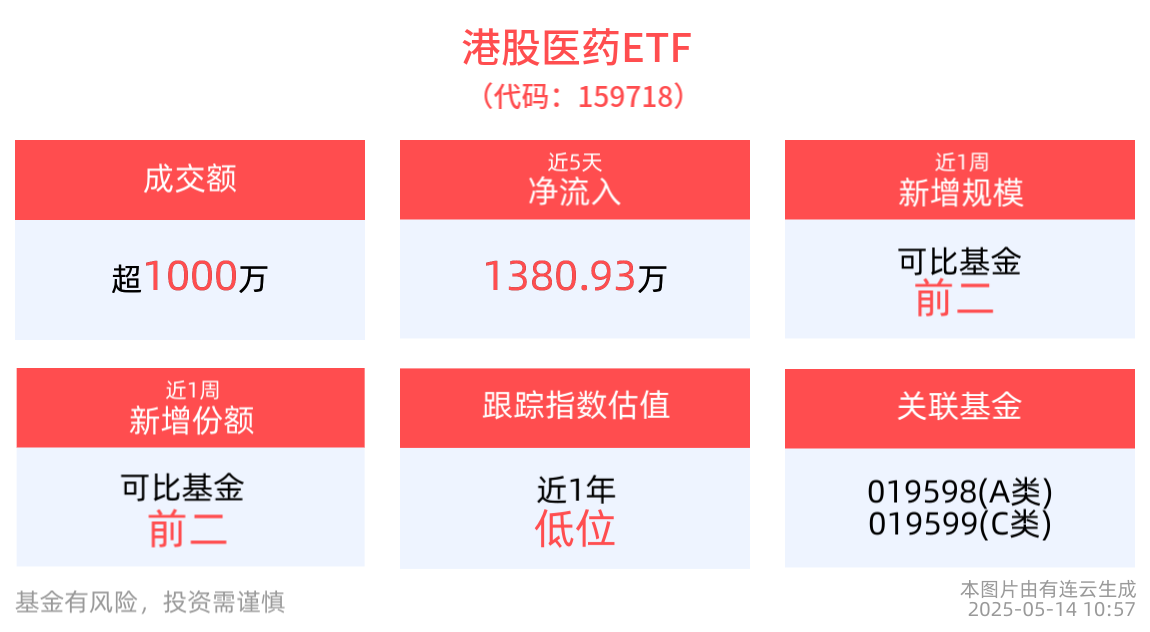
Group 1 - The China Securities Hong Kong Stock Connect Pharmaceutical and Health Comprehensive Index (930965) increased by 0.21% as of May 14, 2025, with notable gains from JD Health (06618) up 5.79%, China Biopharmaceutical (01177) up 4.95%, and Alibaba Health (00241) up 2.51% [1] - The Hong Kong Pharmaceutical ETF (159718) rose by 0.29%, with a recent price of 0.69 yuan, and has accumulated a 4.37% increase over the past month [1] - The average daily trading volume of the Hong Kong Pharmaceutical ETF reached 92.78 million yuan in the last month, with a significant weekly scale growth of 999.97 million yuan and an increase of 19 million shares [1] Group 2 - Over 1,000 listed companies have received institutional research in May, with more than 90% of these companies achieving positive returns since the beginning of the month [2] - The most concentrated sectors for institutional research include machinery, electronics, and biopharmaceuticals, with a focus on structural investment opportunities in humanoid robots, electronic sub-sectors, innovative drugs, and pharmaceutical exports [2] Group 3 - Several U.S. healthcare AI companies reported Q1 earnings that exceeded expectations, with many raising their full-year guidance, boosting market confidence in healthcare AI [3] - OpenAI launched a new open-source health benchmark, HealthBench, designed to evaluate large models in real-world medical scenarios, developed over 11 months with input from 262 doctors across 60 countries [3] Group 4 - Ping An Securities recommends continued attention to the innovative pharmaceutical sector supported by policy, as well as consumer-oriented traditional Chinese medicine and healthcare sectors [4] Group 5 - Yongxing Securities believes that the competitiveness of domestic innovative drugs is continuously improving, particularly in their overseas market prospects [5] - Guoyuan Securities notes that all annual reports for 2024 and Q1 2025 in the pharmaceutical industry have been disclosed, with a shift in market focus from earnings to changes in industry and company fundamentals [5] - The innovative drug sector is entering a phase of results realization, with significant R&D progress expected to remain a key investment theme for 2025 [5] Group 6 - The China Securities Pharmaceutical and Medical Device Innovation Index (931484) decreased by 0.40%, with mixed performance among constituent stocks [8] - The Medical Innovation ETF (516820) fell by 0.59%, with a recent price of 0.34 yuan, while it has seen a 0.29% increase over the past week [9] - The Medical Innovation ETF has an average daily trading volume of 49.06 million yuan over the past week [9] Group 7 - The top ten weighted stocks in the China Securities Hong Kong Stock Connect Pharmaceutical and Health Comprehensive Index account for 60.54% of the index, with notable stocks including BeiGene (06160) and WuXi Biologics (02269) [11] - The top ten weighted stocks in the China Securities Pharmaceutical and Medical Device Innovation Index represent 66.51% of the index, with leading companies such as Hengrui Medicine (600276) and WuXi AppTec (603259) [14]
港股科技ETF(159751)获资金青睐,京东一季度业绩大超预期
Xin Lang Cai Jing· 2025-05-14 02:37
Group 1 - The core viewpoint of the news highlights the positive performance of Hong Kong's technology ETF and the strong earnings report from JD.com, indicating growth in revenue and operating profit [1][2] - JD.com reported a revenue of 16.645 billion RMB for Q1 2025, representing a year-on-year growth of 25.5%, and an operating profit of 1.071 billion RMB, up 119.8% year-on-year [1] - The company launched several innovative drugs in Q1 2025, expanding treatment options for patients, and made significant advancements in the application of AI technology in healthcare services [1] Group 2 - According to a report from Credit Lyonnais, JD.com is expected to see a 15% year-on-year increase in total revenue for Q1, driven by increased demand for pharmaceuticals due to a flu outbreak and improved user traffic from trade-in promotions [2] - The report estimates a 20% year-on-year increase in pharmaceutical sales and over 10% growth in health products and medical devices [2] - The company is projected to achieve a 14% year-on-year revenue growth in the first half of the year, with a stable net profit margin of 6.6% [2] Group 3 - The Hong Kong technology sector is benefiting from high demand in AI computing and applications, with strong performance in smart driving and industrial intelligence [2] - Analysts from two firms emphasize the importance of tracking technological advancements and commercialization impacts on the fundamentals of related companies [2]