消费品以旧换新

Search documents
盘前机会前瞻|2026年“国补”政策来了!新增智能眼镜品类,这几家公司相关产品已为头部品牌供货(附概念股)
Sou Hu Cai Jing· 2025-12-31 01:32
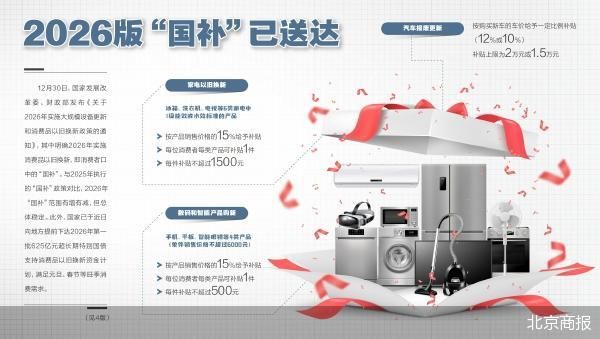
Core Insights - The National Development and Reform Commission and the Ministry of Finance announced a subsidy policy for 2026, providing a 15% subsidy for personal purchases of specific electronic products, including smartphones, tablets, smartwatches, and smart glasses [2][5] - The policy marks a significant change from 2025 by including smart glasses, recognized as the "next generation human-computer interaction interface," in the subsidy program [2][5] Subsidy Details - Consumers can receive a 15% subsidy on the purchase price of eligible products, with a maximum subsidy of 500 yuan per item for smart devices priced under 6000 yuan [3][6] - For home appliances, the subsidy applies to energy-efficient products (1st level) such as refrigerators, washing machines, televisions, air conditioners, computers, and water heaters, with a maximum subsidy of 1500 yuan per item [3][6] Structural Optimizations - The subsidy program has expanded its scope to include smart glasses, smartwatches, and smart home products, enhancing the support for digital and intelligent devices [3][6] - The policy continues to support the replacement of old appliances and vehicles, focusing on energy-efficient products and promoting a shift towards green and low-carbon upgrades [3][6]

最新发布!重大利好!
天天基金网· 2025-12-31 01:17
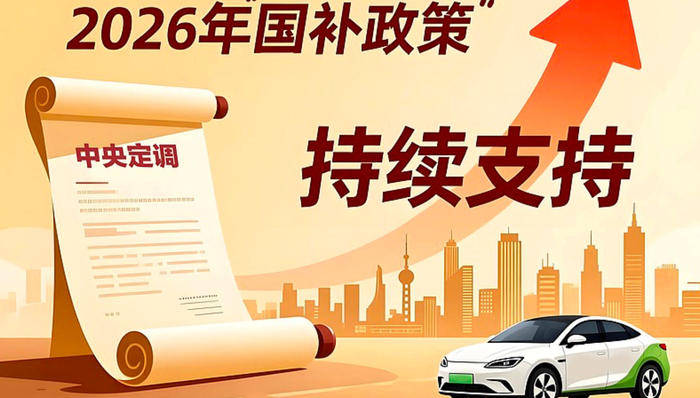
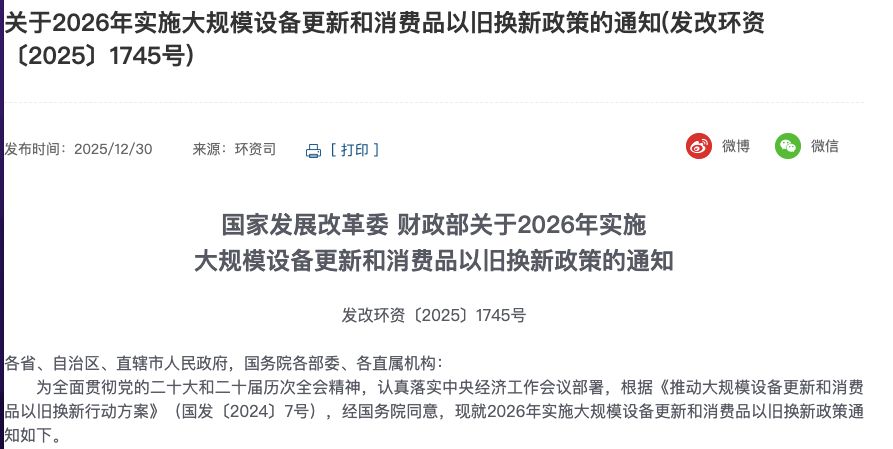
上天天基金APP搜索777注册即可领500元券包,优选基金10元起投!限量发放!先到先得! 2026年"国补"政策来了! 12月30日晚间消息,国家发改委、财政部印发《关于2026年实施大规模设备更新和消费品以旧换新政策 的通知》,明确2026年"两新"政策的支持范围、补贴标准和工作要求。 2026年,将继续实施汽车报废更新和汽车置换更新补贴;继续实施家电以旧换新补贴,支持范围聚焦冰 箱、洗衣机、电视、空调、电脑、热水器等6类产品;同时,将数码产品购新补贴拓展为数码和智能产品 购新补贴,支持范围包括手机、平板、智能手表(手环)、智能眼镜和智能家居产品。 另据新华社报道,近日,国家发改委会同财政部,已向地方提前下达2026年第一批625亿元超长期特别 国债支持消费品以旧换新资金计划。 两部门重磅发布 12月30日,国家发展改革委、财政部印发的《关于2026年实施大规模设备更新和消费品以旧换新政策的 通知》(以下简称"通知")对外发布。据悉,2026年"两新"政策主要做了3个方面优化: 一是优化支持范围。设备更新方面,总体延续2025年支持范围,在民生领域增加老旧小区加装电梯、养 老机构设备更新,在安全领域增加消 ...
A股头条:2026年“国补”政策来了;汽车以旧换新补贴实施细则出炉;个人出售购买满2年的住房免征增值税
Jin Rong Jie· 2025-12-31 00:38
Group 1 - The National Development and Reform Commission and the Ministry of Finance announced a subsidy policy for consumer electronics and appliances, providing a 15% subsidy for purchases of certain products, including smartphones and smart home devices, starting in 2026 [1] - Consumers can receive a subsidy of up to 500 yuan for each eligible smart product purchased, with a maximum subsidy of 1500 yuan for major appliances [1] - The policy aims to stimulate consumption and support the transition to smart and energy-efficient products, indicating a clear direction towards intelligent technology [1] Group 2 - A total of 625 billion yuan in special long-term bonds has been allocated to support the old-for-new consumption policy, with funds being distributed ahead of the New Year and Spring Festival to meet seasonal demand [2] - The National Development and Reform Commission will oversee the implementation of this policy, ensuring effective use of the subsidy funds and monitoring throughout the process [2] Group 3 - The Ministry of Finance and the State Taxation Administration announced a new tax policy, exempting individuals from value-added tax when selling homes purchased for over two years, effective January 1, 2026 [3] - The tax rate for homes sold within two years has been reduced from 5% to 3%, although the overall impact on the market is expected to be limited [3] Group 4 - The Ministry of Industry and Information Technology and three other departments released a digital transformation plan for the automotive industry, aiming to enhance smart manufacturing capabilities by 2027 [4] - Key targets include increasing the digitalization level of component manufacturers, improving labor productivity by 10%, and reducing product development and delivery cycles by 20% [4] Group 5 - iMoutai announced plans to launch a new product line in 2026, with production volumes aimed at preventing market speculation and ensuring supply-demand balance [5] Group 6 - The U.S. stock market faced pressure with declines in major indices, influenced by internal divisions within the Federal Reserve, while some tech stocks showed mixed performance [6] - The Nasdaq China Golden Dragon Index experienced fluctuations, reflecting the volatility in the market [6] Group 7 - The agricultural sector is focusing on increasing soybean oil production and self-sufficiency, alongside the development of modern livestock and aquaculture industries [10] - The initiative aims to enhance agricultural productivity and establish a diversified food supply system while maintaining strict land use regulations [10] Group 8 - The Ministry of Education plans to introduce policies to integrate artificial intelligence into education, aiming to cultivate high-quality talent for the future [11] - The initiative will focus on different educational stages and promote AI literacy among students [11]



牛市早报|2026年“国补”政策公布,中央农村工作会议召开
Xin Lang Cai Jing· 2025-12-31 00:19
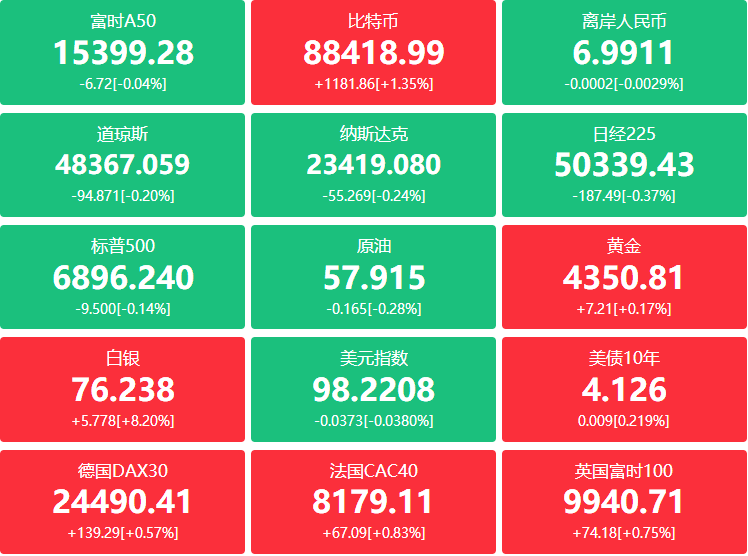
Market Data - As of December 30, the Shanghai Composite Index fell by 0.16 points, closing at 3965.12 points; the Sci-Tech Innovation 50 Index rose by 1.01% to 1359.87 points; the Shenzhen Component Index increased by 0.49% to 13604.07 points; and the ChiNext Index gained 0.63% to 3242.9 points [1] - U.S. stock markets experienced slight declines, marking a third consecutive day of losses, with the Dow Jones down by 0.2%, the S&P 500 down by 0.14%, and the Nasdaq down by 0.24% [1] - International oil prices saw a minor drop, with light crude oil futures for February 2026 closing at $57.95 per barrel, down by $0.13 (0.22%), and Brent crude oil futures for February closing at $61.92 per barrel, down by $0.02 (0.03%) [1] Economic Policies - The National Development and Reform Commission (NDRC) and the Ministry of Finance have allocated 625 billion yuan in special government bonds to support a consumption upgrade program for replacing old consumer goods [2] - The NDRC has issued a notice regarding a large-scale equipment update and consumer goods replacement policy for 2026, which includes subsidies for energy-efficient home appliances, providing 15% of the product price as a subsidy, capped at 1500 yuan per item for eligible consumers [3][4] - The 2026 policy has revised the subsidy standards, removing certain appliances from the subsidy list and lowering the maximum subsidy for energy-efficient products from 2000 yuan to 1500 yuan [3] - A new tax policy effective January 1, 2026, will reduce the value-added tax rate on the sale of residential properties held for less than two years from 5% to 3%, thereby lowering the tax burden on property sales [4] Industry Developments - The Central Rural Work Conference has outlined plans to stabilize grain and oil production, enhance farmland protection, and promote rural income growth [5] - The Ministry of Industry and Information Technology has released a digital transformation implementation plan for the automotive industry, aiming for over 95% adoption of R&D tools and a 10% increase in labor productivity by 2027 [5] - Changxin Technology's IPO application has been accepted by the Shanghai Stock Exchange, with a planned fundraising amount of 29.5 billion yuan [5] - Beijing Zhiyuan Huazhang Technology Co., Ltd. has initiated its IPO process in Hong Kong, with an expected market value exceeding 50 billion HKD [6]

盘前必读丨2026年首批“国补”资金已下达;个人销售住房增值税降了
Di Yi Cai Jing Zi Xun· 2025-12-30 23:25
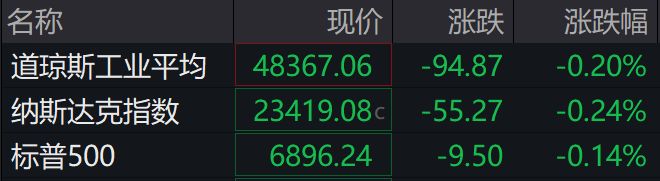
Group 1: Market Overview - The U.S. stock market indices closed lower, with the S&P 500 down by 0.14%, Nasdaq down by 0.24%, and Dow Jones down by 0.20% [1] - The communication services sector was boosted by a 1.1% increase in Meta Platforms, which announced the acquisition of AI startup Manus [1] - Notable movements in tech stocks included Tesla down by 1.13%, Nvidia down by 0.36%, and Amazon up by 0.20% [1] Group 2: Chinese Stocks Performance - The Nasdaq Golden Dragon China Index fell by 0.27%, with Alibaba down by 0.76% and JD.com down by 1.91% [2] - In contrast, Netease rose by 0.80% and Baidu increased by 4.39% [2] Group 3: Commodity Market - Light crude oil futures for February 2026 fell by $0.13, closing at $57.95 per barrel, a decrease of 0.22% [2] - Spot gold increased by 0.8%, reaching $4364.70 per ounce after a significant drop from a historical high of $4549.71 [2] Group 4: Automotive Industry Policies - The 2026 policy plan for "old-for-new" subsidies in consumer goods includes support for automobiles, home appliances, and digital products, with new subsidies for smart glasses and smart home products [3] - The implementation of the VAT law will begin on January 1, 2026, detailing taxpayer classifications and tax rate applications [3] Group 5: Automotive Digital Transformation - The automotive industry digital transformation plan aims for significant improvements by 2027, including a 10% increase in labor productivity and a 20% reduction in product development and delivery cycles [4][5] - The plan emphasizes the integration of AI in various operational aspects, including R&D and manufacturing [5] Group 6: Automotive Subsidy Implementation Details - The 2026 subsidy details specify that individuals scrapping eligible vehicles can receive up to 20,000 yuan for purchasing new energy vehicles [6][7] - Additional subsidies are available for consumers who sell their vehicles and purchase qualifying new energy or low-emission vehicles [7] Group 7: Corporate Announcements - Dongjie Intelligent has terminated its major asset restructuring plan and resumed trading [8] - Zijin Mining expects a net profit increase of approximately 59%-62% for 2025 [8] - China National Airlines plans to purchase 60 Airbus A320NEO aircraft, with a catalog price of about $9.53 billion [8]
2026“国补”继续!“两新”政策部署来了,将优化支持范围
Xin Hua She· 2025-12-30 23:21
Core Viewpoint - The 2026 "National Subsidy" policy has been announced, focusing on large-scale equipment updates and the replacement of consumer goods, with specific support for electric vehicles and smart products like smart glasses [1][6]. Group 1: Support Scope Optimization - The support scope for equipment updates will continue from 2025, adding new categories such as the installation of elevators in old residential areas and equipment updates in elderly care institutions [2][7]. - In the consumer goods replacement program, the focus will be on key consumer products with strong market impact, including continued subsidies for vehicle scrappage and replacement, as well as for six categories of home appliances [2][7]. - The subsidy for digital products will now include smart products, covering smartphones, tablets, smartwatches, smart glasses, and smart home products [2][7]. Group 2: Subsidy Standard Optimization - The subsidy for updating old residential elevators will shift from a fixed amount to a tiered system based on the number of floors [3][8]. - For scrapping old commercial vehicles, there will be a priority for replacing them with electric vehicles [3][8]. - The consumer goods replacement subsidy will maintain the upper limit for vehicle subsidies while adjusting the fixed subsidy to a percentage of the vehicle price; home appliance subsidies will be set at 15% of the price for energy-efficient products, with a maximum of 1,500 yuan per item [3][8]. Group 3: Implementation Mechanism Optimization - The project application and review processes will be streamlined to lower the investment threshold for applications, enhancing support for small and medium-sized enterprises [4][9]. - The funding distribution method will be optimized, and strict measures will be taken against fraudulent claims and price inflation before subsidies [4][9]. - A unified subsidy standard will be implemented nationwide for vehicle scrappage, replacement, and six categories of home appliances, with coordination among various government departments to ensure effective policy execution [4][9].
2026年汽车“国补”来了!按车价比例进行补贴 最高不超2万元
Mei Ri Jing Ji Xin Wen· 2025-12-30 23:16
Core Viewpoint - The National Development and Reform Commission and the Ministry of Finance have issued a notice regarding the implementation of large-scale equipment updates and consumer goods replacement policies in 2026, outlining support scope, subsidy standards, and operational requirements for the "Two New" policy [1][4]. Summary by Relevant Sections Policy Optimization - The 2026 "Two New" policy includes three main optimizations: support scope, subsidy standards, and implementation mechanisms [4]. - The policy continues to support subsidies for scrapping and replacing old vehicles, particularly focusing on personal consumers who register scrapped vehicles in their name [4][6]. Subsidy Standards - For consumer goods replacement, the subsidy for purchasing new energy vehicles is set at 12% of the vehicle price (up to 20,000 yuan), while for 2.0-liter or below fuel vehicles, it is 10% (up to 15,000 yuan) [4]. - For vehicle replacement, the subsidy for new energy vehicles is 8% (up to 15,000 yuan), and for 2.0-liter or below fuel vehicles, it is 6% (up to 13,000 yuan) [6]. - Compared to the 2025 policy, the subsidy amounts remain unchanged, but the criteria have been adjusted to be based on vehicle price, aligning with the high-quality development goals of the automotive industry [6]. Market Impact - The announcement of the policy is expected to mitigate market impacts from the transition of the vehicle purchase tax for new energy vehicles from full exemption to a 50% reduction starting January 1, 2026 [8]. - The "old-for-new" subsidy policy has significantly driven sales, with over 2.5 trillion yuan in related sales and more than 11.2 million vehicles sold under this scheme in the first 11 months of the year [8]. - Projections indicate that the transaction volume for "old-for-new" vehicles in 2025 could exceed 12 million units, with the market scale expected to surpass 180 billion yuan [8]. Implementation and Funding - To ensure smooth implementation of the "Two New" policy, the National Development and Reform Commission has allocated 62.5 billion yuan in special bonds to support consumer goods replacement [8][9]. - The commission will work with relevant departments to enhance coordination and monitoring of the subsidy funds, ensuring a balanced and orderly execution of the policy [9]. Industry Outlook - Analysts believe that the continuation of national subsidies will stabilize domestic demand through inventory updates and structural upgrades in product categories [10].
625亿元超长期特别国债提前下达
Xin Lang Cai Jing· 2025-12-30 19:09
Core Viewpoint - The National Development and Reform Commission (NDRC) and the Ministry of Finance have announced a plan to allocate 62.5 billion yuan in special long-term bonds to support the consumption upgrade policy for 2026, aiming to stimulate consumer demand during peak seasons like New Year's Day and Spring Festival [1] Group 1: Policy Implementation - The 2026 "Two New" policy will continue to support equipment updates in various sectors, including the installation of elevators in old residential areas and equipment updates in elderly care institutions [2] - The policy will also enhance the coverage of key consumer goods with high driving effects, focusing on the replacement and recycling of automobiles and household appliances [2][3] - The subsidy for old residential elevators will be adjusted to a tiered system based on the number of floors, while electric trucks will be prioritized for subsidies in the old operating vehicle replacement program [3] Group 2: Subsidy Standards - The subsidy for household appliances will focus on energy-efficient products, providing 15% of the product price with a maximum subsidy of 1,500 yuan per item [3] - The subsidy standards for digital and smart products will remain unchanged, covering items such as smartphones, tablets, and smart home devices [3] Group 3: Compliance and Oversight - The policy includes measures to combat fraudulent subsidy claims and ensure compliance with national standards for vehicle and appliance replacements [4] - The NDRC will lead inter-ministerial coordination to implement the "Two New" policy effectively, with various departments responsible for developing specific implementation guidelines [5]
汽车以旧换新调整为按车价比例补贴
Xin Lang Cai Jing· 2025-12-30 18:07
三是优化实施机制。设备更新方面,优化项目申报机制和审核流程,进一步降低申报项目的投资额门 槛,加大对中小企业的支持力度,扩大政策惠及面。消费品以旧换新方面,优化资金分配方式,完善全 链条实施细则,严厉打击骗补套补和"先涨后补"等违法违规行为。同时,落实全国统一大市场建设要 求,对汽车报废更新、汽车置换更新、6类家电以旧换新、4类数码和智能产品购新,明确在全国范围内 执行统一的补贴标准。 相关报道详见P09 一是优化支持范围。设备更新方面,总体延续2025年支持范围,在民生领域增加老旧小区加装电梯、养 老机构设备更新,在安全领域增加消防救援、检验检测设备更新,在消费基础设施领域增加商业综合 体、购物中心、百货店、大型超市等线下消费商业设施的设备更新。消费品以旧换新方面,进一步集中 资源,着力提升覆盖人群广、带动效应强的重点消费品"得补率"。继续实施汽车报废更新和汽车置换更 新补贴;继续实施家电以旧换新补贴,支持范围聚焦冰箱、洗衣机、电视、空调、电脑、热水器等6类 产品;同时,将数码产品购新补贴拓展为数码和智能产品购新补贴,支持范围包括手机、平板、智能手 表(手环)、智能眼镜和智能家居产品(含适老化家居产品)。 ...
汽车补贴按价浮动 明年“两新”政策继续
Bei Jing Shang Bao· 2025-12-30 16:04
Group 1 - The core policy for 2026 includes large-scale equipment updates and a trade-in program for consumer goods, with support for home appliances and digital products [1][3] - Consumers purchasing energy-efficient home appliances will receive a subsidy of 15% of the product price, capped at 1500 yuan per item, with a limit of one item per category per consumer [1] - New digital products eligible for subsidies include smartphones, tablets, smartwatches, and smart glasses, with a similar subsidy structure as home appliances [3] Group 2 - The automotive subsidy policy for 2026 will adjust from fixed amounts to a percentage of the vehicle price, linking subsidies directly to the purchase price [3][4] - For vehicle trade-ins, consumers can receive an 8% subsidy on the price of new energy vehicles, capped at 15,000 yuan, and a 6% subsidy for fuel vehicles with an engine size of 2.0 liters or less, capped at 13,000 yuan [3][4] - The scrapping and replacement subsidy offers higher rates, with 12% for new energy vehicles (up to 20,000 yuan) and 10% for smaller fuel vehicles (up to 15,000 yuan) [4] Group 3 - Funding for the "national subsidy" program will primarily come from the issuance of long-term special bonds, with the issuance amount increasing from 150 billion yuan last year to 300 billion yuan this year [4][5] - The central government will support local governments with a 9:1 funding ratio for the consumer goods trade-in program, with varying central government contributions based on regional classifications [4][5] - Unused subsidy funds by the end of 2026 will be reclaimed by the central government, and regions with significant unfulfilled subsidy claims will face increased oversight [5]