量子科技

Search documents
一批“四川造”量子科技成果正式发布
Xin Lang Cai Jing· 2026-01-26 21:05
Core Viewpoint - Quantum technology is a key focus for Sichuan province, which is actively promoting its development through policies and initiatives aimed at establishing a robust industrial ecosystem [1][2] Group 1: Industry Development - The 2026 Quantum Technology Industry Ecosystem Development Conference was held in Chengdu, emphasizing the importance of quantum technology as a future industry for Sichuan [1] - Sichuan has established itself as a leader in quantum technology development in China, with significant contributions from institutions like the University of Electronic Science and Technology [1] - The province has created six national and provincial high-level innovation platforms and has implemented over 100 national research projects [1] Group 2: Key Initiatives and Collaborations - The conference served as a platform for supply-demand matching, showcasing new quantum products such as the all-stack domestic four-computation fusion super node and quantum financial gateway [1] - A series of significant achievements, typical application cases, and product supply and demand lists were released during the event [1] - The establishment of the Sichuan Quantum Technology Academy and the Sichuan Quantum Technology Industry Fund was announced, along with the initiation of the Sichuan Quantum Technology Industry Association [1] Group 3: Future Directions - Sichuan plans to deepen its focus on quantum technology by leveraging the "four-chain integration" approach, which includes innovation chain leadership, industrial chain collaboration, financial chain optimization, and talent chain activation [2]
广东:加快提升金融业规模能级
Zhong Guo Zheng Quan Bao· 2026-01-26 20:54
Group 1 - The Guangdong provincial government aims for a GDP growth target of 4.5%-5% for the year, emphasizing the importance of a strong start to the 14th Five-Year Plan [1] - The report highlights the need to enhance the scale and capability of the financial sector, support insurance product innovation, and facilitate corporate financing and mergers [1] - By 2025, Guangdong's GDP is projected to grow by 3.9%, maintaining its position as the top province in China for 37 consecutive years, with public budget revenue increasing by 3% and goods import-export growth at 4.4% [1] Group 2 - The report emphasizes the acceleration of emerging industries such as new energy, new materials, and smart vehicles, aiming to cultivate more pillar industries [2] - It calls for strengthening original innovation and tackling key core technologies, particularly in quantum technology, artificial intelligence, and integrated circuits [2] - In the real estate sector, the focus is on stabilizing the market through targeted policies, promoting the utilization of idle commercial properties, and enhancing the quality of housing and property services [2]
筑梦星辰海 川跃新境
Si Chuan Ri Bao· 2026-01-26 20:52
Group 1: Core Technology Trends - The global technology wave is reshaping the economic landscape, with a shift from "what can be done" to "what should be done" in 2026, integrating social responsibility into technological development [2] - Artificial intelligence (AI) is the main driver of technological innovation, moving towards large-scale implementation and industrialization [2][3] - AI will transition from conceptual demonstrations to a phase of value realization, focusing on the integration of technology, industry, and governance [3] Group 2: Robotics and AI - Humanoid robots are entering a phase of large-scale trials, driven by breakthroughs in physical AI that allow robots to understand and interact with physical laws [4][5] - The development of humanoid robots will significantly change human-machine coexistence, requiring global collaboration and unified technical standards [5] Group 3: Commercial Space - The commercial space industry in China is poised for significant growth, transitioning from capability building to value creation, with a focus on reusable rockets and satellite networks [6][7] - 2026 is expected to be a pivotal year for the commercialization of space services, driven by advancements in satellite communication technology [7] Group 4: Future Transportation - Super high-speed rail, utilizing low vacuum tube technology, aims to achieve speeds over 1000 km/h, overcoming weather-related disruptions [8][9] - China is at the forefront of this technology, with significant engineering breakthroughs and ongoing trials [10] Group 5: Quantum Technology - Quantum technology is becoming a focal point for global research, with quantum error correction recognized as a key area for future advancements [11][12] - China is positioned in the leading tier of quantum communication and computing, with significant contributions expected from regions like Sichuan [12] Group 6: 6G Technology - The development of 6G technology is underway, promising speeds 10-100 times faster than 5G and enabling comprehensive coverage across air, land, and sea [13][14] - Sichuan is actively working on key technologies to accelerate the industrialization of 6G [15] Group 7: Controlled Nuclear Fusion - Research in controlled nuclear fusion is advancing towards engineering practice, with multiple countries exploring various technological routes [16][17] - China's strategic development in nuclear fusion is gaining momentum, supported by recent legislative frameworks [17] Group 8: Deep Space Exploration - Deep space exploration aims to expand human understanding of the universe, with significant global advancements in observational technology [18][19] - Sichuan is emerging as a key research hub for astronomy and deep space exploration, contributing to national strategic initiatives [19] Group 9: Brain-Computer Interfaces - Brain-computer interfaces are evolving to enhance human-machine interaction, with applications in healthcare and consumer technology [20][21] - Sichuan has developed a complete industry chain for brain-computer interfaces, with a market size of 1 billion yuan, entering a new phase of clinical application [22] Group 10: Biomedicine - The biomedicine sector is a critical area for innovation, integrating biotechnology with pharmaceuticals to drive high-quality development [23][24] - Sichuan is actively cultivating its biomedicine industry, focusing on various key and emerging sectors to enhance its competitive edge [24]


创新质量持续提升知识产权效益加速显现
Xin Lang Cai Jing· 2026-01-26 16:56
Core Insights - The report highlights significant advancements in China's intellectual property (IP) landscape, showcasing a robust increase in patents, trademarks, and geographical indications, indicating a strong commitment to building a knowledge-based economy [1][2]. Group 1: Patent and Trademark Statistics - A total of 972,000 invention patents, 1,461,000 utility model patents, and 666,000 design patents were authorized in the year [1]. - The number of registered trademarks reached 4,206,000, with 384,000 trademark review cases concluded and 112,000 opposition cases processed [1]. - The number of patent transfer and licensing registrations reached 697,000, marking a year-on-year increase of 13.7% [1]. Group 2: Innovation Quality and Regional Activity - The number of high-value invention patents increased by 2.2 percentage points compared to the overall growth rate, totaling 2,292,000 [2]. - The Yangtze River Delta, Beijing-Tianjin-Hebei, and Guangdong regions accounted for approximately two-thirds of the total effective invention patents in China, with effective registered trademarks exceeding half of the national total [2]. Group 3: Economic Impact and International Protection - The value added by patent-intensive industries surpassed 18 trillion yuan, increasing its share of GDP from 11.97% in 2020 to 13.38% in 2024 [3]. - China's brand value among the top 5,000 global brands reached $1.81 trillion, ranking second globally [3]. - The National Intellectual Property Administration (NIPA) is enhancing foreign IP protection, establishing 99 overseas IP dispute response platforms across 30 provinces, and providing over 4,800 consultations to businesses, recovering losses of 2.75 billion yuan [4][5].
让人才活水激荡起高精尖产业发展澎湃春潮
Xin Lang Cai Jing· 2026-01-26 16:55
Core Viewpoint - Beijing is embarking on a significant development journey for its high-tech industries, emphasizing the importance of building a skilled workforce to drive innovation and economic growth [1][6]. Group 1: High-Tech Industry Development - The Beijing government has prioritized the development of high-tech industries in its work report, focusing on areas such as integrated circuits, international pharmaceutical innovation parks, and the implementation of "AI+" initiatives [1][6]. - The city aims to cultivate a modern industrial system that includes advanced sectors like 6G and quantum technology, requiring a robust and skilled talent pool [1][2]. Group 2: Talent Requirements - The evolving nature of high-tech industries necessitates a new breed of talent that combines deep expertise in specific fields with broad interdisciplinary knowledge [2]. - There is a call for the cultivation of "strategic craftsmen" and "industrial scientists" who possess system thinking, innovative spirit, and excellent execution capabilities [2]. Group 3: Talent Ecosystem - To establish itself as a global benchmark city for the digital economy, Beijing must attract top-tier talent and develop a substantial base of skilled engineers and technical managers [3]. - The city is encouraged to create a competitive talent ecosystem that includes comprehensive educational pathways and strong industry-academia collaboration [3]. Group 4: Structural Talent Optimization - The transition to new economic drivers requires a restructuring of the talent pool, focusing on engineers who understand both traditional crafts and digital technologies [4]. - There is a need for a cultural shift that encourages exploration and tolerates failure, allowing for the emergence of innovative talent [4]. Group 5: Value of Talent - The role of talent has evolved from a mere production factor to a strategic foundation for economic and social development, reflecting a significant change in development philosophy [5]. - High-skilled talent is seen as essential for supporting high-quality development and sustainable competitiveness in Beijing, contributing to the city's overall progress [5].
超70亿“爆款”重现!市场风向变了
Zhong Guo Zheng Quan Bao· 2026-01-26 14:13
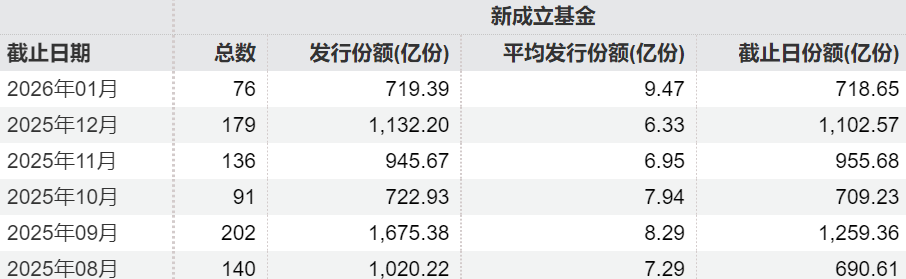
Group 1 - The core viewpoint of the articles indicates a significant rebound in the issuance of actively managed equity funds, highlighted by the launch of the Guangfa Research Smart A fund, which achieved an issuance of 7.221 billion shares, marking it as a "blockbuster product" [1][4] - As of January 25, 76 new funds have been established in 2026, with a total issuance of 71.939 billion shares, showing a recovery in the fund issuance market [2][3] - The average issuance of new funds in January 2026 reached 9.47 billion shares, significantly higher than the 6.33 billion shares in December 2025, indicating a notable improvement in market conditions [3] Group 2 - The issuance of actively managed equity funds is gaining momentum, with several funds exceeding 2 billion shares, including the E Fund Balanced Selection with 3.408 billion shares [5] - The upcoming issuance of 50 new funds before the Spring Festival suggests a balanced market between actively managed equity funds and passive index funds, with both types of funds having equal representation [5] - Institutions are cautiously optimistic about the equity market in 2026, with expectations of significant style and structural shifts, driven by positive policies and improving fundamentals [6]
推出22项任务96条举措 上海徐汇持续营造一流营商环境
Zhong Zheng Wang· 2026-01-26 14:01
目前,徐汇区累计跨国公司地区总部和外资研发中心达175家。外资企业占徐汇区企业总数的 17%,贡献了近50%的经济总量,成为徐汇区经济社会发展的重要参与者、推动者和见证者。 "作为总部位于瑞士的全球精密仪器领军企业,梅特勒-托利多选择扎根徐汇区漕河泾开发区,从最 初的初创团队发展为如今自主研发、生产并向中国及全球市场供应领先产品,覆盖实验室与工业分析全 产业链的核心企业,每一步成长都离不开徐汇区优质营商环境带来的全方位赋能。"梅特勒-托利多中国 区实验室、过程分析事业部总经理储锦兰表示,企业将持续加大在徐汇区的投资布局,双方将共同开 启"工业上楼"战略合作新篇章。 中证报中证网讯(记者 乔翔)1月26日,2025年度上海市徐汇区招商引资表彰大会举行。会上, 《徐汇区加快打造国际一流营商环境行动方案(2026年)》正式发布,标志着徐汇区将持续深化政务服 务、市场竞争、产业生态、社会共治"四大环境"建设,着力构建全要素支撑的营商生态系统,以更高标 准的全周期服务赋能企业扎根成长、创新突破,加速构建现代化开放型经济新格局。 《行动方案》共推出22项任务96条细化举措,全力将优化营商环境的"施工图"转化为"实景画", ...
贵金属延续新高
Tebon Securities· 2026-01-26 11:07
Market Analysis - A-share market showed mixed performance with the Shanghai Composite Index closing at 4132.61, down 0.09%, while the Shenzhen Component Index fell 0.85% to 14316.64[2] - Total market turnover increased to 3.28 trillion yuan, up 5.2% from the previous trading day, marking the second consecutive day above 3 trillion yuan[2] Precious Metals Performance - Precious metals led the market with the gold jewelry index rising 7.08%, and international spot gold surpassing 5100 USD/oz, reaching a historical high[5] - Silver futures prices climbed to 100 USD/oz, contributing to rapid valuation recovery in the industry chain[5] Commodity Market Trends - The Nanhua Commodity Index closed at 2829.85, up 1.59%, with silver leading gains at 12.78%, platinum up 9.68%, and gold rising 3.67%[7] - Energy and shipping sectors also saw gains, with fuel prices increasing by 6.81%[7] Bond Market Insights - The bond futures market showed mixed results, with the 30-year contract (TL2603) rising 0.20% to 112.51 yuan, while the 10-year contract (T2603) fell 0.02% to 108.18 yuan[7] - The central bank conducted a net withdrawal of 207.8 billion yuan, indicating a tightening liquidity environment[7] Investment Recommendations - Focus on sectors such as photovoltaic, commercial aerospace, and precious metals, while being cautious of speculative risks in concept stocks[7] - Monitor upcoming performance forecasts and the impact of the Federal Reserve's meeting on January 28[13]
广东培育形成8个千亿级、17个百亿级现代农业产业集群
Zhong Guo Xin Wen Wang· 2026-01-26 10:49
Core Insights - Guangdong has developed 8 trillion-level and 17 hundred-billion-level modern agricultural industry clusters, leading the nation in total aquatic product output, marine fish farming output, and marine fish seedling output [1] - During the 14th Five-Year Plan period, Guangdong is advancing the construction of a modern industrial system, achieving breakthroughs in traditional, emerging, and future industries [1] - Major industrial projects such as BASF's core facility, ExxonMobil's first phase, and China Resources Microelectronics' 12-inch production line have been completed, with industries like electronic information, new energy vehicles, and low-altitude economy flourishing [1] Industry Development - Guangdong aims to elevate traditional industries such as electronics, machinery, chemicals, light industry, building materials, textiles, metallurgy, mining, and shipbuilding to mid-to-high-end levels, while strengthening brands in home appliances, food, clothing, furniture, jewelry, toys, and footwear [2] - The province will promote innovation infrastructure, technology R&D, and product upgrades, focusing on emerging industries like new energy, new materials, smart connected vehicles, robotics, pharmaceuticals, aerospace, integrated circuits, low-altitude economy, and biomanufacturing [2] - Guangdong will establish a long-term mechanism for rapid identification and precise policy implementation for new industry tracks, supported by a multi-level, systematic pilot service network and venture capital funds [2]
科创投资,变了
FOFWEEKLY· 2026-01-26 10:04
导读: 在当下复杂的投资环境下,投资人一定要顺势而为,拥抱贝塔。 作者|矛哥 来源 |常垒创投 2025,我是如何实现:硬科技,从入门到彻底放弃。 上面这句话不是我说的,但不止一个人跟我说过,无论是一级投资的朋友还是二级的朋友。 之前一个VC投资的朋友曾跟我说过,他们只投资两类商业模型的企业: 要么上来就巨额亏损,需要持续融资; 要么上来就赚钱,后续不太需要融资。 因为其余的业务模型都不支撑VC的投资框架,我觉得还蛮有道理。 当下的科创投资周期跟当年TMT时代的互联网投资越来越像。 都是巨额融资,巨额亏损; 都是商业模式看不懂,花钱补贴客户,短期算不过账; 大洋彼岸,都有成功对标企业;投资机构都要抱团站队,因为结局都看不清。 但也有不同之处。 在TMT时代,钱主要花在了流量获取和补贴C端用户上。 在科创时代,钱也投在了流量上,不过主要是为了博领导的眼球,而补贴主要用在B端大客户上。 在TMT投资时代,政府国资的钱不敢上。 在当下科创时代,市场信仰派的钱却不敢上了。 投资的信仰和价值观本没有对错,只是在不同周期,各种价值观获得的收益反馈却截然不同。 在往期的文章里我们曾提出,2023年会出现一个投资的分水岭,本 ...