
中长期资金入市

Search documents
资本市场“长钱长投”制度环境将进一步完善
Zhong Guo Zheng Quan Bao· 2025-09-24 20:17
● 本报记者 昝秀丽 截至8月底,中长期资金合计持有A股流通市值约21.4万亿元,较"十三五"末增长32%;保险资金投资股 票和权益类基金超5.4万亿元,余额较"十三五"末增长85%……"十四五"期间,投资端改革实现重大突 破。 证监会近日明确,将更好发挥中长期资金"压舱石""稳定器"作用,持续强化长周期考核,不断提高跨境 投融资便利度,吸引更多源头活水,努力让更多全球资本投资中国、共享成长。市场人士预期,下一 步,改革将聚焦提升入市便利度,推出实质性举措,优化"长钱长投"环境、增强资产可投性并丰富对冲 工具,"引长钱、促长投"效果有望加快显现。 改革见效 "长钱长投"格局逐步形成 "十四五"以来,资本市场着力构建"长钱长投"机制,以保险资金、公募基金等为代表的中长期资金加速 入市,更好地发挥中长期资金"压舱石""稳定器"作用,投资端改革实现重大突破。 ——险资布局权益市场投资规模显著提升。目前,险资投资股票和权益类基金超5.4万亿元,余额较"十 三五"末增长85%。金融监管总局先后批复第二批、第三批保险资金长期股票投资试点资格,总金额 1720亿元。 兴业证券首席策略分析师张启尧表示,今年年初,六部门联合发 ...
杨德龙:政策利好叠加资金推动 本轮慢牛长牛行情行稳致远
Xin Lang Ji Jin· 2025-09-24 11:26
Group 1 - The A-share market has experienced significant changes over the past year, with total market capitalization increasing from 68 trillion to 104 trillion, surpassing the 100 trillion mark [1] - The bull market was initiated by the "924" policy, leading to a rapid rise in the Shanghai Composite Index, which increased by nearly 1000 points within a few trading days [1] - The second wave of the bull market began in late June, driven by sectors such as chips, semiconductors, AI, and innovative pharmaceuticals, further solidifying the bull market trend [1][2] Group 2 - The technology sector has become the new market leader, with the total market capitalization of the electronics industry surpassing that of the banking sector [2] - Over a thousand stocks have doubled in value, primarily in industries like machinery, electronics, and biomedicine, indicating a strong performance in the tech sector [2] - The shift of household savings from real estate to the stock market, along with increased foreign investment, has fueled the liquidity-driven bull market [2] Group 3 - Technology innovation is now a core national strategy, with the market capitalization of technology companies exceeding 25% of the A-share market [3] - The number of technology firms among the top 50 companies has increased from 18 to 24, highlighting the growing importance of tech companies in the market [3] - Financial resources are increasingly directed towards technology sectors, particularly in areas benefiting from domestic substitution policies [3] Group 4 - The channels for long-term capital entering the market are expanding, with various types of long-term funds holding approximately 21.4 trillion in A-shares, a 32% increase since the end of the 13th Five-Year Plan [4] - Regulatory efforts are being made to accelerate the entry of long-term capital, which is expected to favor stable cash flow and high dividend yield companies [4] Group 5 - Financial support for the real economy has intensified, with banks and insurance companies providing 170 trillion in new funds over five years, particularly for high-end manufacturing [5] - Companies with core technologies aligned with new productive forces are likely to receive more resource support, benefiting sectors like high-end equipment and new energy vehicles [5] Group 6 - The capital market is expected to continue its bull market trajectory, with a significant increase in the proportion of technology companies among newly listed firms [6] - The market has seen a notable increase in companies returning value to investors, with total distributions reaching 10.6 trillion over the past five years, an increase of over 80% compared to the previous period [6] Group 7 - Regulatory bodies are actively improving mechanisms for capital formation and long-term capital entry, enhancing market resilience and risk management [7] - The annualized volatility of the Shanghai Composite Index has decreased from 19% to 15.9%, indicating improved market stability [7]
"9·24”一周年,A股总市值破116万亿元,四大变革重塑中国资本市场新生态
3 6 Ke· 2025-09-24 04:09
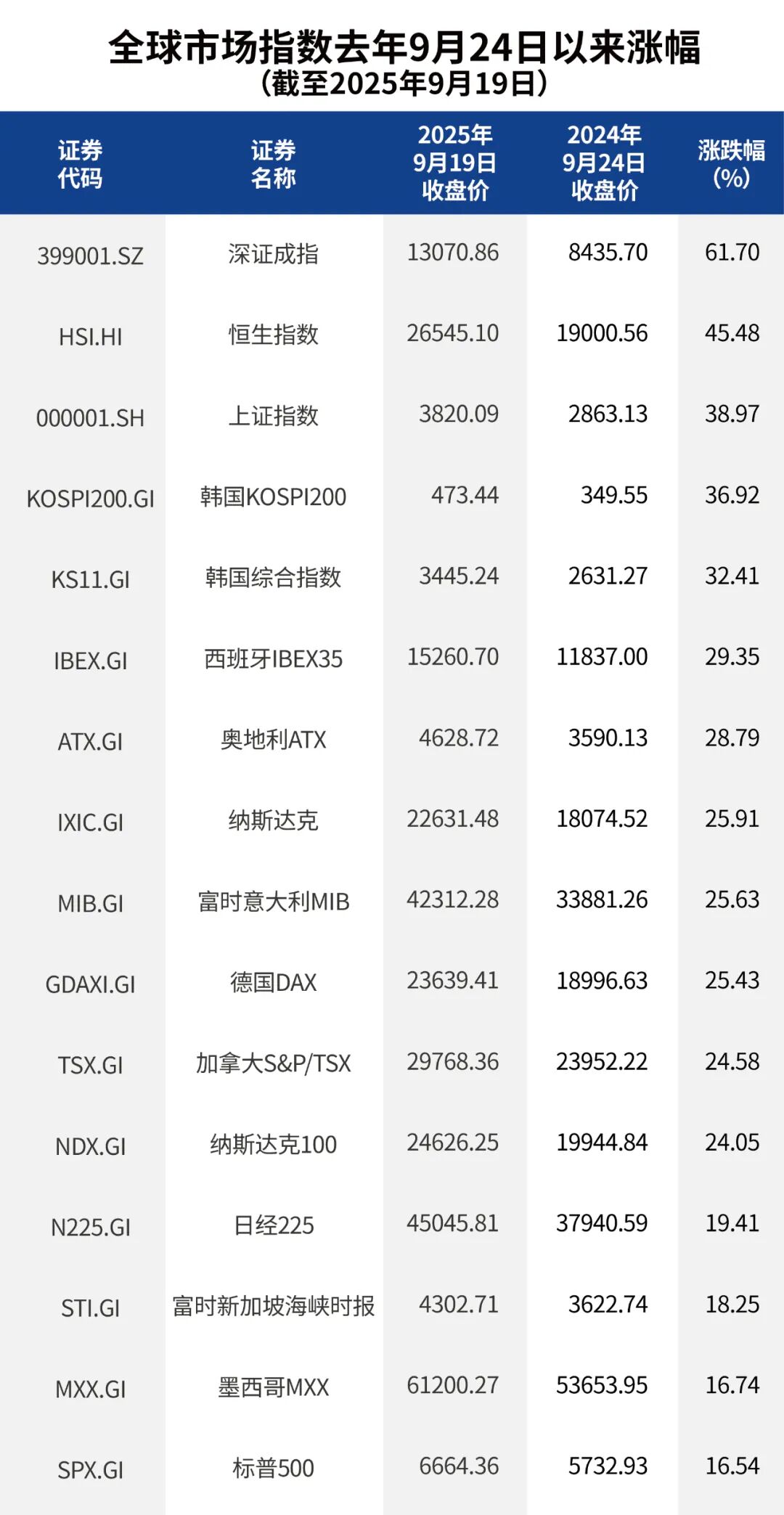
Core Insights - The "9·24 market" initiated a significant transformation in the A-share market, marking the beginning of a slow bull market characterized by a focus on technology and leading companies, which is essential for China's economic transition [1][16] Policy Foundation - On September 24, 2024, a comprehensive financial policy package was launched to stabilize the real estate, stock market, and economy, which was a critical turning point for the market [2] - The People's Bank of China introduced new monetary policy tools to support stock repurchases and long-term capital inflows, while the China Securities Regulatory Commission (CSRC) encouraged mergers and acquisitions [2][3] Market Performance - Since the launch of the "9·24 market," the total market capitalization of the Shanghai and Shenzhen stock exchanges increased from 81.8 trillion yuan to 116.6 trillion yuan, a rise of 42.54% [7] - The Shenzhen Composite Index saw a cumulative increase of 61.7%, outperforming major global indices [4][5] Capital Inflows - Foreign investment in Chinese assets has shown a positive trend, with net inflows exceeding 10.1 billion USD in the first half of 2025, reversing two years of net outflows [8] - The market has attracted significant foreign capital, particularly in May and June 2025, indicating a growing global interest in Chinese equities [8] Structural Changes - The market has shifted from a focus on small-cap stocks to a concentration on leading companies, with high-dividend sectors and technology growth driving the market [9] - The financial sector's market capitalization increased by 25.18%, while the electronic equipment sector surged by 113%, highlighting the dominance of technology in the current market landscape [11] Investor Engagement - The number of new stock accounts opened in 2025 surged by approximately 48%, reflecting increased investor confidence and market activity [15] - The A-share market has seen a significant rise in trading volume, with daily trading exceeding 2 trillion yuan for 28 consecutive trading days [15] Future Outlook - The "9·24 market" is viewed as a foundational milestone for the long-term development of the A-share market, with expectations of continued growth driven by structural reforms and enhanced investor confidence [16][17] - Analysts suggest that emerging technologies and sectors such as photovoltaics and rare earths may present future investment opportunities [17]

十大维度透视“十四五”资本市场新变化,这份“成绩单”亮眼!
Zhong Guo Zheng Quan Bao· 2025-09-24 03:32
Core Insights - The capital market reforms during the "14th Five-Year Plan" period have made significant progress, including the full implementation of the registration system for stock issuance and the enhancement of investor protection [1][3][21]. Group 1: Registration System Reform - The registration system reform has been deeply advanced, with total financing in the stock and bond markets reaching 57.5 trillion yuan, and the proportion of direct financing increasing by 2.8 percentage points to 31.6% compared to the end of the "13th Five-Year Plan" [3]. Group 2: Establishment of Beijing Stock Exchange - The China Securities Regulatory Commission (CSRC) has promoted the establishment of the Beijing Stock Exchange (BSE) to serve innovative small and medium-sized enterprises, with 276 companies currently listed on the BSE and over 14,000 companies served by the New Third Board [4][5]. Group 3: Market Stability and Investor Protection - The CSRC has prioritized maintaining market stability, implementing new policies and reforms in key areas such as issuance, listing, mergers and acquisitions, trading, and delisting [7][8]. - The cash dividends from A-share listed companies reached 10.6 trillion yuan over the past five years, which is 2.07 times the amount raised through IPOs and refinancing during the same period [8]. Group 4: Support for Technological Innovation - Over 90% of newly listed companies during the "14th Five-Year Plan" period are high-tech enterprises, with strategic emerging industries now accounting for over half of the A-share market [10]. - The market capitalization of technology companies among the top 50 companies has increased from 18 to 24 since the end of the "13th Five-Year Plan" [11]. Group 5: Growth of ETF Products - The number of listed ETFs has grown from 370 to 1,282, with total assets increasing from 1.1 trillion yuan to over 5 trillion yuan, making it the largest ETF market in Asia [14]. Group 6: Long-term Capital Inflows - By the end of August this year, various long-term funds held approximately 21.4 trillion yuan of A-share circulating market value, a 32% increase compared to the end of the "13th Five-Year Plan" [15]. Group 7: High-level Opening Up - The capital market has seen significant progress in high-level institutional opening up, with the number of foreign-controlled institutions increasing and the investment scope for qualified foreign institutional investors expanding [21][22][23]. - By the end of August 2025, 907 foreign institutions had obtained qualified foreign institutional investor status, holding a total of 949.3 billion yuan [26].
“引长钱促长投”改革效果加快显现 各类中长期资金合计持有市值逾20万亿元
Jin Rong Shi Bao· 2025-09-24 03:32
Core Insights - The Chinese Securities Regulatory Commission (CSRC) is accelerating investment reforms to establish a "long money long investment" policy framework, with significant achievements in promoting long-term capital into the market as of August 2023 [1][4] Group 1: Investment Reforms - The CSRC has implemented a comprehensive fee reduction reform in the public fund industry, achieving a significant breakthrough with a three-phase fee reduction plan that has been fully rolled out [2] - The third phase of the fee reduction reform is expected to save investors approximately 30 billion yuan annually, with an overall reduction of about 34% in sales fees [2] - Cumulatively, the three phases of the public fund fee reform are projected to save investors around 51 billion yuan each year, exceeding the initial reduction targets [2] Group 2: Public Fund Industry Growth - The public fund industry in China has reached a record high, surpassing 35 trillion yuan by the end of August 2023, indicating its growing importance in the capital market [3] - The successful implementation of the fee reduction reform marks a new phase of high-quality development for the public fund industry [3] Group 3: Long-term Capital Investment - Long-term capital plays a crucial role in stabilizing the market and mitigating short-term volatility, with a reported increase of 6.4 trillion yuan in the A-share market's circulating value held by various long-term funds, representing a year-on-year growth of 42.7% [4] - As of August 2023, various long-term funds collectively held approximately 21.4 trillion yuan in A-share circulating market value [4] Group 4: ETF Development - The CSRC has proposed establishing a fast-track approval process for ETF index funds to enhance the scale and proportion of equity funds, with ETF assets exceeding 5 trillion yuan by August 2023 [5] - The development of innovative ETF products has catered to diverse investment needs, contributing to the high-quality growth of the industry [5] - Central Huijin has significantly increased its holdings in ETFs, with a total value of 1.28 trillion yuan by mid-2025, accounting for nearly 30% of the total ETF market [5]
“引长钱促长投”改革效果加快显现
Jin Rong Shi Bao· 2025-09-24 02:54
Core Viewpoint - The Chinese government is accelerating investment reforms to promote long-term capital investment in the capital market, with significant achievements reported in the entry of medium- and long-term funds into the market [1][4]. Group 1: Investment Reforms - The China Securities Regulatory Commission (CSRC) has issued guidelines to encourage medium- and long-term funds to enter the market, with a total of approximately 21.4 trillion yuan in A-share market value held by various medium- and long-term funds as of the end of August this year [1][4]. - The comprehensive fee reduction reform for public funds has been fully implemented, with a projected annual reduction of approximately 510 million yuan for investors, exceeding the initial targets [2][3]. Group 2: Public Fund Industry - The public fund industry in China has reached a record high, surpassing 35 trillion yuan in total assets by the end of August, marking a significant milestone in the industry's development [3]. - The fee reduction reform is seen as a critical step towards high-quality development in the public fund sector, with the third phase of the reform focusing on reducing sales fees and benefiting investors [2][3]. Group 3: Role of Medium- and Long-Term Funds - Medium- and long-term funds are crucial for stabilizing the capital market and mitigating short-term volatility, with a year-on-year increase of 42.7% in the market value held by these funds [4]. - The government has implemented measures to facilitate the entry of social security, insurance, and pension funds into the market, enhancing the overall investment landscape [4]. Group 4: ETF Development - The scale of Exchange-Traded Funds (ETFs) has surpassed 5 trillion yuan, with new innovative products launched to meet diverse investment needs [5]. - Central Huijin has played a significant role in boosting market confidence by increasing its holdings in ETFs, with a total value reaching 1.28 trillion yuan by mid-2025 [5].
"9·24”一周年,A股总市值破116万亿元!四大变革重塑中国资本市场新生态
Mei Ri Jing Ji Xin Wen· 2025-09-24 01:51
Core Viewpoint - The "9·24 market" initiated a significant transformation in the A-share market, marking the beginning of a slow bull market characterized by a focus on technology and leading companies, driven by systemic policy support and a shift in market dynamics [2][19]. Policy Foundation - On September 24, 2024, a comprehensive financial policy package was launched by the People's Bank of China, the Financial Regulatory Administration, and the China Securities Regulatory Commission, which became a key turning point for the market [3]. - Subsequent policies included measures to support long-term capital inflow and streamline the merger and acquisition process, enhancing the market's structural foundation [4]. Market Performance - Since the launch of the "9·24 market," the Shenzhen Component Index has seen a cumulative increase of 61.7%, significantly outperforming major global indices [5][6]. - The total market capitalization of the Shanghai and Shenzhen stock exchanges rose from 81.8 trillion yuan to 116.6 trillion yuan, marking a 42.54% increase [8]. Capital Inflow - Foreign capital has shown a positive trend, with a net inflow of over 10.1 billion USD in the first half of 2025, reversing two years of net outflows [9]. - The market has transitioned from small-cap speculation to a focus on leading companies, creating a dual-driven growth pattern [10][11]. Structural Changes - The financial sector's market capitalization increased by 25.18%, while the electronic equipment sector surged by 113%, indicating a shift towards technology-driven growth [12][11]. - The technology sector has produced significant high-performing stocks, contributing to the overall market's positive momentum [14]. Investor Engagement - The A-share market has seen a notable increase in trading activity, with new account openings rising by approximately 48% year-on-year [16]. - The balance of margin trading reached a historical high of 2.4 trillion yuan, reflecting increased investor confidence and market activity [16]. Future Outlook - The "9·24 market" is viewed as a foundational milestone for the long-term positive trajectory of the A-share market, with ongoing structural reforms and a focus on quality development [17][18]. - The market is expected to continue benefiting from supportive policies and a shift towards value-driven investment, enhancing the overall investment environment [19][20].






政策组合拳显成效 资本市场吸引力不断增强
Zheng Quan Shi Bao· 2025-09-23 18:22
Core Viewpoint - The Chinese capital market has undergone significant reforms since the introduction of a series of financial support measures on September 24, 2024, leading to improved market confidence and stability, with A-shares experiencing substantial inflows of medium to long-term funds [1][2][3]. Group 1: Market Stability - The introduction of structural monetary policy tools has provided ample liquidity, with over 1 trillion yuan in swap operations initiated by the central bank and more than 500 listed companies utilizing loans for stock repurchases, totaling over 120 billion yuan [2]. - The capital market has seen a notable increase in medium to long-term funds, with a total market value of approximately 21.4 trillion yuan held by various long-term investors as of August 2023 [3]. Group 2: Support for Technological Innovation - The capital market has actively supported technological innovation, with over 90% of newly listed companies being technology-oriented, and the technology sector now accounting for more than 25% of the A-share market capitalization [5]. - Regulatory bodies have implemented various reforms to enhance the adaptability and inclusiveness of the capital market, facilitating the growth of innovative enterprises through improved financing mechanisms [4][5]. Group 3: Regulatory Environment - The regulatory framework has been strengthened to combat financial fraud and market manipulation, with significant penalties imposed on violators, including fines totaling 4.1 billion yuan for major financial misconduct cases [6][7]. - A comprehensive accountability system has been established to enhance the effectiveness of regulatory enforcement, creating a market environment where fraudulent activities are deterred [7].
“一揽子”举措支持资本市场回稳向好
Zheng Quan Ri Bao· 2025-09-23 16:41
Group 1: Core Insights - Financial regulatory authorities announced a series of measures to stabilize the capital market, which have shown effectiveness over the past year [1] - A-shares market capitalization surpassed 100 trillion yuan for the first time in August, indicating the success of capital market reforms [1] - The capital market is transitioning from being "policy-driven" to "internally driven," enhancing its ability to support high-quality economic development [1] Group 2: Long-term Capital Inflow - Regulatory bodies have been promoting the entry of long-term capital into the market, with new guidelines and implementation plans issued to facilitate this process [2] - The scale of equity funds has exceeded 10 trillion yuan, and ETF products have become a preferred tool for asset allocation, with a scale surpassing 5 trillion yuan [2] - The total market value held by long-term funds in A-shares increased from 16.7 trillion yuan at the beginning of the year to 21.4 trillion yuan by the end of August, a growth of 28% [3] Group 3: Improving Company Quality and Investment Value - Regulatory measures are being implemented to enhance the quality and investment value of listed companies, including stricter enforcement against illegal activities [5] - The number of disclosed asset restructuring cases has increased significantly, with over 1,300 cases reported this year, a 1.4 times increase compared to the same period last year [5] - Companies are encouraged to adopt value management practices, with 1,568 companies having established value management systems by mid-year [6] Group 4: Capital Market Ecosystem Optimization - The capital market ecosystem is continuously improving, with increased trading activity and a financing scale exceeding 2.42 trillion yuan [8] - The influx of long-term capital has led to a positive shift in market sentiment, increasing investor participation [8] - Future reforms will focus on enhancing the multi-level bond market and improving the regulatory framework for futures [9]
“9·24新政”一周年:资本市场生态焕新 托举千万家庭财富梦
Mei Ri Jing Ji Xin Wen· 2025-09-23 15:57
Group 1 - The A-share market has experienced a strong rebound driven by a series of policy reforms known as the "9.24" new policy, which aims to reshape the ecological structure of China's capital market [1] - The new policy focuses on enhancing investor confidence through comprehensive reforms in investment, financing, and corporate governance, positioning the capital market as a "new reservoir" for safeguarding residents' wealth [1] - By January 2025, a multi-department plan will be implemented to encourage long-term funds, such as insurance and pension funds, to enter the market, indicating a shift from policy text to market momentum [1] Group 2 - The financing sector has seen revitalization through optimized review rules, supporting 230 major asset restructurings in one year, which aids in the integration of listed companies [2] - The introduction of the "Technology Board" in the bond market has opened new financing channels for innovative enterprises, particularly in sectors like chips, biomedicine, and new energy, fostering a positive cycle of industry-market-resident wealth growth [2] - The implementation of new delisting regulations aims to enhance the overall quality of listed companies by removing "zombie" firms and improving investor protection, thereby increasing the value of quality stocks and funds held by residents [2] Group 3 - The transformation of the capital market from a speculative to a value-oriented market reflects a commitment to an investor-centric approach, allowing ordinary people to share in economic growth and achieve asset preservation and appreciation [3] - The capital market serves not only as a financial platform but also embodies the aspirations of millions of families for a better life [3]