汇率

Search documents
5月28日汇市晚评:新西兰联储将利率下调至3.25% 纽元/美元缩减了部分跌幅
Jin Tou Wang· 2025-05-28 09:38
Group 1: Currency Market Overview - The Euro has rebounded towards 1.1350 against the USD, while the GBP is challenging the 1.3500 level [1] - The JPY has fallen to its lowest level in over a week against the USD, remaining weak amid a general USD recovery [1] - The AUD has continued its negative trend, testing the 0.6430 area and breaking below the key 200-day moving average due to the strong USD [1] - The NZD, after a drop of over 1% on Tuesday, has reduced some of its losses on Wednesday [1] - The USD/CAD has shown a recovery for the third consecutive day, starting from the 1.3685 area, which is the lowest level since October 2024 [1] Group 2: Central Bank Insights - ECB Governing Council member Holzmann stated that the ECB should at least postpone further rate cuts until September [3] - The Bank of Japan's Governor Ueda mentioned ongoing tariff negotiations, indicating uncertainty in the economic outlook [3] - The Reserve Bank of New Zealand has lowered its policy rate from 3.50% to 3.25%, marking the sixth consecutive cut, with expectations for at least another 25 basis points reduction [3][4] - The Westpac Bank now anticipates the RBNZ will cut the official cash rate to 3% in August instead of July [4] - Hungary has maintained its benchmark interest rate at 6.5%, aligning with market expectations [5] Group 3: Technical Analysis - The EUR/USD is showing a bullish bias, despite facing strong resistance at 1.1400 [7] - The GBP/USD is in an overbought state with an RSI above 70, facing support at 1.3500 and resistance at 1.3600 [7] - The AUD/USD is attempting to break through an RSI of 60.00, with potential upward targets at 0.6515 and 0.6550 [8]
美联储威廉姆斯:对于新兴市场经济体而言,汇率是影响通胀和需求的一个非常重要的方面。
news flash· 2025-05-28 00:36
Group 1 - The core viewpoint is that exchange rates are a significant factor affecting inflation and demand in emerging market economies [1]
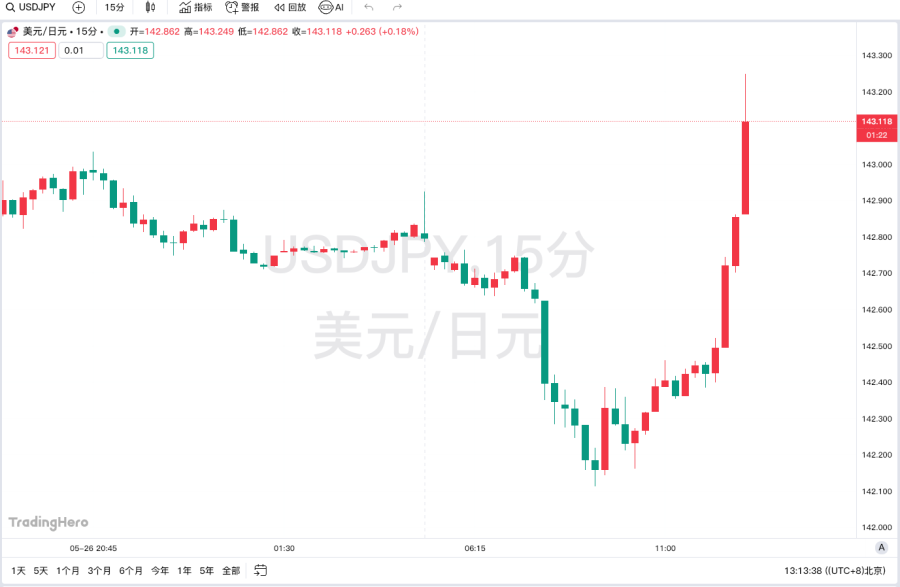
美指反弹 美元兑日元短线上扬近40点
news flash· 2025-05-27 05:19
Core Viewpoint - The US Dollar Index (DXY) is experiencing a rebound, with notable movements in various currency pairs, particularly the USD/JPY which has seen a significant short-term increase [1] Currency Movements - The US Dollar Index (DXY) has risen by 10 points, currently standing at 99.16 [1] - The Euro to US Dollar (EUR/USD) has decreased by 10 points, now at 1.3729 [1] - The British Pound to US Dollar (GBP/USD) has fallen by nearly 20 points, currently at 1.3541 [1] - The US Dollar to Japanese Yen (USD/JPY) has increased by nearly 40 points, now at 143.16 [1]

人民币只在中国叫“人民币”,出国变称呼了?这叫法确实高大上
Sou Hu Cai Jing· 2025-05-26 04:59
Group 1 - The core function of currency is to facilitate the exchange of goods and services, evolving from barter systems to a widely accepted medium of exchange [4][5] - The unification of currency in ancient China, initiated by Emperor Qin Shi Huang, laid a solid foundation for economic exchange and highlighted the importance of currency as a symbol of national strength [5] - The evolution of currency into more convenient forms like paper money and coins has made transactions easier and more efficient [7] Group 2 - The U.S. dollar dominates international trade as the primary settlement currency due to the significant influence of the U.S. economy, with exchange rates reflecting the relative economic strength of countries [9] - A country's currency issuance affects its exchange rate; excessive printing can lead to devaluation, impacting purchasing power and international standing [10] - The Chinese yuan (RMB) has become the fourth most circulated currency globally, symbolizing China's economic strength and increasing influence in international markets [11][12]

新加坡元升至近八个月高点,美元兑新加坡元报1.2825。美元兑马来西亚林吉特汇率再次下跌超过0.6%,报4.20。
news flash· 2025-05-26 01:38
Group 1 - The Singapore dollar has risen to a nearly eight-month high, with the USD/SGD exchange rate reported at 1.2825 [1] - The USD/Malaysian ringgit exchange rate has declined by over 0.6%, currently at 4.20 [1]
金融期货日报-20250523
Chang Jiang Qi Huo· 2025-05-23 02:21
Report Summary 1. Investment Ratings - No specific industry investment ratings are provided in the report. 2. Core Views - **Equity Index**: The Trump tax - cut bill barely passed in the House of Representatives and still faces challenges in the Senate. Fed理事沃勒 said the tax - cut bill triggered the selling of US Treasuries, and if tariffs stabilize, there may be an interest rate cut in the second half of the year. US May Markit manufacturing and services PMIs exceeded expectations and expanded, with the price index rising again. The Eurozone's May PMI unexpectedly contracted, and the service sector had its worst performance in 16 months. After the US - Japan finance ministers' meeting, the US said "no exchange - rate discussion, the current exchange rate reflects fundamentals", and Japan said "no discussion on US Treasuries". In the domestic market, the rotation is fast, the main driving force of the market is weak, and the equity index may fluctuate [1]. - **Treasury Bonds**: Recently, the market has entered a data vacuum zone, lacking new positive or negative factors, and oscillation has become the consensus. From the futures trend, the long - and short - side forces are evenly matched. During the oscillation period, when it touches the upper or lower limit of the range, there will be short - term confrontations between the long and short sides. Without incremental information or fundamental data guidance in the short term, the oscillation pattern is expected to continue, and the market may continue to focus on spread mining [3]. 3. Strategy Recommendations - **Equity Index**: Adopt a defensive and wait - and - see strategy [2]. - **Treasury Bonds**: Bullish in the short term [4]. 4. Market Review - **Equity Index**: The main contract futures of the CSI 300 index fell 0.05%, the main contract futures of the SSE 50 index rose 0.1%, the main contract futures of the CSI 500 index fell 0.7%, and the main contract futures of the CSI 1000 index fell 0.81% [6]. - **Treasury Bonds**: The 10 - year main contract rose 0.01%, the 5 - year main contract rose 0.0%, the 30 - year main contract fell 0.04%, and the 2 - year main contract rose 0.0% [9]. 5. Technical Analysis - **Equity Index**: The KDJ indicator of the Shanghai Composite Index shows a possible oscillating operation with adjustment risks [7]. - **Treasury Bonds**: The KDJ indicator of the T main contract shows an oscillating operation and may rebound [10]. 6. Futures Data | Date | Futures Variety | Closing Price (Yuan/Zhang) | Increase/Decrease (%) | Trading Volume (Lots) | Open Interest (Lots) | | --- | --- | --- | --- | --- | --- | | 2025 - 05 - 22 | CSI 300 Main Continuous | 3879.60 | - 0.05 | 52835 | 143884 | | 2025 - 05 - 22 | SSE 50 Main Continuous | 2715.40 | 0.10 | 28918 | 51342 | | 2025 - 05 - 22 | CSI 500 Main Continuous | 5614.80 | - 0.70 | 53832 | 116140 | | 2025 - 05 - 22 | CSI 1000 Main Continuous | 5950.00 | - 0.81 | 148619 | 195203 | | 2025 - 05 - 22 | 10 - Year Treasury Bond Main Continuous | 108.81 | 0.01 | 65126 | 156071 | | 2025 - 05 - 22 | 5 - Year Treasury Bond Main Continuous | 105.98 | - 0.00 | 47004 | 116615 | | 2025 - 05 - 22 | 30 - Year Treasury Bond Main Continuous | 119.52 | - 0.04 | 67554 | 82843 | | 2025 - 05 - 22 | 2 - Year Treasury Bond Main Continuous | 102.37 | - 0.00 | 34274 | 100554 | [12]
日本财务省外汇事务最高官员三村淳:日本和美国并未讨论具体的汇率水平。美国和日本认同,汇率的突然波动是不可取的。汇率应该由市场决定。
news flash· 2025-05-22 03:52
汇率应该由市场决定。 美国和日本认同,汇率的突然波动是不可取的。 日本财务省外汇事务最高官员三村淳:日本和美国并未讨论具体的汇率水平。 ...
5月22日电,日本财务官三村淳称,日美财长会谈未讨论汇率水平,重申汇率应由市场决定。
news flash· 2025-05-22 03:51
智通财经5月22日电,日本财务官三村淳称,日美财长会谈未讨论汇率水平,重申汇率应由市场决定。 ...
财长不谈汇率!日元升值之路已被美国“盖章”认定?
Jin Shi Shu Ju· 2025-05-22 02:50
根据美国财政部的一份声明,美国财长贝森特和日本财务大臣加藤胜信在加拿大举行的一次会议中,没有讨论外汇水平。这一消息导致日元周四开盘走弱, 但随后重回强势。 这份声明有助于加藤胜信降低日元快速波动的风险,此前日本财务省在过去几年一直努力阻止日元贬值。 此次会议的结果表明,美国对日元升值没有重大异议,此前美国总统特朗普曾指责日本通过压低货币价值来获取不公平优势。 然而,日元的任何大幅升值都可能增加日本陷入经济衰退的可能性,尤其是在两国继续贸易协议谈判之际,关税继续打击日本汽车制造商。 强势货币将挤压企业利润和工资增长势头,因为贸易担忧已经损害了消费者信心。日本经济上季度出现萎缩,最新的贸易数据显示,出口可能继续拖累经济 增长。 美国财政部于周三表示,贝森特和加藤胜信"重申了他们的共同信念,即汇率应由市场决定,并且目前美元兑日的汇率反映了基本面。" 两位官员在加拿大班夫举行的七国集团(G7)财长和央行行长会议期间举行了会晤。 财政部表示,贝森特和加藤胜信讨论了与美日经济关系相关的问题,包括全球安全以及两国正在进行的双边贸易谈判。 加藤胜信在双边会谈后在加拿大告诉记者:"我们得以深化关于货币政策基本思路的讨论。"他补 ...
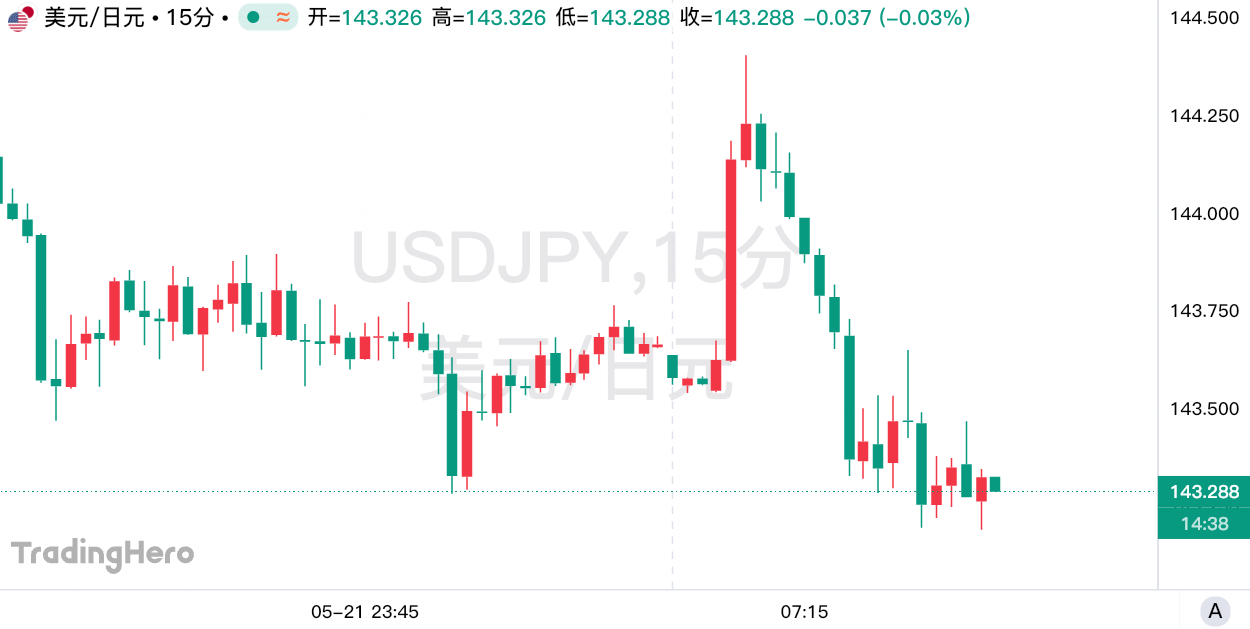
美元/日元短线拉升40多点,升破144关口。此前美国和日本财长讨论了汇率问题。
news flash· 2025-05-21 22:11
美元/日元短线拉升40多点,升破144关口。此前美国和日本财长讨论了汇率问题。 ...