人口老龄化

Search documents
欠发达地区如何应对老龄化
Jing Ji Ri Bao· 2025-04-28 22:13
地可考虑强化政策导向、财政投入的示范引导作用,以土地、税费、金融等配套政策降低准入门槛,搭 建跨区域产业协作平台,营造有利于养老产业发展的良好环境。 (作者系黑龙江省中国特色社会主义理论体系研究中心特聘研究员) 人口老龄化是世界人口发展的必然趋势。当前,我国人口老龄化进程加快,深度影响经济社会发展走 向。今年的《政府工作报告》明确提出,积极应对人口老龄化,完善发展养老事业和养老产业政策机 制。需要注意的是,我国人口老龄化在不同地区、不同领域的影响呈现明显的差异性,应对方法也应有 所不同。《中共中央国务院关于加强新时代老龄工作的意见》提出"老龄化风险梯次应对",意在强调要 根据人口老龄化风险和挑战的大小、范围、缓急程度等因素梯次配置应对策略。那么,为什么要梯次应 对?对欠发达地区而言,该如何更好应对人口老龄化? 人口老龄化,一般来讲,是指人口结构转变的动态过程,表现为老年人口在总人口中的比例不断上升, 但并不等同于风险和挑战。人口老龄化的风险和挑战,是指在这个过程中扩散出的可能对社会造成的不 确定损失,这种不确定损失,会因应对能力的不同而不同。衡量一个区域、一个领域人口老龄化带来的 风险和挑战,既要看老龄化的影 ...
800名高净值投资者共话投资机遇——2025财富论坛暨国泰海通证券重庆分公司揭牌活动举行
Sou Hu Cai Jing· 2025-04-19 11:06
Core Insights - The event marked the unveiling of Guotai Haitong Securities' Chongqing branch, emphasizing the importance of financial services in supporting local economic development [1][5]. Group 1: Company Developments - Guotai Haitong Securities Chongqing branch aims to leverage opportunities and contribute to the high-quality development of Chongqing's economy [1][5]. - The branch is positioned to provide diverse and efficient financial services to enhance the economic and social development of the Jiangbei District and Chongqing [5]. - The event was attended by nearly 800 high-net-worth investors and representatives from various financial institutions, indicating strong interest and support for the new branch [6]. Group 2: Industry Context - Chongqing is recognized as a key city for high-quality development, with the local government prioritizing the financial industry as a crucial pillar for growth [5]. - The forum highlighted the undervaluation of state-owned enterprises (SOEs) in the national economy, with SOEs contributing nearly 50% of profits and dividends in the A-share market [6]. - The increasing necessity for self-sufficiency in technology is expected to keep the tech sector active, while the current asset valuation environment presents a favorable opportunity for investment in Chinese assets [6].



简析“走出去”养老以及护理人员短缺两大难题
Cai Jing Wang· 2025-04-15 05:55
Group 1: Aging Population in Japan - Japan has the highest aging population globally, with 36.25 million elderly people as of September 2024, accounting for 29.3% of the total population, marking a record high since 1950 [1] - By 2050, the number of elderly individuals without spouses or close relatives is projected to reach 4.48 million, representing 11.5% of the elderly population [1] Group 2: Shortage of Caregiving Workforce - Japan faces a severe shortage of caregiving personnel, with an average recruitment ratio of 1.03 across industries, while the caregiving sector averages 4.0, with some regions like Nara and Tokyo reaching 5.86 and 6.15 respectively [2] - The caregiving workforce gap is expected to reach approximately 320,000 by 2025 and 690,000 by 2040 [2] Group 3: Government Initiatives - The Japanese government has implemented various policies to attract foreign caregivers, including bilateral EPA agreements and specific visa categories for caregiving roles [3][4] - Despite these efforts, issues such as high turnover rates and cultural barriers hinder the effectiveness of these initiatives [3][4] Group 4: Challenges for Foreign Caregivers - Foreign caregivers face significant challenges, including language barriers and cultural differences, which complicate their integration into the Japanese workforce [3] - The slow wage growth in Japan's caregiving sector diminishes its attractiveness to foreign workers, leading to dissatisfaction and increased instances of workers going missing [4] Group 5: Outbound Elderly Migration - Japan has seen an increase in elderly citizens relocating to Southeast Asian countries for retirement, with around 1.31 million Japanese living abroad as of October 2022, including approximately 200,000 seniors [5] - However, the number of retirees moving abroad is minimal compared to Japan's large elderly population, making it an insufficient solution to the aging crisis [5] Group 6: Adaptation Challenges for Japanese Seniors Abroad - Japanese seniors face adaptation challenges when relocating, including climate, dietary differences, and social integration, which can lead to feelings of isolation [6][7] - The reality of living abroad may not meet the expectations of Japanese retirees, complicating their decision to move [6][7] Group 7: Overall Implications - The aging population and the shortage of caregiving resources present a significant challenge for Japan, with current strategies of attracting foreign workers or encouraging outbound migration unlikely to provide a comprehensive solution [2][5][6]
2024年多省份人口增长 广东增幅居首
Zhong Guo Jing Ying Bao· 2025-04-11 20:05
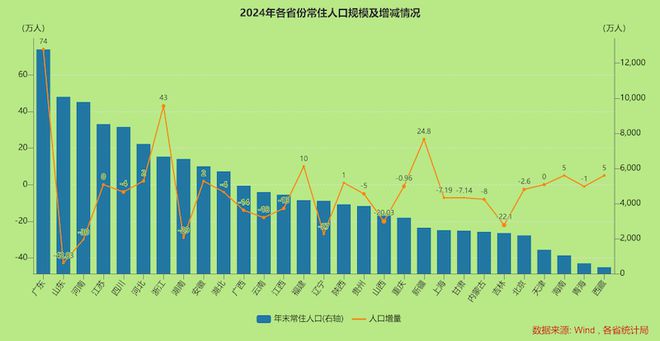
Core Insights - The report highlights the population changes across various provinces in China for the year 2024, indicating that most provinces have experienced a decline in their resident population, with only a few showing growth [2][3]. Population Growth and Decline - Among the 29 provinces that have reported their 2024 population data, only 9 provinces have seen an increase in their resident population, with Guangdong leading the growth by adding over 700,000 residents [2][4]. - The provinces with a population increase of 100,000 or more are limited to four, with Guangdong's growth being the most significant [2][3]. - Conversely, 9 provinces have reported a decline of over 100,000 residents, with Shandong experiencing the largest decrease at approximately 428,300 residents [11][12]. Guangdong Province - Guangdong's resident population reached 127.8 million, marking an increase of 740,000 from the previous year, reclaiming its position as the province with the highest population growth [4][5]. - The natural population growth in Guangdong contributed significantly to its overall increase, with a birth rate of 8.89‰ and a natural growth rate of 3.69‰ [5]. Zhejiang Province - In contrast, Zhejiang's population growth relied more on mechanical growth rather than natural increase, with a negative natural growth rate reported for both 2023 and 2024 [6][9]. - The province's population increased by 430,000 in 2024, but it still faced challenges with a declining birth rate [6][9]. Northeast Region - The northeastern provinces, particularly Jilin and Liaoning, have seen a resurgence in population decline, with both provinces losing over 200,000 residents in 2024 [7][12]. - The demographic challenges in these provinces are exacerbated by high elderly dependency ratios and low birth rates, contributing to their ongoing population decline [8][9]. Shandong Province - Shandong has faced continuous population decline for three consecutive years, with a reported decrease of 428,300 residents in 2024, the highest in the country [11][12]. - The province's natural growth rate has been negative for three years, indicating a concerning demographic trend [11]. Other Provinces - Other provinces experiencing significant population declines include Henan, Hunan, and Jiangxi, each losing over 100,000 residents in 2024 [12]. - The report indicates that the central region is particularly affected, with most provinces showing a downward trend in population [12].
中部人口“缩水”近百万,哪些省份正在回流?
Mei Ri Jing Ji Xin Wen· 2025-04-07 15:56
Core Insights - The article discusses the population changes across various provinces in China for the year 2024, highlighting significant trends in population growth and decline among different regions [1][5]. Group 1: Population Growth and Decline - 28 provinces have reported their permanent resident population data for the end of 2024, with 8 provinces experiencing population growth, 2 remaining stable, and 18 witnessing declines [1]. - Guangdong has reclaimed its position as the province with the highest population increase, adding 740,000 residents, surpassing Zhejiang [6][7]. - Shandong has seen the largest population decline, losing 428,000 residents in 2023, marking it as the province with the most significant drop [1][6]. Group 2: Regional Analysis - In the central region, only Anhui has reported a population increase, while the other five provinces collectively lost 960,000 residents [5][13]. - Sichuan and Henan, both major economic provinces, have also experienced population declines, with Sichuan losing 40,000 and Henan losing 300,000 residents [10][13]. - The northeastern provinces, particularly Liaoning and Jilin, which had seen a brief population inflow in 2023, are now again facing outflows, with Liaoning losing 49,000 and Jilin losing 108,000 residents in 2024 [17][21]. Group 3: Factors Influencing Population Changes - Population changes are influenced by both natural growth (births minus deaths) and migration patterns [5][6]. - Guangdong's population growth is attributed to a high birth rate, with 1.13 million births in the previous year, making it the only province with over a million births [6][7]. - In contrast, Shandong's population decline is exacerbated by a net outflow of over 430,000 residents in two years, raising concerns about its population potentially falling below 100 million [9][17]. Group 4: Policy Responses - Jiangsu has introduced 15 measures to promote childbirth, including direct financial support for families [8]. - Both Hunan and Hubei are implementing strategies to attract and retain young talent, focusing on improving living conditions and reducing the cost of raising children [15].

2024人口格局变了!经济第一大省重返第一,经济第二大省陷入停滞!什么信号?
21世纪经济报道· 2025-04-01 09:05
Core Viewpoint - The article discusses the changing population dynamics across various provinces in China in 2024, highlighting both growth and decline trends in different regions, influenced by economic factors and demographic shifts. Summary by Sections Population Growth Trends - In 2024, 25 provinces have reported population data, with 8 provinces showing positive growth. Notably, Guangdong ranks first in total population growth, while Zhejiang leads in mechanical growth [1][3][6]. - Some provinces that previously experienced continuous population growth, such as Jiangsu, have now reached zero growth, while others like Shaanxi, Anhui, and Fujian have rebounded [3][10]. Economic Factors Influencing Population Movement - The decline in cross-province migration is attributed to narrowing regional economic disparities and high living costs in major cities, which have reduced their attractiveness [4]. - Guangdong and Zhejiang maintain their appeal due to strong economic structures and development potential, particularly in digital economy and manufacturing [4][9]. Population Statistics - As of March 31, 2024, Guangdong's population is reported at 127.8 million, with a net increase of 740,000, while Shandong and Jiangsu show negative growth trends [6][9]. - In 2024, Shandong's natural population growth rate is -1.67‰, indicating a decline of 16,800 people, while Jiangsu's population remains stable compared to the previous year [9][10]. Demographic Changes and Aging Population - The article highlights the relationship between population changes and the aging demographic, with provinces like Jiangsu showing a significant proportion of elderly residents, impacting natural growth rates [11][18]. - The need for improving population structure through higher birth rates and attracting young talent is emphasized, as many regions face challenges due to aging populations [18][20]. Regional Variations and Strong Provincial Capitals - Some provinces, such as Shaanxi and Anhui, have seen a rebound in population due to the development of strong provincial capitals, which attract residents through diverse job opportunities and lower living costs compared to first-tier cities [14][16]. - The article notes that while some midwestern provinces are experiencing positive growth, eastern coastal regions remain the primary destinations for population inflow [17]. Policy Recommendations for Population Improvement - To address the challenges of an aging population, the article suggests enhancing public services related to childcare and healthcare, as well as implementing supportive policies for young families [20]. - Attracting young talent requires not only job opportunities but also a vibrant cultural environment that fosters a sense of belonging [20].

2025博鳌亚洲论坛|亚洲开发银行前行长中尾武彦:日本养老金模式可持续性正在承压
Bei Jing Shang Bao· 2025-03-26 09:47
2025博鳌亚洲论坛|亚洲开发银行前行长中尾武 彦:日本养老金模式可持续性正在承压 中尾武彦表示,亚洲在过去几十年间凭借庞大的人口和年轻的劳动力群体享受到了人口红利,成为全球 经济增长的重要引擎。然而,随着出生率持续下降和预期寿命显著提高,亚洲国家正面临快速老龄化带 来的严峻挑战:一方面,劳动力供应减少,老年抚养比上升,另一方面,医疗和护理成本也在急剧增 长。尤其随着人们寿命的延长,慢性病、高血压等健康问题愈发引起人们的重视,这也导致医疗开支和 养老金负担不断加重。 中尾武彦介绍,日本是亚洲较早进入老龄化社会的国家,目前实行"三支柱"养老结构:第一支柱是全民 覆盖的基本养老金,第二支柱是企业年金,第三支柱为个人或企业自主缴纳的养老金。然而,现收现付 与积累制双轨并行的日本养老金模式受资金池有限、人口下降和投资回报低等因素影响,其可持续性正 在承压。 中尾武彦建议,面对老龄化社会所带来的挑战,亚洲各国需寻求多元化的应对方案进行积极调整,如发 展护理机器人、推动产业结构调整等,来缓解人口老龄化对经济和社会带来的冲击。 北京商报讯(记者 岳品瑜 董晗萱)3月25日至3月28日,博鳌亚洲论坛2025年年会在海南博鳌举 ...
2025博鳌亚洲论坛|周小川:养老金改革是系统性工程,并非简单“资金填补”
Bei Jing Shang Bao· 2025-03-26 08:24
在3月25日举行的"人口老龄化与养老金改革"分论坛中,博鳌亚洲论坛副理事长周小川表示,养老金改 革的根本动因在于制度可持续性面临严峻挑战。当前部分省份已出现养老金入不敷出的问题,总量资金 失衡导致积累资金逐渐耗尽。国际经验表明,养老金制度初始设计的预见性至关重要,但中国从计划经 济向市场经济转型的特殊背景,使得社保体系"一步到位优化"难度极大。全球多数国家同样面临养老金 危机,改革压力具有普遍性。 2025博鳌亚洲论坛|周小川:养老金改革是系统性 工程,并非简单"资金填补" 北京商报讯(记者 岳品瑜 董晗萱)3月25日至3月28日,博鳌亚洲论坛2025年年会在海南博鳌举行。 养老金改革受许多外围因素影响,其一是企业负担。周小川指出,2019年企业养老金缴纳比例从20%降 至16%,既是国内经济下行压力下的应对之举,也受到国际竞争环境的影响。美国特朗普政府推行减税 政策后,中国通过降低增值税和企业养老金费率以增强企业竞争力。 老龄化加剧背景下,个人养老规划的不确定性进一步凸显。周小川提到,现有养老金替代率(约40%— 50%)难以满足退休生活需求,若想达到国际平均70%的水平,需依靠"第三支柱"补充。应增强第三 ...
周小川:养老金改革要注意到企业竞争力的需求、个人对劳动的积极性等
Peng Pai Xin Wen· 2025-03-26 07:05
Group 1 - The core viewpoint is that pension reform in China has made significant achievements, but sustainability remains a critical issue, with various pressures and dissatisfaction still present [3][4] - Pension reform is a complex system project influenced by multiple factors, including enterprise competitiveness, individual labor motivation, and the relationship between central and local finances [4][5] Group 2 - The first factor is enterprise competitiveness, which is closely related to the pension system. Increased international competition or domestic economic downturns can heighten pressure on pension reforms [5] - The second factor is individual labor motivation, which can be affected by issues such as retirement for homemakers and the financial burden on young workers, potentially leading to decreased work incentives [5][6] - The third factor involves the relationship between central and local finances, highlighting the need for a clear understanding of pension funding mechanisms and the importance of fiscal discipline at the provincial level [7]

从老龄化到深度老龄化:美国72年,日本25年,中国仅21年
Bei Jing Ri Bao Ke Hu Duan· 2025-03-25 09:52
Core Viewpoint - The aging population is a significant global issue, with Asia experiencing rapid aging compared to other regions, necessitating reforms in pension systems and the development of the elderly care industry [1][3][4]. Group 1: Aging Population Statistics - As of 2023, 14.2% of the population in Asia, including China, is aged 60 and above, marking the entry into an aging society [3]. - Predictions indicate that by 2050, the number of individuals aged 60 and above in the Asia-Pacific region will reach 1.3 billion [3]. - The transition from an aging society to a deep aging society is notably rapid in China, taking only 21 years from 2001 to 2021, compared to longer durations in Western countries [3]. Group 2: Policy Responses and Reforms - Countries in Asia are focusing on maintaining pension sustainability and fostering the elderly care industry as key policy priorities [4]. - Measures being implemented include delaying retirement age, increasing pension benefits, and promoting private pension development [4]. - Specific examples of reforms include Japan's approach of delaying retirement age and adjusting pension growth rates, while South Korea has increased pension contribution rates from 9% to 13% [4]. - China is also advancing reforms such as nationwide pension coordination and the establishment of a third pillar for pensions, alongside the implementation of a delayed retirement system starting January 2023 [4].