
人民币国际化

Search documents
人民银行:持续完善宏观审慎和金融稳定委员会工作机制,创新丰富政策工具箱
Sou Hu Cai Jing· 2026-01-26 12:53
会议要求,2026年宏观审慎工作要继续按照构建覆盖全面的宏观审慎管理体系部署,强化中央银行宏观 审慎管理功能,持续完善宏观审慎和金融稳定委员会工作机制,逐步拓展宏观审慎政策覆盖范围,前瞻 性研判系统性金融风险隐患,创新丰富政策工具箱,维护金融市场稳健运行和金融体系整体稳定。以服 务构建新发展格局为导向,进一步完善人民币跨境使用政策,促进货物贸易便利化,优化人民币清算行 布局,更好发挥货币互换作用,发展人民币离岸市场,支持上海国际金融中心建设,更好满足各类主体 人民币交易结算、投融资、风险管理等需求。 北京商报讯(记者 廖蒙)1月26日,据中国人民银行官网,中国人民银行于1月22日召开2026年宏观审 慎工作会议,会议总结2025年宏观审慎管理和跨境人民币业务工作,分析当前形势,部署2026年工作。 会议认为,2025年中国人民银行加快构建宏观审慎管理体系,完善治理机制,夯实宏观审慎监测评估的 规范化、标准化和实战化能力,加强系统重要性金融机构、金融市场、跨境资本流动等重点领域宏观审 慎管理。推进人民币国际化,完善人民币跨境使用安排,优化货币互换和清算行网络,强化人民币融资 货币功能,进一步支持贸易投资便利化, ...
【金融街发布】中国人民银行召开2026年宏观审慎工作会议
Zhong Guo Jin Rong Xin Xi Wang· 2026-01-26 12:40
Core Viewpoint - The People's Bank of China (PBOC) is focusing on enhancing its macro-prudential management system and promoting the internationalization of the Renminbi (RMB) in 2026, following the guidelines from the 20th National Congress and the Central Economic Work Conference [1][2]. Group 1: Macro-Prudential Management - In 2025, the PBOC accelerated the construction of a macro-prudential management system, improving governance mechanisms and enhancing the standardized and practical capabilities of macro-prudential monitoring and assessment [1]. - Key areas of focus include systemically important financial institutions, financial markets, and cross-border capital flows [1]. Group 2: Renminbi Internationalization - The PBOC aims to further promote the internationalization of the RMB by optimizing cross-border usage arrangements and enhancing the network of currency swaps and clearing banks [2]. - The goal is to strengthen the RMB's financing capabilities and support trade and investment facilitation, thereby improving service to the real economy [1][2]. Group 3: Future Work Directions - The macro-prudential work in 2026 will continue to build a comprehensive management system, enhance the central bank's macro-prudential management functions, and expand the coverage of macro-prudential policies [2]. - There will be a focus on forward-looking assessments of systemic financial risks and the innovation of policy tools to maintain stable financial markets and overall financial system stability [2].

央行最新会议:维护金融市场稳健运行
证券时报· 2026-01-26 12:36
2026年1月22日,中国人民银行召开2026年宏观审慎工作会议,会议以习近平新时代中国特 色社会主义思想为指导,深入学习贯彻党的二十届四中全会和中央经济工作会议精神,落实 中国人民银行工作会议要求,总结2025年宏观审慎管理和跨境人民币业务工作,分析当前形 势,部署2026年工作。中国人民银行党委委员、副行长陶玲出席会议并讲话。 会议认为,2025年中国人民银行加快构建宏观审慎管理体系,完善治理机制,夯实宏观审慎 监测评估的规范化、标准化和实战化能力,加强系统重要性金融机构、金融市场、跨境资本 流动等重点领域宏观审慎管理。推进人民币国际化,完善人民币跨境使用安排,优化货币互 换和清算行网络,强化人民币融资货币功能,进一步支持贸易投资便利化,持续提高服务实 体经济能力。 会议要求,2026年宏观审慎工作要继续按照构建覆盖全面的宏观审慎管理体系部署,强化中 央银行宏观审慎管理功能,持续完善宏观审慎和金融稳定委员会工作机制,逐步拓展宏观审 慎政策覆盖范围,前瞻性研判系统性金融风险隐患,创新丰富政策工具箱,维护金融市场稳 健运行和金融体系整体稳定。以服务构建新发展格局为导向,进一步完善人民币跨境使用政 策,促进货物 ...


央行:前瞻性研判系统性金融风险隐患,创新丰富政策工具箱
Sou Hu Cai Jing· 2026-01-26 12:30
会议要求,2026年宏观审慎工作要继续按照构建覆盖全面的宏观审慎管理体系部署,强化中央银行宏观 审慎管理功能,持续完善宏观审慎和金融稳定委员会工作机制,逐步拓展宏观审慎政策覆盖范围,前瞻 性研判系统性金融风险隐患,创新丰富政策工具箱,维护金融市场稳健运行和金融体系整体稳定。以服 务构建新发展格局为导向,进一步完善人民币跨境使用政策,促进货物贸易便利化,优化人民币清算行 布局,更好发挥货币互换作用,发展人民币离岸市场,支持上海国际金融中心建设,更好满足各类主体 人民币交易结算、投融资、风险管理等需求。 责编:王时丹 | 审核:李震 | 监审:古筝 【大河财立方消息】据中国人民银行1月26日消息,1月22日,中国人民银行召开2026年宏观审慎工作会 议,总结2025年宏观审慎管理和跨境人民币业务工作,分析当前形势,部署2026年工作。中国人民银行 党委委员、副行长陶玲出席会议并讲话。 会议认为,2025年中国人民银行加快构建宏观审慎管理体系,完善治理机制,夯实宏观审慎监测评估的 规范化、标准化和实战化能力,加强系统重要性金融机构、金融市场、跨境资本流动等重点领域宏观审 慎管理。推进人民币国际化,完善人民币跨境使用 ...
央行:2026年宏观审慎工作要继续按照构建覆盖全面的宏观审慎管理体系部署
Zheng Quan Shi Bao Wang· 2026-01-26 12:17
人民财讯1月26日电,2026年1月22日,中国人民银行召开2026年宏观审慎工作会议,落实中国人民银行 工作会议要求,总结2025年宏观审慎管理和跨境人民币业务工作,分析当前形势,部署2026年工作。中 国人民银行党委委员、副行长陶玲出席会议并讲话。 会议要求,2026年宏观审慎工作要继续按照构建覆盖全面的宏观审慎管理体系部署,强化中央银行宏观 审慎管理功能,持续完善宏观审慎和金融稳定委员会工作机制,逐步拓展宏观审慎政策覆盖范围,前瞻 性研判系统性金融风险隐患,创新丰富政策工具箱,维护金融市场稳健运行和金融体系整体稳定。以服 务构建新发展格局为导向,进一步完善人民币跨境使用政策,促进货物贸易便利化,优化人民币清算行 布局,更好发挥货币互换作用,发展人民币离岸市场,支持上海国际金融中心建设,更好满足各类主体 人民币交易结算、投融资、风险管理等需求。 会议认为,2025年中国人民银行加快构建宏观审慎管理体系,完善治理机制,夯实宏观审慎监测评估的 规范化、标准化和实战化能力,加强系统重要性金融机构、金融市场、跨境资本流动等重点领域宏观审 慎管理。推进人民币国际化,完善人民币跨境使用安排,优化货币互换和清算行网络, ...
人民币中间价“破7” 国际化进程迈入新窗口期
2 1 Shi Ji Jing Ji Bao Dao· 2026-01-26 12:16
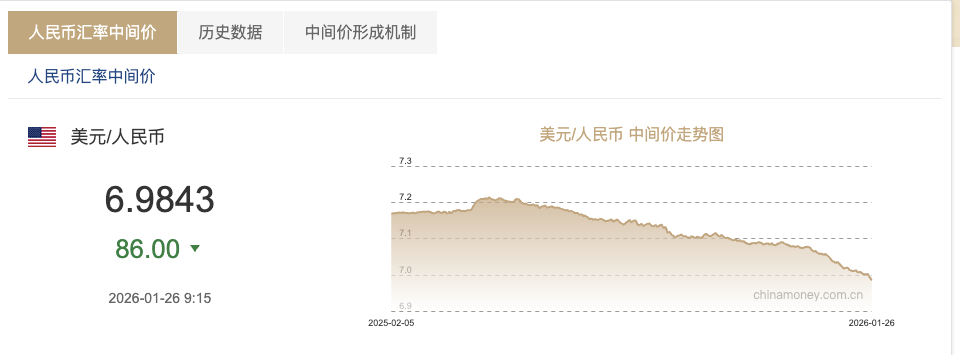
21世纪经济报道记者 唐婧 继在岸、离岸人民币兑美元汇率双双升破7关口之后,人民币对美元汇率中间价亦悄然破7。 1月26日,中国人民银行授权中国外汇交易中心公布,当日银行间外汇市场人民币汇率中间价为1美元对人民币6.9843元,相较前一交易 日中间价6.9929,调升86基点,续创2023年5月以来的新高。 人民币汇率中间价是指中国外汇交易中心根据中国人民银行授权,每日上午9:15发布的基准汇率,覆盖人民币对美元、欧元、日元、港 元、英镑等主要外汇币种。中间价由中国外汇交易中心根据做市商报价计算得出,是银行间外汇交易市场和银行挂牌汇价的重要参考指 标。 人民币兑美元汇率升值对个人和企业都会带来深刻影响。居民跨境消费、留学和旅游成本降低,换汇时可兑换更多美元。而对持有美元 存款或美元理财产品的居民来说,其资产以人民币计价会出现缩水。对美出口企业的价格竞争力可能会相对削弱,结汇环节的利润有所 减少。相反,依赖进口原材料、零部件的制造业企业则受益于进口成本降低,改善企业盈利状况。 不过,从高层表态来看,人民币汇率升值对进出口贸易的影响整体有限。中国人民银行副行长邹澜此前在国新办新闻发布会上表示,外 贸企业以人民币开 ...
人民币汇率中间价创32个月新高
21世纪经济报道· 2026-01-26 11:46
记者丨 唐婧 编辑丨曾芳 继在岸、离岸人民币兑美元汇率双双升破7关口之后,人民币对美元汇率中间价亦悄然破7。 1月26日,中国人民银行授权中国外汇交易中心公布,当日银行间外汇市场人民币汇率中间价 为1美元对人民币6.9843元, 相较前一交易日中间价6.9929,调升86基点,续创2023年5月 (32个月)以来的新高。 图/21世纪经济报道 还有多名受访人士告诉记者,美联储降息背景下美元指数持续走弱、岁末年初时点企业结汇需 求上升,以及中国经济基本面整体形势改善是本轮人民币汇率升值的重要动力,且部分积极因 素仍将延续至2026年。 例如,长城证券首席经济学家汪毅预计,展望2026年,弱美元格局或将延续,美联储继续降息 成为大概率事件,而中国经济和出口存在支撑,人民币仍然处于双向波动区间,但升值节奏可 能转为平稳。 人民币避险属性进一步增强 人民币汇率中间价是指中国外汇交易中心根据中国人民银行授权,每日上午9:15发布的基准汇 率,覆盖人民币对美元、欧元、日元、港元、英镑等主要外汇币种。中间价由中国外汇交易中 心根据做市商报价计算得出,是银行间外汇交易市场和银行挂牌汇价的重要参考指标。 人民币兑美元汇率升值对 ...
自贸债:制度型开放的新引擎
Guo Ji Jin Rong Bao· 2026-01-26 11:37
Core Insights - The Free Trade Zone Bonds (referred to as "FTZ Bonds") have evolved over the past decade into a key innovation for China's financial openness, establishing a market ecosystem characterized by cross-border features and risk resilience [1][3] - The issuance of FTZ Bonds has created efficient channels for cross-border financing for the real economy and has accumulated valuable experiences for institutional openness [1][3] - Future developments should draw on experiences from mature markets like London and Hong Kong to further activate market potential and allow domestic and foreign capital to share in China's opportunities [1][3] Market Development - FTZ Bonds serve as a "two-way bridge" linking domestic and foreign capital markets, with a cumulative issuance of approximately 130 billion yuan by June 2025, attracting diverse issuers and investors [3] - The first issuance of the "Yulan Bond" in January 2026 marked a significant step in providing offshore financing paths for financial institutions in the FTZ, with a cumulative issuance exceeding 22 billion yuan and a year-on-year growth rate of over 40% [3][4] Strategic Focus - FTZ Bonds should focus on three core areas: supporting national strategies, empowering the real economy, and promoting the internationalization of the renminbi [4] - The market still has potential for growth, with limited participation channels for domestic investors and high costs for foreign investors due to issues like custody and settlement mechanisms [4] Legislative Framework - The introduction of the "Regulations on the Development of FTZ Offshore Bond Business" in December 2025 marks a new phase for the FTZ Bond market, providing clear institutional expectations and defining the boundaries of FTZ offshore bonds [5][6] - The regulations aim to enhance market governance through a combination of government oversight, regulatory collaboration, and industry self-discipline [5][6] Future Directions - The FTZ Bond market should continuously adapt to market needs and international experiences, focusing on functional orientation, flexible institutional frameworks, and optimizing key mechanisms [6][7] - Efforts should be made to lower participation costs for international investors and broaden participation channels for domestic investors, including integrating FTZ Bonds into liquidity asset measurements for commercial banks [9][10] Ecosystem Development - The development of a professional intermediary service system is essential for enhancing the efficiency of the entire service chain, including underwriting, legal, rating, and auditing services [10] - Risk management mechanisms must be strengthened, including monitoring cross-border capital flows and establishing clear rules for investor rights protection [11]
美债突破38万亿, 中美博弈又一轮升级,在香港人民币直接挂钩黄金
Sou Hu Cai Jing· 2026-01-26 11:06
Core Viewpoint - The article discusses the transformation of Hong Kong into a financial hub that allows the direct exchange of the Chinese yuan for physical gold, thereby reducing reliance on the US dollar and challenging the existing financial order [1][3][5]. Group 1: RMB Internationalization Challenges - Prior to establishing the gold vault, the internationalization of the RMB faced significant hurdles, as overseas investors had limited options for utilizing RMB outside of China [3]. - As of the end of 2024, offshore RMB deposits in Hong Kong exceeded 1 trillion yuan, with net inflows from southbound funds surpassing 785 billion HKD, indicating a substantial but stagnant capital pool [3]. - The current system forces RMB holders to constantly monitor exchange rates to convert back to USD, highlighting the currency's status as a "shadow currency" [3]. Group 2: New Financial Mechanisms - The newly upgraded "multi-functional gold financial service center" in Hong Kong allows RMB holders to directly exchange their currency for physical gold without needing to convert to USD [5]. - This mechanism fundamentally alters the perception of RMB, transforming it from a currency that can only be exchanged for USD to one that can be directly converted into gold [5]. - Hong Kong is also advancing the issuance of "digital gold tokens" for settling transactions in commodities like oil and chips, bypassing traditional systems like SWIFT [5][7]. Group 3: Strategic Positioning of Hong Kong - The financial dynamics in Hong Kong are influenced by its currency peg to the USD and its common law system, which provide a familiar interface for international capital [9][11]. - The dual system of pegging HKD to USD while linking RMB to gold positions Hong Kong as a buffer in the US-China financial rivalry [13]. - This strategy aims to transition Hong Kong from a financing center to a pricing center, attracting global investors to trade gold directly in RMB [13]. Group 4: Ambitious Gold Reserve Goals - Hong Kong plans to increase its gold reserves to 2,000 tons within three years, which would nearly match the gold reserves of the People's Bank of China [17]. - This significant accumulation of gold is not merely for storage but aims to establish Hong Kong as an independent "gold pricing hub" in the international market [17][18]. - The ultimate goal is to shift global gold pricing power from New York and London to Shanghai and Hong Kong, facilitating transactions in RMB and physical gold [20].

中国拟向境外投资者开放镍、锂期货交易
Xin Lang Cai Jing· 2026-01-26 10:09
Group 1 - China will allow foreign investors to participate in domestic nickel and lithium futures trading, which is a significant move to enhance its influence in the global commodity market [1][3] - The China Securities Regulatory Commission announced that nickel and lithium carbonate futures and options are among the 14 futures and options to be opened up, although no specific timeline for the opening has been provided [1][3] - China aims to strengthen its pricing power in the global commodity market, which is currently dominated by international financial centers like London, Singapore, and New York [1][3] Group 2 - The Shanghai Futures Exchange has previously announced an international development plan that includes allowing foreign investors to use foreign currency as margin for participating in RMB-denominated futures trading [2][4] - Opening futures trading to foreign investors is expected to enhance China's pricing power in commodities and improve the risk management system for non-ferrous metals [2][4] - Previous efforts to open up commodity futures have had limited success, with RMB-denominated copper and crude oil futures failing to disrupt the dominance of international exchanges, while the Dalian Commodity Exchange's iron ore futures have seen some success since their opening [2][4]