
制度创新

Search documents
持续创新制度设计,推动资本市场回稳向好
2 1 Shi Ji Jing Ji Bao Dao· 2025-08-04 22:22
Group 1 - The core viewpoint of the meeting emphasizes enhancing the attractiveness and inclusiveness of China's capital market to consolidate its recovery and positive momentum [1][3] - Improving investment expectations is crucial for increasing market attractiveness, focusing on encouraging domestic and foreign capital to enter the market and enhancing the investment value of listed companies [1][2] - The meeting highlights the importance of a multi-layered capital market system to meet the diverse financing needs of different types and sizes of enterprises, ensuring support for various industries and protecting the rights of small investors [2][4] Group 2 - The capital market has shown significant improvement since the second quarter, with the Shanghai Composite Index rising from a low of 3040 points to over 3600 points, and the ChiNext Index increasing from 1756 points to over 2400 points, indicating a recovery in investor confidence [3][4] - Measures to consolidate the positive momentum of the capital market include expanding capital market adjustment tools, creating new financial instruments, and enhancing the liquidity support for central financial institutions [4] - The overall strategy aims to build a modern financial system that efficiently allocates resources, serves various entities, and balances risk and return through institutional innovation and market openness [4]
东方枢纽先行启动区年底前封闭运行 受邀境外人员免签 一次入区可停留30天 并可根据需要申请延期
Jie Fang Ri Bao· 2025-08-02 02:11
Core Points - The Shanghai Oriental Hub International Business Cooperation Zone allows global invitees with valid invitations to enter without a visa, staying for 30 days with the option to extend [1][3] - The zone aims to become a new high ground for institutional opening in China, showcasing Shanghai's role as a pioneer in reform and opening up [1][2] - The area covers approximately 0.88 square kilometers, strategically located near major transport hubs like Pudong International Airport and Shanghai East Station [2] Regulatory Framework - The management measures for the cooperation zone include the "Shanghai Oriental Hub International Business Cooperation Zone Management Measures," "Interim Measures for Customs Supervision of the Shanghai Oriental Hub," and "Interim Regulations on Access Management by the National Immigration Administration" [2][3] - The zone implements a "one line open, one line controlled" policy, extending from goods to natural persons, facilitating cross-border movement [2][3] Facilitation of Business Activities - The cooperation zone supports international business activities by allowing global invitees to enter without a visa, promoting business meetings, negotiations, and product launches [4] - It provides a full chain of services for international business exchanges and technological cooperation, enabling companies to engage in cross-border research and development [5] Infrastructure and Services - The zone is planning high-standard innovation and research facilities to support key industries such as biomedicine, integrated circuits, artificial intelligence, aerospace, and new materials [5] - It aims to enhance the internationalization of professional services, allowing foreign professionals with recognized qualifications to provide services in accounting, finance, law, and consulting [5] Continuous Innovation - The cooperation zone is positioned as a "testing ground" for institutional innovation, with plans to optimize regulations and services based on domestic and international best practices [6] - It will introduce multi-language services, international aviation services, and various payment methods to facilitate international business exchanges [6]
上海东方枢纽国际商务合作区:先行启动区今年内将封闭运行
Zhong Guo Xin Wen Wang· 2025-08-01 09:26
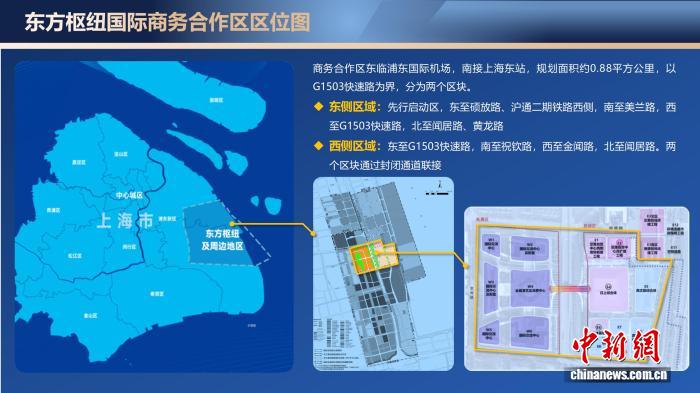
图为上海东方枢纽国际商务合作区区位图。(上海市人民政府新闻办公室 供图) 作为中国首个以"最大程度便利人员跨境流动"为目标的特定政策区域,上海东方枢纽国际商务合作区规 划面积约0.88平方公里,东临浦东国际机场,南接上海东站,东侧区域为先行启动区。根据建设时间 表,2025年,上海东方枢纽商务合作区先行启动区将完成封闭验收,基本功能落地运行;2028年实现全 域封闭运作,建成重点功能性基础设施;2030年全面建成。 《上海东方枢纽国际商务合作区管理办法》《中华人民共和国海关对上海东方枢纽国际商务合作区监管 暂行办法》和《国家移民管理局关于上海东方枢纽国际商务合作区通行管理规定(暂行)》已于近日发 布。 上述三项基础性制度分别明确了商务合作区的运行方式,人员与物品的管理办法,以及进出区域的具体 规定。 中新网上海8月1日电 (记者 李姝徵)在8月1日举行的上海市政府新闻通气会上,上海东方枢纽国际商务 合作区管理局副局长吴群峰介绍,目前有关上海东方枢纽国际商务合作区三项基础性制度已经发布,重 点项目建设正在推进,按计划2025年底前将实现先行启动区封闭运行。 在行李物品管理方面,上海东方枢纽国际商务合作区对入区境 ...

前海蛇口自贸片区连续四年“制度创新”第一 上半年进出口总值2608亿元
Shen Zhen Shang Bao· 2025-08-01 00:36
Core Insights - The total import and export value of the Qianhai Shekou Free Trade Zone reached 260.86 billion yuan in the first half of the year, marking an 11.5% year-on-year increase and accounting for about two-thirds of the total import and export value of Guangdong's free trade zones [1] - Qianhai Shekou Free Trade Zone has ranked first in China's Free Trade Zone Institutional Innovation Index for four consecutive years, with 104 institutional innovation achievements replicated nationwide [2] - The foreign trade container throughput at Shekou Port exceeded 8.19 million TEUs in the first half of the year, reflecting a 10.7% year-on-year growth [3] - Qianhai has established a cross-border supply chain mechanism leveraging its proximity to Hong Kong, with imports and exports to Hong Kong reaching 59.24 billion yuan, a 90.2% increase year-on-year [4] Group 1: Institutional Innovation - Qianhai Shekou Free Trade Zone has implemented innovative policies such as "one-time testing, one-time certification, and integrated passage," and has introduced offshore trade tax exemption policies [2] - The number of customs-registered enterprises in the zone has grown to nearly 12,000, a 5.7-fold increase since its establishment [2] Group 2: Smart Regulation - The "Mawan Model" at Mawan Smart Port, the first 5G green low-carbon port in the Guangdong-Hong Kong-Macao Greater Bay Area, has redefined customs clearance processes [3] - The introduction of intelligent inspection robots has significantly reduced inspection times for imported fruits and hazardous materials by 30%-50% [3] Group 3: Cross-Border Supply Chain - The "global procurement - Qianhai consolidation - Hong Kong direct delivery" model has improved warehouse utilization rates by 52.8% [4] - Siemens (Shenzhen) has established a global repair center in Qianhai, expected to operate by September 2024, facilitating the repair of nearly 2,000 magnetic resonance coils [4]
AI驱动 向“上海智造”跃升 龚正主持市政府常务会议
Jie Fang Ri Bao· 2025-07-31 01:49
Group 1: AI and Manufacturing - The Shanghai government is implementing the "AI + Manufacturing" initiative to accelerate the intelligent development of the manufacturing industry [1] - The strategy aims to leverage AI to drive the high-end, intelligent, green, and integrated upgrades of manufacturing, transitioning from "Shanghai Manufacturing" to "Shanghai Intelligent Manufacturing" [1] - The plan emphasizes innovation empowerment, focusing on lightweight technology trends and developing industrial-grade intelligent systems tailored for specific sectors [1] - A differentiated "AI +" implementation path will be established, promoting intelligent transformation in traditional manufacturing and focusing on smart terminals in emerging manufacturing [1] - The initiative aims to cultivate and expand intelligent solution service providers while reducing transformation costs for enterprises [1] Group 2: Logistics and High-end Medical Devices - The government has agreed on a plan to optimize and enhance the efficiency of logistics and customs clearance at Shanghai's aviation ports [2] - The plan includes redesigning the logistics clearance process to achieve faster clearance speeds and improved business environments, with a focus on smart and standardized operations [2] - A pilot project for an intelligent cargo station and centralized inspection center at Pudong International Airport is to be established, aiming for full coverage of International Air Transport Association CEIV certification categories [2] - The high-end medical device industry is also a focus, with plans to accelerate the entire chain from R&D to clinical application and manufacturing [2] - The government aims to support local innovative enterprises and cultivate internationally competitive leading companies in the high-end medical device sector [2]
我国外贸逆势实现“三个首次” 背后有哪些因素在支撑?
Yang Shi Xin Wen· 2025-07-31 01:29
Core Insights - China's foreign trade achieved remarkable results in the first half of the year, with three significant milestones: exports exceeding 13 trillion yuan, over 600,000 enterprises engaged in import and export activities, and private enterprises' import and export scale surpassing 12 trillion yuan for the first time [1][2][3] Group 1: Trade Growth and Infrastructure - The increase in foreign trade is supported by the addition of over 72 new shipping routes across major ports, including Shanghai, Ningbo-Zhoushan, and Qingdao [1] - The establishment of new trade cooperation groups and memorandums with countries like Sri Lanka, Bangladesh, Grenada, and Azerbaijan has contributed to trade facilitation [2] - The contribution rate of exports to Belt and Road Initiative countries reached 79.4% in the first half of the year, with emerging markets accounting for over 80% of the growth [2] Group 2: Role of Private Enterprises - Private enterprises accounted for 57.3% of China's foreign trade, with their import and export scale exceeding 12 trillion yuan, growing at a rate 4.4 percentage points higher than the national average [3][5] - High-tech products from private enterprises are increasingly meeting international market demands, exemplified by a private company in Henan that produced advanced electronic materials and achieved a 70% increase in export value [3][5] - The shift towards self-developed AI toys in Dongguan demonstrates the adaptability and innovation of private enterprises in response to market changes [4][5] Group 3: Institutional Innovation - Institutional innovations, such as the establishment of cross-border e-commerce pilot zones and optimized port layouts, have facilitated market expansion for foreign trade enterprises [5][6] - The successful export of bio-jet fuel from Jiangsu represents a new avenue for green exports, supported by a "white list" regulatory scheme [6] - The rapid growth of the bonded maintenance industry, particularly in Chengdu, highlights the increasing importance of maintenance services as a form of "invisible exports" [6][7]
福建自贸试验区:制度创新加力 “自贸经验”给力
Zhong Guo Chan Ye Jing Ji Xin Xi Wang· 2025-07-31 00:58
Group 1: Institutional Innovation and Economic Cooperation - The Fujian Free Trade Zone has introduced 647 institutional innovation achievements since its establishment in April 2015, with 38 being replicated nationwide and 482 promoted within the province [1] - Over the past decade, 126 institutional innovations related to Taiwan have been launched, including the recognition of certain professional qualifications for Taiwanese personnel [2][3] - The Pingtan area has developed a comprehensive service system for professional qualification recognition, benefiting nearly 10,000 Taiwanese individuals [3] Group 2: High-Quality Development through Industry Innovation - The Fujian Free Trade Zone has rapidly developed modern high-end industrial clusters, particularly in aviation maintenance, digital industries, and cross-border e-commerce [4] - The Xiamen area has established a leading third-party aviation maintenance base, with over 80% of its business coming from overseas [4][5] - Newland Technology Group, a key player in the digital technology sector, has successfully expanded its international market presence, benefiting from the Free Trade Zone's institutional innovations [6] Group 3: Cross-Border E-Commerce Growth - The Pingtan area has implemented a cross-border e-commerce export model that has significantly reduced inventory costs for merchants, achieving an export value of 9.71 billion yuan by April 2025 [7] - Since 2015, the Pingtan area has seen a substantial increase in cross-border e-commerce, with the value of bonded imports rising from 27 million yuan to 6.2 billion yuan by 2024, reflecting an annual growth rate of 72% [7] Group 4: Future Directions - The Fujian Free Trade Zone aims to deepen institutional openness and align with international high standards, focusing on generating more policy outcomes for comprehensive reform and high-level opening-up [8]
增长11.5%!前海蛇口自贸片区上半年进出口跃升
Sou Hu Cai Jing· 2025-07-30 22:49
Core Insights - The Shenzhen Qianhai Shekou Free Trade Zone achieved a total import and export value of 260.86 billion yuan in the first half of the year, marking an 11.5% year-on-year increase, and continues to lead Guangdong Province's free trade zones [2] - Qianhai has ranked first in China's Free Trade Zone Institutional Innovation Index for four consecutive years, showcasing its role as a strategic hub for domestic and international dual circulation [3] - The Qianhai area has seen a significant increase in customs-registered enterprises, with numbers growing 5.7 times since its establishment, and import-export volume rising from 71.2 billion yuan in 2015 to 536.7 billion yuan in 2024, averaging over 25% annual growth [3] Institutional Innovation - Qianhai's "Five Freedoms and One Orderly" approach has led to breakthroughs in trade facilitation and investment liberalization, making it a strategic support for national strategies and high-quality development [3] - The area has implemented a highly efficient customs clearance system, introducing policies such as "one inspection, one certification, one passage," and has pioneered offshore trade tax exemption policies [3] Smart Supervision - The Ma Wan Smart Port, the first 5G green low-carbon port in the Guangdong-Hong Kong-Macao Greater Bay Area, has redefined customs clearance processes with innovations like intelligent diversion and embedded supervision [4] - The port area achieved a foreign trade container throughput of over 8.19 million TEUs in the first half of the year, reflecting a 10.7% year-on-year increase [4] Deep-Hong Kong Collaboration and New Business Models - Qianhai leverages its proximity to Hong Kong to explore new high-level open paths, implementing a "front store and back warehouse" model to enhance cross-border supply chain mechanisms [6] - Hong Kong has become Qianhai's largest trading partner, with imports and exports reaching 59.24 billion yuan in the first half of the year, a 90.2% increase [6] Enterprise Services - Qianhai has established a rapid response mechanism for enterprises, addressing challenges related to customs, taxation, and foreign exchange, which has significantly boosted supply chain exports [7] - The area aims to continue integrating reforms for trade rules and enhance its role as a key connection point for domestic and international dual circulation [7]

我国外贸交出亮眼答卷,实现“三个首次”背后有哪些因素在支撑?
Yang Shi Wang· 2025-07-30 03:33
Core Insights - China's foreign trade achieved remarkable results in the first half of the year, with three historical milestones: exports exceeding 13 trillion yuan, over 600,000 enterprises engaged in import and export activities, and private enterprises' import and export scale surpassing 12 trillion yuan for the first time [1][6]. Group 1: Trade Growth and Infrastructure - Major ports in China, including Shanghai, Ningbo-Zhoushan, and Qingdao, added over 72 new shipping routes and more than 19 new destination ports in the first half of the year [3]. - The Western Land-Sea New Corridor has seen significant developments, including the successful operation of "railway container connections to roll-on/roll-off ships" and the regular operation of freight trains between China, Laos, and Thailand [5]. Group 2: Contribution of Private Enterprises - Private enterprises accounted for 57.3% of China's foreign trade in the first half of the year, with their import and export scale surpassing 12 trillion yuan, growing at a rate 4.4 percentage points higher than the national average [6][8]. - High-tech products from private enterprises have seen a 12.5% increase in exports, showcasing their adaptability and resilience in the international market [8]. Group 3: Policy and Innovation - Institutional innovations have played a crucial role in expanding market opportunities for foreign trade enterprises, including the establishment of cross-border e-commerce pilot zones and optimized port layouts [9]. - The successful export of bio-jet fuel, derived from previously undesirable waste oil, highlights the potential for green products in international markets, supported by new regulatory frameworks [9][11].
广西“三个着力”推动自贸试验区建设质效提升
Zhong Guo Chan Ye Jing Ji Xin Xi Wang· 2025-07-28 22:29
Group 1 - The Guangxi Zhuang Autonomous Region Market Supervision Administration is implementing national strategies to enhance the Free Trade Zone (FTZ) by focusing on deepening reforms and expanding openness [1] - The administration is innovating the business registration confirmation system, transitioning from subjective licensing to objective confirmation, and establishing a credit-based regulatory framework [1] - The market access commitment system is being piloted, significantly reducing approval time by 80% and processing steps by 50% [1] Group 2 - The construction of the China-ASEAN port inspection and testing system is accelerating, aiming to enhance the efficiency and capability of import and export inspections [2] - The establishment of a standardization cooperation center with ASEAN countries is ongoing, with over 28 million quality service interactions provided to foreign trade enterprises [2] - Collaboration with Hong Kong's STC is supporting the quality improvement of Guangxi products, resulting in over 1,050 enterprises obtaining high-end quality certification [2] Group 3 - International and bilateral standardization cooperation is being strengthened, particularly in key industries like rail transportation and new energy vehicles [3] - A cross-border express logistics standardization cooperation memorandum has been signed with Vietnamese enterprises, focusing on developing bilingual logistics standards [3] - The first national railway standard in Laos has been developed in collaboration with Chinese institutions, marking a significant milestone in standardization efforts [3]