量子计算

Search documents
加密货币立法倒计时!比特币脱钩全球流动性,量子计算威胁下12万人面临爆仓
Sou Hu Cai Jing· 2026-01-14 08:22
Group 1 - The core viewpoint of the articles highlights the importance of regulatory clarity for the cryptocurrency industry, with the U.S. Congress preparing to upgrade financial market regulations and the introduction of the "Digital Asset Clear Act" aimed at establishing clear rules for digital assets [1] - The recent market dynamics indicate a shift in institutional demand for Bitcoin, with over $100 million in capital inflows reported on January 12, breaking a previous trend of capital outflows [2] - The global cryptocurrency market has experienced significant volatility, with over 120,000 individuals facing liquidation in the past 24 hours, amounting to a total liquidation value of $685 million [1] Group 2 - The analysis indicates that Bitcoin's price movements have recently decoupled from global liquidity trends, suggesting a divergence from traditional monetary supply patterns [2] - Concerns regarding quantum computing's potential threat to cryptocurrency security have been raised, with predictions that Bitcoin may enter a "quantum event horizon" by 2025, posing risks to older wallets [3] - The current market sentiment shows low demand from small investors, contrasting with previous bullish trends where retail investors were more active [2]
超12万人爆仓!SEC主席点火,虚拟币“一夜冲天”!“致命威胁”乍现,影响几何?
券商中国· 2026-01-14 07:32
Core Viewpoint - The virtual currency market has experienced a significant surge, with Bitcoin surpassing $96,500 and Ethereum reaching $3,380, driven by regulatory developments, renewed institutional demand, and a weakening dollar [1][2][4]. Group 1: Market Surge - Bitcoin reached a peak of $96,500, while Ethereum saw an increase of nearly 8% in the last 24 hours [2]. - A total of 121,715 traders were liquidated, with a total liquidation amount of $685 million [2]. - The market is characterized by a lack of retail investor participation, contrasting with previous bull market behaviors [5]. Group 2: Regulatory Developments - SEC Chairman Paul Atkins emphasized the importance of the upcoming week for the cryptocurrency industry, indicating that Congress is set to upgrade financial market regulations [4]. - The Senate Banking Committee is expected to review the latest draft of the Digital Asset Market Clarity Act, which aims to establish clear rules for digital assets and protect retail investors [4]. Group 3: Institutional Demand - Institutional interest in Bitcoin is reportedly increasing, with over $100 million in capital inflows observed recently, breaking a trend of capital outflows [4]. - The net open interest in Bitcoin futures has shown positive growth, indicating increased participation in the derivatives market [4]. Group 4: Economic Factors - The recent U.S. inflation data suggests no additional inflationary pressures that would compel the Federal Reserve to adopt aggressive monetary policies, contributing to a weaker dollar [4]. - The DXY index, which measures the dollar's strength against other currencies, has stabilized around 99 points, limiting bullish momentum for the dollar [4]. Group 5: Emerging Threats - Bitcoin has recently decoupled from global M2 supply trends, indicating a potential shift in its relationship with traditional liquidity [5]. - Concerns have been raised regarding quantum computing's ability to potentially compromise cryptocurrency security, particularly older wallets [6].


20cm速递|创业板50ETF国泰(159375)涨超1.7%,科技主题与行业轮动受关注
Mei Ri Jing Ji Xin Wen· 2026-01-14 02:55
Group 1 - The core viewpoint of the article highlights the strong performance of the technology sector, particularly in the 0-1 stage themes such as quantum computing, nuclear fusion, and commercial aerospace, with significant attention on the commercial aerospace sector and its related industries [1] - The article notes that the ChiNext 50 ETF (159375) rose over 1.7%, reflecting the overall positive sentiment in the technology and emerging industries, which include electric equipment, new energy, pharmaceuticals, and computers [1] - The report emphasizes the importance of theme investments, recommending a focus on the space photovoltaic industry and AI application sectors, particularly the industrialization process of SpaceX's space photovoltaic initiatives and the deepening development of AI applications [1] Group 2 - The article mentions that the ChiNext 50 Index (399673) tracks the performance of 50 securities with high trading volumes in the ChiNext market, which are characterized by high growth potential and liquidity [1] - It is indicated that the sectors expected to perform well in the first half of the year include technology (0-1 technology themes and overseas computing/optical communication) and anti-involution sectors such as lithium batteries, chemicals, and non-ferrous metals, while advanced manufacturing and cyclical sectors are to be monitored in the second half [1]

量子计算环境支撑系统:稳定运行的“生命保障”
Zhong Zheng Wang· 2026-01-14 02:44
Core Insights - The quantum computing environment support system is essential for the stable operation of quantum computers, providing extreme operating conditions for quantum chips [1] - The dilution refrigerator is a critical component for superconducting quantum computing, requiring temperatures close to absolute zero to ensure the normal functioning of superconducting qubits [1] - The global market for dilution refrigerators is dominated by a few companies, creating high technical and market barriers [1] Industry Developments - The core goal of China's quantum computing environment support system development is self-sufficiency, aiming to overcome foreign technology blockades and promote the scaling of the quantum computing industry [2] - Significant progress has been made in the domestic production of core equipment, with companies collaborating to break the monopoly of foreign firms like Bluefors and Oxford Instruments [2] - The domestically developed SL series dilution refrigerator has achieved complete self-control in core refrigeration principles and key components, successfully being sold overseas [2] Investment Opportunities - The quantum computing environment support system has strong demand as a foundational element of the quantum computing value chain, with market demand expected to grow alongside the increase in superconducting qubit numbers and deployment scale [2] - The acceleration of domestic substitution and the continuous improvement of the supporting industrial chain will create certain investment opportunities in related segments [2] - Companies with core technological barriers and comprehensive solutions in the collaborative industrial chain are likely to seize industry development opportunities and become key investment targets in the quantum computing sector [2]
天弘基金2026年投资策略会:AI非泡沫,2050年将替代99.9%白领
Sou Hu Cai Jing· 2026-01-14 01:19
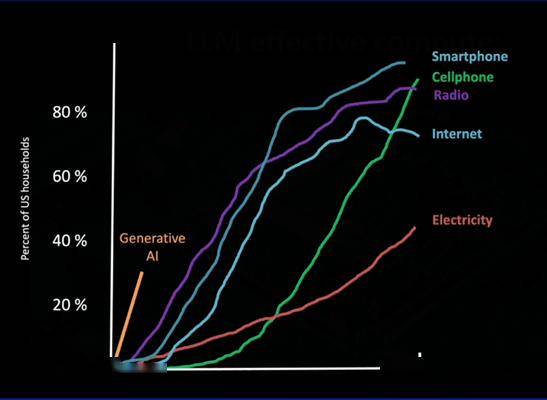
Core Viewpoint - AI is not in a bubble but is expected to replace 99.9% of white-collar jobs in the next two decades [1][5] Group 1: AI Evolution and Impact - The penetration rate of Generative AI has surpassed 30%, making it one of the fastest-adopted technologies globally [2][6] - Effective compute power is growing at an annual rate of approximately 6 to 16 times, potentially reaching 180 million times its current level in five years [3] - AI is evolving towards an "Innovator AI" stage, capable of independent work with minimal external instructions, expected to be achieved by late 2028 to early 2029 [3] Group 2: Overcoming Data Limitations - The global AI token generation is increasing at a rate of about 5 times per year, projected to reach 625 times its current scale in five years [4] - AI's ability to learn from self-generated data may help it overcome the "data wall," which refers to the limited growth of useful information on the internet [4] Group 3: AI's Role in Workforce Transformation - AI's evolution from simple chatbots to advanced reasoning and embodied intelligence indicates a shift towards "expert collaborative systems" [5][8] - By 2050, it is predicted that 90% of physical labor and 99.9% of white-collar jobs will be performed by AI, transforming human roles towards higher-level creativity and decision-making [8] Group 4: Investment Landscape and Economic Outlook - Current AI investments by major tech companies account for about 1.3% of the US GDP, with strong cash flow supporting these investments [9] - The macroeconomic environment is different from the internet bubble era, with current interest rates declining and inflation expected to stabilize around 2% [9] - Valuations of leading tech stocks are more rational compared to the peak of the internet bubble, with current P/E ratios around 30 times [9] Group 5: Future Technological Developments - Quantum computing is anticipated to be a key area of advancement, potentially enhancing computational power by millions or billions of times [10] - The next two decades may experience a "Goldilocks Economy," characterized by moderate inflation and strong economic growth [10] Group 6: Investment Strategies - The company is focusing on systematic investment strategies through index-based tools to capture technology sector growth [10][11] - A diverse range of technology-focused ETFs has been established to target high-growth sectors and capitalize on the ongoing technological transformation [10]
上海再夺“中国区域科创”第一,多项关键指标显优势
Di Yi Cai Jing· 2026-01-13 12:31
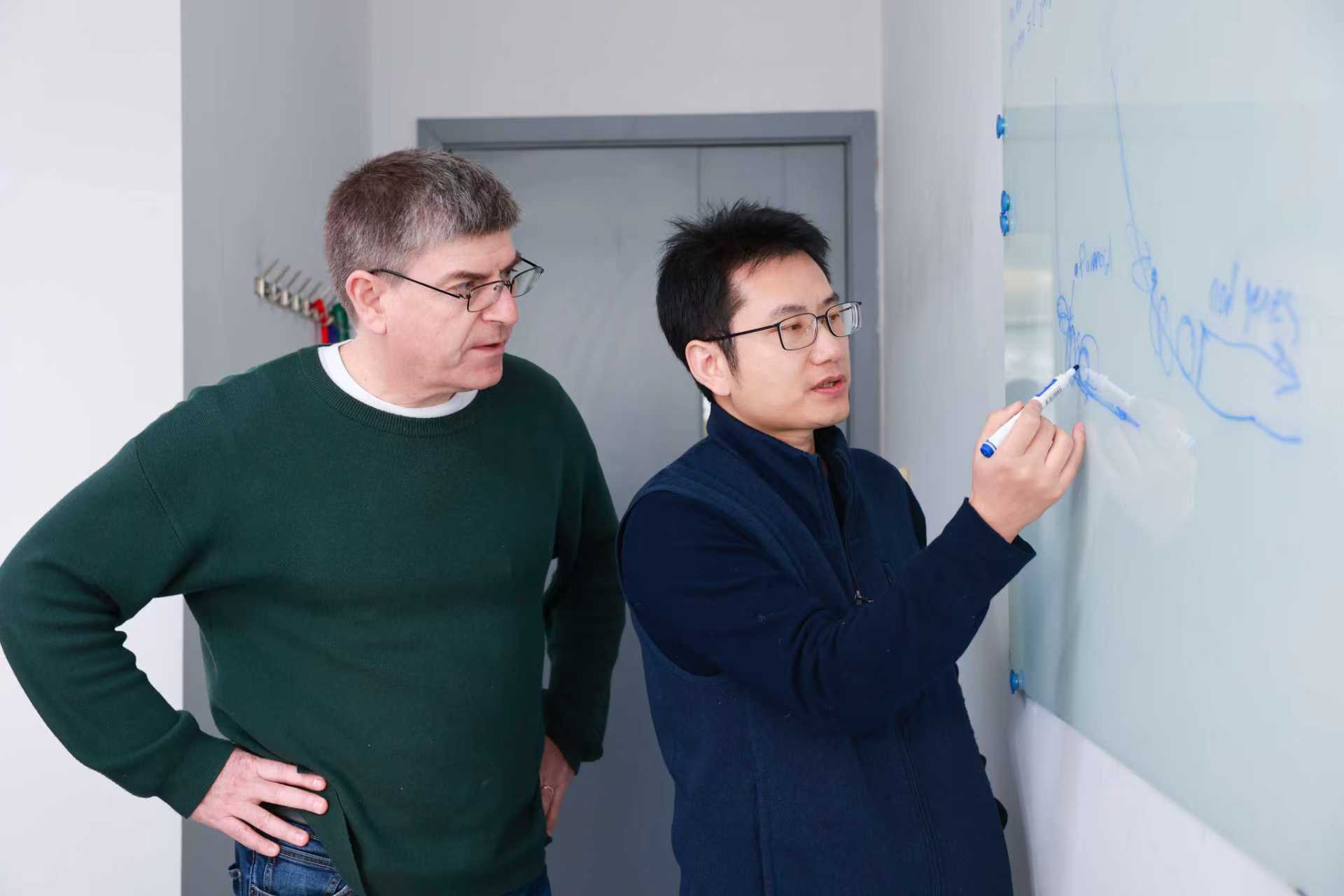
这些年来,上海科创中心建设如火如荼,与纽约、旧金山-圣何塞、巴黎、东京、伦敦等都市圈开展角逐,逐步位于国际科创中心城市的第一方队。 今年伊始,中国科学院分子植物科学卓越创新中心Jeremy Murray(杰睿)研究员团队与张余研究员团队在《科学》杂志在线发表了科研论文,破解了困扰 植物学界20多年的难题。 作为该中心引进的外籍人才,加拿大籍研究员杰睿已在上海生活八年,这也是他第二次在《科学》杂志上发表论文。他对第一财经介绍,他在上海的研究组 规模比之前的都大,所以可以去做一些想做的研究。 12日,上海交通大学人工智能学院副院长卢策吾教授创办的科技企业穹彻智能正式推出口袋机采——通过智能手机和App,每位使用者都可以成为数据采集 的参与者,完成任务并上传数据,实现数据采集。该公司是卢策吾2016年选择回国发展后创立的具身智能企业。 杰睿研究员团队与张余研究员团队的最新成果,解开了困扰植物学界20多年的难题,破译了豆科植物与根瘤菌之间共生配对密码 受访者供图 近年来,像杰睿、卢策吾这样的科研人员,支撑了上海科技创新成果多点开花。 官方数据显示,2025年,上海科学家发表顶刊论文181篇,占全国的30.6%,较20 ...
近亿元战略融资,由中国移动独家投资!
Sou Hu Cai Jing· 2026-01-13 10:33
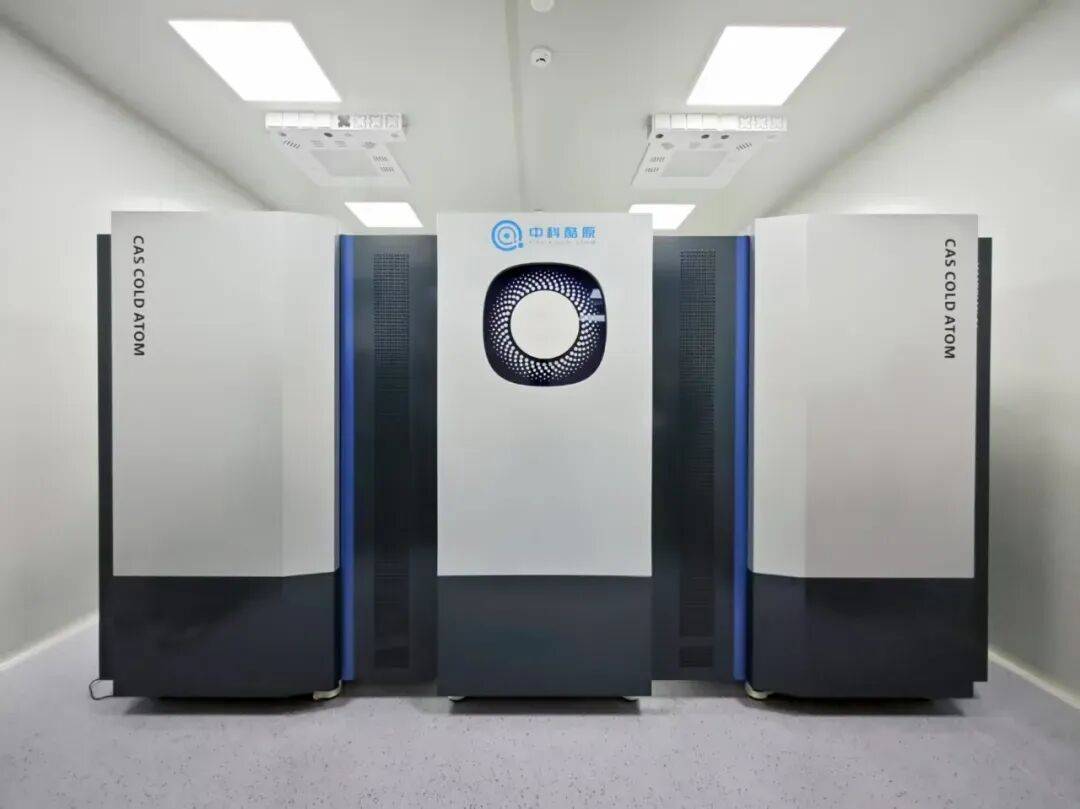
Core Viewpoint - Zhongke Kuyuan Technology (Wuhan) Co., Ltd. has completed a nearly 100 million yuan strategic financing round, exclusively invested by China Mobile Chain Long Fund, highlighting its significant position in the quantum technology sector [1] Group 1: Company Overview - Zhongke Kuyuan was established in 2020, with a core team originating from the Chinese Academy of Sciences, excelling in atomic interference precision measurement and neutral atom quantum computing [1] - The company is a leading enterprise in the quantum technology industry chain in Hubei Province and a founding member of the National Quantum Technology Industry-Academia-Research Innovation Alliance [1] - Zhongke Kuyuan has applied for over 70 patents related to quantum computing and precision measurement, with nearly 50% being invention patents [1] Group 2: Technological Advancements - In 2024, Zhongke Kuyuan launched the "Hanyuan 1" atomic quantum computer, which operates without the need for low-temperature environments, significantly reducing deployment costs [2] - The company also introduced the "Kuyuan Quantum Cloud" platform, enabling universities and enterprises to access quantum computing power via the cloud, accelerating technology dissemination [2] - The "Hanyuan" quantum computer offers advantages such as long coherence time and high control precision, making it suitable for building general-purpose quantum computers [4] Group 3: Commercialization Efforts - Zhongke Kuyuan is focusing on the commercialization of its "Hanyuan" series quantum machines, developing both full programming and global control technology routes, and creating a quantum computing cloud platform to lower user entry barriers [4] - The company collaborates with industries such as finance, pharmaceuticals, and materials to develop quantum algorithms, facilitating the transition from research to industrial application [4] Group 4: Funding and Strategic Partnerships - In the past year, Zhongke Kuyuan has secured multiple rounds of financing, including strategic investments from the Wuhan Guanggu Chip Quantum Technology Investment Fund and other funds totaling several million yuan [6] - The recent investment from China Mobile Chain Long Fund is seen as a strategic move to build an ecosystem that integrates quantum computing with 5G/6G network optimization and big data analysis, aligning with China Mobile's strategic goals [6][7] - This investment also supports the national focus on quantum technology as a key direction in the "9+6" strategic emerging industries layout by the State-owned Assets Supervision and Administration Commission [7]

量子计算测控系统:精准操控的“神经中枢”
Zhong Zheng Wang· 2026-01-13 04:55
Core Insights - Quantum computing measurement and control systems are a critical component of quantum computers, acting as the "nerve center" that determines the performance and effective output of quantum chips [1][2] - The global quantum computing industry is advancing towards a thousand-bit scale, placing unprecedented demands on the integration, scalability, stability, and automation of measurement and control systems [1] - China has made significant strides in this field, achieving a key leap from breaking monopolies to leading in engineering, with the "Benyuan Tianji 4.0" system supporting over 500 quantum bits [2] Industry Developments - The measurement and control system is essential for signal generation, acquisition, and control in quantum chips, with its precision and stability directly impacting chip performance [1] - The U.S. has classified quantum measurement and control systems as a key emerging technology, while companies like Zurich Instruments and NVIDIA are exploring hybrid computing architectures [1] - China's "Benyuan Tianji" series has demonstrated scalable production capabilities, supporting various quantum computing tasks for over 37 million users across 163 countries [2] Challenges and Opportunities - Despite advancements, China faces challenges in high-precision control technology and the absence of industry standards, indicating significant potential for technological progress and investment [2] - Experts suggest a focus on "top-down design and integrated soft-hard breakthroughs" to enhance control technology and establish modular, open architecture standards [2] - Continuous innovation in measurement and control systems is expected to drive the overall computational power of quantum computers and attract long-term capital to core technology breakthroughs and ecosystem standardization [2]
年内首只翻倍股停牌核查
2 1 Shi Ji Jing Ji Bao Dao· 2026-01-12 14:25
| 志特新材 | | 300986 | | --- | --- | --- | | 33.38 SECNY 15:30:48 液 | | +5.56 +19.99% 通 融 △ △ + | | Wind ESG评级 | BB | 详情 | | 交生 | 198.57% 120日 | 150.22% | | 5日 | 148.73% 250日 | 277.71% | | 20日 | 229.19% 52周高 | 27.82 | | 60日 | 186.28% 52周低 | 7.52 | 志特新材分别在1月8日和6日发布了股票交易异常波动公告。 公司同时明确,不存在关于公司应披露而未披露的重大事项,也不存在处于筹划阶段的重大事项。公司及子 公司生产经营正常,主营业务目前未发生重大变化。 志特新材是2026年A股首只翻倍股,也是年内涨幅最大的股票,截至1月12日已6连20cm涨停,近20个交易日 涨近230%。 1月12日晚,志特新材(300986)(300986)公告称,公司股票自2026年1月5日至1月12日连续6个交易日涨 停,涨幅为198.57%,股价波动较大。为维护投资者利益,公司将就股票交易波动情况进行 ...
年内首只翻倍股停牌核查
21世纪经济报道· 2026-01-12 14:21
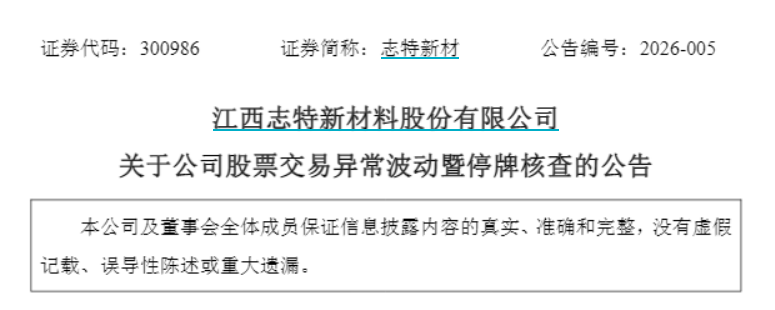
记者丨刘雪莹 编辑丨曾静娇 1月12日晚,志特新材(300986)公告称,公司股票自2026年1月5日至1月12日连续6个交易日 涨停,涨幅为 198.57% ,股价波动较大。为维护投资者利益, 公司将就股票交易波动情况进 行核查 ,股票自1月13日开市起停牌,预计停牌时间不超过3个交易日。 公司提醒广大投资者 注意二级市场交易风险。 公司同时明确,不存在关于公司应披露而未披露的重大事项,也不存在处于筹划阶段的重大事 项。公司及子公司生产经营正常,主营业务目前未发生重大变化。 志特新材是2026年A股首只翻倍股,也是年内涨幅最大的股票, 截至1月12日已6连20cm涨 停,近20个交易日涨近230%。 志特新材分别在1月8日和6日发布了股票交易异常波动公告。 志特新材属于铝行业,是AI应用、量子计算概念股。近日被称之为"科技春晚"的《中国科技创 新盛典》正式播出,志特新材代理的防火隔热材料产品在节目中亮相。( 详情 ) (声明:文章内容仅供参考,不构成投资建议。投资者据此操作,风险自担。) SFC 出品 | 2 1财经客户端 2 1世纪经济报道 商业航天ETF爆发,有人7天收益够交1个月房租,多家上市公司紧急 ...