金发姑娘经济

Search documents
高盛闭门会-全球跨资产2026展望-超配股票Alpha机会增加中国亮眼-金发姑娘各种多元化看好黄金
Goldman Sachs· 2026-01-16 02:53
Investment Rating - The report suggests an overweight position in equities while maintaining neutral allocations in bonds, commodities, and cash, with a low allocation to credit [2] Core Insights - Despite high market valuations, macro fundamentals are expected to support the current levels, and high valuations alone do not constitute a bearish signal [3] - Economic growth in 2026 is anticipated to be diversified, driven by fiscal policy, regulatory easing, and AI penetration, while political and geopolitical risks should be monitored [4] - The importance of diversification in asset allocation is emphasized, particularly in the late economic cycle, with a recommendation for alternative strategies and diverse investment styles [5][6] Summary by Sections Economic Outlook - The macro outlook for 2026 is positive, with strong performance expected in the first half, but potential slowdown in the second half. Growth will be more diversified, supported by fiscal policy and AI integration [4] Market Valuation - Current valuations are high, with the S&P Shiller PE ratio at its highest level since the tech bubble, but macro factors support these valuations, indicating that high valuations alone do not signal a market downturn [3] Asset Allocation Strategy - The asset allocation strategy for early 2026 favors risk assets, particularly equities, while maintaining neutral positions in bonds and commodities. Credit is underweighted due to low credit spreads [2] - The report highlights the need for selective and cautious approaches in spread trading and credit investments, recommending an overweight in equities to navigate the current economic environment [7] Sector and Regional Trends - Different regions are driven by various factors, with the U.S. led by technology, while value stocks are recovering in Europe. The report notes a balanced dynamic across sectors, creating opportunities for alpha generation [8] Commodity Market Outlook - The commodity market is expected to see a divergence in returns, with gold projected to rise to $4,900 per ounce by year-end, while Brent crude oil prices are expected to decline to an average of $56 per barrel [18]
天弘基金2026年投资策略会:AI非泡沫,2050年将替代99.9%白领
Sou Hu Cai Jing· 2026-01-14 01:19
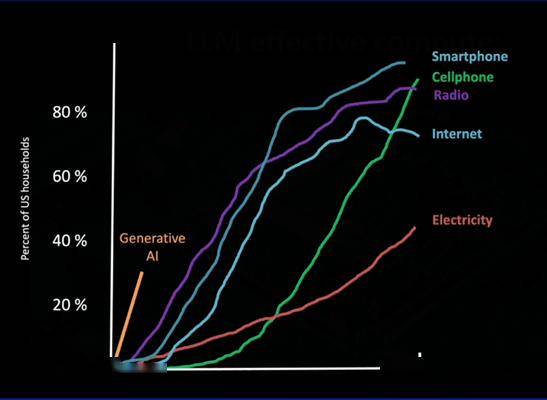
Core Viewpoint - AI is not in a bubble but is expected to replace 99.9% of white-collar jobs in the next two decades [1][5] Group 1: AI Evolution and Impact - The penetration rate of Generative AI has surpassed 30%, making it one of the fastest-adopted technologies globally [2][6] - Effective compute power is growing at an annual rate of approximately 6 to 16 times, potentially reaching 180 million times its current level in five years [3] - AI is evolving towards an "Innovator AI" stage, capable of independent work with minimal external instructions, expected to be achieved by late 2028 to early 2029 [3] Group 2: Overcoming Data Limitations - The global AI token generation is increasing at a rate of about 5 times per year, projected to reach 625 times its current scale in five years [4] - AI's ability to learn from self-generated data may help it overcome the "data wall," which refers to the limited growth of useful information on the internet [4] Group 3: AI's Role in Workforce Transformation - AI's evolution from simple chatbots to advanced reasoning and embodied intelligence indicates a shift towards "expert collaborative systems" [5][8] - By 2050, it is predicted that 90% of physical labor and 99.9% of white-collar jobs will be performed by AI, transforming human roles towards higher-level creativity and decision-making [8] Group 4: Investment Landscape and Economic Outlook - Current AI investments by major tech companies account for about 1.3% of the US GDP, with strong cash flow supporting these investments [9] - The macroeconomic environment is different from the internet bubble era, with current interest rates declining and inflation expected to stabilize around 2% [9] - Valuations of leading tech stocks are more rational compared to the peak of the internet bubble, with current P/E ratios around 30 times [9] Group 5: Future Technological Developments - Quantum computing is anticipated to be a key area of advancement, potentially enhancing computational power by millions or billions of times [10] - The next two decades may experience a "Goldilocks Economy," characterized by moderate inflation and strong economic growth [10] Group 6: Investment Strategies - The company is focusing on systematic investment strategies through index-based tools to capture technology sector growth [10][11] - A diverse range of technology-focused ETFs has been established to target high-growth sectors and capitalize on the ongoing technological transformation [10]

国泰海通:2026年1月建议超配风险资产及A/H股美股
Sou Hu Cai Jing· 2025-12-30 14:34
Core Viewpoint - Guotai Junan suggests an overweight allocation to risk assets in January due to the Federal Reserve's expected interest rate cuts and balance sheet expansion, which may reduce policy uncertainty and market volatility [1] Group 1: Asset Allocation Recommendations - The recommended allocation for January is 50.00% in equities, 35.00% in bonds, and 15.00% in commodities [1] - For January 2026, the suggested equity allocation is 47.50%, with an overweight in A-shares and Hong Kong stocks (10.00%), and U.S. stocks (17.50%), while underweighting European stocks (2.50%) and Indian stocks (2.50%), and maintaining a standard allocation in Japanese stocks (5.00%) [1] Group 2: Rationale for Equity Allocation - Multiple factors support the performance of Chinese equities, with a recommendation to overweight A/H shares due to the upcoming work conference and the start of the 14th Five-Year Plan, which may lead to broader fiscal deficits and more aggressive policies [1] - The "Goldilocks" scenario is emerging, favoring U.S. stock performance, as the U.S. economy shows resilience despite cooling, with weakening inflation and corporate earnings expectations potentially supporting upward movement in U.S. stocks [1]

有克制的“价”“量”双宽——12月FOMC会议点评
一瑜中的· 2025-12-11 12:19
Core Viewpoint - The December FOMC meeting resulted in a 25 basis point rate cut to a target range of 3.5%-3.75%, aligning with market expectations, while the Fed's tone remained neutral to slightly hawkish [2][20] Group 1: Interest Rate Decisions - The Fed's decision to cut rates by 25 basis points was anticipated, with 3 out of 12 FOMC members opposing the cut, indicating internal dissent [20] - The dot plot indicates only one rate cut is expected next year, which is below market pricing of two cuts [3][12] - The Fed's economic outlook is described as "Goldilocks," with upward revisions to GDP growth forecasts for 2025-2028 and downward revisions to inflation forecasts for the same period [6][21] Group 2: Economic Projections - GDP growth forecasts for Q4 of 2025, 2026, 2027, and 2028 are now projected at 1.7%, 2.3%, 2.0%, and 1.9% respectively, compared to previous estimates of 1.6%, 1.8%, 1.9%, and 1.8% [21] - Core PCE inflation forecasts for the same periods are adjusted to 3.0%, 2.5%, 2.1%, and 2.0%, down from 3.1%, 2.6%, 2.1%, and 2.0% [21] Group 3: Balance Sheet Management - The Fed is restarting "Reserve Management Purchases" (RMP) to maintain adequate reserve levels, with a purchase scale of $40 billion per month starting this December [14][35] - RMP is distinct from quantitative easing (QE), as it involves purchasing short-term Treasury securities to manage liquidity rather than a broad monetary policy shift [15][16] Group 4: Market Reactions - Following the FOMC meeting, the stock market saw gains, with the Dow Jones Industrial Average rising by 1.05%, and the S&P 500 increasing by 0.67% [38] - The dollar index fell by 0.6% to 97.24, while yields on 10-year and 2-year Treasury bonds decreased [38]

有克制的价量双宽:12月FOMC会议点评
Huachuang Securities· 2025-12-11 12:08
Group 1: Interest Rate Changes - The FOMC lowered the interest rate by 25 basis points to a target range of 3.5%-3.75%, aligning with market expectations[1] - The dot plot indicates a forecast of one rate cut in both next year and the year after, but there is significant disagreement among members[3] - There were 2 dissenting votes against the rate cut, with 6 out of 19 participants supporting no rate cut[3] Group 2: Economic Projections - The Fed raised its GDP growth forecasts for Q4 2025-2028 to 1.7%, 2.3%, 2.0%, and 1.9% respectively, compared to previous estimates of 1.6%, 1.8%, 1.9%, and 1.8%[1] - Core PCE inflation forecasts for the same period were adjusted to 3.0%, 2.5%, 2.1%, and 2.0%, down from 3.1%, 2.6%, 2.1%, and 2.0%[1] - The Fed's assessment of downside risks to growth has decreased, while the outlook for unemployment risks has also improved[21] Group 3: Quantitative Easing Measures - The Fed announced the restart of "Reserve Management Purchases" (RMP) to maintain adequate reserve levels, starting at a pace of $40 billion per month[5] - This RMP is a technical operation aimed at increasing liquidity in the money market, distinct from traditional quantitative easing (QE)[13] - The current asset purchase scale is smaller than previous QE measures, with the Fed's balance sheet at approximately $6.6 trillion compared to $3.8 trillion in 2019[7] Group 4: Market Reactions - Following the FOMC meeting, U.S. stock markets rose, the dollar index fell, and U.S. Treasury yields declined[35] - The futures market adjusted expectations for rate cuts next year from 2 to approximately 2.24 times, with the year-end policy rate forecast decreasing from 3.159% to 3.082%[35]
广发策略 | 降息疑云之下,美股如何演绎?——港股&海外周聚焦(11月第4期)
Xin Lang Cai Jing· 2025-11-24 23:26
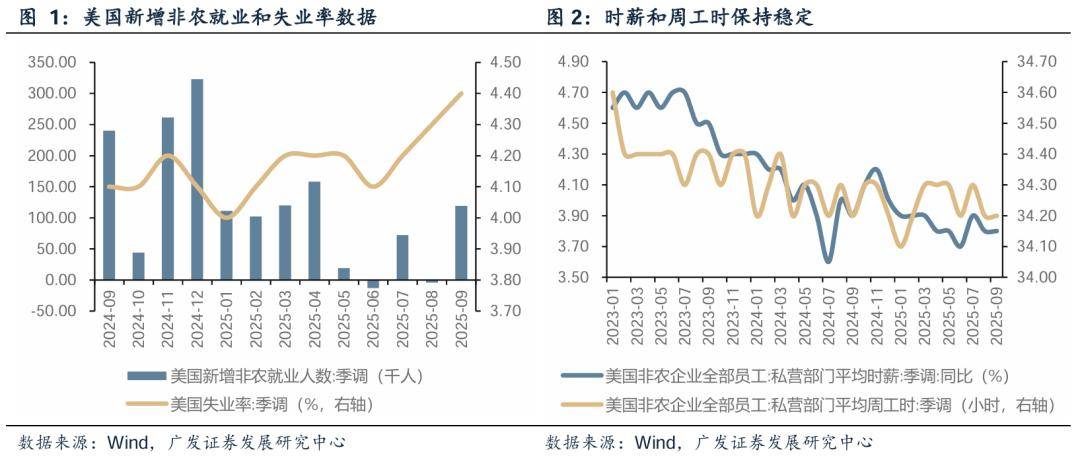
Group 1 - The core viewpoint is that the US stock market is expected to recover in the short term due to the alleviation of three major negative factors: concerns over the AI bubble, tightening liquidity, and macroeconomic uncertainty [2][3][4] - The US non-farm payrolls for September increased by 119,000, significantly exceeding the expected increase of 52,000, with the unemployment rate rising slightly to 4.4%, the highest level since October 2021 [6][10] - The market interpreted the non-farm report as neutral to weak, with the probability of a 25 basis point rate cut in December rising from 39% to 71% following the report [12][14] Group 2 - The current economic situation in the US is characterized by a "K-shaped" economy and a "Goldilocks" economy, both of which are expected to support strong stock market performance [4][31] - Despite concerns over the AI bubble, the overall health of corporate balance sheets remains acceptable, with only Oracle showing high leverage characteristics [26][34] - The liquidity situation has improved significantly after the government reopened, alleviating previous concerns about dollar liquidity [28][34] Group 3 - The employment market is currently in a delicate balance, with both job growth and layoffs occurring simultaneously, indicating a lower risk of significant downturns in the short term [18][20] - Historical analysis suggests that the Fed may pause rate cuts in the short term, as the current economic indicators do not show signs of a significant recession [22][24] - The potential for sector rotation is highlighted, particularly in the healthcare sector, which has seen recent inflows after underperforming since late 2022 [34]

降息疑云之下,美股如何演绎?
Sou Hu Cai Jing· 2025-11-24 00:30
Group 1 - The core point of the article is that the U.S. non-farm payrolls increased by 119,000 in September, significantly exceeding expectations of 52,000, while the unemployment rate rose slightly to 4.4%, the highest level since October 2021 [1][19][24] - The average hourly wage increased by 0.2% month-on-month and 3.8% year-on-year, with expectations of 0.3% and 3.7% respectively [19][24] - The non-farm report is interpreted by investors as neutral to weak, leading to a rise in the probability of a 25 basis point rate cut in December from 39% to 71% [1][24] Group 2 - The current economic conditions suggest that the urgency for a rate cut in December is not strong, as inflation remains moderately rising and the risk of a significant downturn in the job market is low [3][32][38] - Historical analysis indicates that "soft landing" rate cuts typically range from 75 to 100 basis points, and with no clear signs of recession, the Federal Reserve may pause rate cuts in the short term [3][38][40] - There are internal divisions among Federal Reserve officials regarding the direction of monetary policy, with some supporting a rate cut in December [3][40] Group 3 - The U.S. stock market is expected to experience a rebound in the short term as recent concerns over AI bubbles, liquidity tightening, and macroeconomic uncertainties have largely dissipated [9][43] - The current economic landscape features both "K-shaped" and "Goldilocks" economic conditions, which historically have not negatively impacted stock market performance [12][49][52] - The health of corporate balance sheets remains acceptable, with only Oracle showing high leverage, alleviating concerns over debt risks [45] Group 4 - The liquidity situation in the U.S. has improved significantly following the government reopening, which has alleviated previous concerns about dollar liquidity [47] - The recent non-farm payroll data has shifted expectations regarding interest rate cuts, with the market now anticipating a more favorable environment for risk assets [49][55] - The focus for investors should remain on sectors with strong alpha potential, particularly in AI sub-sectors, while also considering potential rotations into healthcare, which has seen recent inflows [18][55]
高盛预警:年底前美股“金发姑娘”行情恐遭冲击
Feng Huang Wang· 2025-09-30 02:22
Core Viewpoint - Goldman Sachs warns that the "Goldilocks" market for U.S. stocks may face challenges before the end of the year, citing three potential risks: growth shock, interest rate shock, and a new dollar bear market [1][3]. Group 1: Market Conditions - The S&P 500 index is nearing historical highs, with valuations approaching levels seen during the internet bubble, raising concerns about a potential stock market bubble [1]. - Optimism surrounding artificial intelligence (AI) and technology companies continues to drive the U.S. stock market [1]. Group 2: Risks Identified - The "three bears" risks identified by Goldman Sachs include: - "Growth shock," which could arise from rising unemployment or disappointment with AI [2]. - "Interest rate shock," which refers to the possibility of the Federal Reserve not implementing further rate cuts [3]. - A "new dollar bear market," where the dollar could decline by 10%, negatively impacting foreign investment in U.S. stocks [3]. Group 3: Market Outlook - Despite the identified risks, Goldman Sachs emphasizes that these shocks have not yet materialized, and the short-term outlook remains stable [4]. - Comparisons have been made between the current S&P 500 index and the late 1990s internet bubble, suggesting that there may still be room for market gains before a potential downturn [4].

美联储降息即将落地,狂欢中的美股需要聚焦三大问题
Sou Hu Cai Jing· 2025-09-16 09:00
Group 1 - The U.S. stock market is experiencing a rally, with the Nasdaq 100 index recently achieving its longest winning streak in over a year, having risen for five consecutive months [1] - Morgan Stanley warns that the anticipated interest rate cut by the Federal Reserve may dampen investor enthusiasm, as the market has already priced in a quarter-point cut [3] - The S&P 500 index has been in a period of low volatility, with daily fluctuations averaging less than 0.9%, marking the longest calm period in two years, yet it continues to reach new highs [3] Group 2 - The market's reaction to the Federal Reserve's interest rate decision will depend on various scenarios, including the perceived dovishness of the Fed's guidance and any indications of economic slowdown [4] - Historical data shows that the S&P 500 index typically declines in September, but it has risen in past instances when the Fed cut rates without an economic contraction [6] - The potential for the stock market to continue reaching new highs post-rate cut hinges on improved economic data, sustained dovish signals from the Fed, and strong corporate earnings, particularly in the tech sector [8]
高盛预警:"黄金之夏"或即将终结美股市场平静或被打破
Sou Hu Cai Jing· 2025-08-27 06:47
Group 1 - Goldman Sachs' analysis indicates that the strong performance of the U.S. stock market during the summer, referred to as the "golden summer," is facing multiple challenges as investors return to the market [1][4] - The S&P 500 index has risen over 30% since the end of April, primarily driven by the performance of the "seven tech giants," while the market volatility index (VIX) has dropped to its lowest level of the year [3] - Concerns are growing regarding three major risk factors: signs of a cooling U.S. economy, uncertainty in trade policies, and political issues affecting the independence of the Federal Reserve [3] Group 2 - The labor market's continued weakness suggests that a "Goldilocks" economic environment does not exist, making the current market rally difficult to sustain [3] - The market's pricing of these risks appears insufficient, as evidenced by a 5 basis point increase in the 30-year U.S. Treasury yield to 4.94%, signaling potential warnings [3] - Despite a rebound in the U.S. dollar index since July, the simultaneous movement of risk and safe-haven assets indicates a growing divergence among investors [3]