
食品安全

Search documents
陈刚前往望城区调研文旅融合发展情况并督导安全生产和食品安全工作
Chang Sha Wan Bao· 2025-12-29 01:59
Core Insights - The article discusses the development of cultural tourism integration in Wangcheng District, focusing on the enhancement of tourist experiences and safety measures in local attractions [1][2] Group 1: Cultural Tourism Development - The city is optimizing the design and layout of the Tongguan Old Street, emphasizing a people-centered approach and fine craftsmanship to improve visitor experience and satisfaction [1] - There is a focus on creating cultural IPs, such as "I have a heart for Tongguan, not just the kiln," to enhance the cultural identity of the area [1] - In the development of the Jianggang Ancient Town, the emphasis is on leveraging local resources to create innovative consumption scenarios and diversify cultural tourism offerings [1] Group 2: Safety and Quality Assurance - The city officials stress the importance of balancing development with safety, ensuring high-level safety measures to support quality growth in tourism [1] - At Hunan Dawang Food Co., the focus is on reinforcing safety production responsibilities and enhancing employee safety awareness through a combination of human and technical defenses [1]
80亿紫燕两年缩水千家门店,最近又“摊上事了”
阿尔法工场研究院· 2025-12-29 00:05
Core Viewpoint - The article highlights the recent controversy surrounding Ziyan Food due to an incident involving a staff member allegedly stealing beef from a customer, which has raised concerns about the company's management and food safety issues [3][7][16]. Group 1: Incident and Response - Ziyan Food issued an apology on December 25, stating that the involved employee was terminated and the store would undergo corrective measures [4][13]. - The company offered tenfold compensation to affected customers and a 1,000 yuan gift card, along with compensation for customers who had shopped at the affected store since December [5][12]. - The incident has exposed weaknesses in Ziyan Food's supervision of franchise stores under its distribution expansion model [5][35]. Group 2: Financial Performance - In the first three quarters of the year, Ziyan Food reported revenue of 2.514 billion yuan, a year-on-year decrease of 6.43%, and a net profit of 194 million yuan, down 44.37% [33][34]. - The company faced challenges in cash flow, with net cash flow from operating activities dropping by 39.23% to 252 million yuan [34]. Group 3: Food Safety Issues - Ziyan Food has a history of food safety problems, including instances of excessive E. coli in products and reports of rodents in stores [16][21][19]. - The company has previously faced scrutiny for its food safety practices, with multiple products failing microbiological tests [16][18]. Group 4: Business Model and Market Presence - Ziyan Food operates primarily through a distribution model, which has allowed rapid expansion, increasing the number of stores from under 2,000 in 2018 to 6,205 by the end of 2023 [24][27]. - However, the number of stores has recently declined to 5,144, indicating potential issues with the effectiveness of its aggressive expansion strategy [30][29]. Group 5: Pricing Strategy - The company has faced backlash for its increasing pricing strategy, with significant price hikes reported for various products over the past year [23][24]. - For example, a specific dish's price rose from 20.8 yuan to 27.4 yuan within a few months, reflecting a broader trend of rising costs [23].


冬日“饺”好运,守住食安底线
Xin Lang Cai Jing· 2025-12-28 18:23
贺照阳 通讯员 闫鹏飞 其中,沙门氏菌常隐藏在畜禽肉中,污染后肉类可能无明显异常,但食用后会引发急性肠胃炎,出现腹痛、腹 泻、呕吐等症状;金黄色葡萄球菌还会产生耐热肠毒素,哪怕后续高温烹饪也可能残留,食用后会导致短 时间内剧烈呕吐。 剁馅时,一定要将案板和刀具生熟分开,避免生肉上的致病菌污染蔬菜或餐具。饺子馅尽量现包现吃,隔夜 放置的馅料不仅营养流失,还会因细菌大量繁殖产生代谢产物,大大增加食源性疾病风险。 包好的饺子如果当天吃不完,要平铺在盘子里放进冰箱冷冻,冻硬后再装袋,防止黏连变质。虽然低温能抑 制致病菌活性,但无法完全杀灭,因此冷冻保存建议不超过1个月。煮的时候一定要水开后下锅,大火煮到 饺子全部浮起,彻底杜绝"外熟里生"的安全隐患。 速冻饺子的安全 核心是冷链和保质期 买速冻饺子时,要选包装完好、没有解冻痕迹的。 济南报道 饺子,是冬日家庭餐桌的暖心常客。无论是全家围坐、巧手擀皮包制的手工饺,还是冰箱里常备的便捷速 冻饺,吃得安心、健康,才是舌尖上的头等大事。元旦佳节将至,热腾腾的饺子又将香飘千家万户,山东省疾 病预防控制中心卫生检验检测所专家李丹迪、李心朋,特此带来"吃饺子"的健康科普,为大家的节 ...
《中国食品安全状况研究报告(2025)》等多项研究成果发布
Xin Lang Cai Jing· 2025-12-28 14:16
Group 1 - The conference on the application of artificial intelligence in food safety risk governance showcased various platforms and guidelines aimed at enhancing food safety standards in China [1] - Key research reports released include the "China Food Safety Status Research Report (2025)" and case studies on digital transformation in food enterprises and the liquor industry [1][3] - The "China Food Safety Status Research Report (2025)" highlights progress in the traceability system for agricultural products and food, with the "one product, one code" traceability system being promoted nationwide [1] Group 2 - The report on developing AI applications in food safety risk governance emphasizes the active exploration and accumulation of experiences across various regions, leading to diverse application scenarios [3] - Examples of AI applications include the creation of regional food safety risk maps and the use of AI visual systems in the "Bright Kitchen" platform to identify violations in real-time [3] - The promotion of the "one product, one code" traceability system and the establishment of blockchain-based cross-domain traceability models are crucial for transitioning from passive response to proactive prevention in food safety governance [3]
经济日报:别被玫瑰盐迷花眼
Xin Lang Cai Jing· 2025-12-28 05:00
Core Insights - The rise of pink Himalayan salt as a trendy seasoning has been driven by its perceived health benefits and aesthetic appeal, leading to prices that are several times higher than regular salt [1][2] - Recent reports of heavy metal contamination in pink salt have raised significant health concerns, highlighting the risks associated with popular food products [1][3] Group 1: Marketing and Consumer Perception - The marketing of pink salt effectively targets consumer psychology, leveraging its mineral content and unique color to create a premium image [2] - The association with Himalayan origins and claims of being "natural" resonate with consumers' anxieties about industrial food products, leading them to equate higher prices with better nutrition [2] Group 2: Health Risks - Pink salt does not meet national food safety standards, particularly in terms of color and purity, and contains higher levels of harmful heavy metals compared to refined salt [3] - Long-term consumption of pink salt poses serious health risks, including potential damage to the nervous system and kidneys, as well as an increased cancer risk [3] Group 3: Regulatory Issues - The recent food safety scandal has exposed regulatory gaps, particularly in cross-border e-commerce, where differences in food standards are exploited by sellers [4] - Some sellers import pink salt under the guise of "industrial salt" to bypass food safety regulations, leading to its unauthorized sale as a food product [4] Group 4: Recommendations for Safety - Regulatory bodies need to enhance food safety regulations for cross-border e-commerce, clarifying the distinction between industrial and edible salt [5] - E-commerce platforms should enforce stricter product labeling and eliminate misleading marketing claims, ensuring consumer protection [5] - Consumer education is crucial, emphasizing the importance of standard compliance and the core function of salt as a seasoning rather than a health product [5]
2025年英国国防出口交易额超200亿英镑|首席资讯日报
首席商业评论· 2025-12-28 04:12
Group 1 - The UK government announced that defense export transactions will exceed £20 billion (approximately 189.5 billion RMB) by 2025, marking the highest level in over 40 years. This record is attributed to several major defense cooperation agreements, including a £10 billion (approximately 94.8 billion RMB) deal with Norway for the construction of at least five Type 26 frigates, which is the largest naval export transaction in UK history [2] Group 2 - Tianjin has launched the "2026 New Spring Consumption Season" with over 1,000 promotional activities aimed at boosting consumption across various sectors, including food, accommodation, transportation, and retail. The campaign will run throughout the first quarter of 2026, focusing on key events such as New Year's and the Spring Festival [3] Group 3 - Srey New Materials stated that its liquid rocket engine thrust chamber is a critical component of the engine, requiring materials with excellent high-temperature resistance and thermal conductivity to ensure proper engine operation during rocket launches [4] Group 4 - The "Artificial Intelligence and Food Safety Risk Governance" research results were released in Beijing, showcasing platforms for food safety supervision and digital transformation guidelines for food industries. The event highlighted seven research outcomes, including the "2025 China Food Safety Status Research Report" [6] Group 5 - The China Industrial Internet Research Institute has officially released an industrial data resource database, which aggregates key data on materials, components, and processes to support industrial AI model training. The database includes 230 million digital industrial products, 180,000 raw material specifications, 35 terabytes of real-time equipment operation data, and 300,000 process data entries [7] Group 6 - Shengyuan Environmental Protection received a warning letter from the Xiamen Securities Regulatory Bureau for failing to timely disclose significant losses from a private equity product subscribed by its subsidiary, which violated information disclosure regulations [8] Group 7 - Suzhou Tongxin Medical Technology Co., Ltd. has had its IPO application accepted by the Science and Technology Innovation Board, aiming to raise 1.064 billion RMB for projects related to implantable left ventricular assist systems and working capital [9] Group 8 - National grain procurement has exceeded 200 million tons, an increase of 3.2 million tons compared to the same period last year, marking the highest level in recent years. The procurement progress for various grains, including indica rice and corn, is reported to be on track [10] Group 9 - Several lithium iron phosphate manufacturers, including Hunan Youneng and Wanrun New Energy, announced production cuts due to high upstream raw material prices and cost pressures. The production adjustments are described as necessary maintenance and do not affect overall order fulfillment [11] Group 10 - Greebo stated that its commercial cleaning robots are in the pre-mass production testing and optimization phase, focusing on adapting to complex commercial scenarios and ensuring performance stability before market launch [12] Group 11 - A lawsuit involving a subsidiary of Xinwangda, claiming quality issues with delivered battery cells, has been filed for over 2.314 billion RMB. The case has been accepted by the Ningbo Intermediate People's Court [13]

江南大学报告:2024年全国食品安全抽检合格率97.04%
Bei Ke Cai Jing· 2025-12-28 03:52
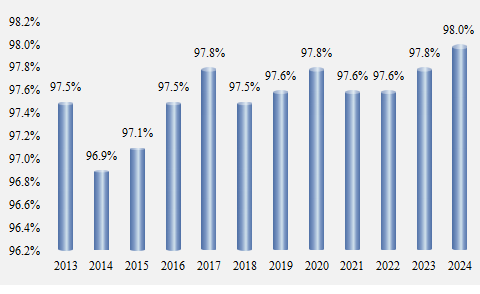
Core Insights - The report indicates that the overall quality compliance rate of major agricultural products in China reached 98% for the first time in 2024, reflecting a positive trend in food safety [1][2][3] - The total food import value for 2024 is approximately $126.73 billion, showing a decrease of 9.5% compared to the previous year [1][10] Agricultural Production - In 2024, the national grain production reached 70.65 million tons, an increase of 1.6% from the previous year, marking a new milestone above 70 million tons [2] - The per capita grain availability increased by 25 kg compared to the end of the 13th Five-Year Plan, reaching 500 kg, which is above the internationally recognized safety line of 400 kg [2] - The annual vegetable production in 2024 reached 86.11 million tons, an increase of 11.2 million tons since 2019 [2] Food Safety Monitoring - The overall compliance rate for food safety supervision and sampling in 2024 was 97.04%, a slight decrease from the previous year [6][7] - The compliance rates for specific categories such as vegetables, fruits, and tea were 97.9%, 98.2%, and 99.2% respectively, with the overall compliance rate for five major categories reaching 98% [3] Food Industry Performance - The food industry maintained double-digit growth in investment, with large-scale food enterprises achieving revenues of 906.53 billion yuan, reflecting a 4.1% increase in industrial added value [6] - The food manufacturing sector, including beverages and refined tea, saw industrial added value growth of 5.8% and 4.8% respectively [6] Food Imports and Compliance - The main categories of imported food include vegetables and fruits ($24.94 billion), meat and its products ($23.05 billion), and seafood ($18.16 billion), accounting for 52.19% of total food imports [10] - In 2024, 4,200 batches of foreign food were rejected for not meeting national food safety standards, an increase of 78.12% from the previous year [11] Regulatory Actions - A total of 23 announcements regarding the prohibition and restriction of pesticides were issued, with 80 pesticides listed, including 56 highly toxic ones [5] - The report highlights the enforcement actions taken against food safety violations, including over 69,772 cases related to harmful substances exceeding standard limits [13]
别被玫瑰盐迷花眼
Xin Lang Cai Jing· 2025-12-27 22:49
Core Viewpoint - The rise of rose salt as a trendy seasoning has been driven by marketing strategies that exploit consumer psychology, but recent findings of heavy metal contamination have raised significant health concerns and highlighted vulnerabilities in the food safety regulatory framework [2][3][4]. Group 1: Marketing and Consumer Perception - Rose salt has gained popularity due to its appealing pink color and the perception of being a "natural" product, which aligns with current consumer trends favoring aesthetics and health consciousness [3]. - The marketing narrative surrounding Himalayan salt effectively targets consumer anxieties about industrial food, leveraging geographical storytelling to justify premium pricing [3]. - Misleading claims about the health benefits of rose salt, such as being "rich in minerals," have contributed to consumer misconceptions that higher prices equate to better nutrition [3]. Group 2: Health Risks - Rose salt does not meet national standards for edible salt, particularly in terms of color and purity, and contains higher levels of harmful heavy metals like lead and arsenic compared to refined salt [4]. - Long-term consumption of rose salt poses serious health risks, including potential damage to the nervous system and kidneys, as well as an increased risk of cancer [4]. Group 3: Regulatory Issues - The recent food safety incident has exposed regulatory gaps, particularly in the cross-border e-commerce sector, where differences in food standards are exploited by sellers [5]. - Some vendors import rose salt under the guise of "industrial salt" to bypass food safety regulations, leading to its unauthorized sale as a food product [5]. - E-commerce platforms have failed to enforce adequate product verification, allowing rose salt to be marketed without necessary safety certifications [5]. Group 4: Recommendations for Improvement - Regulatory bodies need to enhance food safety regulations for cross-border e-commerce, clarifying the distinction between industrial and edible salt [6]. - E-commerce platforms should take responsibility by mandating clear labeling of products as "non-edible salt" and eliminating misleading marketing claims [6]. - Consumer education is crucial, emphasizing that standard, affordable salt meets dietary needs without the risks associated with trendy products like rose salt [6].

我国米面油等抽检不合格率连续5年下降
Xin Lang Cai Jing· 2025-12-27 16:36
Core Insights - The overall food safety situation in China is stable, with low non-compliance rates for major food items over the past five years [3] Group 1: Food Safety Compliance - The non-compliance rate for edible vegetable oil due to illegal addition of ethyl maltol has significantly improved, dropping from 2.08% in 2020 to 0.08% this year [3] - The non-compliance rate for aflatoxin B1 in peanut oil has decreased for four consecutive years [3] - The non-compliance rates for vermicelli, homemade oil cakes, and fried dough sticks due to aluminum residue have continuously declined over five years [3] Group 2: Infant Formula Safety - The compliance rate for domestic infant formula products has remained above 99.95% for four consecutive years [3] - The inspection of infant formula covers all registered production and sales enterprises, ensuring adherence to national food safety standards [3] Group 3: Regulatory Actions - A total of 190,000 cases of non-compliant food have been investigated and dealt with this year, resulting in fines and confiscations amounting to 451 million yuan [3] - Over 57,540 inspections of school canteens and off-campus catering units have been conducted, leading to 12,067 cases of violations being filed, with fines totaling 46.96 million yuan [3] - 40 entities have been included in the serious violation and dishonesty list due to food safety violations [3]
卖未认证电动车、麻辣烫容器发霉……湖南公布一批民生领域“铁拳”行动典型案例
Xin Lang Cai Jing· 2025-12-27 14:35
Core Viewpoint - The Hunan Provincial Market Supervision System has intensified its efforts in addressing consumer issues and illegal activities in the market through initiatives like "Iron Fist Action" and "Sword Casting Action," resulting in the investigation and resolution of several significant cases to protect consumer rights and enhance market integrity [1]. Group 1: Case Summaries - A case was reported where a certain electric vehicle store in Taojiang County was found selling electric four-wheelers without the mandatory national product certification (3C certification), with a total value of 86,410 yuan and illegal gains of 700 yuan [1][2]. - The Hunan Provincial Market Supervision Bureau imposed a fine of 50,000 yuan and confiscated the illegal gains of 700 yuan from the electric vehicle store [2]. - The case highlights the importance of 3C certification for electric vehicles, as unqualified vehicles pose safety risks, including brake failure and fire hazards, and cannot be insured, thus protecting consumers, especially vulnerable groups like the elderly [3]. Group 2: Additional Cases - In Hengdong County, a supermarket was penalized for selling products without proper weight measurement, violating regulations that require goods to be weighed after peeling [4][5]. - The supermarket was fined 8,000 yuan and ordered to correct its practices, emphasizing the need for accurate measurement in consumer goods [5][6]. - A case in Linwu County involved an individual infringing on the "Apple" trademark by producing counterfeit Bluetooth earphones, with illegal revenue amounting to 28,176 yuan [7][8]. - The individual faced a fine of 150,000 yuan and confiscation of counterfeit products, underscoring the importance of protecting intellectual property rights to maintain market integrity [8]. Group 3: Food Safety Cases - A food safety violation was reported in a hot pot restaurant in Chenzhou City, where contaminated containers were used for food storage, leading to a fine of 10,000 yuan [9][10]. - This case illustrates the need for stringent oversight of food safety practices, focusing on preventing hidden contamination risks [10]. - In another case, a party venue was found selling unpackaged food without a license, resulting in a fine of 5,000 yuan and confiscation of illegal earnings of 262 yuan [11][12]. - The case highlights the necessity for regulatory bodies to extend their oversight to non-traditional food service establishments to ensure comprehensive market regulation [13].