
5G

Search documents
联瑞新材涨2.01%,成交额1.36亿元,主力资金净流出127.19万元
Xin Lang Cai Jing· 2026-01-15 05:32
Core Viewpoint - Lianrui New Materials Co., Ltd. has shown a mixed performance in stock trading, with a slight year-to-date decline but a notable increase over the past 20 and 60 days, indicating potential volatility and investor interest in the company [1]. Group 1: Stock Performance - As of January 15, Lianrui's stock price increased by 2.01% to 61.79 CNY per share, with a trading volume of 1.36 billion CNY and a turnover rate of 0.92%, resulting in a total market capitalization of 14.92 billion CNY [1]. - Year-to-date, Lianrui's stock has decreased by 0.48%, with a 5-day decline of 2.28%, while it has increased by 9.15% over the past 20 days and 9.87% over the past 60 days [1]. Group 2: Financial Performance - For the period from January to September 2025, Lianrui achieved a revenue of 824 million CNY, representing a year-on-year growth of 18.76%, and a net profit attributable to shareholders of 220 million CNY, reflecting a 19.01% increase compared to the previous year [2]. - Since its A-share listing, Lianrui has distributed a total of 381 million CNY in dividends, with 242 million CNY distributed over the last three years [3]. Group 3: Shareholder Information - As of September 30, 2025, Lianrui had 11,000 shareholders, an increase of 42.50% from the previous period, with an average of 22,029 circulating shares per shareholder, down by 29.82% [2]. - Among the top ten circulating shareholders, Hong Kong Central Clearing Limited is the eighth largest with 1.6654 million shares, while Guoshou Anbao Smart Life Stock A ranks ninth with 1.3406 million shares, having decreased by 11,000 shares from the previous period [3].

胜宏科技跌2.00%,成交额25.03亿元,主力资金净流出2.73亿元
Xin Lang Zheng Quan· 2026-01-15 03:02
Group 1 - The core viewpoint of the news is that Shenghong Technology's stock has experienced a decline in price and trading volume, with significant net outflows of capital, indicating potential investor concerns [1] - As of January 15, Shenghong Technology's stock price was 276.27 yuan per share, with a market capitalization of 240.45 billion yuan and a trading volume of 2.503 billion yuan [1] - The company has seen a year-to-date stock price decrease of 3.93%, with a 6.57% drop over the last five trading days [1] Group 2 - Shenghong Technology reported a revenue of 14.117 billion yuan for the period from January to September 2025, representing a year-on-year growth of 83.40% [2] - The net profit attributable to shareholders for the same period was 3.245 billion yuan, showing a significant year-on-year increase of 324.38% [2] - The company has distributed a total of 1.483 billion yuan in dividends since its A-share listing, with 583 million yuan distributed over the last three years [3] Group 3 - As of December 19, the number of shareholders for Shenghong Technology was 192,200, a decrease of 5.43% from the previous period [2] - The average number of circulating shares per shareholder increased by 5.75% to 4,449 shares [2] - Major institutional shareholders have reduced their holdings, with Hong Kong Central Clearing Limited holding 25.5466 million shares, down by 2.1158 million shares [3]

佳力图跌2.03%,成交额4411.24万元,主力资金净流入115.95万元
Xin Lang Cai Jing· 2026-01-15 02:51
Group 1 - The core viewpoint of the news is that Jialitu's stock has shown mixed performance, with a slight increase in price year-to-date but a decline over the past 60 days [1] - As of January 15, Jialitu's stock price was 8.70 yuan per share, with a market capitalization of 4.714 billion yuan [1] - The company has seen a net inflow of main funds amounting to 1.1595 million yuan, with significant buying and selling activity [1] Group 2 - For the period from January to September 2025, Jialitu achieved operating revenue of 483 million yuan, representing a year-on-year growth of 6.32% [2] - The net profit attributable to the parent company for the same period was -43.7372 million yuan, a decrease of 458.34% compared to the previous year [2] - The number of shareholders as of September 30 was 44,900, a decrease of 9.74% from the previous period [2] Group 3 - Jialitu has distributed a total of 380 million yuan in dividends since its A-share listing, with 125 million yuan distributed over the past three years [3]

横店东磁涨3.00%,成交额1.13亿元,主力资金净流入654.84万元
Xin Lang Cai Jing· 2026-01-15 02:22
Core Viewpoint - The stock of Hengdian East Magnetic has shown a positive trend with a 3.00% increase on January 15, reaching a price of 20.58 yuan per share, and the company has demonstrated significant revenue and profit growth in recent months [1][2]. Financial Performance - As of September 30, 2025, Hengdian East Magnetic reported a revenue of 17.562 billion yuan, marking a year-on-year increase of 29.31% [2]. - The net profit attributable to shareholders for the same period was 1.452 billion yuan, reflecting a year-on-year growth of 56.80% [2]. Stock Market Activity - On January 15, 2023, the stock experienced a trading volume of 113 million yuan with a turnover rate of 0.34%, and the total market capitalization stood at 33.478 billion yuan [1]. - The stock has increased by 5.54% year-to-date, with a 2.69% rise over the last five trading days and a 9.94% increase over the last 20 days [1]. Shareholder Information - As of September 30, 2025, the number of shareholders decreased to 80,000, while the average circulating shares per person increased by 8.66% to 20,309 shares [2]. - The top ten circulating shareholders include significant institutional investors, with Hong Kong Central Clearing Limited being the second-largest shareholder, increasing its holdings by 38.7153 million shares [3]. Business Overview - Hengdian East Magnetic, established on March 30, 1999, and listed on August 2, 2006, specializes in the production and sales of permanent magnetic ferrite, soft magnetic ferrite, and solar photovoltaic products [1]. - The company's revenue composition includes 67.47% from photovoltaic products, 16.24% from magnetic materials, 10.77% from lithium batteries, and 3.62% from devices [1].

法尔胜跌3.01%,成交额2485.90万元,主力资金净流出159.65万元
Xin Lang Cai Jing· 2026-01-15 02:22
Group 1 - The core viewpoint of the news is that Farsen's stock has experienced fluctuations, with a recent decline of 3.01% and a total market value of 2.295 billion yuan [1] - As of January 15, Farsen's stock price is reported at 5.47 yuan per share, with a trading volume of 24.859 million yuan and a turnover rate of 1.08% [1] - The company has seen a year-to-date stock price increase of 7.89%, but a significant decline of 23.07% over the past 20 days [1] Group 2 - Farsen's main business involves the production and sales of various steel wire and steel rope products, with 86.14% of revenue coming from metal products and 13.86% from environmental protection services [1] - As of January 9, the number of Farsen's shareholders has increased to 46,000, with an average of 9,114 circulating shares per person [2] - For the period from January to September 2025, Farsen reported an operating income of 205 million yuan, a year-on-year decrease of 24.06%, while the net profit attributable to shareholders was -22.7654 million yuan, an increase of 44.95% year-on-year [2]

QCOM vs. AMD: Which Semiconductor Stock is the Smarter Buy in 2026?
ZACKS· 2026-01-14 16:05
Core Insights - Qualcomm Technologies Inc. and Advanced Micro Devices, Inc. are leading firms in the semiconductor industry, focusing on mobile, PC, and data center markets, with an emphasis on AI and advanced chip technologies [2][4] - Qualcomm is transitioning from a wireless communications firm to a connected processor company, leveraging its extensive intellectual property portfolio [5][6] - AMD has evolved from a consumer-PC chip provider to an enterprise-focused company, bolstered by its acquisition of Xilinx and the introduction of new products [3][10] Qualcomm's Position - Qualcomm is well-positioned for long-term revenue growth, driven by strong 5G traction and a diversified revenue stream [5] - The company is expanding its Snapdragon chipsets for AI PCs and gaming, aiming to reduce reliance on the slowing smartphone market [6][9] - Despite its advancements, Qualcomm faces stiff competition from Intel in the AI PC market and from Samsung and MediaTek in the smartphone sector [7] AMD's Position - AMD is benefiting from rising demand for its EPYC processors and strong enterprise adoption, particularly in cloud deployments and AI applications [11] - The company is expanding its AI market presence with new products like the MI350 series and is seeing strong demand across various sectors [10][11] - AMD faces competition from Intel in traditional computing and from NVIDIA in the GPU market, but has had success in the mobile segment [12] Financial Performance - Qualcomm's fiscal 2026 sales and EPS estimates suggest modest growth of 2.7% and 1%, respectively, with positive trends in EPS revisions [13] - In contrast, AMD's 2025 sales estimates indicate a significant growth of 31.6%, with EPS expected to rise by 19.6%, although EPS estimates have been trending downward [14] - Over the past year, Qualcomm's stock has gained only 0.6%, while AMD has surged by 84.2%, indicating a stronger market performance for AMD [16] Valuation Metrics - Qualcomm appears more attractive from a valuation perspective, with a price/earnings ratio of 13.46 compared to AMD's 34.67 [17] - Both companies are rated with a Zacks Rank of 3 (Hold), but Qualcomm's lower valuation may provide a slight edge as a better investment option [18][19]



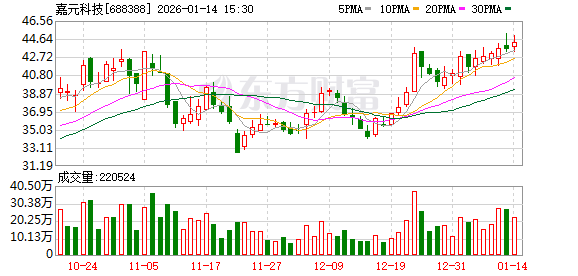
嘉元科技:公司在PCB铜箔领域的发展战略主要围绕高端化、差异化展开
Zheng Quan Ri Bao· 2026-01-14 11:43
Core Viewpoint - The company is focusing on high-end and differentiated products in the PCB copper foil sector to meet the demands of emerging fields such as AI, computing power, and 5G [2] Group 1: Company Strategy - The company's development strategy in the PCB copper foil field emphasizes high-end and differentiated products, including high-frequency and high-speed copper foil, HDI copper foil, HVLP, DTH, and special functional copper foils [2] - The company is implementing a "produce one, reserve one, research one" strategy to accelerate the R&D and manufacturing of various high-performance electrolytic copper foil products [2] Group 2: Product Development and Achievements - The company has made technological breakthroughs in high-performance electronic circuit copper foils, including RTF, HTE, HVLP, DTH, and HDI copper foils [2] - The ultra-thin copper foil (UTF) for PCBs has entered mass production, and significant progress has been made in developing RTF/HVLP products for high-frequency and high-speed circuit and IC packaging applications [2] - RTF has passed certification testing by leading enterprises and is capable of mass production, while other products have completed laboratory validation and are undergoing testing with downstream customers [2]

兆龙互连涨0.86%,成交额4.13亿元,后市是否有机会?
Xin Lang Cai Jing· 2026-01-14 09:36
Core Viewpoint - The company, Zhejiang Zhaolong Interconnect Technology Co., Ltd., is experiencing growth in revenue and profit, driven by its capabilities in high-speed cables and optical products, as well as benefiting from the depreciation of the RMB. Group 1: Company Performance - For the period from January to September 2025, the company achieved a revenue of 1.518 billion yuan, representing a year-on-year growth of 13.28% [7] - The net profit attributable to the parent company was 138 million yuan, showing a significant year-on-year increase of 53.82% [7] - The company has distributed a total of 113 million yuan in dividends since its A-share listing, with 82.34 million yuan distributed over the past three years [8] Group 2: Market Position and Products - The company has established itself as a core partner in the active cable (AEC) sector for leading international interconnect solution providers due to its technological expertise in high-speed cables [2] - It offers a range of optical products, including fiber optic jumpers and connectors, primarily serving high-end projects in finance, education, and healthcare, while also expanding into overseas markets [2] - The company is one of the few in China capable of designing and manufacturing data cables that meet the new data transmission requirements of the 5G era [2] Group 3: Financial Metrics and Shareholder Information - As of September 30, 2025, the company's overseas revenue accounted for 61.93% of total revenue, benefiting from the depreciation of the RMB [3] - The average trading cost of the stock is 55.15 yuan, with the stock price nearing a resistance level of 54.55 yuan, indicating potential for upward movement if this level is surpassed [6] - The company has a total market capitalization of 18.493 billion yuan, with a trading volume of 413 million yuan and a turnover rate of 2.98% on January 14 [1]
Cognizant: Stable Cash Flows Despite Gross Margin Decline
Seeking Alpha· 2026-01-14 08:32
Company Overview - Khaveen Investments is a global Investment Advisory Firm focused on serving the investment needs of high-net-worth individuals, corporations, associations, and institutions [1] - The firm is a registered investment adviser with the Securities Exchange Commission (SEC) [1] - It offers a range of services including market and security research, business valuation, and wealth management [1] Investment Strategy - The flagship Macroquantamental Hedge Fund maintains a diversified portfolio with exposure to hundreds of investments across various asset classes, geographies, sectors, and industries [1] - The investment approach integrates top-down and bottom-up analysis, utilizing three core strategies: global macro, fundamental, and quantitative [1] Core Expertise - The firm specializes in disruptive technologies that are transforming modern industries, including Artificial Intelligence, Cloud Computing, 5G, Autonomous and Electric Vehicles, FinTech, Augmented and Virtual Reality, and the Internet of Things (IoT) [1]


2月份全社会用电量同比增长8.6% 互联网和相关服务用电量日均同比增长25.2%
Ren Min Ri Bao· 2026-01-14 08:13
Core Viewpoint - In February, China's total electricity consumption reached 743.4 billion kilowatt-hours, marking an 8.6% year-on-year increase, with various sectors showing different growth rates [1] Electricity Consumption by Sector - The primary industry consumed 9.8 billion kilowatt-hours, up 10.2% year-on-year [1] - The secondary industry consumed 462.4 billion kilowatt-hours, reflecting a 12.4% year-on-year increase [1] - The tertiary industry consumed 142.0 billion kilowatt-hours, with a year-on-year growth of 9.7% [1] - Urban and rural residential electricity consumption totaled 129.2 billion kilowatt-hours [1] Cumulative Electricity Consumption - From January to February, total electricity consumption reached 1,556.4 billion kilowatt-hours, showing a 1.3% year-on-year increase [1] - The low growth rate in electricity consumption for the first two months was partly attributed to warmer average temperatures in January, leading to only a 0.1% year-on-year increase in residential electricity consumption [1] Sector-Specific Growth - The information transmission/software and information technology services sector saw a daily year-on-year electricity consumption growth of 13.5% from January to February [1] - Driven by advancements in artificial intelligence, big data, cloud computing, and 5G, the internet and related services sector experienced a daily year-on-year electricity consumption growth of 25.2% [1] - The wholesale and retail sector recorded a daily year-on-year electricity consumption growth of 9.0% [1] - The electric vehicle sector, particularly in charging and swapping services, saw a remarkable daily year-on-year electricity consumption growth of 40.1% [1]