以旧换新补贴政策

Search documents
大行评级|中银国际:预计中国汽车行业今年开门红 首季或进入去库存阶段
Ge Long Hui· 2026-01-02 07:15
Core Viewpoint - The report from Zhongyin International indicates that the recent policy notification from the State Council regarding the 2026 large-scale equipment update and consumer goods trade-in subsidy will continue to incentivize the automotive, home appliance, and digital product sectors, with targeted optimizations to enhance policy effectiveness [1] Group 1: Subsidy Policy Details - The fiscal budget for subsidies is expected to decrease, but the new policy is clearly tilted towards the mid-to-high-end market, with the corresponding subsidy reduction for eligible models being much lower than market concerns [1] - Digital product subsidies will remain at 15% of the selling price, with a cap of 500 yuan, which is better than market expectations [1] - Home appliance subsidies will be tightened, focusing on six core categories and only subsidizing products that meet the first-level energy efficiency standard, with the subsidy rate reduced from 20% to 15% of the selling price [1] Group 2: Industry Outlook - With the early implementation of subsidy details and timely allocation of subsidy funds, the automotive industry is expected to achieve a strong start in 2026 [1] - However, due to consumer hesitation in the fourth quarter leading to high channel inventory at year-end, the first quarter of 2026 may enter a destocking phase [1] Group 3: Company Impact - Companies such as Li Auto, Xiaomi, NIO, Wenjie, and Zeekr are expected to be minimally affected by the adjustments to the trade-in subsidy [1]
汽车报废补贴再扩围,家电补贴兼顾“收旧+售新”
Xin Lang Cai Jing· 2025-12-31 16:59
Group 1 - The Ministry of Commerce and other departments have released implementation details for the 2026 vehicle trade-in subsidy and notifications for the 2026 home appliance trade-in and digital product purchase subsidies, expanding the support scope compared to 2025 [1] Group 2 - For the 2026 vehicle trade-in subsidy, the registration date for old gasoline passenger cars must be before June 30, 2013, for diesel and other fuel passenger cars before June 30, 2015, and for new energy passenger cars before December 31, 2019 [2] - The subsidy for vehicle trade-ins will be based on the new car price, with a maximum of 20,000 yuan for scrapping and 15,000 yuan for replacement, and subsidies will be paid within 30 working days for eligible applications [2] Group 3 - The notification emphasizes the improvement of the waste home appliance recycling system, requiring participating businesses to have recycling capabilities and to provide one-stop services for selling new and collecting old appliances [3] - It encourages home appliance sales companies to collaborate with manufacturers and recycling firms for trade-in promotions, offering discounts to consumers who purchase new appliances and return old ones [3] Group 4 - Starting January 1, 2026, consumers will receive subsidies for purchasing energy-efficient home appliances and certain digital products, with a subsidy of 15% of the final sales price after discounts, capped at 1,500 yuan for home appliances and 500 yuan for digital products [4]
汽车视点丨年末“翘尾”未现 出口或成2026年车市主要“增长极”
Xin Hua Cai Jing· 2025-12-09 09:41
Group 1: Domestic Passenger Car Market Performance - In November, the retail volume of passenger cars in China was 2.225 million units, a year-on-year decrease of 8.1% and a month-on-month decline of 1.1% [1] - Cumulative retail sales from January to November reached 21.483 million units, reflecting a year-on-year growth of 6.1% [1] - The market growth pattern shows fluctuations, with a trend of "high in the front and stable later," indicating a return to normal growth [1] Group 2: New Energy Vehicle (NEV) Market Dynamics - In November, 22 manufacturers achieved monthly NEV wholesale sales exceeding 10,000 units, contributing 94.2% to total NEV sales, with leading brands being BYD, Geely, and Chery [2] - The "second-generation" NEV brands are showing strong growth, with their market share reaching 14.65%, up by 1.1 percentage points year-on-year [2] - The export of NEVs from Chinese brands reached 1.78 million units from January to November, a staggering increase of 139% year-on-year, with NEVs accounting for 40.6% of total exports [3] Group 3: Pricing and Promotion Trends - In November, the number of models with price reductions was 19, a decrease from the previous year, while the average discount for new energy vehicles rose to 10.1%, an increase of 3.1 percentage points year-on-year [4] - The average price reduction for new energy vehicles from January to November was 24,000 yuan, equivalent to 11.7% of the vehicle price [5] - The overall inventory in the industry increased by 60,000 units in November, contrasting with a decrease of 220,000 units in the same month last year [5] Group 4: Future Market Outlook - The expiration of the new energy vehicle purchase tax exemption at the end of the year is expected to boost sales in December, but may lead to challenges in 2026 due to reduced incentives [6] - Analysts predict that total passenger car wholesale sales will grow by approximately 2.9% in 2026, with NEVs being the main growth driver [7] - The competition in the market is expected to intensify with the introduction of 173 new models in 2026, over 90% of which will be NEVs or offer NEV options [7]



汽车视点丨年末“翘尾”未现,出口或成2026年车市主要“增长极”
Zhong Guo Jin Rong Xin Xi Wang· 2025-12-09 09:35
Core Insights - The domestic passenger car retail market in China experienced a decline in November, with retail volume at 2.225 million units, down 8.1% year-on-year and a slight decrease of 1.1% month-on-month. Cumulatively, from January to November, retail sales reached 21.483 million units, reflecting a year-on-year growth of 6.1% [1] - The market dynamics show a pattern of "high at the beginning, stable later, and pressure in the fourth quarter," influenced by high base figures from the previous year and a gradual return to normal growth [1] - The "old-for-new" subsidy policy significantly supported market growth earlier in the year, but its impact is diminishing as subsidies are phased out, leading to a decrease in daily subsidy applications [1] Passenger Car Market Performance - In November, the wholesale sales of new energy vehicles (NEVs) saw 22 manufacturers surpassing 10,000 units, contributing 94.2% to total NEV sales, indicating a concentration in the market [2] - Major domestic brands like BYD, Geely, and Chery led the sales, with respective volumes of 475,000, 188,000, and 112,000 units [2] - The "second-generation" new energy brands are gaining momentum, with their market share reaching 14.65%, up 1.1 percentage points year-on-year [2] Export Trends - November marked a record high for passenger car exports at 601,000 units, a significant year-on-year increase of 52.4%. Domestic brands accounted for 525,000 units of this total [3] - Cumulatively, from January to November, exports of domestic brand NEVs reached 1.78 million units, a staggering increase of 139% year-on-year, with NEVs making up 40.6% of total exports [3] - The structure of NEV exports is improving, with the share of plug-in hybrid vehicles rising from 26% to 42% year-on-year [3] Promotional Activities and Market Dynamics - The anticipated year-end "tail effect" in the market did not materialize, although promotional activities remain strong, particularly for traditional fuel vehicles and NEVs [4] - In November, the average promotional discount for traditional fuel vehicles was stable at 24%, while NEVs saw an increase in promotional intensity, averaging 10.1% [4] - The average price reduction for new NEVs from January to November was 24,000 yuan, equating to 11.7% of the vehicle price [4] Inventory and Market Outlook - Due to weak retail performance in November, overall industry inventory increased by 60,000 units, contrasting sharply with a decrease of 220,000 units in the same month last year [5] - The inventory warning index for automotive dealers rose to 55.6%, indicating a decline in industry prosperity [5] - Looking ahead, the expiration of the NEV purchase tax exemption is expected to boost December sales but may create pressure for 2026, potentially leading to a "micro-growth" phase in the domestic market [6] Future Projections - Analysts predict that total passenger car wholesale sales will grow by approximately 2.9% in 2026, with NEVs expected to drive this growth with a projected increase of 19% [7] - The competitive landscape is set to intensify with 173 new models expected to launch, over 90% of which will be NEVs or offer NEV options [7] - The domestic market may enter a deep adjustment phase in 2026, with globalization becoming a critical factor for future automotive company trajectories [7]





吉利汽车(00175.HK)2025三季报点评:Q3业绩符合预期 新品密集发力
Ge Long Hui· 2025-11-19 21:34
Core Insights - The company reported Q3 2025 revenue of 89.19 billion yuan, with a year-on-year increase of 26.5% and a quarter-on-quarter increase of 14.7%, meeting expectations [1] - Net profit for Q3 2025 was 3.82 billion yuan, reflecting a year-on-year increase of 59.3% and a quarter-on-quarter increase of 5.6% [1] Revenue Performance - Total sales volume for Q3 2025 reached 761,000 units, with a year-on-year increase of 42.5% and a quarter-on-quarter increase of 7.9% [1] - The average selling price (ASP) per vehicle was 117,000 yuan, showing a year-on-year decline of 11.2% but a quarter-on-quarter increase of 6.3% [1] Profitability Metrics - Gross margin for Q3 2025 was 16.6%, with a year-on-year improvement attributed to scale effects and product mix enhancement [1] - The company achieved a single-vehicle profit of 5,300 yuan, with significant year-on-year improvement of 19.1% [2] Cost and Expenses - Selling, research and development, and administrative expense ratios for Q3 2025 were 6.0%, 4.9%, and 1.5%, respectively, with year-on-year changes of +1.2%, +0.3%, and -0.6% [1] - The increase in selling expense ratio was primarily due to marketing costs associated with the launch of four new models in Q3 [1] Other Financial Metrics - Other income for Q3 2025 was 950 million yuan, with a quarter-on-quarter decrease of 18.9%, including a foreign exchange loss of 250 million yuan [2] - Zeekr Technology Group reported a net loss of 460 million yuan for Q3 2025, with a single-vehicle loss of 3,000 yuan, although the loss narrowed quarter-on-quarter [2] Future Outlook - The company raised its net profit forecast for 2025 to 18.1 billion yuan, up from the previous estimate of 15 billion yuan, due to strong sales performance [2] - The net profit forecasts for 2026 and 2027 were adjusted downwards to 19.5 billion yuan and 27.2 billion yuan, respectively, considering potential impacts from tax policies [2] - The company maintains a "buy" rating for Geely Automobile, with corresponding price-to-earnings ratios of 9, 8, and 6 for the years 2025, 2026, and 2027 [2]
苏 泊 尔(002032) - 002032苏 泊 尔投资者关系管理信息20251027
2025-10-27 07:16
Group 1: Financial Performance - In the first three quarters of 2025, the company achieved operating revenue of 16.897 billion yuan, a year-on-year increase of 2.33%, while the net profit attributable to shareholders was 1.366 billion yuan, a year-on-year decline of 4.66% [4] - Both operating revenue and net profit saw a year-on-year decline in the third quarter, primarily due to the impact of external sales [4] Group 2: Sales and Market Strategy - The company has focused resources on core product categories and actively developed new categories with market potential, leading to stable growth in domestic sales [4] - The "old-for-new" subsidy policy has positively impacted the home appliance industry, and the company has made significant investments to support domestic sales [5] Group 3: Cost Management - The company has implemented strict and effective control over various expenses, with a slight increase in the expense ratio in the third quarter due to heightened marketing investments in response to intense market competition [6] - Future plans include continuing strict expense management while optimizing resource input efficiency [6] Group 4: Product Development and Innovation - The company will continue to monitor consumer needs and update products based on differentiated scenarios, maintaining investment in core product categories for research and marketing [7] - New product categories will be developed to ensure sustainable growth [7] Group 5: External Sales Challenges - External sales faced pressure in the third quarter due to intensified international trade tensions and weak demand in the European market [8] - Major external clients have lowered their annual performance expectations, negatively impacting the company's external sales orders [9] Group 6: Production and Supply Chain - The company has increased production capacity at its Vietnam base to address uncertainties in tariff policies, particularly for products exported to North America [9] - The company aims to leverage its scale and responsive capabilities to provide cost-competitive products for external clients [9] Group 7: Online and Offline Sales Channels - Online sales channels, including traditional e-commerce platforms like Tmall, JD.com, and Pinduoduo, have shown stable development and contributed significantly to sales [9] - The company plans to enhance its online presence and optimize its product and store matrix to gain market share, while offline channels are stabilizing but still affected by online growth [9]

广发证券:重卡国内销量保持同比高增 整车推荐中国重汽等
智通财经网· 2025-10-10 03:56
Core Viewpoint - The heavy truck industry is at the beginning of an upward cycle, with the expanded subsidy policy for vehicle replacement in 2025 expected to accelerate domestic sales and return to average levels. Although export growth has temporarily slowed, there is significant overseas market potential. Current low valuations of truck stocks suggest that future profits may reach new highs alongside sales, indicating untapped investment value in truck stocks [1]. Sales Performance - In August, heavy truck wholesale, terminal, and export volumes increased by 46.7%, 66.0%, and 15.6% year-on-year, respectively. The wholesale sales volume reached 92,000 units, with a year-to-date total of 716,000 units, reflecting a 14.5% increase year-on-year [2]. - Terminal sales in August were 67,000 units, with a cumulative total of 486,000 units for the year, marking a 25.3% year-on-year increase [2]. - Heavy truck exports totaled 39,000 units in August, with a year-to-date total of 246,000 units, showing a 7.1% year-on-year increase [2]. Inventory and Demand - Inventory levels are healthy, with total inventory at 129,000 units as of the end of August, a slight year-on-year decrease. The dynamic inventory-to-sales ratio stands at 2.4, indicating a reasonable range [3]. - Since the beginning of 2025, logistics demand has shown signs of recovery, with a year-on-year growth rate of 3.8% in August for road freight turnover [3]. Market Share - In the first eight months of 2025, Foton Motor's heavy truck wholesale market share increased by 5.4 percentage points to 12.6% [3]. - Dongfeng Group, Shaanxi Automobile Group, and Foton Motor's terminal sales market shares also saw increases, reaching 21.1%, 11.5%, and 12.3%, respectively [3]. - Heavy Truck Group and Foton Motor's export market shares increased by 5.1 and 5.2 percentage points to 45.8% and 8.7%, respectively [3].



数读卫浴制品半年报|箭牌家居业绩领跑只是“纸面富贵”?惠达卫浴应收账款、存货周转天数双高
Xin Lang Cai Jing· 2025-09-15 10:43
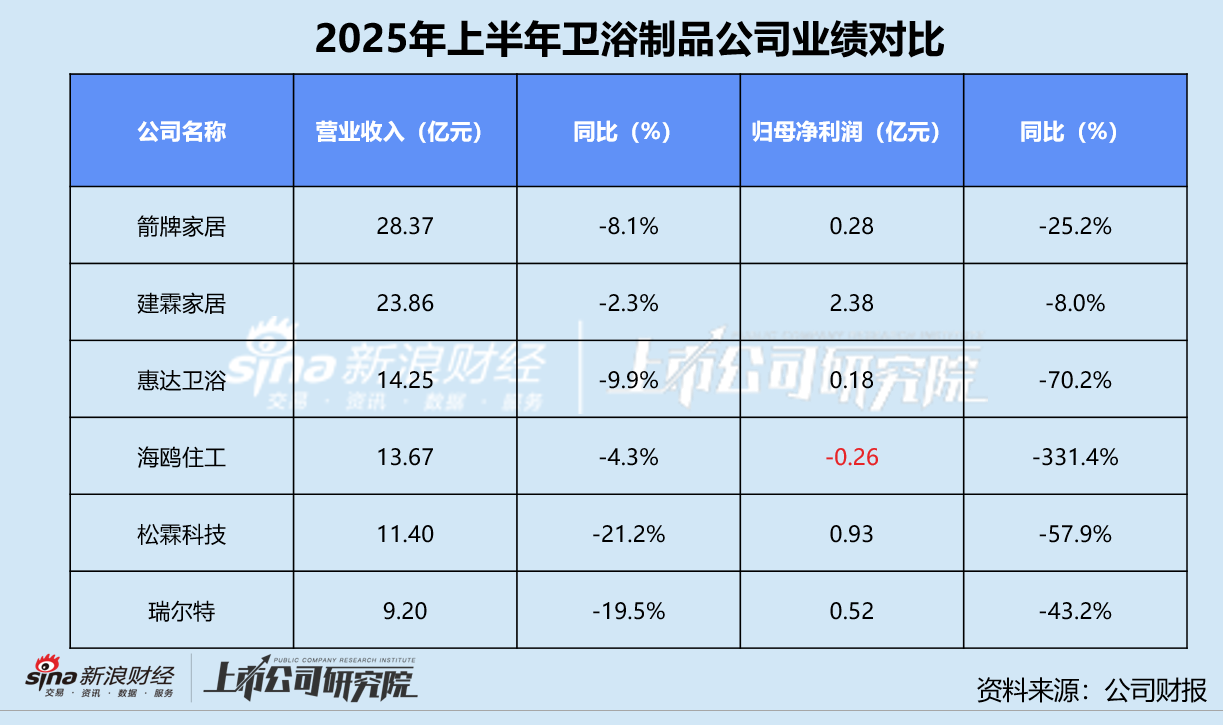
Core Viewpoint - The domestic real estate market continues to face pressure in the first half of 2025, impacting the home furnishing industry, although the implementation of a subsidy policy for durable consumer goods has somewhat mitigated the downturn [1] Investment and Construction - Residential investment reached 3.58 trillion yuan, a year-on-year decline of 10.4% - New residential construction area was 22.3 million square meters, down 19.6% - Completed residential area was 16.3 million square meters [1] Home Furnishing Industry Performance - Six listed bathroom product companies reported a total revenue of 10.076 billion yuan, a year-on-year decrease of 9.5% - Arrow Home ranked first with a revenue of 2.837 billion yuan, surpassing the second-ranked Jianlin Home by approximately 451 million yuan - Rietter's revenue fell significantly by 19.5% to 920 million yuan compared to the first half of 2024 [1] Cost Control - Operating costs for bathroom product companies generally decreased due to business contraction, with Arrow Home and Jianlin Home's cost reductions outpacing revenue declines - Arrow Home's operating cost was 2.001 billion yuan, leading the sector [1] Expense Efficiency - Jianlin Home was the only company to see an increase in sales, management, and R&D expenses year-on-year - Rietter reduced all three expense categories, while Huida Bathroom had the highest sales expense ratio at 11.8% - Songlin Technology had the highest management expense ratio at approximately 13.5% [1] Profitability - Jianlin Home reported a net profit of approximately 238 million yuan, while the combined net profit/loss of the other five companies was only 165 million yuan - Jianlin Home also experienced the smallest decline in net profit compared to the first half of 2024 [1] Profit Quality - Only Arrow Home reported a net outflow in operating cash flow, while Songlin Technology, Jianlin Home, and Huida Bathroom saw a year-on-year decrease in net operating cash flow - Huida Bathroom had high accounts receivable and inventory turnover days, at 98 days and 160 days respectively, affected by the weak performance of upstream real estate companies [1]


数读卫浴制品半年报 | 箭牌家居业绩领跑只是“纸面富贵”? 惠达卫浴应收账款、存货周转天数双高
Xin Lang Zheng Quan· 2025-09-15 10:37
Core Viewpoint - The domestic real estate market in China continues to face pressure in the first half of 2025, impacting related industries such as home furnishings and sanitary ware, with significant declines in investment, construction, and sales metrics [1][3]. Investment and Construction - Residential investment reached 3.58 trillion yuan, down 10.4% year-on-year - New residential construction area was 22.3 million square meters, a decrease of 19.6% - Completed residential area was 16.3 million square meters, down 15.5% [1]. Sales Performance - Residential sales area declined by 3.7% - New residential property sales amounted to 442 billion yuan, down 5.5%, with residential sales dropping by 5.2% [1]. Home Furnishing Industry Impact - The home furnishing industry is affected, but the implementation of trade-in subsidies for durable consumer goods since Q4 2024 has somewhat mitigated the downturn [1]. - In the first half of 2025, revenue for furniture manufacturing enterprises above designated size totaled 302.39 billion yuan, down 4.9%, while total profit fell by 23.1% to 10.64 billion yuan [1]. Financial Performance of Sanitary Ware Companies - Six listed sanitary ware companies reported a combined revenue of 10.076 billion yuan, down 9.5%, with a total net profit of 403 million yuan, compared to 681 million yuan in the same period of 2024 [1][3]. - Arrow Home led in revenue with 2.837 billion yuan, while Seagull Home reported a net loss of 26.06 million yuan, marking its first loss since 2009 [11]. Cost Control - Operating costs for sanitary ware companies generally decreased, with Arrow Home's costs at 2.001 billion yuan, 1.15 times that of the second-largest, Jianlin Home [4]. - Seagull Home's operating cost ratio was notably high at 87.1%, primarily due to geopolitical tensions affecting export costs [4]. Expense Efficiency - Jianlin Home was the only company to see increases in sales, management, and R&D expenses, while others like Ruierte reduced all three [7]. - Huida Sanitary had the highest sales expense ratio at 11.8% [7]. R&D Investment - R&D expense ratios for sanitary ware companies ranged from 3% to 5%, with Songlin Technology leading at 10.2% [8]. - Huida Sanitary's R&D expenses fell over 33% due to project fluctuations [8]. Profitability - Jianlin Home reported a net profit of approximately 238 million yuan, the highest among peers, with a minimal decline of 8.0% year-on-year [11]. - Seagull Home's net profit margin was -2.4%, the lowest among the companies analyzed [11]. Cash Flow and Quality - Only Arrow Home reported a net outflow in operating cash flow, while others like Songlin Technology and Jianlin Home saw declines in cash flow net amounts [14]. - Huida Sanitary's accounts receivable and inventory turnover days were notably high, indicating potential liquidity issues [16].
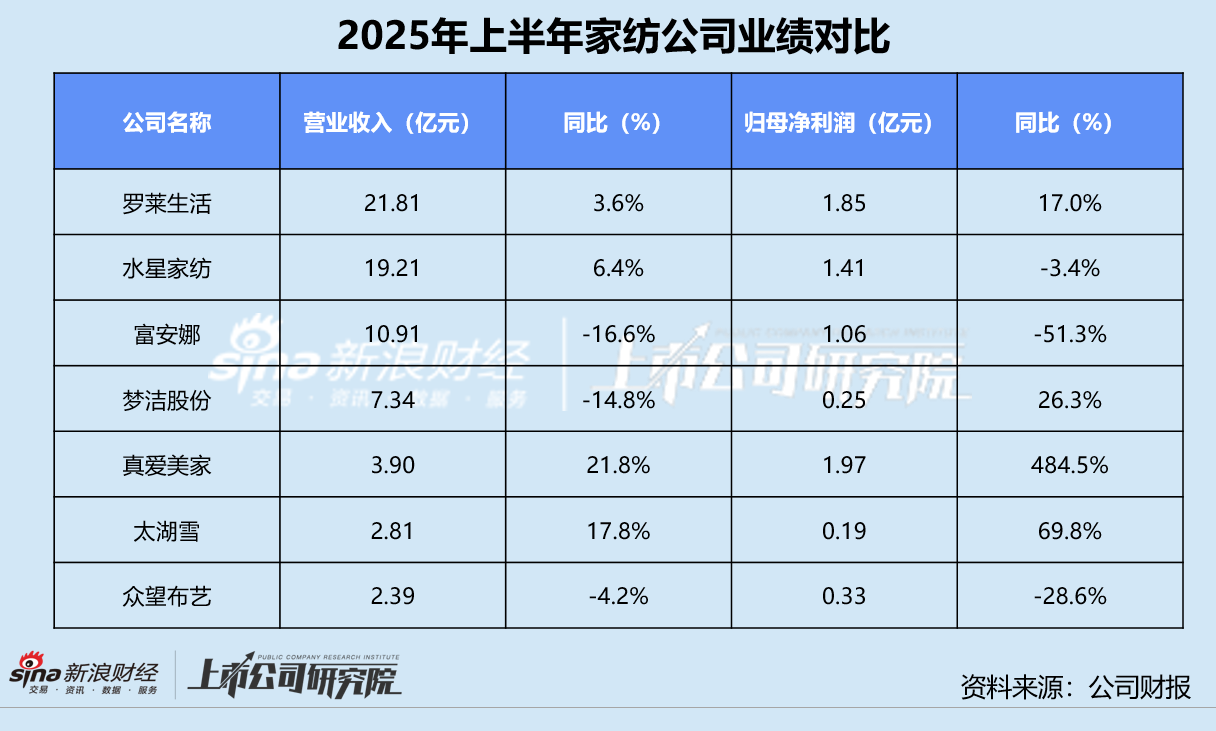
数读家纺半年报 | 富安娜归母净利润“腰斩” 水星家纺、太湖雪三费齐升
Xin Lang Zheng Quan· 2025-09-15 10:37
Core Viewpoint - The domestic real estate market continues to face pressure in the first half of 2025, impacting the home textile industry, with significant declines in investment, new construction, and sales figures [1] Investment and Market Performance - Residential investment reached 3.58 trillion yuan, down 10.4% year-on-year - New residential construction area was 22.3 million square meters, a decrease of 19.6% - Residential completion area fell to 16.3 million square meters, down 15.5% - Residential sales area decreased by 3.7%, with new commodity housing sales amounting to 4.42 trillion yuan, down 5.5% [1] Home Textile Industry Impact - The home textile industry is adversely affected, with home textile consumption showing insufficient momentum despite the implementation of a subsidy policy for durable consumer goods [1] - In the first half of 2025, the total revenue of seven listed home textile companies was 6.837 billion yuan, roughly flat compared to the same period in 2024, while net profit increased by 22.8% to 708 million yuan [1] Company Performance Overview - Leading company in revenue: Luolai Life with 2.181 billion yuan, 3.6% increase year-on-year - Mercury Home Textile reported 1.921 billion yuan, a 6.4% increase, but net profit decreased by 3.4% - Fuanna's revenue dropped by 16.6% to 1.091 billion yuan, with a significant decline in core product revenue [3] - The highest revenue growth was seen in Zhenai Meijia, with a focus on blankets, achieving a 21.8% increase in revenue [3] Cost Control and Efficiency - Operating costs generally increased, with Luolai Life's costs at 1.138 billion yuan, the highest among peers - Zhenai Meijia's operating cost ratio approached 80%, while Fuanna maintained a lower ratio of 46.4% due to direct sales channel strategies [4] - Dreamjie Co. was the only company to see a decrease in sales, management, and R&D expenses [7] Profitability Analysis - Zhenai Meijia led in net profit with approximately 197 million yuan, a nearly sixfold increase year-on-year - Fuanna's net profit was halved due to inventory pressure and high sales expenses, despite maintaining a gross margin of 53.6% [9] - The net profit margin for Zhenai Meijia reached 50.5%, significantly higher than its peers [9] Cash Flow and Receivables Management - Approximately 57.1% of companies saw a year-on-year increase in operating cash flow exceeding 100% - Luolai Life's operating cash flow increased by 28.9% to 377 million yuan, while Mercury Home Textile experienced a net cash outflow [11] - Zhenai Meijia had an accounts receivable turnover period of 91 days, significantly longer than Fuanna's [14]