
存储芯片价格上涨

Search documents
存储价格暴涨,这个“上古”功能要重回旗舰机了?
猿大侠· 2025-12-10 04:11
Core Viewpoint - The article discusses the potential return of MicroSD card slots in flagship smartphones due to rising NAND flash prices and the need for cost control among manufacturers [3][8][11]. Group 1: MicroSD Card Slot Trends - MicroSD card slots were commonly used for expanding storage in devices, especially during the feature phone era, but have been removed from many high-end smartphones in recent years for design and cost reasons [3]. - Major brands like Samsung and Huawei have eliminated MicroSD slots in their flagship models, while mid-range and budget devices still rely on them [3]. - There is speculation that MicroSD slots may return to flagship models as manufacturers reassess their storage strategies in light of rising memory costs [8]. Group 2: NAND Flash Price Increases - The demand for AI computing has led to a shortage of enterprise memory (HBM), causing a decrease in consumer-grade NAND flash supply and significant price increases [6]. - SanDisk has raised NAND flash prices three times in 2025, with the most recent increase in November reaching 50%, breaking market expectations [6][7]. - The consensus in the industry is that the shortage and price increases for DRAM will persist until at least 2027, impacting smartphone memory chip supplies [6]. Group 3: Cost Management Strategies - Smartphone manufacturers, particularly in the Android ecosystem, are reevaluating the feasibility of including MicroSD slots in flagship models to manage costs [8]. - By offering models with MicroSD support, manufacturers can keep base prices lower while allowing users to expand storage affordably, thus maintaining sales volume and revenue [8][9]. - The new MicroSD Express standard has improved performance, with some cards achieving read/write speeds of up to 800MB/s, addressing previous speed limitations [9]. Group 4: User Demand and Future Outlook - There remains a strong user demand for expandable storage, as the price difference between high-capacity internal storage and MicroSD cards is significant, making the latter a more attractive option for cost-sensitive consumers [11]. - However, flagship models are already in production, and it may take until the second half of 2026 for manufacturers to incorporate MicroSD slots into new designs [11].


iPhone 17 Pro系列上市两月两次降价促销 网友吐槽“优惠力度小”
Zhong Guo Jing Ying Bao· 2025-12-09 04:08
Group 1 - Apple has initiated price promotions for the iPhone 17 series, including discounts of 300 yuan for the iPhone 17 Pro and Pro Max models, with new prices starting at 8699 yuan and 9699 yuan respectively [2][3] - The iPhone 17 series has seen two official price reductions within two months of its launch, indicating a more aggressive and flexible sales strategy by Apple in a competitive high-end market [2][4] - The iPhone 17 series has performed well in sales, with the basic model's sales increasing over 100% year-on-year, while the Pro and Pro Max models also experienced significant growth during the "Double 11" shopping festival [4][5] Group 2 - Compared to the previous year's iPhone 16 series, the promotional efforts for the iPhone 17 Pro series are more restrained, with fewer discounts available [5] - Apple's recent management changes include the departure of key executives, which may impact the company's strategic direction [6] - The rising prices of storage chips pose a significant challenge for smartphone manufacturers, although Apple is expected to manage these pressures better than Android competitors due to its more unified storage specifications and supply chain management [7][8]

对话杨元庆:AI不存在泡沫,2026年存储芯片价格还会持续上涨
Tai Mei Ti A P P· 2025-11-21 07:15
Core Insights - Lenovo Group reported a record high revenue of 146.4 billion yuan for Q2 of FY2025/26, marking a 15% year-on-year increase, with adjusted net profit rising 25% to 3.66 billion yuan [2] - The company's IDG smart device business generated 108.1 billion yuan, a 12% increase, while the ISG infrastructure solutions business saw a 24% rise to approximately 29.3 billion yuan [2] - AI-related business revenue now accounts for 30% of total revenue, up 13 percentage points year-on-year, indicating AI as a significant growth driver for Lenovo [3] Revenue Breakdown - IDG smart device business revenue: 108.1 billion yuan, up 12% [2] - ISG infrastructure solutions business revenue: approximately 29.3 billion yuan, up 24% [2] - SSG solutions and services business revenue: nearly 20% year-on-year growth [2] AI and Market Trends - AI's growth is expected to be sustainable, with significant demand for memory, flash, and solid-state drives, leading to rising storage chip prices [3][4] - Morgan Stanley indicates that the AI-driven memory supercycle is real, with potential for stronger and longer-lasting impacts than anticipated [4] - The global traditional PC market is projected to grow by 5% to 10%, driven by AI PC demand, which is expected to account for 31% of global PC shipments by 2025 [6][8] Supply Chain and Pricing - Lenovo has secured optimal contracts with key component suppliers, ensuring sufficient supply despite rising prices [5][6] - The company is well-positioned to manage supply shortages and price increases better than competitors due to strong supplier relationships [5] Future Outlook - Lenovo plans to focus on personal and enterprise intelligence, with expectations of continued growth in both areas [7] - The global server market is projected to grow by approximately 44.6% by 2025, with AI servers expected to see a 46.7% increase, driving overall market expansion [8]


存储芯片价格疯涨50% 手机会继续涨价吗?
Zhong Guo Jing Ying Bao· 2025-11-19 06:48
Core Viewpoint - The global consumer electronics market is facing challenges due to rising storage prices, leading to downward adjustments in production and shipment forecasts for smartphones and laptops in 2026 [1][2]. Group 1: Market Forecast Adjustments - TrendForce has revised its 2026 global smartphone and laptop production forecasts from a growth of 0.1% and 1.7% to declines of 2% and 2.4% respectively [1]. - The ongoing inflation and strong upward cycle in memory prices are expected to increase overall production costs, which may lead to higher end-product prices and further impact consumer demand [1][2]. Group 2: Procurement Strategies of Manufacturers - Several smartphone manufacturers, including Xiaomi, OPPO, and vivo, have reportedly paused their storage chip purchases due to high price increases, with some DRAM inventories falling below three weeks [2][3]. - Analysts suggest that it is unlikely for manufacturers to halt procurement entirely, as doing so would risk losing market share; instead, they may opt to raise product prices to cover rising component costs [2][3]. Group 3: Cost Impact on Smartphone Pricing - The price increase of storage chips is expected to raise smartphone production costs by an additional 5% to 7% in the coming year, following an 8% to 10% increase in 2025 [5][6]. - Recent smartphone launches have seen price hikes across various brands, indicating that the cost pressures from rising storage prices are being passed on to consumers [4][5]. Group 4: Financial Performance of Companies - Transsion Holdings reported a revenue increase of 22.6% in Q3, but a net profit decline of 11.06%, attributing this to competitive pressures and rising supply chain costs [7]. - Xiaomi's Q3 financial report indicated a rise in sales costs due to increased prices of core components, reflecting the broader industry trend of rising costs impacting profitability [7][8]. Group 5: Market Dynamics and Trends - The high-end smartphone segment is better positioned to absorb cost increases due to higher profit margins, while mid-range and low-end models are more vulnerable to cost fluctuations [6][8]. - The ongoing supply constraints in the storage market may lead to a market reshuffle, favoring larger brands while smaller players struggle to secure resources [8].
港股异动 | 小米集团-W(01810)再跌超3% 较6月高点跌超三成 高盛称做空小米成对冲基金共识
智通财经网· 2025-11-07 03:51
Core Viewpoint - Xiaomi Group's stock has declined over 30% from its peak in June, with a current drop of 3.08% to HKD 42.1, amid increasing short-selling activity by hedge funds [1][1][1] Group 1: Stock Performance - Xiaomi's stock price has fallen to HKD 42.1, representing a decline of over 30% since June's highest point [1] - The trading volume reached HKD 30.76 billion, indicating significant market activity [1] Group 2: Hedge Fund Activity - Hedge fund short positions on Xiaomi surged by 53% in the past week, reflecting growing bearish sentiment [1] - Recent data shows that selling pressure from pension funds and hedge funds has dominated the market in the last two weeks [1] Group 3: Investor Sentiment - Investor sentiment is turning cautious ahead of Xiaomi's third-quarter earnings report scheduled for November 18 [1] - Feedback from hedge funds suggests that Xiaomi is viewed as a consensus short/sell target in the short term due to a lack of catalysts [1] Group 4: Analyst Outlook - Goldman Sachs has lowered its target price for Xiaomi, citing rising storage chip prices that suppress smartphone gross margins [1] - The growth rate of Xiaomi's AIoT business has slowed to single digits, and delays in the electric vehicle phase two factory are impacting deliveries [1]

板块异动 | 存储芯片探底回升 机构再次上调四季度DRAM价格涨幅
Shang Hai Zheng Quan Bao· 2025-11-03 06:29
Core Viewpoint - The storage chip market is experiencing a rebound, with significant price increases expected for DRAM in the fourth quarter, driven by increased demand from cloud service providers [1] Group 1: Market Performance - As of November 3, storage chip stocks showed strong performance, with companies like Aerospace Intelligence and Taiji Industry hitting their daily price limits, and others like Purun and Xiangnong Chip rising significantly [1] - TrendForce has revised its forecast for fourth-quarter DRAM price increases from 8%-13% to 18%-23%, indicating a strong upward trend in pricing [1] Group 2: Future Outlook - Looking ahead to 2026, TrendForce anticipates a 4% annual increase in server shipments, driven by cloud service providers adopting high-performance computing architectures [1] - The increase in server DRAM capacity is expected to boost overall DRAM demand, leading to a prolonged supply shortage situation [1]
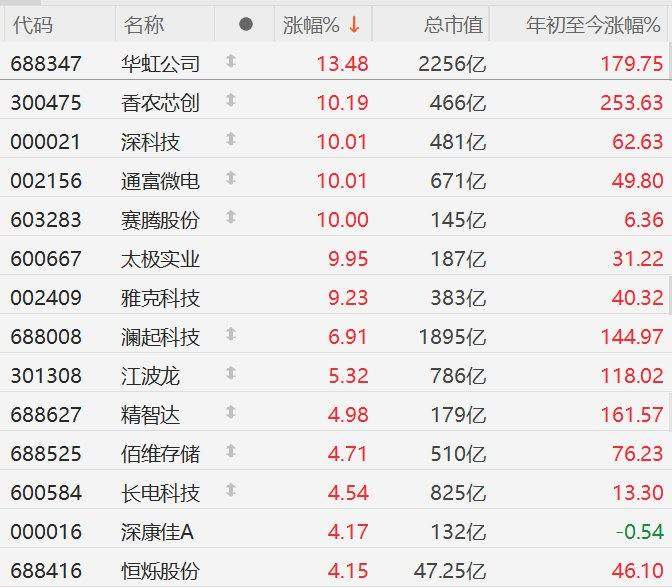
A股存储芯片股强势,华虹公司涨超13%、香农芯创涨超10%创历史新高!深科技、通富微电、赛腾股份10CM涨停
Ge Long Hui· 2025-10-09 01:56
Core Viewpoint - The A-share market for storage chip stocks has shown strong performance, with several companies reaching historical highs due to a sustained increase in global storage chip prices over the past six months [1][2]. Group 1: Company Performance - Huahong Company saw a rise of 13.48%, reaching a market capitalization of 225.6 billion, with a year-to-date increase of 179.75% [2]. - Shannon Microelectronics increased by 10.19%, with a total market value of 46.6 billion and a year-to-date growth of 253.63% [2]. - Deep Technology and Tongfu Microelectronics both experienced a 10.01% increase, with market capitalizations of 48.1 billion and 67.1 billion respectively, and year-to-date increases of 62.63% and 49.80% [2]. - Other notable performers include Saiteng Co. (10% increase), Taiji Industry (9.95% increase), and Yake Technology (9.23% increase), all approaching or reaching their daily limit [1][2]. Group 2: Market Trends - According to a recent report from CFM Flash Memory Market, global storage chip prices have been on the rise, with expectations for Q4 indicating a price increase of over 10% for server eSSD and a 10% to 15% increase for DDR5 RDIMM [2].



美光科技创下历史新高,全球存储芯片市场迎来新一轮价格飙升
Ge Long Hui A P P· 2025-10-01 14:41
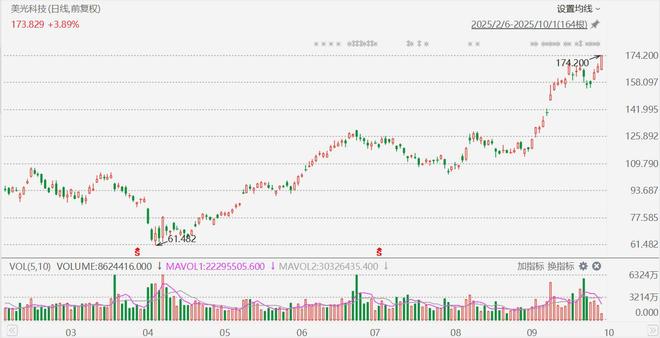
Core Viewpoint - Micron Technology (MU.US) experienced a significant price increase, rising over 4% to reach a historical high of $174.2, driven by a new wave of price surges in the global memory chip market due to supply-demand imbalance, technological advancements, and geopolitical factors [1] Industry Summary - The memory chip market is currently witnessing a price surge, with analysts optimistic about the industry's outlook for the next two years [1] - The first wave of price increases in the memory market began in early April 2025, initiated by SanDisk's price hike notification to customers [1] - In September, a second wave of price increases was confirmed when SanDisk announced a price increase of over 10% for all its products [1] - Recently, Micron Technology notified its channel partners of a price increase of 20%-30% for its memory products, effective from September 12, with all pricing for DDR4, DDR5, LPDDR4, and LPDDR5 products halted and agreements with customers suspended [1]

存储芯片股走强,兆易创新涨超6%,佰维存储涨近5%
Ge Long Hui· 2025-09-29 02:05
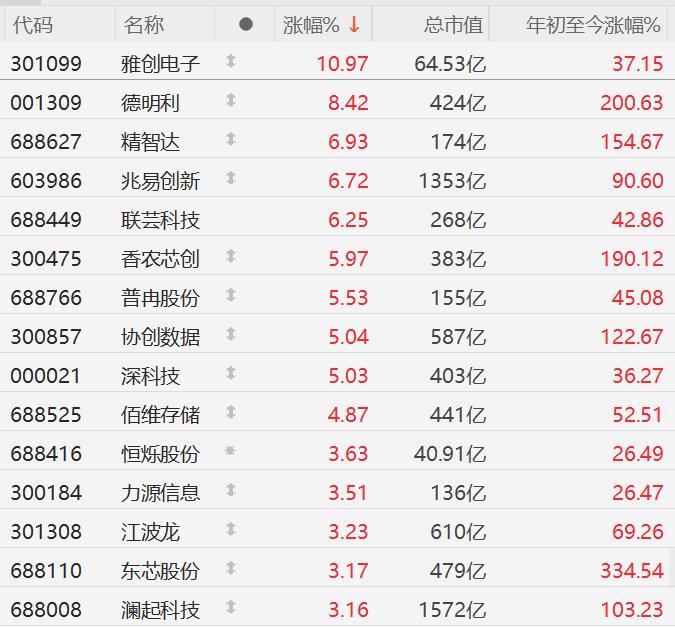
Core Viewpoint - The A-share market for storage chip stocks has strengthened significantly due to supply tightness and surging demand from cloud enterprises, leading to notable price increases and stock performance in the sector [1]. Group 1: Market Performance - Yachuang Electronics saw a nearly 11% increase in stock price, while Demingli rose over 8% [1]. - Other companies such as Jingzhida, Zhaoyi Innovation, and Lianyun Technology experienced gains exceeding 6% [1]. - The overall trend indicates a robust performance in the storage chip sector, with several companies achieving substantial year-to-date growth percentages [2]. Group 2: Price Adjustments and Supply Dynamics - Major storage module manufacturer Adata announced a halt on DDR4 pricing starting from the 29th, prioritizing DDR5 and NAND flash supply to key customers [1]. - Samsung Electronics raised its memory product prices by 30%, while NAND flash prices increased by 5% to 10% [1]. - Micron Technology informed customers of a price hike ranging from 20% to 30% [1].


中信证券:Q2主流存储与利基DRAM涨价 存储模组厂迎来盈利拐点
智通财经网· 2025-06-25 00:54
Core Insights - The report from CITIC Securities indicates that mainstream storage and niche DRAM prices are rising, with expectations for revenue growth among major storage manufacturers in Q2 2025 and a profitability turning point for storage module manufacturers [1] - It is anticipated that storage prices will maintain an upward trend in Q3 2025, particularly for DDR4 and DDR5 memory [3] Price Review - DRAM prices have shown a moderate increase for DDR5, while DDR4 prices have surged due to accelerated production cuts by manufacturers, with DDR5 contract prices rising approximately 2% and DDR4 prices increasing by 30% on average in May [1][2] - The average price increase for DDR4 8/16Gb chips in May exceeded 30% due to urgent procurement by downstream customers [1] NAND Flash Market - The reduction in production by manufacturers has led to a mild increase in NAND Flash prices, with TLC wafer prices rising by 6% to 14% in March, and SSD prices following suit [2] - Demand for enterprise SSDs continues to rise, particularly from North American CSP manufacturers [2] Price Outlook - For Q3 2025, DDR5 and NAND prices are expected to rise moderately, while DDR4 prices are projected to increase by 8% to 13% [3] - TrendForce forecasts that DDR4 PC/server memory module prices will rise by 18% to 23% and 8% to 13% respectively in Q3 2025 [3] - NAND Flash wafer prices are expected to increase by 3% to 8% in Q2 and 5% to 10% in Q3 2025 [3] Module Pricing - DDR5 memory prices have remained stable, while DDR4 prices have surged by 20% to 64% in the industry and channel markets [2] - SSD prices have seen a slight decline of 3% to 0% in the same period, while mobile storage prices have increased moderately by 0% to 14% [2]
