
改革攻坚

Search documents
“八个坚持”拓开2026年中国经济大视野
Guo Ji Jin Rong Bao· 2025-12-15 03:12
Group 1: Macroeconomic Policy and Domestic Market - The core macroeconomic policy emphasizes a more proactive approach, focusing on quality and efficiency as key development themes, with the "Eight Persistences" as critical directives for economic work in the first year of the 14th Five-Year Plan [1] - Domestic demand has become the main driver of economic growth, contributing an average of 93.1% to economic growth from 2013 to 2024, highlighting the importance of a strong domestic market as a long-term strategy [2][3] Group 2: Innovation and New Growth Drivers - The necessity of innovation-driven growth is underscored, as new momentum is essential for future development and competitive positioning, requiring a systemic reshaping of production factors and business models [4][5] - The development of new momentum must support both high-end industries and traditional industry upgrades, creating high-quality employment and meeting the needs of the populace [5] Group 3: Reform and High-Quality Development - Continuous reform is essential to inject vitality into high-quality development, addressing deep-seated issues that have emerged due to changing development stages [6][7] - Emphasis on technological innovation as a key driver for high-quality development, necessitating a deep integration of innovation systems and breaking down institutional barriers [7] Group 4: Open Economy and International Cooperation - China aims for a higher level of openness, promoting multi-faceted cooperation to adapt to global economic changes and challenges, emphasizing the importance of collaborative networks in various fields [8][9] - The need for innovative cooperation mechanisms to address challenges posed by protectionism and geopolitical tensions is highlighted, focusing on quality and resilience in partnerships [9] Group 5: Coordinated Development and Urban-Rural Integration - The strategy of promoting coordinated development aims to address the growing disparities between urban and rural areas, emphasizing the need for a balanced and inclusive development approach [10][11] - Regional integration strategies like the Beijing-Tianjin-Hebei collaboration and the Yangtze River Economic Belt are examples of efforts to optimize resource allocation and promote high-quality regional economic layouts [11] Group 6: Green Transformation and Carbon Neutrality - The commitment to achieving carbon peak by 2030 and carbon neutrality by 2060 reflects China's responsibility in global climate governance and the need for a comprehensive green transformation [12][13] - Innovation is identified as the core engine for achieving carbon goals, requiring advancements in renewable energy, energy efficiency, and the establishment of supportive institutional frameworks [14] Group 7: Focus on People's Livelihood - The emphasis on prioritizing people's livelihoods reflects the increasing complexity of public demands, necessitating a responsive governance approach that addresses specific community needs [15][16] - Establishing long-term mechanisms to ensure sustainable improvements in public welfare is crucial, with a focus on resource allocation and social governance [16] Group 8: Risk Management - The need to manage risks in key areas such as real estate and local debt is highlighted, with a focus on maintaining stability while actively addressing potential threats [17][18] - A balanced approach to risk management is essential, combining immediate responses with long-term structural improvements to foster sustainable development [18]
中央经济工作会议召开 创金合信基金魏凤春:政策延续扩张 存量增量并重
Xin Lang Cai Jing· 2025-12-15 02:06
Core Viewpoint - The Central Economic Work Conference held on December 10-11 in Beijing emphasizes the continuation of proactive fiscal policies and moderately loose monetary policies for the upcoming year, signaling a focus on economic recovery and stability amid external uncertainties [1][6]. Fiscal Policy - The fiscal policy is expected to maintain a relatively stable total expenditure while optimizing the structure and revitalizing existing resources, utilizing special bonds and policy financing to support key areas [2][8]. - Consumption vouchers and tax incentives will be employed to stimulate resident consumption [2][8]. Monetary Policy - Interest rate cuts may still be necessary to ensure reasonable price recovery and change the persistent low inflation expectations, while also lowering financing costs for the real economy [2][8]. - The monetary policy will focus on stabilizing the exchange rate and adjusting financial regulations to restore the transmission from loose monetary policy to credit expansion [2][8]. Domestic Demand - The conference prioritizes "expanding domestic demand" as a key task, viewing it as a strategic necessity to counterbalance external uncertainties and enhance internal circulation [3][9]. - The core of expanding domestic demand lies in consumption rather than investment, requiring collaboration among enterprises, government, and residents to create a robust domestic market [3][9]. Innovation and New Growth Drivers - Future new growth drivers will focus on digital economy, artificial intelligence, advanced manufacturing, and renewable energy, among others [4][9]. - The capital market is expected to support innovation through pricing, financing, and mergers and acquisitions, facilitating the integration of technological achievements into the industry [4][9]. Reform for High-Quality Development - Key areas for reform include the implementation of the Private Economy Promotion Law, the establishment of a unified national market, and financial market reforms to enhance direct financing [5][10]. - Effective markets require a proactive government that clearly defines boundaries to prevent overreach and ensure high-quality development [5][10]. Risk Management - The approach to risk management should avoid piecemeal solutions and instead focus on comprehensive debt restructuring to create space for credit expansion [6][10]. - Strengthening accountability and recovery mechanisms in risk management is essential to balance growth and risk prevention [6][10]. International Cooperation - Areas for deepened cooperation include digital trade, green economy, and high-end manufacturing, presenting various investment opportunities [7][11]. - Investment opportunities are identified in cross-border e-commerce, renewable energy, and infrastructure projects along the Belt and Road Initiative [7][11]. Capital Market Opportunities - The development of county-level economies, green transformation, and long-term care insurance systems are expected to open up capital market opportunities in infrastructure, renewable energy, and healthcare services [8][12]. - Specific investment opportunities include supply chain services, smart logistics, and green building technologies [8][12].
投资于人民生为大!解读2025中央经济工作会议
Xin Lang Cai Jing· 2025-12-15 00:00
Core Viewpoint - The central economic work meeting emphasizes the integration of investment in both material and human resources, indicating a focus on improving people's livelihoods in 2026 [1][1]. Group 1: Investment in Human Resources - The meeting highlights the importance of investing in people and prioritizing livelihoods, suggesting that future economic efforts will concentrate on the welfare of the population [1][1]. - Key initiatives include stabilizing employment for critical groups such as college graduates and migrant workers, as well as enhancing the quality and capacity of job opportunities [1][1]. Group 2: Education and Structural Adjustments - There is a focus on restructuring the allocation of educational resources, which is seen as a significant step towards improving human capital [1][1]. - Experts are optimistic about the implementation of detailed measures related to educational reforms and resource distribution [1][1]. Group 3: Broader Economic Goals - The meeting also addresses broader tasks such as reform challenges and the "dual carbon" initiative, indicating a commitment to sustainable development [1][1]. - The anticipation of more specific measures being rolled out in the coming year reflects a proactive approach to economic management [1][1].
好评中国|锚定高质量发展,奋力实现“十五五”良好开局
Huan Qiu Wang· 2025-12-13 07:45
Core Insights - The Central Economic Work Conference held on December 10-11, 2025, is crucial for setting the direction for China's economic work in 2026 and ensuring a good start for the "15th Five-Year Plan" [1][2] - The conference emphasizes the importance of unity in thought, consensus, and confidence to navigate the complexities of the current economic landscape and achieve high-quality development [2][3] Economic Strategy - The conference outlines a series of strategic deployments focused on stabilizing and advancing economic growth, with a priority on domestic demand and building a strong domestic market [3] - Key tasks include boosting consumption, optimizing investment, fostering innovation, and addressing risks in real estate and local debt [3][4] Leadership and Governance - Strengthening the Party's comprehensive leadership over economic work is highlighted as essential for overcoming challenges and achieving targets [4] - The need for a correct performance view that prioritizes people's well-being and practical results is emphasized, along with avoiding bureaucratic tendencies [4] Future Outlook - The conference sets a clear roadmap for 2026, aiming for a robust start to the "15th Five-Year Plan" and a commitment to high-quality development [5] - A call for collective effort and determination to overcome obstacles and achieve economic goals is made, reinforcing the vision for a modern socialist country [5]
财信研究院宏观团队|目标积极务实,政策提质增效,内需主导强化——2025年中央经济工作会议解读
Xin Lang Cai Jing· 2025-12-13 07:10
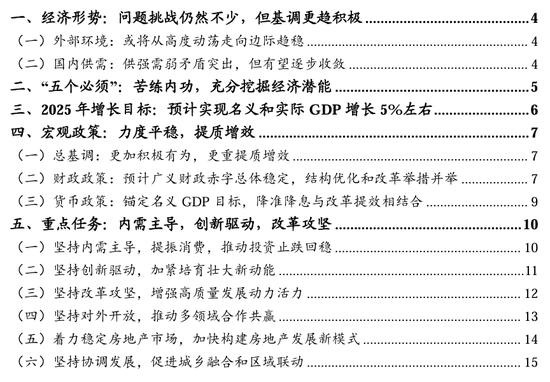
Economic Situation - The economic situation is characterized by persistent challenges, but the overall tone is becoming more positive. The external environment is expected to stabilize marginally, while domestic supply-demand imbalances are highlighted as a significant issue [2][10]. - The meeting emphasizes the need to address "development and transformation" issues, indicating that many challenges can be resolved through concerted efforts [10]. Five Musts - The meeting outlines "Five Musts" to enhance economic potential, focusing on internal capacity building to respond to external challenges and the importance of policy support alongside reform innovation [2][18]. - Key strategies include ensuring effective market regulation while promoting investment in both physical and human capital [19]. 2025 Growth Target - The growth target for 2026 is set at approximately 5% for both nominal and real GDP, reflecting a pragmatic approach to align with long-term goals and current economic conditions [3][21]. - The transition of growth drivers is expected, with the "three new economies" projected to surpass the real estate sector historically [21]. Macroeconomic Policy - The macroeconomic policy framework is shifting from "promoting stability through growth" to "enhancing quality and efficiency," indicating a focus on structural optimization rather than mere expansion [4][26]. - Fiscal policy is expected to maintain a deficit rate around 4%, with a focus on improving the efficiency of spending rather than just increasing the scale [30][31]. - Monetary policy will remain moderately accommodative, with expectations for potential rate cuts and targeted support for key sectors [36][40]. Key Tasks - The emphasis on domestic demand is paramount, with strategies to boost consumption and stabilize investment growth projected at 2-3% for 2026 [5][46]. - Innovation-driven growth is prioritized, with plans to strengthen the integration of education, technology, and talent development [6][50]. - Reforms will focus on eliminating barriers to development, enhancing market dynamics, and improving the business environment [7][57]. Real Estate Market - The policy focus is shifting towards stabilizing the real estate market, moving from demand stimulation to a balanced supply-demand approach [8][63].

八大重点任务,每一项都沉甸甸的,都吸引着世界的目光
Sou Hu Cai Jing· 2025-12-13 03:00
Group 1 - The primary task is to maintain domestic demand as the leading force and build a strong domestic market, which is crucial for economic stability amidst international uncertainties [2] - The second task emphasizes innovation-driven growth, highlighting the need for increased market demand to stimulate corporate innovation and economic momentum [2] - The third task focuses on deepening reforms to enhance high-quality development, which is essential for generating new momentum and increasing market vitality [4] Group 2 - The fourth task is to uphold openness and promote win-win cooperation across multiple fields, despite challenges from unilateralism and protectionism in the international environment [4] - The fifth task stresses coordinated development to promote urban-rural integration and regional collaboration, which is vital for achieving common prosperity and modernization [5] - The sixth task is to lead with "dual carbon" initiatives, committing to comprehensive green transformation and environmental protection [6] Group 3 - The seventh task prioritizes people's livelihoods, aiming to improve the quality of life and ensure that every citizen experiences happiness and pride [8] - The eighth task involves maintaining a strong bottom line by proactively and prudently addressing risks in key areas, particularly in real estate and local government debt [8]
明确“路线图” 中央经济工作会议部署八项任务
Zhong Guo Xin Wen Wang· 2025-12-12 06:05
Core Insights - The Central Economic Work Conference outlined eight key tasks for China's economic work in 2026, emphasizing the importance of domestic demand and innovation-driven growth [1][2][3] Group 1: Economic Strategy - The first task is to "insist on domestic demand as the main driver and build a strong domestic market," highlighting its significance in the overall economic development [1] - The second task focuses on "insisting on innovation-driven growth and accelerating the cultivation of new momentum," indicating that technological innovation will play a crucial role in expanding domestic demand [1] - The third task emphasizes "deepening reforms to enhance the vitality of high-quality development," which includes improving the national unified market and optimizing the business environment to address institutional bottlenecks [1] Group 2: External Relations and Cooperation - The fourth task is to "insist on opening up and promoting win-win cooperation in multiple fields," which aims to enhance the synergy between domestic and international markets and resources [2] - The fifth task stresses "coordinated development to promote urban-rural integration and regional linkage," essential for achieving a broader and more robust new development pattern [2] Group 3: Sustainability and Social Welfare - The sixth task is to "insist on leading with 'dual carbon' goals to promote comprehensive green transformation," aligning with the previously announced goals of carbon peak and carbon neutrality [2] - The seventh task focuses on "prioritizing people's livelihoods and striving to do practical things for the public," reiterating the importance of stabilizing employment, businesses, markets, and expectations [2] Group 4: Risk Management - The eighth task is to "ensure bottom-line stability and actively and prudently resolve risks in key areas," particularly in stabilizing the real estate market and managing local government debt risks [2] - The overall economic policy approach is shifting from "promoting stability through growth" to "quality and efficiency," emphasizing the need for coordinated policy efforts [3]
田轩:真抓实干“十五五” | 立方大家谈
Sou Hu Cai Jing· 2025-12-12 03:06
Core Insights - The 2025 Central Economic Work Conference has established a clear policy blueprint for China's economic direction, emphasizing a "systematic thinking" and "effectiveness-oriented" approach to economic policy [2][3] Group 1: Economic Policy Focus - The conference highlights a shift from broad policy coverage to targeted and precise measures, integrating existing and new policies to address economic challenges [2] - Specific institutional designs and action plans have been introduced to tackle issues such as consumption restrictions, corporate debt, and real estate market fluctuations [2] Group 2: Identifying Challenges and Opportunities - The conference acknowledges the achievements of China's economy while also recognizing significant challenges, including external environmental changes and domestic supply-demand imbalances [3] - A consensus has been built around the long-term positive outlook for the economy, despite acknowledging transitional pains [3] Group 3: Practical Experience and Methodology - Five key principles for economic work have been identified: maximizing economic potential, balancing policy support with reform, ensuring effective governance, integrating investments in goods and people, and strengthening internal capabilities to face external challenges [4] - These principles provide a methodological framework for addressing economic governance and avoiding fragmentation [4] Group 4: Addressing Core Economic Issues - The conference identifies three main focus areas: expanding domestic demand, fostering innovation and reform, and managing risks in key sectors such as real estate and local government debt [5] - Measures to combat "involution" in competition and address deep-seated economic contradictions have been emphasized [5] Group 5: Policy Coordination and Expectations - The conference promotes a combination of proactive fiscal policy and moderately loose monetary policy, aiming for policy continuity while optimizing implementation strategies [6] - A focus on improving policy coherence and managing expectations is highlighted to stabilize market confidence [6] Group 6: Enhancing Domestic Demand - Specific actions to boost consumption include implementing a "Consumption Promotion Special Action" and a "Rural Residents Income Increase Plan," aimed at removing unreasonable restrictions and enhancing service consumption potential [7] - Investment strategies will focus on increasing central budget investments and optimizing local government bond usage to stimulate private investment [9] Group 7: Innovation and Reform Initiatives - The conference outlines plans for establishing three major international technology innovation centers and enhancing intellectual property protection in emerging fields [10] - A focus on integrating technology and industry innovation is emphasized, with a call for supportive policies for venture capital and long-term funding for early-stage projects [10] Group 8: Social Welfare and Employment - The conference emphasizes the importance of social welfare measures, including stabilizing employment for graduates and migrant workers, and enhancing social security for flexible employment [12] - Policies aimed at improving education, healthcare, and childcare support are highlighted to address public concerns and enhance living standards [12] Group 9: Risk Management Strategies - A targeted approach to risk management is proposed, particularly in the real estate sector and local government debt, with specific measures to control inventory and optimize debt restructuring [13][14] - The focus is on preventing systemic risks while addressing core risk areas through structured and effective measures [13] Group 10: Capital Market Development - The conference calls for continued deepening of capital market reforms to enhance market attractiveness and inclusivity, with a focus on long-term investment and institutional improvements [15][16] - Emphasis is placed on creating a multi-layered and differentiated market system to support various stages of enterprise development [16]
田轩解读2025中央经济工作会议:真抓实干“十五五”
Xin Lang Cai Jing· 2025-12-12 02:43
Core Viewpoint - The Central Economic Work Conference has established a clear policy blueprint for the beginning of the 14th Five-Year Plan, emphasizing a systematic and practical approach to economic policy, focusing on targeted and effective measures to address existing challenges and stimulate economic growth [1][17][18]. Group 1: Economic Policy Focus - The conference highlighted the need for a shift from broad policy coverage to targeted and practical measures, integrating existing and new policies to enhance effectiveness [1][18]. - It emphasized the importance of addressing long-standing issues while recognizing new challenges, aiming to stabilize expectations and release internal economic momentum [2][20]. Group 2: Key Economic Strategies - The conference identified five essential strategies for economic governance: maximizing economic potential, balancing policy support with reform innovation, ensuring effective regulation, combining investments in physical and human capital, and strengthening internal capabilities to face external challenges [3][21]. - It focused on three main areas: expanding domestic demand, fostering innovation and reform, and managing risks in key sectors such as real estate and local government debt [4][22]. Group 3: Policy Implementation - The conference called for a combination of proactive fiscal policies and moderately loose monetary policies, ensuring policy continuity while optimizing implementation methods [6][23]. - It stressed the importance of coherent policy evaluation and management mechanisms to enhance market confidence and ensure effective execution [6][23]. Group 4: Domestic Demand and Investment - The conference proposed dual strategies to boost domestic demand through consumption and investment, including specific actions to increase central budget investments and stimulate private investment [7][24]. - It emphasized the need for a policy framework that supports consumer spending and investment in infrastructure, education, and healthcare to solidify the foundation for domestic demand growth [8][26]. Group 5: Innovation and Reform - The conference outlined plans to establish major international technology innovation centers and enhance intellectual property protection to drive innovation [9][27]. - It called for comprehensive reforms in various sectors, including the establishment of a unified national market and the promotion of private sector rights [10][28]. Group 6: Social Welfare and Risk Management - The conference highlighted the importance of social welfare measures, focusing on employment stability and improving living standards for vulnerable groups [11][29]. - It proposed targeted risk management strategies for the real estate market and local government debt, emphasizing a structured approach to prevent systemic risks [12][30].
【新华解读】“推动经济实现质的有效提升和量的合理增长”明年怎么干?这次会议划重点
Xin Hua Cai Jing· 2025-12-12 00:50
Core Viewpoint - The Central Economic Work Conference emphasizes the need to "promote qualitative effective improvement and reasonable quantitative growth" for the upcoming year, aiming for a good start to the "14th Five-Year Plan" [1] Economic Growth and Challenges - The conference highlights the importance of maintaining a reasonable GDP growth rate over the next decade to achieve the goal of reaching the per capita GDP level of moderately developed countries by 2035 [1] - Current economic challenges include longstanding issues, new challenges, and a deepening impact from external environmental changes, with a notable contradiction between strong supply and weak demand [1][2] Policy Measures - The conference outlines several key tasks for the upcoming year, including enhancing counter-cyclical and cross-cyclical adjustments, implementing a more proactive fiscal policy, and maintaining a moderately loose monetary policy [2] - It is estimated that a 1% increase in GDP can provide approximately 2 million jobs, emphasizing the urgency of improving economic growth capabilities to address insufficient demand [2] Domestic Demand and Consumption - "Domestic demand as the main driver" is identified as the top priority for economic work, focusing on strengthening domestic demand to ensure economic stability and security [3] - Specific measures to boost consumption include implementing special actions to stimulate consumption, formulating income increase plans for urban and rural residents, and promoting urban renewal [3] Innovation and Reform - Innovation is ranked second among the eight key tasks for the upcoming year, with a focus on driving new momentum through technological innovation [4] - The conference emphasizes the need for reform to stimulate economic potential, with a focus on overcoming development challenges through targeted reforms [5] Real Estate Market Stability - The conference places significant emphasis on stabilizing the real estate market, advocating for city-specific policies to control supply, reduce inventory, and improve supply quality [7] - The goal is to enhance market activity and address potential homebuyer demand, with expectations for continued policy support in the real estate sector [7]