
数字化发展

Search documents
有色金属业保资源优供给促转型
Jing Ji Ri Bao· 2025-10-20 22:13
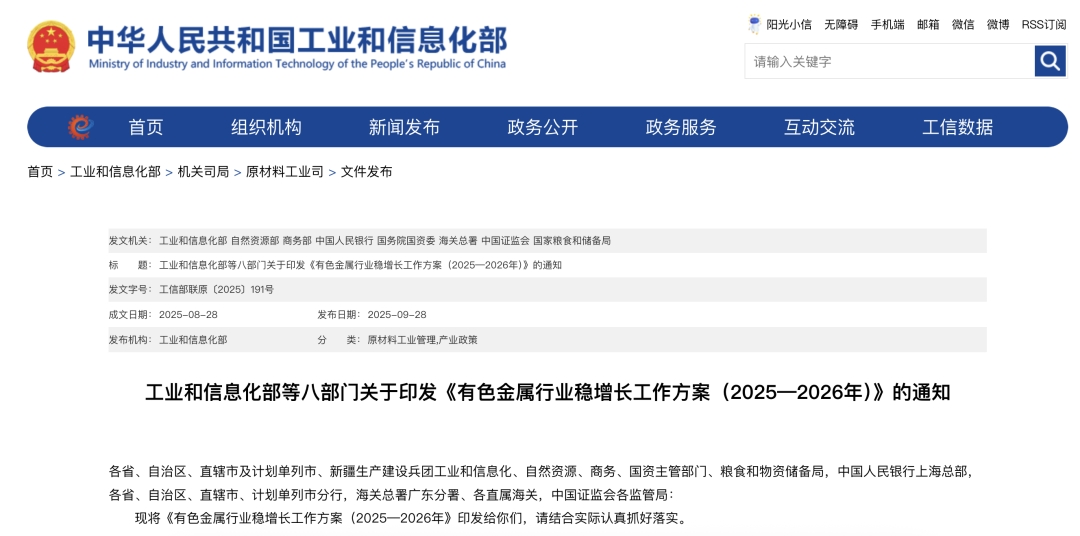
Core Viewpoint - The recent "Work Plan for Stable Growth in the Nonferrous Metal Industry (2025-2026)" aims to enhance the resilience and safety of the industry, targeting an average annual growth of around 5% in value-added output and 1.5% in the production of ten nonferrous metals from 2025 to 2026 [1][2]. Group 1: Resource Utilization - The plan emphasizes the need for a new round of exploration strategies to improve domestic resource supply, particularly for copper, aluminum, lithium, nickel, cobalt, and tin [2]. - It aims to enhance resource recovery rates and support the establishment of recycling bases in suitable regions, with a focus on increasing the efficiency of resource utilization [2]. - The government has allocated 300 billion yuan to support the replacement of old consumer goods, which will contribute to the recycling of nonferrous metals [2]. Group 2: Technological Innovation - The industry faces challenges in providing stable supplies of high-end products, necessitating a focus on high-end product innovation and the development of new materials [4][5]. - Companies like China Aluminum Corporation are committed to advancing research and industrial application of high-performance materials and enhancing their production capabilities [5][6]. - Jiangxi Copper is exploring new technologies and processes to improve resource utilization and develop high-purity metals [5][6]. Group 3: Industry Transformation - The plan highlights the importance of green and digital transformation in the nonferrous metal industry, aiming for a more sustainable and efficient production process [6][7]. - Companies are encouraged to adopt energy-efficient technologies and practices, with a focus on reducing carbon emissions and improving environmental performance [6][7]. - Digital transformation initiatives are being promoted, including the establishment of smart factories and the integration of AI technologies to enhance operational efficiency [7][8].
交行副行长杨涛:围绕航运产业链各环节 系统做好航运金融服务
Xin Hua Cai Jing· 2025-10-19 13:40
Core Insights - The Chinese shipping industry is innovating and accelerating the formation of new productive forces, enhancing the capabilities of the Shanghai International Shipping Center, which supports international trade and contributes to China's high-level opening-up [1] Group 1: Shipping Industry Performance - In the first half of this year, China's shipbuilding completion and new orders accounted for 52% and 68% of the global total, respectively, with new orders for green ships making up 69% of the global total [1] - China has historically gathered the manufacturing of large LNG carriers, large cruise ships, and aircraft carriers, which are considered the "crowning jewels" of shipbuilding [1] - The Yangshan Deep-Water Port has the world's leading operational efficiency for automated terminals and ranks first globally in port connectivity index, forming a shipping industry cluster worth hundreds of billions [1] Group 2: Financial Services and Green Transition - The company is embracing the trend of green transformation in shipping, focusing on financing for LNG-powered and methanol-powered vessels, and has participated in establishing the first financial standards for the water transport industry's transition [2] - The company has a significant presence in shipping leasing, with over half of its leasing investments in the past three years directed towards compliant green vessels [2] Group 3: Digitalization and Smart Manufacturing - The company is enhancing its shipping financial services through digitalization, utilizing AI, big data, and blockchain to improve online and automated service levels [2] - The company has launched various financial solutions like "Shipping Butler" to help shipping companies reduce costs and increase efficiency, and is actively involved in building a digital platform for shipping trade [2] - The company is also focusing on financing for high-end ship manufacturing, supporting smart ships and unmanned vessels, with a total project amount exceeding 100 billion and holding over 450 vessels [3] Group 4: Future Strategies - The company plans to deepen its commitment to the national strategy of building a strong shipping nation, enhancing its shipping financial service capabilities, and providing comprehensive financial services across the shipping industry chain [3] - The company aims to leverage its comprehensive operational advantages to offer integrated financial services such as equity, loans, bonds, and leasing to upstream and downstream enterprises [3] - The company will continue to strengthen its digital operations, focusing on building financial scenarios in shipping and exploring technology empowerment for efficient cross-border settlement, financing, and risk control [3]

高原十二载 守护万家灯火(青春日记)
Ren Min Ri Bao· 2025-10-10 22:10
Core Insights - The article highlights the journey and achievements of a female engineer in the high-altitude power sector of Qinghai, showcasing her contributions to the development and management of substations in the region [1][2]. Group 1: Career Development - The engineer graduated from North China Electric Power University in 2013 and began her career in the Qinghai-Tibet Plateau, specifically at the 330 kV Yushu Substation [1]. - She faced challenges such as altitude sickness but adapted by increasing her inspection frequency and engaging with local communities [1]. - Over twelve years, she participated in the acceptance of 14 substations, identified 376 defects, and completed 380 power supply tasks [2]. Group 2: Achievements and Recognition - In 2016, she became the youngest and only female station manager of the 750 kV Xining Substation, after successfully completing a 100-day acceptance task at the Tarla Substation [2]. - She received multiple honors, including the National Labor Model and the title of "Most Beautiful Worker" in 2025 [2]. Group 3: Future Goals - Currently, she is responsible for the operation and maintenance management of 65 ultra-high voltage substations in the province and aims to enhance her knowledge in power grid operation and automation [2]. - The focus is on contributing to the intelligent and digital development of the power grid through innovative research and upgrades [2].
上海“五篇大文章”贷款余额4.8万亿元,同比增13.7%
2 1 Shi Ji Jing Ji Bao Dao· 2025-10-10 12:10
Core Viewpoint - The Shanghai Financial "Five Major Articles" initiative aims to enhance the city's financial services and support high-quality economic development, with a target loan balance of 4.8 trillion yuan by August 2025, reflecting a year-on-year growth of 13.7% [1][2]. Group 1 - The Shanghai Financial "Five Major Articles" initiative has established a working group comprising 16 departments, resulting in 92 tasks and 275 specific projects to ensure effective implementation [1]. - The loan balance for the initiative is projected to reach 4.8 trillion yuan by August 2025, which is 6.6 percentage points higher than the growth rate of other loans [1]. - The initiative emphasizes the importance of aligning financial reforms with Shanghai's strategic goals for high-quality development and the construction of five centers [2]. Group 2 - The initiative focuses on enhancing the role of financial services in supporting technological innovation, green development, and digital transformation [2]. - It aims to improve financial inclusivity by innovating financial products and services, particularly in the areas of elderly finance and urban development [2]. - Collaboration among various departments is essential for the successful advancement of the initiative, including strengthening connections between industry and finance [2]. Group 3 - The People's Bank of China introduced the top-level design and policy framework for the financial "Five Major Articles" during the meeting [3]. - Various financial products and services were presented, including the "Husheng Points" financial service package and the "Specialized, Refined, Unique, and Innovative Loan" product manual [3]. - The meeting highlighted the importance of risk prevention and regulatory cooperation to maintain systemic financial stability [2].
青云科技回复上交所问询:上半年营收降30.56%,持续亏损但竞争力仍存
Xin Lang Cai Jing· 2025-09-29 11:55
Core Viewpoint - Qingyun Technology reported a significant decline in revenue and net profit for the first half of 2025, indicating ongoing challenges in its business operations and financial health [1] Revenue and Profitability - In the first half of 2025, the company achieved operating revenue of 100.11 million yuan, a year-on-year decrease of 30.56% [1] - The net profit attributable to shareholders was -41.56 million yuan, a year-on-year decrease of 10.43% [1] - The company's net assets stood at 43.63 million yuan, reflecting a substantial year-on-year decrease of 69.76% [1] Business Adjustments - The company is actively reducing low-margin business scales, with hardware sales in integrated software and hardware products declining by 58.16% compared to the same period last year [2] - Some clients have adjusted their procurement needs due to their own business planning and budget cycles, leading to a decrease in software product revenue [2] Long-term Losses - The company's long-term losses are attributed to strategic transformation pains and the need to digest historical investment costs [3] - The shift away from low-margin businesses towards high-margin AI computing cloud services has not yet generated significant revenue [3] - Fixed asset depreciation and labor costs create rigid expenses that pressure profits during the revenue adjustment phase, although gross margins are improving [3] Market Competitiveness - The company maintains a stable customer base, and the newly developed AI computing cloud business injects growth potential [4] - Industry policies supporting digital development present opportunities for the company [4] - Despite facing competition from large enterprises in the public cloud sector, the company holds a certain ranking in the private cloud hyper-converged software market and has competitive advantages in computing scheduling [4] Financial Health and Sustainability - The company's fundamentals have not experienced significant adverse changes, with continuous improvement in gross margins and a gradual narrowing of net losses [5] - The company has indicated risks related to lack of profitability and declining performance, while implementing strategic adjustments and cost optimization measures [5] - Although net assets continue to decline, the rate of decline has slowed, and the company aims to avoid delisting risks [5] Cash Flow and Liquidity - In the first half of 2025, the net cash flow from operating activities was -26.61 million yuan, with a continuously increasing and high asset-liability ratio [6] - The decrease in cash balance is primarily due to increased bank loan repayments [6] - The company manages its cash flow reasonably, with interest income matching the scale of funds, and has taken on long-term loans for daily operational turnover [6] - The current cash flow is sufficient to meet daily operational needs, but liquidity risks have been highlighted, prompting the company to implement various measures to improve cash flow [6]

有色金属行业稳增长划定重点 将实施新一轮找矿突破战略行动
Xin Hua Wang· 2025-09-29 02:08
Core Viewpoint - The Ministry of Industry and Information Technology, along with seven other departments, has issued a "Work Plan for Stable Growth in the Nonferrous Metal Industry (2025-2026)", aiming to address structural issues and promote sustainable growth in the industry [1][2]. Group 1: Industry Goals and Objectives - The work plan sets a target for the nonferrous metal industry to achieve an average annual value-added growth of around 5% from 2025 to 2026 [2]. - It aims for an average annual production growth of 1.5% for ten types of nonferrous metals, with significant progress in domestic resource development for copper, aluminum, and lithium [2]. - The plan includes a target to exceed 20 million tons in the production of recycled metals and to enhance the supply capacity of high-end products [2]. Group 2: Key Initiatives - The work plan outlines ten initiatives focusing on resource conservation, supply optimization, transformation promotion, consumption expansion, and cooperation strengthening [2]. - It emphasizes efficient resource utilization and the implementation of a new round of exploration strategies, particularly for copper, aluminum, lithium, nickel, cobalt, and tin [2][3]. - The plan supports the development of green and efficient mining technologies for low-grade and complex ores, as well as the comprehensive utilization of waste nonferrous metals and emerging solid waste [2]. Group 3: Industry Challenges and Responses - The nonferrous metal industry faces structural challenges, including insufficient domestic supply of key metals like copper and aluminum, despite having some advantages in resource endowment and extraction [3]. - Companies like China Aluminum Corporation are expected to actively participate in the new exploration strategy, enhancing resource investigation and accelerating new mine construction [3]. - The work plan also stresses the importance of maintaining a dynamic balance between total supply and demand, avoiding irrational behaviors in the new energy mineral sector, and promoting strategic cooperation across the industry chain [4].
10项举措!八部门最新印发
Zheng Quan Shi Bao· 2025-09-28 08:21
Core Viewpoint - The Ministry of Industry and Information Technology, along with eight other departments, has issued the "Work Plan for Stable Growth in the Nonferrous Metals Industry (2025-2026)", aiming for an average annual growth of around 5% in value-added output and a 1.5% increase in the production of ten nonferrous metals over the next two years [1][3][9]. Summary by Sections Overall Requirements - The plan emphasizes quality and efficiency, integrating technological and industrial innovation, and balancing supply and demand to enhance the resilience and security of the industry chain [8]. Main Goals - The nonferrous metals industry aims for an average annual value-added growth of approximately 5% and a 1.5% increase in the production of ten nonferrous metals from 2025 to 2026. Additionally, the production of recycled metals is expected to exceed 20 million tons, with continuous improvements in high-end product supply capabilities and advancements in green, low-carbon, and digital development [3][9]. Work Measures 1. **Promote Efficient Resource Utilization**: - Implement a new round of mineral exploration strategies, focusing on copper, aluminum, lithium, nickel, cobalt, and tin. Support the efficient and green extraction of low-grade and complex ores, and enhance the recycling of waste nonferrous metals [4][9]. 2. **Strengthen Technological Innovation**: - Drive breakthroughs in high-quality raw materials and advanced materials for key industries, enhancing product quality and supporting the construction of pilot platforms for new materials and low-carbon smelting processes [5][10]. 3. **Expand Effective Investment**: - Accelerate the approval and construction of mineral resource development projects, optimize the layout of key projects, and promote energy-saving and pollution-reduction transformations in various sectors [5][11]. 4. **Expand Consumption Demand**: - Promote the upgrade of bulk metal consumption, support long-term procurement agreements between upstream and downstream enterprises, and enhance the application of rare metals in emerging industries [6][14]. 5. **Deepen Open Cooperation**: - Assist enterprises in responding to unreasonable foreign trade restrictions, enhance the export of high-end new materials, and support the construction of overseas nonferrous metal projects [6][15]. Safeguard Measures - Emphasize organizational support and policy backing to ensure the stable growth of the nonferrous metals industry, with a focus on resource development, technological innovation, and talent support [17][18].

联合国贸发会议警告称2025年海运贸易增幅将大幅放缓
Jing Ji Guan Cha Wang· 2025-09-25 02:01
Core Insights - The global shipping industry is currently facing a highly uncertain and turbulent environment, as highlighted in a report by the United Nations Conference on Trade and Development (UNCTAD) [1] - Following a steady growth in 2024, the growth rate of maritime trade is expected to significantly slow down to 0.5% in 2025 [1] Industry Challenges - Geopolitical tensions, changes in trade policies, climate impacts, and regulatory adjustments are driving up shipping costs and forcing changes in shipping routes [1] - Port congestion and the demand for green transformation are accelerating the push for digitalization, although many developing economies remain lagging [1] Recommendations - UNCTAD calls for actions to promote stable trade policies, accelerate green and digital transformation, enhance cybersecurity, and provide support to developing countries, particularly the most vulnerable economies, to mitigate the impact of high transportation costs [1]
第三届中亚国家议会论坛举行 各方呼吁加强合作促区域发展
Zhong Guo Xin Wen Wang· 2025-09-23 12:13
Core Viewpoint - The third Central Asian Parliamentary Forum emphasizes the importance of enhancing connectivity, deepening economic and digital cooperation to promote regional stability and sustainable development [1][2]. Group 1: Regional Cooperation - Leaders from the five Central Asian countries highlighted the need for strengthened interconnectivity as a key focus for cooperation [1]. - The resolution of border issues between Kyrgyzstan and its neighbors has enhanced regional trust [1]. - The China-Kyrgyzstan-Uzbekistan railway is identified as a significant project to expand freight channels, boosting trade, investment, and industrial cooperation [1]. Group 2: Legislative Support - Kazakhstan's Senate Chairman proposed three recommendations for promoting regional cooperation: improving legal frameworks for economic exchanges, providing legislative support for AI and digital development, and enhancing ecological cooperation for sustainable development [1]. - The importance of continuous parliamentary attention to economic growth drivers, labor migration management, and digital development was emphasized by Tajikistan's Senate Chairman [2]. Group 3: Future Forums - The first two Central Asian Parliamentary Forums were held in Kazakhstan in 2023 and are scheduled to take place in Uzbekistan in 2024 [3].
长荣股份:2025年上半年扭亏为盈
Zhong Zheng Wang· 2025-08-30 04:30
Core Viewpoint - Long Yong Co., Ltd. reported a revenue of 726 million yuan for the first half of 2025, a year-on-year decrease of 3.8%, but achieved a net profit of 5.02 million yuan, marking a turnaround from losses [1] Group 1: Financial Performance - The company's revenue for the first half of 2025 was 726 million yuan, down 3.8% year-on-year [1] - The net profit attributable to shareholders was 5.02 million yuan, indicating a return to profitability [1] - The revenue from equipment manufacturing and system solutions reached 627 million yuan, with a gross margin increase of 1.95% compared to the same period last year [1] Group 2: Business Development - Overseas business revenue amounted to 247 million yuan, with significant growth in Southeast Asia and Eastern Europe markets [2] - The smart digital business segment generated sales revenue of approximately 63.91 million yuan, a year-on-year increase of 49.77% [2] - The company is actively promoting multiple smart factory projects and has secured new orders in non-printing industries [2] Group 3: Renewable Energy and Healthcare - The renewable energy segment, led by the subsidiary Long Yong Green Energy, achieved sales revenue of approximately 23.87 million yuan from high-efficiency photovoltaic components [2] - The healthcare business is expanding with new medical device projects and has obtained qualifications for blood dialysis and insurance in Tianjin [3] - Long Yong Huaxin, a subsidiary, reported sales revenue of approximately 36.96 million yuan, with new project investments nearing 308 million yuan [3]
