
有色

Search documents
春季躁动初现!周末迎来两大利好
Mei Ri Jing Ji Xin Wen· 2025-12-29 03:07
Market Performance - The market has shown a rebound, with the Shanghai Composite Index achieving an eight-day consecutive rise, matching the record from April [1] - The CSI 500 Index and the ChiNext Index had the highest weekly gains, both exceeding 3.9%, while the micro-cap index had the smallest gain of only 0.7% [1] Market Outlook - The Shanghai Composite Index is close to the upward trend line from September to October, with a potential breakout expected next week [4] - Despite the recent gains, there is a historical pattern of short-term corrections following five consecutive daily gains [4][5] - The current market is characterized as a bull market with a "slow bull" feature, suggesting a positive outlook for long positions [5] Key Investment Themes - Major investment themes include the AI industry chain, solid-state battery industry, energy storage, commercial aerospace, humanoid robots, innovative pharmaceuticals, and non-ferrous metals [5] - The commercial aerospace sector is highlighted as a hot investment theme, with expectations for continued acceleration despite recent declines in U.S. commercial aerospace stocks [6][7] - AI hardware stocks have shown weakness due to concerns over year-end liquidity and performance, but these concerns are expected to ease after the New Year [7] Sector Analysis - The humanoid robot sector has shown a double-bottom pattern since late August, indicating potential for future growth, although it requires patience due to its current state [8] - Lithium battery and energy storage sectors are linked to AI power, with significant market demand and price increases in lithium carbonate indicating strong future potential [9] - The non-ferrous metals sector is gaining attention due to rising international gold and silver prices, as well as historical highs in copper prices, suggesting a bullish outlook for gold, silver, copper, and lithium-cobalt [9][10] Summary and Strategy - The market is showing signs of a spring rally, with a mid-term bullish outlook and a focus on stable sector stocks [10] - Key sectors to monitor include AI hardware, humanoid robots, commercial aerospace, non-ferrous metals, lithium batteries, and energy storage, with an emphasis on core stocks [10]
持币过节效应偏弱,A股放量走强
Dong Zheng Qi Huo· 2025-12-28 08:16
Report Industry Investment Rating - The short - term, medium - term, and long - term trend rating of stock index futures is "oscillation" [4] Core Viewpoint of the Report - This week, the global stock market recovered. Affected by foreign holiday misalignment, the A - share market was mainly priced by domestic capital. The Shanghai Composite Index achieved eight consecutive positive days with increasing trading volume. The sentiment of holding cash for the holiday was low. In the short term, there are limited macro - level negatives, and positive factors like Beijing's real - estate policy optimization will boost the market. The subsequent market is expected to be oscillatory and positive, and long positions in stock index futures can be held continuously [2][10] Summary According to the Directory 1. One - Week View and Overview of Key Macroeconomic Events 1.1 Next - Week Viewpoint - The subsequent market is expected to be oscillatory and positive, and long positions in stock index futures can be held continuously [2][10] 1.2 Key Events This Week - On December 22, the central bank introduced a one - time credit repair policy for personal overdue information from January 1, 2020, to December 31, 2025, with a single - amount limit of no more than 10,000 RMB. The 12 - month LPR remained unchanged for the seventh consecutive month, with the 1 - year LPR at 3.0% and the 5 - year and above LPR at 3.5% [11][12] - On December 23, Shanghai proposed the main economic goals for the 15th Five - Year Plan period and long - term goals for 2035 [13][14] - On December 24, the Ministry of Housing and Urban - Rural Development promoted the spot - sale system for commercial housing. Beijing optimized real - estate policies, including relaxing purchase conditions for non - local households and supporting multi - child families' housing needs. There were also reports of SMIC planning to raise prices for downstream customers [15][16][17] - On December 26, the National Venture Capital Guidance Fund was officially launched. The profit of industrial enterprises above designated size decreased by 13.1% in November. The central bank aimed to increase the scale and proportion of medium - and long - term funds invested in A - shares [18][19][20][21] 2. One - Week Market Performance Overview 2.1 Global Stock Market Weekly Overview - From December 22 - 26, the global stock market denominated in US dollars rose. The MSCI Global Index increased by 1.43%, with emerging markets (+2.11%) > developed markets (+1.35%) > frontier markets (+0.74%). The South Korean stock market rose 6.87%, outperforming the world, while the Indian stock market fell 0.21%, performing the worst globally [22] 2.2 Chinese Stock Market Weekly Overview - From December 22 - 26, Chinese equity assets rose significantly. In terms of different markets, A - shares > Chinese concept stocks > Hong Kong stocks. The average daily trading volume of the A - share markets in Shanghai, Shenzhen, and Beijing was 1965.3 billion yuan, an increase of 204.7 billion yuan compared to last week. All broad - based A - share indices closed higher, with the CSI 500 Index rising 4.03%, performing the best, and the micro - cap stock index rising 0.68%, performing the worst [25] 2.3 Weekly Overview of GICS Primary Industries in Chinese and Foreign Stock Markets - Most GICS primary industries globally rose this week. The leading industry was materials (+2.78%), and the industry with the largest decline was consumer staples (-0.07%). In the Chinese market, materials had the largest increase (+5.85%), and consumer staples lagged (-0.65%) [28] 2.4 Weekly Overview of China A - Share CITIC Primary Industries - Among A - share CITIC primary industries, 24 rose (20 last week) and 6 fell (10 last week). The industry with the largest increase was non - ferrous metals (+6.45%), and the industry with the largest decline was commerce and retail (-1.31%) [31] 2.5 Weekly Overview of China A - Share Styles - Small - cap growth stocks outperformed this week [35] 2.6 Overview of Stock Index Futures Basis - Relevant charts show the basis of IH, IF, IC, and IM in the past 6 months [38][39] 3. Overview of Index Valuation and Earnings Forecast 3.1 Broad - Based Index Valuation - The report provides PE, eight - year percentile, PE at the beginning of the year, PE change during the year, PB, eight - year percentile, PB at the beginning of the year, and PB change during the year for multiple broad - based indices such as the SSE 50, CSI 100, etc. [44] 3.2 Primary Industry Valuation - The report provides valuation data for various primary industries, including PE, eight - year percentile, PE at the beginning of the year, PE change during the year, PB, eight - year percentile, PB at the beginning of the year, and PB change during the year [45] 3.3 Equity Risk Premium of Broad - Based Indices - The ERP of the CSI 300, CSI 500, and CSI 1000 decreased slightly this week [46][51] 3.4 Consensus Earnings Growth Forecast of Broad - Based Indices - The 2025 expected earnings growth rate of the CSI 300 was adjusted down to 8.65%, and the 2026 rate to 9.20%. For the CSI 500, the 2025 rate was adjusted down to 27.35%, and the 2026 rate was adjusted up to 22.23%. For the CSI 1000, the 2025 rate was adjusted up to 28.56%, and the 2026 rate was adjusted down to 23.09% [52] 4. Liquidity and Capital Flow Tracking 4.1 Interest Rates and Exchange Rates - This week, the 10 - year bond yield rose, the 1 - year yield fell, and the spread widened. The US dollar index was 98.0, and the offshore RMB exchange rate was 7.03 [62] 4.2 Tracking of Trading - Type Capital - This week, the average daily trading volume of north - bound funds decreased by 26.4 billion yuan compared to last week, and the margin trading balance increased by 41.3 billion yuan [61] 4.3 Tracking of Capital Flows through ETFs - There were 30 on - exchange ETFs tracking the CSI 300, 29 tracking the CSI 500, 15 tracking the CSI 1000, and 40 tracking the CSI A500. This week, the share of ETFs tracking the CSI 300 increased by 530 million, the CSI 500 by 690 million, the CSI 1000 by 1.3 billion, and the CSI A500 by 6.1 billion [65][66][69] 5. Tracking of High - Frequency Domestic Macroeconomic Data 5.1 Supply - Side: Tire Production Rate Declined - The report shows data on national blast furnace operating rates, coking enterprise operating rates, domestic crude steel daily output, etc., and the tire production rate declined [71][72][73] 5.2 Consumption - Side: Seasonal Uptick in Real - Estate Transactions - There was a seasonal uptick in real - estate transactions, including data on first - hand housing transaction areas in 30 large and medium - sized cities, second - hand housing transaction areas in 16 key cities, land transaction areas in 100 large and medium - sized cities, and second - hand housing listing volume and prices. The year - on - year growth rate of passenger car wholesale sales rebounded, and the crude oil price dropped to around $63.7 per barrel [78][79][87] 5.3 Inflation Monitoring: The Uptrend of Producer Goods and Agricultural Product Prices Leveled Off - Producer goods prices rose rapidly, agricultural product prices recovered, and the report also shows the weekly change rate of the commodity index [89][90][94]
市场主流观点汇总-20251223
Guo Tou Qi Huo· 2025-12-23 11:52
Report Summary 1. Report Industry Investment Rating The report does not provide an overall industry investment rating. 2. Core Viewpoints The report objectively reflects the research views of futures and securities companies on various commodity varieties, tracks hot - spot varieties, analyzes market investment sentiment, and summarizes investment driving logic. It also presents the market mainstream strategy views and investment logic for different asset classes based on the views of multiple institutions [1]. 3. Summary by Catalog 3.1 Market Quotes - **Commodities**: From December 15 to December 19, 2025, among commodities, the prices of some products such as coking coal, PTA, and polysilicon increased, with coking coal rising by 9.00%, PTA by 5.81%, and polysilicon by 5.34%. While the prices of some products such as copper, soybean meal, and corn decreased, with copper down 1.05%, soybean meal down 1.26%, and corn down 1.84% [2]. - **A - shares**: The Shanghai Stock Exchange 50 Index rose 0.32%, the CSI 500 Index remained unchanged, and the CSI 300 Index fell 0.28% [2]. - **Overseas Stocks**: The FTSE 100 Index rose 2.57%, the French CAC40 Index rose 1.03%, the NASDAQ Index rose 0.48%, the S&P 500 Index rose 0.10%, the Hang Seng Index fell 1.10%, and the Nikkei 225 Index fell 2.61% [2]. - **Bonds**: The yields of 2 - year and 5 - year Chinese government bonds increased by 0.38bp and 0.24bp respectively, while the yield of 10 - year Chinese government bonds decreased by 0.44bp [2]. - **Foreign Exchange**: The US dollar index rose 0.32%, the US dollar central parity rate fell 0.12%, and the euro - US dollar exchange rate fell 0.28% [2]. 3.2 Commodity Views - **Macro - financial Sector** - **Stock Index Futures**: Among 7 institutions, 0 were bullish, 0 were bearish, and 7 were neutral. Positive factors included overseas central bank policies, increased long - term capital allocation after index corrections, market attention to technology themes, and expected policy dividends in 2026. Negative factors included a decline in M1 growth, weakening policy impetus, weak economic momentum, and time - consuming policy implementation [3]. - **Treasury Bond Futures**: Among 7 institutions, 3 were bullish, 0 were bearish, and 4 were neutral. Positive factors were weak fundamentals, central bank liquidity injection, the attractiveness of 30 - year bond yields, and potential bond market recovery. Negative factors were low probability of short - term interest rate cuts, increased influence of trading disks, and concerns about ultra - long bond supply and demand [3]. - **Energy Sector** - **Crude Oil**: Among 8 institutions, 0 were bullish, 5 were bearish, and 3 were neutral. Positive factors were supply disruptions in Venezuela, inventory decline in the US, increased refinery utilization rates in China and the US, and strong local refined oil demand. Negative factors were limited impact of Venezuelan supply disruptions, rising non - OPEC production, increasing floating storage inventory, and expected slowdown in demand growth [4]. - **Agricultural Products Sector** - **Soybean Meal**: Among 7 institutions, 0 were bullish, 3 were bearish, and 4 were neutral. Positive factors were high import costs of US soybeans, pre - holiday stocking demand, increased replenishment by traders after price drops, and signs of short - position reduction in futures. Negative factors were strong expectations of a South American soybean harvest, poor performance of domestic soybean auctions, high inventory in oil mills, and weak purchasing willingness of feed enterprises [4]. - **Non - ferrous Metals Sector** - **Copper**: Among 8 institutions, 4 were bullish, 0 were bearish, and 4 were neutral. Positive factors were zero long - term processing fees in 2026, low spot smelting fees, continuous increase in copper foil operating rates, a decline in domestic copper concentrate port inventory, and high market attention. Negative factors were end - of - year capital shortages, high social inventory, weak terminal demand in the off - season, and a decline in the operating rate of refined copper rods [5]. - **Chemical Industry Sector** - **Glass**: Among 7 institutions, 0 were bullish, 0 were bearish, and 7 were neutral. Positive factors were potential cold - repair plans in late December, low near - month valuations, and potential boost from real - estate policies. Negative factors were a decline in deep - processing order days, slow market shipments, high inventory, and limited upside potential due to high inventory and off - season pressure [5]. - **Precious Metals Sector** - **Gold**: Among 7 institutions, 3 were bullish, 0 were bearish, and 4 were neutral. Positive factors were an increase in the US unemployment rate, lower - than - expected CPI, an increase in non - commercial net long positions in gold, and long - term support from central bank gold purchases. Negative factors were rapid adjustment of the gold - silver ratio, approaching a key resistance level, and market divergence on the Fed's interest - rate cut rhythm [6]. - **Black Metals Sector** - **Coking Coal**: Among 8 institutions, 3 were bullish, 0 were bearish, and 5 were neutral. Positive factors were release of supply pressure, low valuation, production cuts by some coal mines, increased winter - storage demand from steel mills, and improved spot - market transactions. Negative factors were high imports, a decline in steel mills' daily hot - metal production, reduced demand from coking plants, and an increase in total coking coal inventory [6].
策略周报:继续耐心布局高景气-20251221
HWABAO SECURITIES· 2025-12-21 13:02
Group 1 - The report emphasizes the importance of patiently positioning in high-growth sectors despite year-end market volatility, with a focus on sectors like AI, semiconductors, new energy, and non-ferrous metals [3][12] - The bond market shows signs of recovery in bullish sentiment, with expectations for interest rate cuts and new public fund fee regulations, although the report advises maintaining a neutral duration stance due to potential resistance in further declines of the 10-year government bond yield [3][12] - The report highlights that the A-share market has shown resilience in certain high-growth sectors, suggesting a favorable outlook for the upcoming spring market in January and February [3][12] Group 2 - Recent economic data indicates a decline in consumer growth to 1.3% in November, with fixed asset investment growth falling to -2.6%, reflecting increased pressure on the domestic economy [9] - The report notes that the bond market has priced in negative factors, leading to improved market sentiment, while the A-share market has experienced fluctuations due to global market concerns, particularly following the Bank of Japan's interest rate hike [10][12] - The report tracks key indicators in the A-share and bond markets, noting a slight decline in A-share valuation and trading activity, with average daily trading volume dropping to 17,605 billion yuan [20]
中央经济工作会议解读:供需协同、向新而行
HWABAO SECURITIES· 2025-12-12 10:30
Economic Outlook - The assessment of external conditions has improved compared to last year, indicating a reduction in adverse impacts from external changes[7] - The macro policy tone has shifted from "extraordinary" to "normal," reflecting a return to conventional policy measures[8] - Fiscal policy is expected to focus more on quality rather than quantity, with a marginal reduction in the intensity of fiscal measures[9] Monetary Policy - Monetary policy remains supportive, with a new emphasis on the goal of reasonable price recovery alongside economic stability[10] - There is still room for interest rate cuts, but the extent may be less certain than in previous years[11] Supply and Demand Dynamics - The focus has shifted from "demand insufficiency" to "strong supply and weak demand," indicating a dual approach to address supply-demand imbalances[12] - Policies will emphasize increasing residents' income and enhancing service consumption to stimulate demand[12] Risk Management - The approach to risk has transitioned from "preventing risks" to "managing risks," reflecting progress in controlling major risks in real estate and local government debt[13] Market Implications - Short-term market adjustments are anticipated following the Central Economic Work Conference, but the prevailing bull market sentiment may provide opportunities for investment[14] - High-growth sectors such as AI, new energy, and semiconductors are expected to outperform in the near term, while high-dividend stocks will gain attention later in the year[15]
策略周报:由守转攻,布局高景气方向等风起-20251207
HWABAO SECURITIES· 2025-12-07 11:25
Group 1 - The report indicates a shift from a defensive to an offensive strategy, suggesting a proactive approach to invest in high-growth sectors as market conditions improve [3][12][13] - It highlights that external and internal volatility risks have eased, with previous high-growth sectors showing signs of stabilization, and anticipates further consolidation in December [3][10] - The report recommends focusing on sectors with upward momentum, such as AI, semiconductors, new energy, non-ferrous metals, and the ChiNext and Sci-Tech Innovation Board, in anticipation of a spring market rally in early 2026 [3][12][13] Group 2 - In the bond market, the report notes potential disturbances due to year-end factors, with expectations that the 10-year government bond yield will remain above 1.80% in the short term [3][12] - It mentions that the bond market may face limitations due to increased profit-taking by institutions and the pending implementation of new public fund fee regulations [3][12] - The report suggests maintaining a neutral duration in bond investments while waiting for favorable conditions to emerge [3][12] Group 3 - The report provides a review of the weekly market performance, indicating that A-shares have shown signs of stabilization and recovery, particularly in growth sectors [10][12] - It notes that the Hong Kong market has also experienced a recovery, influenced by improved global market sentiment [10][12] - The report emphasizes that overseas markets are generally on an upward trend, driven by expectations of a Federal Reserve rate cut and improved liquidity conditions [10][12]
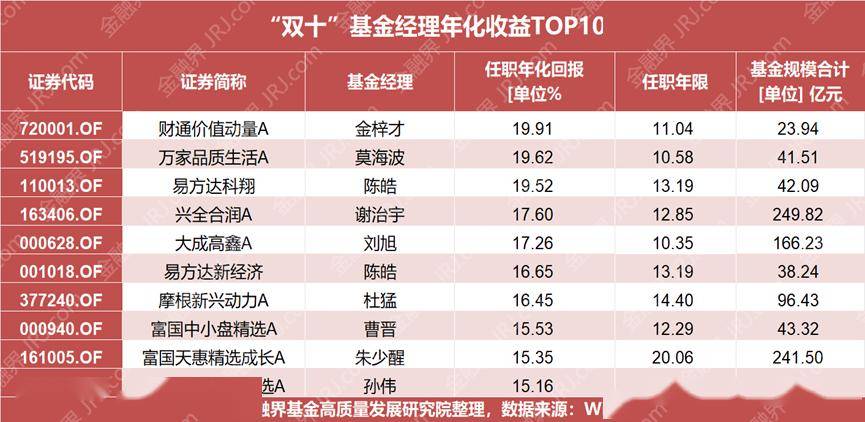
熊市不慌,牛市能涨!十年‘双十’基金经理名单曝光
Sou Hu Cai Jing· 2025-12-02 11:22
Core Insights - The Shanghai Composite Index has reached the 4000-point mark for the first time in ten years, indicating a resurgence in market enthusiasm and a rise in the net value of many actively managed equity funds [1] - The "Double Ten" fund managers, defined as those with over ten years of management experience and an annualized return exceeding 10%, have proven to be resilient in various market conditions [1] Fund Manager Performance - The top ten "Double Ten" fund managers include notable figures from mid-sized fund companies, such as Jin Zicai from Caitong Fund and Mo Haibo from Wanji Fund, showcasing their strong performance over the years [1][2] - Jin Zicai's Caitong Value Momentum Fund and Mo Haibo's Wanji Quality Life Fund have demonstrated strong offensive capabilities during bull markets while maintaining a maximum drawdown of around 20% during market corrections, reflecting good risk management [2][3] Annualized Returns - The annualized returns for the top fund managers in 2025 show Caitong Value Momentum A at 63.10% and Wanji Quality Life A at 61.63%, indicating robust performance in the current year [3] - Historical performance data reveals significant fluctuations, with Caitong Value Momentum A achieving a return of 70.96% in 2019 and a decline of -23.09% in 2023, while Wanji Quality Life A had a peak return of 35.04% in 2021 [3] Long-Term Management - Zhu Shaoxing from Fortune Fund exemplifies long-term management, having managed the Fortune Tianhui Growth Mixed Fund since 2005, maintaining an annualized return of over 15% [4]

环保行业2025Q3基金持仓:板块持仓下降,行业不乏绝对收益、边际向好、景气主题标的
Changjiang Securities· 2025-11-04 23:30
Investment Rating - The report maintains a "Positive" investment rating for the environmental industry [10]. Core Insights - The environmental sector's heavy positions in public funds have decreased, with the top ten holdings totaling approximately 5.438 billion yuan, accounting for 0.13% of all disclosed fund stock holdings, a decrease of 0.10 percentage points from the previous quarter [2][4][18]. - The A-share environmental sector is currently underweight, with a standard allocation ratio of 0.94% as of the end of Q3 2025 [4][18]. - The report highlights three investment styles in the environmental sector for Q3: market hot themes, absolute returns, and marginal changes [7][33]. Summary by Sections Fund Holdings - As of Q3 2025, the top heavy positions in public funds include Shanghai Xiba (0.91 billion yuan), Huanlan Environment (0.82 billion yuan), and Weiming Environmental (0.63 billion yuan) [5][29]. - The number of funds holding significant positions in leading companies reflects market attention, with Huanlan Environment leading with 59 funds [5][23]. Market Trends - The report notes a shift towards solid battery-related stocks and waste incineration leaders, indicating a growing market risk appetite [7][33]. - The environmental sector is experiencing a transition from government to business (ToB) and consumer (ToC) models, which is expected to improve cash flow and valuation recovery [19][35]. Investment Strategy - The report suggests focusing on companies with long-term value in waste incineration and water assets, such as Huanlan Environment, Guangda Environment, and Weiming Environmental [8][36]. - It emphasizes the importance of detecting service companies and environmental sanitation firms, highlighting potential growth in these areas [43]. Performance Metrics - The report indicates that the environmental sector's performance metrics are currently at historical lows, with a notable decline in heavy positions due to market concerns over subsidy adjustments and economic pressures [19][33]. - The report also discusses the potential for valuation recovery as companies explore new growth avenues and improve operational cash flows [19][35].



PMI回落,政策加力正当时
HUAXI Securities· 2025-10-31 11:21
Manufacturing Sector - The manufacturing PMI fell to 49.0% in October, down 0.8 percentage points from September and matching the level seen in April 2025, during peak US-China trade tensions[1] - Production and new orders were the largest contributors to the decline, dragging down the PMI by 0.55 and 0.27 percentage points, respectively[1] - The manufacturing prices decreased, with raw material purchase prices and factory prices both dropping by 0.7 percentage points to 52.5% and 47.5%, respectively[2] Service Sector - The service sector's business activity index slightly rebounded to 50.2%, up 0.1 percentage points, but new orders fell by 0.7 percentage points to 46.0%[3] - The gap between the business activity index and new orders widened to 4.2, the highest since October 2024, indicating persistent demand weakness[3] Construction Sector - The construction sector saw new orders rebound by 3.7 percentage points to 45.9%, marking the second consecutive month of increase, although the business activity index fell slightly to 49.1%[4] - The rebound in construction PMI was primarily driven by civil engineering projects related to infrastructure, with business activity index rising over 5 percentage points to above 55%[4] Economic Outlook - The overall composite PMI for October was 50.0%, down 0.6 percentage points from September, the lowest since early 2023[5] - The need for monetary policy support is increasing as the economy shows signs of continued slowdown, with GDP growth at 4.8% in Q3[5] Policy Measures - In October, significant policy measures were implemented, including the rapid deployment of 500 billion yuan in policy development financial tools and the resumption of government bond trading[6] - The likelihood of further monetary easing, including potential rate cuts, is rising, with expectations for a possible reduction in reserve requirements and structural interest rate cuts[6] Market Implications - The liquidity-driven bull market characteristics remain evident, with a lack of momentum for a shift towards cyclical and consumer sectors, suggesting continued focus on technology and dividend stocks[7] - Structural risks persist, with high transaction concentration and elevated stock prices, indicating an increased probability of market volatility[7]
中信建投:“十五五”规划有望进一步夯实牛市基础
Di Yi Cai Jing· 2025-10-26 23:54
Group 1 - The "14th Five-Year" plan has been released, which is expected to enhance market risk appetite in the short term due to increased policy clarity [1] - The long-term vision of the "14th Five-Year" plan outlines a modern industrial system blueprint, providing a clear growth path for A-shares, potentially solidifying the foundation for a bull market through technological breakthroughs and industrial upgrades [1] Group 2 - Key industries to focus on include AI, semiconductors, robotics, batteries, innovative pharmaceuticals, non-ferrous metals, machinery, military industry, social services, and large finance [1]
