深度价值投资

Search documents
百亿基金经理收益回暖!张坤规模领衔 王明旭7产品年内亏损
Nan Fang Du Shi Bao· 2025-08-08 08:02
Core Insights - The active management equity funds are experiencing a strong recovery in returns, with 95% achieving positive returns and an average return exceeding 15% as of August 7, 2025 [1][2] - The pharmaceutical sector has emerged as the biggest winner, with four funds doubling their returns, all focused on this industry [3] Fund Performance - As of August 7, 2025, the average return for over 4,500 active equity funds is 15.03%, while more than 93% of over 2,500 stock index funds have positive returns averaging 11.8% [2] - Active equity funds have outperformed major indices like CSI 300 (4.6%) and CSI 500 (10.6%) after three years of underperformance [2] Fund Manager Dynamics - There are 90 active equity fund managers managing over 10 billion yuan, with Zhang Kun from E Fund leading at over 50 billion yuan [5][6] - Among these managers, 86 have achieved positive returns, with the average return for those managing over 30 billion yuan being 9.8%, which is lower than the average of the top 90 managers [6] Sector Focus - The four funds that doubled their returns are primarily invested in the pharmaceutical sector, including Changcheng Pharmaceutical Industry Selection and Huashan Pharmaceutical Biotechnology [3] - The top-performing managers, Zhang Wei and Zhang Lu, have focused on themes like innovative drugs and robotics, contributing to their high returns of 65.8% and 53.4% respectively [8] Underperforming Funds - Despite the overall positive trend, 228 active equity funds reported negative returns, with the worst performer, Qianhai Kaiyuan AI A, showing a return of -18.5% [3] - Wang Mingxu from GF Fund has seen 7 out of 8 funds underperform, with a bottom return of -7.4% [8][9] Investor Sentiment - Although the A-share market has been rising, investor confidence in active equity funds remains low, with a significant reduction in total shares of active equity funds by approximately 198.24 billion shares in the first half of 2025 [3]
百亿基金经理收益回暖!张坤规模领衔,王明旭7产品年内亏损
Nan Fang Du Shi Bao· 2025-08-08 07:51
Group 1 - The core viewpoint of the articles indicates a strong recovery in the performance of actively managed equity funds in 2025, with 95% of these funds achieving positive returns and an average return exceeding 15% as of August 7 [2][3] - The pharmaceutical sector has emerged as the biggest winner, with four actively managed equity funds achieving returns that have doubled this year, all focusing on the pharmaceutical industry [4][5] - As of mid-2025, there are 90 fund managers managing over 10 billion yuan, with Zhang Kun from E Fund leading with over 50 billion yuan under management [8][9] Group 2 - The average return of actively managed equity funds has outperformed major stock indices, such as the CSI 300 and the CSI 500, which recorded returns of 4.6% and 10.6% respectively [3] - The average return of the entire market of over 4,500 actively managed equity funds is 15.03%, compared to 11.8% for over 2,500 stock index funds [3] - Despite the overall positive performance, there are still 228 actively managed equity funds with negative returns, with the worst performer, Qianhai Kaiyuan AI A, showing a return of -18.5% [4][6] Group 3 - The top-performing funds in the pharmaceutical sector include Changcheng Pharmaceutical Industry Selection, Bank of China Hong Kong Stock Connect Pharmaceutical, Yongying Pharmaceutical Innovation Selection, and Huashan Pharmaceutical Biotechnology, all achieving significant returns [4][5] - The performance of fund managers varies significantly, with some, like Zhang Wei and Zhang Lu, achieving returns of 65.8% and 53.4% respectively, while others, such as Wang Mingxu, have negative returns [12][13] - The total scale of actively managed equity funds reached 3.39 trillion yuan by mid-2025, although the total number of shares decreased by 198.24 billion compared to the end of the previous year [6][7]

业绩集体回暖老牌私募“王者归来”
Zhong Guo Zheng Quan Bao· 2025-08-06 21:09
Core Viewpoint - The resurgence of established private equity firms in China is highlighted, with many achieving significant performance recoveries and attracting renewed investment interest after a period of underperformance [1][2]. Group 1: Performance Recovery - Established private equity firms are experiencing a performance rebound, with some reporting year-to-date returns exceeding 40% [1]. - Notable firms like淡水泉投资 and 重阳投资 have reported year-to-date returns of 15.98% and over 15%, respectively, with近一年收益率 around 35% [1][2]. - 源乐晟 has also seen a turnaround, with year-to-date returns reaching 35.54% and over 40% in the last six months [2]. Group 2: Investment Strategies - Various strategies are being employed by established private equity firms, including deep value investing and growth-oriented investments, particularly in sectors like artificial intelligence [2]. - The adaptability of investment strategies to different market conditions is emphasized, with firms adjusting their approaches based on asset performance [2]. Group 3: Research and Organizational Reforms - Firms are actively reforming their research and investment frameworks to enhance adaptability and decision-making [3]. - For instance, 淡水泉投资 has restructured its research organization to improve its understanding of emerging industries and market dynamics [3]. - 星石投资 has implemented a multi-fund manager system to enhance decision-making and performance accountability [3]. Group 4: Market Outlook - The outlook for the market remains positive, with expectations of structural opportunities driven by policy support and active capital [4]. - Key areas of focus include the revaluation of high-quality Chinese assets, the globalization of competitive industries, and advancements in technology innovation [4]. - 源乐晟 anticipates favorable conditions in both Chinese and U.S. stock markets, driven by economic resilience and adjustments in investor sentiment [4].
老牌私募业绩“逆袭”,他们靠什么“反击”?
Zhong Guo Zheng Quan Bao· 2025-08-06 13:54
Core Insights - Established private equity firms are experiencing a performance rebound, with some products achieving over 40% returns in the past six months and regaining investor interest [1][2] Group 1: Performance Recovery - The market has shown signs of recovery, leading to a significant performance rebound for established private equity firms, with notable examples including: - Zhaojun's Dushuquan achieving a year-to-date return of 15.98% and a one-year return of 35.46% as of August 1 [2] - Chongyang Investment's products also recording over 15% returns year-to-date and close to 35% over the past year [2] - Yuanlesheng's representative products achieving a year-to-date return of 35.54% and over 40% in the last six months [2] - Pankin Investment's products yielding 27.67% year-to-date [2] - High Yi Asset's products exceeding 10% returns year-to-date [2] Group 2: Investment Strategies - Different investment strategies have been employed by established private equity firms to adapt to market conditions: - Some firms focus on deep value investment, heavily investing in undervalued blue-chip stocks [3] - Others are capitalizing on growth opportunities in sectors like AI [3] - Firms are also reforming their investment research systems to enhance adaptability, such as Dushuquan's organizational changes and the establishment of a new industry research institute [3][4] Group 3: Future Outlook - The outlook for the market remains optimistic, with structural opportunities expected to dominate: - Dushuquan emphasizes that despite uncertainties, high levels of capital activity will support the market, focusing on three key opportunities: valuation reassessment of quality Chinese assets, globalization of advantageous Chinese industries, and technological innovation [5] - Yuanlesheng's current asset allocation includes technology (overseas AI and domestic computing power), innovative pharmaceuticals, non-ferrous metals, new consumption, and non-bank financials, with non-bank financials being a new addition due to rising market activity and interest rates [6]
深渊掘金者:伯里的逆向价值投资启示录
Sou Hu Cai Jing· 2025-07-11 14:11
Core Insights - Michael Burry's investment philosophy emphasizes identifying mispriced assets during market failures, rooted in the "margin of safety" theory, leading to significant investment opportunities [2][3] - Burry's ability to analyze risk data and predict market downturns allowed him to make calculated bets, such as shorting subprime mortgages, which ultimately resulted in substantial profits [3][4] - His contrarian approach to investment, leveraging behavioral finance concepts, highlights the importance of recognizing and capitalizing on collective cognitive biases in the market [4][5] - Burry's long-term investment strategy, characterized by patience and a focus on intrinsic value, contrasts sharply with the short-term focus prevalent in the hedge fund industry [5][6] Group 1 - Burry's investment philosophy is based on finding pricing discrepancies in undervalued assets during market misjudgments, as evidenced by his analysis of subprime mortgage contracts [2] - He identified that 80% of subprime borrowers had falsified income documents, leading to a 47% deviation from intrinsic value, which he termed the "value abyss" [2] - Burry's approach to risk assessment involved creating extensive historical data models to predict market behavior, allowing him to make informed investment decisions [3][4] Group 2 - The ability to break away from consensus thinking is crucial for investors, as demonstrated by Burry's focus on overlooked data, such as the rise of "ninja loans" in the subprime market [4] - Burry's investment in silver futures during the cryptocurrency market crash exemplifies his contrarian strategy, based on the belief that precious metals would regain historical value amid fiat currency crises [4][5] - His average holding period of 4.7 years reflects a commitment to long-term value creation, contrasting with the industry average of 1.3 years [5] Group 3 - Burry's insights extend beyond investment strategies, emphasizing the importance of data analysis and logical reasoning in an era of information overload [6] - His philosophy encourages investors to seek opportunities in overlooked data and to maintain conviction in their analysis during market volatility [6] - The quote "In the depths of fear, find the data; in the heights of euphoria, wait for value" encapsulates Burry's approach to navigating market cycles [6]

超卖信号显现!利空因素逐步出清,诺和诺德(NVO.US)跌出“深度价值”?
智通财经网· 2025-06-23 07:24
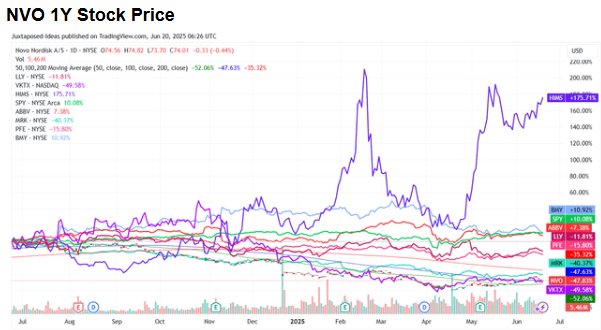
Core Viewpoint - Novo Nordisk's stock price has rebounded after a significant decline from its peak in June 2024, attributed to easing adverse factors related to GLP-1 drugs and expanded collaborations with traditional and telehealth companies, leading to improved performance expectations for the second half of 2025 [1][4]. Financial Performance - Despite management lowering the sales growth forecast for fiscal year 2025 to 17% and operating profit growth to 20%, the company's expanded production capacity supports optimistic market expectations [5][6]. - The company reported a free cash flow of $1.6 billion in Q1 2025, a 91.6% year-over-year increase, while the fiscal year 2024 free cash flow was $10.25 billion, down 16.6% [6][8]. - Analysts project a compound annual growth rate (CAGR) of 13.5% to 15.1% for Novo Nordisk through fiscal year 2027, indicating strong revenue and profit growth despite ongoing price declines for GLP-1 drugs [6][7]. Market Position and Valuation - Novo Nordisk's forward P/E ratio is 18.47, significantly lower than its 1-year average of 26.53, 5-year average of 31.15, and 10-year average of 24.91, suggesting it is undervalued compared to peers like Eli Lilly, which has a forward P/E of 36.04 [9][10]. - The company's PEG ratio of 1.28 is also lower than the industry average of 1.80, reinforcing the notion of significant investment value [10]. Growth Opportunities - The company is expected to benefit from a large unmet demand, with over 550 million diabetes patients and more than 800 million obesity patients globally, alongside a long treatment care cycle [7]. - Novo Nordisk's direct-to-consumer model through NovoCare, starting March 5, 2025, will offer Wegovy at a promotional price of $499 per month, enhancing its market reach [4][5]. Stock Performance and Outlook - The stock price stabilized at $58 after a significant drop, with a potential upward trend despite facing resistance at $81 [13][16]. - Analysts suggest that the stock has significant upside potential, with a target price of $132.20 based on adjusted earnings per share projections for fiscal year 2027 [17].

兴银基金于龙:在风口之外,静待价值归来的沉稳之道
Zhong Guo Ji Jin Bao· 2025-06-23 07:18
Core Viewpoint - The investment philosophy of Yu Long emphasizes a "hold to maturity" approach akin to bond investing, focusing on patience and value realization over time, contrasting with the prevalent trend of chasing market fads and short-term gains [1][3][4]. Investment Strategy - Yu Long's strategy is characterized by simplicity and a contrarian nature, relying on a long-term internal rate of return as the sole investment decision metric [3][4]. - The sources of investment returns are categorized into three areas: value distribution (dividends and buybacks), value creation through reinvestment, and value discovery from market mispricing [3][4]. - The target internal return rate for the investment portfolio is aimed to be above 15%, allowing for price fluctuations without concern as long as the quality companies are purchased at low prices [3][4]. Stock Selection Criteria - The selection criteria prioritize both "cheap" and "high-quality" companies, with a preference for leading and state-owned enterprises due to their stable dividend capabilities and capital returns [3][4][6]. - Yu Long typically maintains a concentrated portfolio of around 10 stocks, believing that fewer holdings can effectively control risk and enhance returns [6][7]. - The focus is on companies with strong competitive advantages, growth potential, safety margins, risk pricing, sound governance, and transparency [7][9]. Market Approach - The investment approach is fundamentally bottom-up, avoiding reliance on macroeconomic trends or industry rotations, and instead focusing on individual stock valuation [6][7]. - Yu Long seeks opportunities in underappreciated sectors, where companies may be undervalued despite having solid fundamentals [7][9]. - The strategy involves buying when market sentiment is low, capitalizing on the fear and panic of others to acquire undervalued assets [9][10]. Long-Term Holding Philosophy - The holding period for investments is generally long, with a low turnover rate, reflecting a willingness to wait for value to materialize over time [7][10]. - The philosophy underscores that true investment success comes from maintaining a rational approach and resisting the urge for immediate gratification [4][10].
慢就是快!这只红利主题基金近五年年化16%|1分钟了解一只吾股好基(六十三)
市值风云· 2025-05-29 10:03
Core Viewpoint - The article introduces the China Europe Dividend Advantage Flexible Allocation Mixed Fund, managed by Lan Xiaokang, highlighting its strong performance in risk control and excess returns, with a focus on achieving returns that exceed the benchmark while maintaining a balanced investment approach [2][3]. Performance Summary - The fund has shown impressive performance metrics, with a five-year annualized return of 15.7%, significantly outperforming its benchmark and the CSI 300 index [3][4]. - Year-to-date (YTD) return stands at 8.24%, with a total return of 106.31% over 7.1 years, indicating a stable upward trend in net value [4][5]. - The fund's maximum drawdown since inception is -25%, and under Lan Xiaokang's management, it has maintained a maximum drawdown of only -22%, showcasing effective risk management [8]. Management Background - The fund was established in April 2018, initially managed by renowned fund manager Cao Mingchang, with Lan Xiaokang as a co-manager. Since 2021, Lan has taken sole management, adopting a deep value investment style [6][12]. - Lan Xiaokang's investment strategy combines macroeconomic analysis with a bottom-up stock selection approach, focusing on long-term cash flow generation and valuation [17][18]. Investment Strategy - The fund maintains a balanced industry allocation, with a preference for sectors such as energy and non-ferrous metals, while adhering to a low valuation strategy [14][20]. - Lan Xiaokang emphasizes the importance of valuation over industry growth rates, seeking assets with stable growth and mispriced cyclical assets [18]. Holder Structure - The fund has attracted significant institutional investment, with an institutional holding ratio of 84% as of the end of last year, indicating strong confidence from institutional investors [20].

近五年年化超11%,又一只能打的深度价值基金!|1分钟了解一只吾股好基(六十一)
市值风云· 2025-05-27 10:10
Core Viewpoint - The article highlights the performance and investment strategy of Penghua Optimal Value Stock A, managed by Wu Xuan, emphasizing its ability to control risks while achieving excess returns and long-term capital appreciation [2][3]. Performance Summary - The fund has shown strong performance, with a five-year annualized return of 11.4%, consistently ranking among the top in its category [3][4]. - Year-to-date (YTD) return is 8.77%, with a one-year return of 15.21%, outperforming its benchmark and the CSI 300 index [4][8]. - The fund's maximum drawdown during Wu Xuan's management is only -19.3%, indicating effective risk management [10]. Fund Management - Wu Xuan has been managing the fund since its inception in late 2019, with a focus on deep value investing and risk control [7][13]. - The fund's total net asset size is 30.13 billion, with a low turnover rate, reflecting a long-term holding strategy [2][20]. Holdings and Sector Allocation - The fund maintains a balanced sector allocation, with significant investments in traditional sectors such as non-bank financials, banking, food and beverage, and textiles [15]. - Major holdings include China Telecom and China Mobile, which together account for over 18% of the portfolio [17][18]. Investor Composition - The fund has seen an increase in institutional ownership, reaching nearly 93% by the end of last year, indicating a preference for its stable investment style [21]. - The largest institutional holding accounts for approximately 14% of the fund, which is within regulatory limits to mitigate risks associated with large redemptions [24].

连续三年显著超越基准,这些基金经理为什么可以加薪?| 基金投资力测评
2 1 Shi Ji Jing Ji Bao Dao· 2025-05-14 07:03
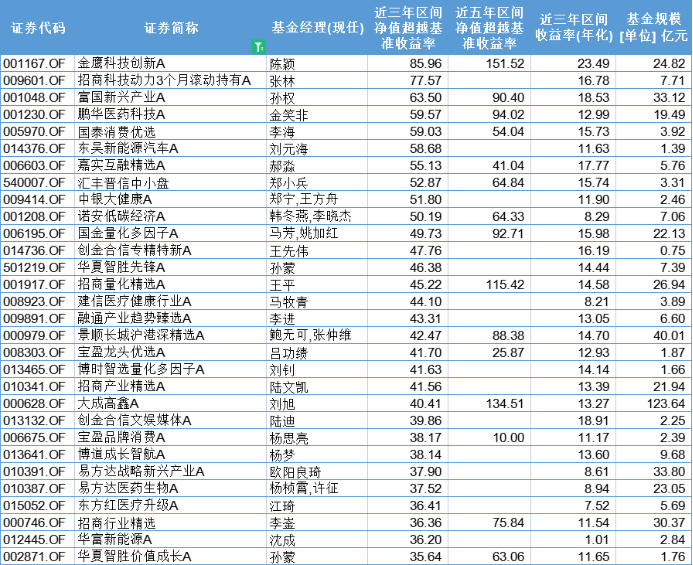
Core Viewpoint - The recent "Action Plan for Promoting High-Quality Development of Public Funds" emphasizes linking fund manager compensation to performance, with significant salary adjustments based on performance relative to benchmarks [1] Group 1: Fund Manager Performance - Chen Ying, managing the Jin Ying Technology Innovation fund, achieved a remarkable 85.96% excess return over the benchmark in the past three years, focusing on AI and technology sectors [3][4] - Sun Quan from the Fu Guo fund has also excelled, with a focus on TMT sectors, achieving significant returns through investments in AI-related companies [5] - Jin Xiao Fei, managing the Peng Hua Medical Technology fund, has delivered a 41.11% return over three years, utilizing a top-down approach to navigate the pharmaceutical sector [6] Group 2: Investment Strategies - Chen Ying emphasizes a diversified portfolio with a focus on emerging technologies, while also managing risks through strategic allocation to blue-chip stocks [4] - Sun Quan's strategy involves identifying competitive companies within high-growth sectors, particularly in AI and renewable energy [5] - Jin Xiao Fei employs a top-down analysis to time market entries and exits, focusing on innovative pharmaceuticals and AI healthcare [6] Group 3: Fund Characteristics - The Jin Ying Technology Innovation fund has a total scale exceeding 72 billion, with a high concentration in technology stocks [3] - The Fu Guo fund managed by Sun Quan has a total scale of over 82 billion, with a significant portion in AI-related stocks [5] - The Peng Hua Medical Technology fund has a scale of approximately 44 billion, with a concentrated portfolio strategy [6] Group 4: Market Trends and Insights - The article highlights the importance of understanding market cycles and the specific stages of industries when making investment decisions [4][6] - Fund managers are encouraged to adapt their strategies based on market conditions, with a focus on long-term growth potential [5][6] - The performance of funds is closely tied to the ability of managers to identify and capitalize on emerging trends, particularly in technology and healthcare sectors [22]