清洁能源转型

Search documents
加拿大能源部长:“宁德时代掌握全球顶尖的电网储能解决方案”
中国能源报· 2026-01-21 11:43
Core Viewpoint - The article highlights the strengthening of energy cooperation between China and Canada, emphasizing mutual benefits and the potential for clean energy collaboration [1][3]. Group 1: Energy Cooperation - China and Canada have agreed to enhance cooperation in both clean and traditional energy sectors, including oil, natural gas, and nuclear energy [1]. - A memorandum of understanding was signed to strengthen energy cooperation, with a focus on responsible management of civil nuclear energy and natural uranium trade [1]. - The two countries aim to support bilateral investment and trade in energy, leveraging their complementary strengths in the energy sector [1][3]. Group 2: Role of Chinese Energy Companies - Chinese energy companies, including China National Petroleum Corporation and Contemporary Amperex Technology Co., are seen as key players in this cooperation [2]. - Canada is particularly interested in attracting Chinese investments in renewable energy projects, with discussions ongoing regarding the establishment of battery production facilities by Chinese firms in Canada [2]. - The collaboration is positioned within the context of global energy transition, with a significant market demand for energy storage systems in Canada [2]. Group 3: China's Position in Clean Energy - China is transitioning from being an energy consumer to a "clean energy exporter," showcasing its capabilities in solar, wind, storage, and electric vehicle technologies [3]. - Canada expresses a desire to learn from China's expertise in clean energy solutions to support its own clean grid initiatives [3]. - The partnership is expected to address challenges related to the integration of renewable energy in Canada, providing a model for global energy transition [3].



聚力攻坚开新局,深圳能源召开年度工程建设专题会
Xin Lang Cai Jing· 2026-01-21 10:24
Core Viewpoint - The company held a meeting to summarize the achievements of engineering construction in 2025 and set tasks for 2026, emphasizing safety, quality, and innovation in project management [1][4]. Group 1: Achievements in 2025 - The engineering sector achieved "zero accidents" in safety and "zero incidents" in quality, with significant projects in thermal power, environmental protection, and renewable energy reaching high-quality production [4]. - A total of 96 construction projects were advanced, with a total construction scale reaching 10.61 million kilowatts, marking a historical high [4]. Group 2: Goals for 2026 - The company outlined six key requirements for 2026, focusing on responsibility, quality, project scheduling, cost management, innovation, and talent development [2][3][5][6]. Group 3: Specific Requirements - Emphasize responsibility and risk management to ensure "inherent safety" by implementing safety reviews as prerequisites for new projects and establishing a dynamic risk management mechanism [2][5]. - Focus on quality control and standardization to create benchmark projects, including the development of quantitative quality assessment criteria for renewable energy projects [2][5]. - Implement precise scheduling and targeted efforts to ensure orderly project advancement, with strict monitoring of major project plans and key milestones [2][5]. - Enhance cost management and optimization throughout the project lifecycle, including the establishment of a smart cost management platform [2][5]. - Strengthen innovation and digital capabilities by investing in key technologies and promoting the application of digital management platforms [3][6]. - Build a skilled engineering workforce through a comprehensive training system and an incentive mechanism based on project performance [3][6].

2026年第1期:数据中心带动美国配电投资,清洁能源装机亟需扩容
Huachuang Securities· 2026-01-21 00:25
Investment Rating - The report does not explicitly provide an investment rating for the industry Core Insights - The U.S. electricity system is undergoing a significant transition, with natural gas becoming the dominant fuel source, accounting for approximately 43% of total generation capacity by 2024, while renewable energy sources are rapidly increasing their share, projected to reach 24% by 2025 [2][8][9] - The demand for electricity is expected to rise significantly due to the growth of data centers and electric vehicles, with projections indicating that data centers could consume between 325 billion to 580 billion kilowatt-hours by 2028, representing 6.7% to 12.0% of total U.S. electricity consumption [2][36] - The report highlights the challenges faced by the electricity sector, including aging infrastructure, the need for modernization, and the impact of fluctuating fuel prices on electricity costs [6][28][31] Summary by Sections 1. Overview of the U.S. Electricity System - The U.S. electricity generation is primarily sourced from fossil fuels, nuclear, and renewable energy, with natural gas leading at 41.2% of the generation mix in the first ten months of 2025 [5] - The renewable energy share has increased significantly, providing approximately 23.9% of electricity in the same period, with wind and solar being the largest contributors [5][9] 2. Supply and Demand Dynamics - Natural gas generation capacity is projected to reach 571 GW by 2024, with a consumption increase of about 4% over three years [8] - Renewable energy is expected to dominate new capacity additions, with solar accounting for about half of the new installations in 2025 [9] - Coal's role in the energy mix is declining, with a projected consumption of 448 million short tons in 2025, but the retirement of coal plants is slowing due to rising electricity demand [10][11] 3. Electricity Pricing Trends - Historical electricity prices have shown a gradual increase, with nominal prices rising from approximately 8 cents per kilowatt-hour in the mid-1980s to about 13.5 cents by 2020 [27] - Recent trends indicate a more rapid increase in electricity prices, driven by rising capital expenditures for grid modernization and fluctuating fuel costs [28][31] - Future projections suggest a moderate increase in electricity prices over the next 5-10 years, influenced by demand growth from electrification trends and the need for substantial investments in infrastructure [33][35] 4. Data Center Electricity Consumption - Data centers have seen a dramatic increase in electricity consumption, rising from 76 billion kilowatt-hours in 2018 to approximately 176 billion kilowatt-hours in 2023, representing 4.4% of total U.S. electricity use [36] - The demand from AI-related data centers is expected to grow by 22% in 2025, with projections indicating a tripling of demand by 2030 [36]
欧佩克预测:2026年全球石油供需将持平
Zhong Guo Hua Gong Bao· 2026-01-20 02:49
Core Viewpoint - OPEC's January report predicts a balanced oil supply and demand by 2026, contrasting with other institutions forecasting a significant surplus in oil supply by that year [1] Group 1: Oil Demand and Supply Forecasts - Global oil demand is expected to increase by 1.34 million barrels per day in 2027, remaining roughly stable compared to the 1.38 million barrels per day forecast for 2026 [1] - The market demand for OPEC+ crude oil in 2026 is projected at 43 million barrels per day, consistent with previous forecasts and close to actual data from December 2025 [1] - If OPEC+ maintains its production levels from December 2025, the production in 2026 will fall short of demand by 170,000 barrels per day [1] Group 2: Comparison with Other Institutions - The International Energy Agency (IEA) predicts a surplus of 3.84 million barrels per day in oil supply for 2026, which is about 4% of global demand, contrasting sharply with OPEC's demand growth forecast of 860,000 barrels per day [1] - IEA's latest report does not include a forecast for 2027, but it is expected to release updated data on January 21 [1]
“铜博士”熄火!英伟达乌龙事件 影响有多大
Zhong Guo Zheng Quan Bao· 2026-01-19 14:47
Core Viewpoint - The copper market is experiencing a significant correction, influenced by a data error from Nvidia regarding copper demand for AI data centers, which has led to a downward adjustment in copper price expectations [1][3][5]. Group 1: Market Reaction - On January 19, major copper stocks such as Jiangxi Copper, Yunnan Copper, and Tongling Nonferrous Metals saw declines, with the Wind copper industry index dropping by 0.88% [3]. - The main contract for Shanghai copper futures closed at 101,180 yuan per ton, down 0.68%, continuing a downward trend [3]. - The correction in copper prices is attributed to Nvidia's revised claim that 1 GW of traditional data center racks require approximately 200 tons of copper, a drastic reduction from the previously stated 50,000 tons [3][5]. Group 2: Analyst Insights - Analysts believe that the adjustment in Nvidia's copper demand figures will have a limited short-term impact on the copper market, as the industry had already been cautious about the initial figure [2][5]. - The anticipated copper demand from AI data centers is estimated to be around 40,000 tons annually, with the actual increase in demand expected to be only 15,000 tons [5]. - Citibank projects that copper consumption in the data center sector will account for only 1.4% of global copper consumption by 2025, increasing to 2.4% by 2027 [5]. Group 3: Future Outlook - The copper price is expected to remain high in the first half of the year, driven by macroeconomic inflation expectations and supply constraints, but caution is advised for potential corrections in the second half [2][9]. - Analysts suggest that the copper market may experience a shift from surplus to tight balance in the second quarter, supporting high price levels [9]. - Goldman Sachs maintains a long-term bullish outlook on copper, predicting a price of $15,000 per ton by 2035, but warns of potential price declines in late 2026 and early 2027 due to increased speculative positions [9].




“铜博士”熄火!英伟达乌龙事件,影响有多大
Zhong Guo Zheng Quan Bao - Zhong Zheng Wang· 2026-01-19 14:29
Group 1 - The core viewpoint of the article is that the recent correction in copper prices is significantly influenced by a data error from Nvidia regarding copper demand for AI data centers, which has led to a reassessment of market expectations [1][3][5] - The main copper futures contract on the Shanghai Futures Exchange fell by 0.68%, while leading copper stocks such as Jiangxi Copper, Yunnan Copper, and Tongling Nonferrous Metals also experienced declines [1][3] - Analysts believe that the correction in Nvidia's copper demand estimate from 50,000 tons to approximately 200 tons will have limited short-term impact on the copper market, as the industry had already been cautious about the initial figure [2][5] Group 2 - The recent rise in copper prices was primarily driven by macroeconomic inflation expectations and supply constraints, rather than a tight supply-demand balance [2][7] - Analysts noted that the copper price increase in the past two months was influenced by two main factors: the pursuit of gold prices and the siphoning effect from the U.S., which has secured over half of the global copper inventory [8] - Looking ahead, industry experts expect copper prices to remain high in the first half of the year, with potential risks of correction in the second half due to increasing social inventory and weak downstream orders [9][6] Group 3 - The long-term outlook for copper consumption is optimistic, particularly due to the anticipated expansion of power grids driven by AI development, with the International Energy Agency projecting a 20% increase in grid length by 2030 [6] - Citibank estimates that copper demand from the data center sector will only account for 1.4% of global copper consumption by 2025, increasing to 2.4% by 2027, indicating a modest growth trajectory [5] - Goldman Sachs maintains a bullish long-term outlook for copper, predicting a price of $15,000 per ton by 2035 due to constrained supply and sustained demand growth [9]
BEEAH与马斯达尔联合开发沙迦太阳能项目
Shang Wu Bu Wang Zhan· 2026-01-19 09:22
Group 1 - The core point of the article is the signing of a joint development agreement between BEEAH and Masdar during the World Future Energy Summit to advance utility-scale solar projects in Sharjah and explore energy storage system applications [1] - The agreement will cover the entire process of project assessment, construction, and operation, which will contribute to the UAE's clean energy transition [1]

联合国副秘书长:基础设施、技术治理与全球合作如何重塑可持续发展
Xin Lang Cai Jing· 2026-01-19 01:48
Core Insights - The article emphasizes the urgent need for systemic transformation to drive global progress towards a green, resilient, and inclusive future in the context of climate change and sustainable development challenges [1][11] Group 1: Infrastructure and Climate Goals - Infrastructure is responsible for approximately 79% of greenhouse gas emissions and consumes 88% of climate adaptation funds, while influencing the achievement of 92% of the UN Sustainable Development Goals [4][15] - Immediate fundamental changes in the planning, delivery, and management of infrastructure are necessary to meet the Paris Agreement and sustainable development goals [4][15] - There is a unique opportunity to align infrastructure decisions with global and national climate goals, incorporating inclusive, rights-based climate actions [4][15] Group 2: Clean Energy Transition - Infrastructure is critical for the clean energy transition, and there is a need to significantly reduce its carbon footprint while supporting decarbonization in energy, transportation, and construction sectors [5][16] - The UNOPS is committed to ensuring access to affordable sustainable energy for all and supporting a just transition away from fossil fuels [5][16] Group 3: AI and Governance - The rise of AI is closely linked to the clean energy transition, with significant energy demands from global data centers, but it also presents opportunities to lower costs and emissions [6][17] - There is a stark inequality among countries in leveraging AI benefits and managing risks, particularly in the Asia-Pacific region, which is central to this transition [6][17] - Ethical and inclusive governance is essential to prevent AI from exacerbating global inequalities [6][17] Group 4: Global Governance Gaps - Policy and funding gaps hinder the progress of sustainable development goals, but the implementation gap is often overlooked [7][18] - The international financial order is fragmented and inequitable, making it difficult to address today's complex challenges [7][18] - Many developing countries facing climate crises are trapped in debt-driven development crises, necessitating reforms in the global financial order [7][18] Group 5: UNOPS Commitment - UNOPS focuses on the implementation phase, helping countries design and deliver resilient, sustainable, and inclusive infrastructure [8][19] - The organization aims to create conditions for sustainable development through effective project management and transparent procurement systems [8][19] - A call for "risk-driven resilience" emphasizes the need for infrastructure and systems to withstand shocks and pressures [8][19] Group 6: China's Role in Climate Action - The urgency of global cooperation in addressing climate change and promoting sustainable development is highlighted, with China's role being crucial [9][20] - UNOPS aims to support inclusive development and climate resilience, with China as a key development partner in South-South cooperation [9][20]

以强大电力引擎支撑AI时代竞技
Zhong Guo Neng Yuan Wang· 2026-01-18 03:05
Group 1 - China is projected to have the largest power supply capacity globally, with total installed capacity expected to exceed 3.8 billion kilowatts by 2025, accounting for one-third of the world's total [1][2] - The total electricity consumption in China is anticipated to surpass 10 trillion kilowatt-hours, exceeding the combined annual consumption of the EU, Russia, India, and Japan [1][2] - China has established the world's largest and most advanced power supply system, with a reliability rate of 99.924% and coverage of 99.95% of the country [1][2] Group 2 - The development of renewable energy in China has seen significant growth, with installed capacity for wind and solar power exceeding 1.7 billion kilowatts, historically surpassing thermal power capacity [2][3] - The "14th Five-Year Plan" emphasizes building a clean, low-carbon, safe, and efficient energy system, highlighting safety, cleanliness, and efficiency as core requirements [2][4] - China's energy transition aims to create a complex super system capable of large-scale integration of renewable energy through digital and intelligent means [2][4] Group 3 - The demand for AI computing power necessitates a robust and continuously upgraded power system, as AI model training is energy-intensive [3][4] - The establishment of large-scale green computing centers in renewable energy-rich regions is becoming an economically and environmentally friendly choice [3][4] - A stable and intelligent power grid is essential for ensuring uninterrupted computing services and improving overall energy efficiency [3][4] Group 4 - Challenges remain in the power industry, particularly regarding the intermittency of renewable energy and the high stability requirements of computing facilities [4] - Continuous improvement in flexibility, cross-regional coordination, and market mechanisms is necessary to address these challenges [4] - The modernization of the energy system is crucial for competitiveness in the AI era, with China focusing on solidifying its energy foundation alongside advancements in computing and chips [4][5] Group 5 - China's energy revolution aims to support future digital civilization, ensuring economic development and carbon neutrality while providing a new paradigm for global AI infrastructure [5]
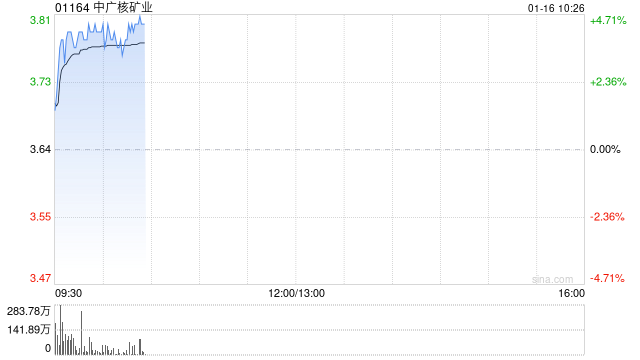
中广核矿业早盘涨超4% 第4季度共生产天然铀702.5tU
Xin Lang Cai Jing· 2026-01-16 02:27
Core Viewpoint - China General Nuclear Power Corporation (CGN) Mining's stock price increased by 4.40%, currently trading at HKD 3.80, with a transaction volume of HKD 112 million [5]. Group 1: Company Performance - In 2025, CGN's 49%-owned Xie Company produced 862.2 tons of natural uranium, while another 49%-owned Ao Company produced 1,836.8 tons, achieving completion rates of 100.1% and 102.0% respectively [5]. - In the fourth quarter of 2025, CGN's invested mines produced a total of 702.5 tons of natural uranium, with a quarterly completion rate of 94.6%. Xie Company produced 249.2 tons, and Ao Company produced 453.3 tons [5]. Group 2: Industry Insights - According to Guojin Securities, the primary supply of uranium is expected to recover in the short term due to the resumption of mining operations, but the long-term supply capacity is facing continuous decline. Secondary supply is unlikely to generate effective increments in the short term [5]. - On the demand side, nuclear power installations are steadily increasing due to energy security, the transition to clean energy, and AI-driven electricity demand, leading to a persistent global supply-demand gap for natural uranium. Expectations of tight supply are driving up long-term contract prices for uranium [5].