
生成式人工智能

Search documents
挖潜服务消费新增长点
Jing Ji Ri Bao· 2026-02-23 23:30
服务消费与民生福祉紧密相关,是推动经济高质量发展的重要抓手,也是满足人民群众美好生活需要的 重要内容。2020年至2025年,我国居民人均服务性消费支出年均增长8.5%,展现出强大的增长动能。 规模扩大的同时,消费者的关注点正在从"有没有"向"好不好"转变,对个性化、多样化、品质化服务消 费产品的需求日益增强。 近日,《加快培育服务消费新增长点工作方案》(以下简称《工作方案》)印发,对进一步优化和扩大 服务供给、培育服务消费新增长点、促进服务消费提质惠民作出系统部署。商务部副部长鄢东表示, 《工作方案》旨在通过扩大优质服务供给,增强服务消费供需适配,提升人民群众的获得感和幸福感。 网络视听开辟空间 当前,我国网络视听用户规模超10亿人。广电总局网络视听节目管理司司长王小亮表示,网络视听已经 深度融入经济社会和人们的生活,成为激活消费、服务民生的重要领域。 "网络视听凭借极强的沉浸感和互动性,能够将用户庞大的'内容注意力'高效转化为'消费行动力',并不 断延伸产业链条,开辟新的服务消费空间。"王小亮表示,透过一部手机、一块屏幕,背后是规模庞 大、活力充沛的服务消费新市场。网络视听服务消费潜力巨大、前景广阔。《工 ...
AI闹新春 燃动中国年
Xin Lang Cai Jing· 2026-02-23 21:43
"我想让豆包帮我编辑一条与老家陕西自然和人文风貌有关的拜年朋友圈,输入要求后,豆包帮我写了 三条不同的文案,有深沉文艺版、简短走心版还有豪迈大气版,每个版本还都给出了搭配图片的建议, 比如,豆包说简短走心的适合配风景,豪迈大气的适合配全景或者航拍。"胡先生说,"看完豆包写的, 我就直接拿来复制使用了,真是太方便了!" (来源:经济参考报) 根据豆包官方数据,除夕当晚,豆包帮用户生成了超过5000万张新春头像,写下了超过1亿条祝福语。 "用千问的AI生视频功能,有很多拜年视频的模板可以选,把里面的图片替换成自己的照片,不用自己 运镜、配乐、想文案,几分钟就可以得到一条自己专属的创意AI拜年视频。"来自河北的相女士说,"以 前过年都是群发拜年文案,今年想玩点不一样的,用AI制作了视频,更别致。" 从"会聊天"到"会办事",智能体的能力正不断进阶。"大年初六,我用千问'一句话下单'了电影《惊蛰无 声》的电影票,只需要说出需求,千问就会自动推荐附近影院临近场次的电影,还推荐了最佳观影区座 位,整个下单过程非常丝滑。"来自北京的王女士说,"科技带来的便捷,让生活变得更高效。" 今年1月15日,千问APP宣布全面接入淘宝 ...
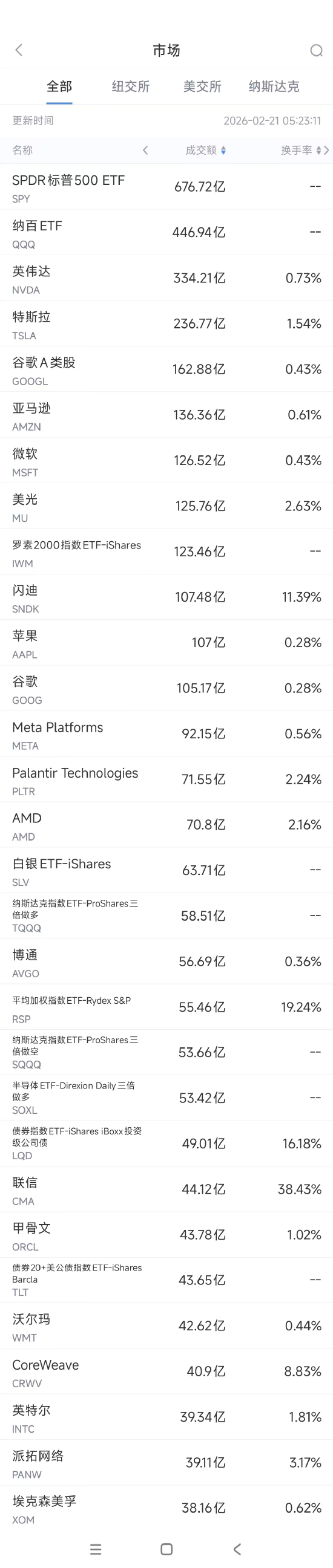
2月21日美股成交额前20:据传英伟达接近向OpenAI投资300亿美元
Xin Lang Cai Jing· 2026-02-20 21:41
Group 1: Nvidia - Nvidia's stock rose by 1.02%, with a trading volume of $33.421 billion. The company is reportedly close to investing $30 billion in OpenAI as part of a long-anticipated funding round, with previous reports indicating an investment of $20 billion in this round [1][10] - This investment will replace a previously planned larger agreement, which was initially reported to be up to $100 billion but was stalled due to CEO Jensen Huang's private criticisms of OpenAI [10] Group 2: Tesla - Tesla's stock increased by 0.03%, with a trading volume of $23.677 billion. A federal judge upheld a $243 million judgment against Tesla related to a fatal 2019 accident involving a Model S equipped with the Autopilot system [10][11] - Analyst Baird upgraded Tesla's stock rating to "outperform" with a target price of $548, noting that recent quarterly performances have not deterred investor focus on Tesla's future [11] Group 3: Google - Google's Class A shares rose by 4.08%, with a trading volume of $16.288 billion. The company is exploring new ways to expand its AI chip market to better compete with Nvidia [10][12] - Google's chips are gaining wider adoption for AI workloads, but the company faces challenges such as manufacturing partner capacity constraints and limited interest from cloud computing competitors [12] Group 4: Amazon - Amazon's stock increased by 2.59%, with a trading volume of $13.636 billion. Morgan Stanley maintains Amazon as a preferred stock, believing its cloud services and retail business are undervalued beneficiaries of generative AI [12] - Analysts noted that Amazon's current stock price corresponds to a 19x GAAP EPS for 2027, with an implied forward growth rate of about 20%, and a 40% discount compared to peers on a PEG basis [12][3] Group 5: Micron and SanDisk - Micron's stock rose by 2.59%, with a trading volume of $12.576 billion, as the storage sector saw a general increase [13] - SanDisk's stock increased by 4.65%, with a trading volume of $10.748 billion [14] Group 6: Meta Platforms - Meta Platforms' stock rose by 1.69%, with a trading volume of $9.215 billion. The company has reduced the stock option grants for most employees by about 5%, following a previous reduction of 10% the prior year [14] - The compensation structure for Meta employees includes base salary, annual bonuses, and equity refreshers, with the company aiming to maintain competitive compensation [14] Group 7: Oracle and CoreWeave - Oracle's stock fell by 5.40%, with a trading volume of $4.378 billion, marking a cumulative decline of 7.5% for the week and over 23% year-to-date [14] - CoreWeave's stock dropped by 8.12%, with a trading volume of $4.09 billion. The CEO disclosed the sale of shares valued at approximately $7.72 million [14][15]





奥特曼和Anthropico的CEO在印度AI峰会拒绝握手
Sou Hu Cai Jing· 2026-02-19 15:45
这一幕迅速在社交媒体上传播开来,引发了人们对这两家人工智能竞争对手之间紧张关系的猜测。 2月19日消息,据外电报道,周四在印度举行的人工智能峰会上,两位人工智能(AI)行业领军人物之间短暂而明显的尴尬瞬间被镜 头捕捉到。 在新德里与印度总理纳伦德拉·莫迪一起合影时,OpenAI 首席执行官萨姆·奥特曼和 Anthropic 首席执行官达里奥·阿莫迪似乎刻意避 免与其他人握手或牵手。 相反,两位高管犹豫片刻后,举起了紧握的拳头,摄像机记录下了这一幕。 此次事件发生之际,OpenAI 和 Anthropic 这两家处于生成式人工智能开发前沿的公司之间的竞争日益激烈。 据报道,阿莫迪在 2020 年离开 OpenAI 后,与他人共同创立了 Anthropic,原因是他在领导层和公司战略方向上存在分歧。 从那时起,Anthropic 将自己定位为人工智能领域以安全为中心的替代方案,并且有时会公开批评 OpenAI 的商业模式,包括通过广 告宣传活动。 OpenAI 和 Anthropic 均未立即对此次简短互动发表评论。 ...

所有人都在等英伟达,真正被低估的,可能是亚马逊
美股研究社· 2026-02-19 09:38
Core Viewpoint - Generative AI has become a defining narrative in global capital markets, with companies like Nvidia, Microsoft, and Google taking center stage, while Amazon remains relatively overlooked despite its significant AI infrastructure and capabilities [1][2]. Group 1: Market Perception of Amazon - Amazon is not perceived as a typical AI company due to its diversified AI strategy, which lacks the clear-cut, explosive narratives seen in Nvidia and Microsoft [3]. - The market has historically undervalued Amazon based on outdated narratives: its retail business is seen as low-margin and capital-intensive, while AWS faces growth concerns amid competition from Microsoft Azure and Google GCP [4]. Group 2: Amazon's AI Capabilities - Generative AI relies on a complex ecosystem involving computing power, data, distribution, and commercial viability, where Amazon possesses significant advantages [5]. - Amazon's AWS is positioned as a "monetization machine" in the AI landscape, transitioning from traditional IT outsourcing to a critical provider of computing resources for AI applications [6]. Group 3: AWS and Retail Synergy - AWS's neutrality and scale allow it to benefit from a variety of AI models, making it less dependent on the success of any single model [7]. - Amazon's retail operations generate vast amounts of data, enabling AI-driven efficiencies that can directly translate into profit margin improvements [8]. Group 4: Investment Timing and Valuation - The current investment question is not whether Amazon has AI capabilities, but whether the market will reprice its cash flow model as AI matures [10]. - Amazon's valuation remains lower than its AI infrastructure warrants, with the potential for significant profit margin expansion as AWS and retail operations leverage AI [11]. Group 5: Conclusion and Future Outlook - The market is transitioning from a phase of speculative AI investments to recognizing the value of companies that control computing power, data, and application scenarios, with Amazon positioned uniquely as both a legacy leader and a foundational player in the AI era [13]. - Amazon may not experience rapid short-term gains like Nvidia, but it offers a more stable long-term return in the AI landscape, making it an attractive investment opportunity as market rationality returns [14].

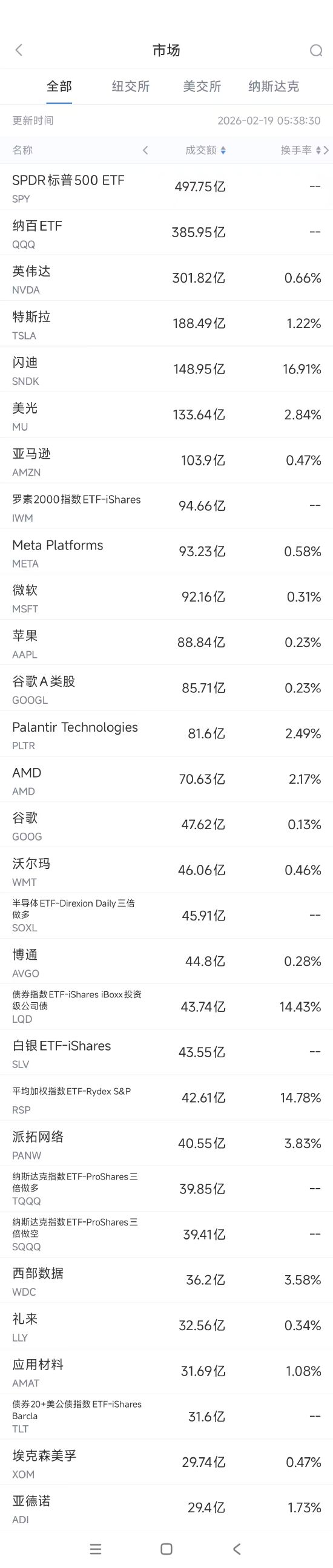
2月19日美股成交额前20:谷歌进军AI音乐创作领域
Xin Lang Cai Jing· 2026-02-18 22:01
Group 1: Nvidia and Meta Partnership - Nvidia's stock rose by 1.63%, with a trading volume of $30.182 billion, following the announcement of a multi-year agreement with Meta Platforms to supply "millions" of next-generation GPUs and other products for Meta's AI data center expansion, reinforcing Nvidia's market leadership [1][2] - Richard Windsor, founder of Radio Free Mobile, indicated that this partnership signals an acceleration in the migration of data centers to Arm architecture, which poses a significant threat to Intel's x86 CPU architecture, labeling the deal as an "Intel killer" [1] Group 2: Tesla's Marketing Adjustments - Tesla's stock increased by 0.17%, with a trading volume of $18.849 billion, after the California DMV identified misleading advertising practices, leading Tesla to stop using the term "Autopilot" and to clarify "Full Self-Driving" as "supervised," thus avoiding a 30-day license suspension [1] Group 3: Other Notable Companies - Micron's stock rose by 5.3%, with a trading volume of $13.364 billion, as Nvidia announced that Micron's Persistent division would utilize Nvidia's BioNeMo and NeMo Agent toolkits to accelerate AI-driven molecular discovery [2] - Apple's stock increased by 0.18%, with a trading volume of $8.884 billion, as the company introduced a new AI feature in Apple Music called "Playlist Playground," allowing users to create playlists from text prompts, set to compete with similar offerings from Spotify [2] - Google's stock rose by 0.43%, with a trading volume of $4.762 billion, as the company announced the launch of its Gemini AI assistant, which can generate music tracks based on user-uploaded content, highlighting the integration of advanced AI tools into mainstream applications [3] - Palantir's stock increased by 1.77%, with a trading volume of $8.16 billion, as the company relocated its headquarters to Miami amid efforts to establish a tech hub in South Florida, while continuing to expand its government and defense contracts [3]



大摩称亚马逊(AMZN.US)是“最被低估生成式人工智能赢家” 维持“增持”评级
智通财经网· 2026-02-18 18:21
分析师认为,亚马逊云服务与零售业务均处在推动并受益于技术进步与消费行为变化的有利位置。展望 未来,亚马逊存在两大关键催化剂,有望推动估值修复并重塑投资者对其ROIC的信心。 其一是亚马逊云服务有望实现30%以上的增长并保持强劲的订单积压。尽管短期增长仍受算力与数据中 心投放节奏制约,分析师对其底层需求充满信心,并看好持续加码的数据中心投资对中长期增长的支撑 作用。其二是"代理式电商"。摩根士丹利认为,亚马逊将通过AI购物助手Rufus扩大垂直领域优势,并 与OpenAI、Gemini、Meta(META.US)等横向代理形成协同,凭借全面准确的商品与价格比较、丰富的 SKU与高效配送,进一步提升消费者使用价值与渗透率。 摩根士丹利分析师Brian Nowak及其团队指出,亚马逊目前股价约对应2027年GAAP每股收益19倍,隐 含约20%的前瞻盈利增长率;按PEG口径计算,较同业折价约40%。尽管市场对AI相关资本开支的投资 回报率(ROIC)仍存疑虑,该行认为,亚马逊在其覆盖的公司中是"最被低估的GenAI(生成式人工智能)赢 家"。 智通财经APP获悉,摩根士丹利表示,亚马逊(AMZN.US)仍是其首选标 ...
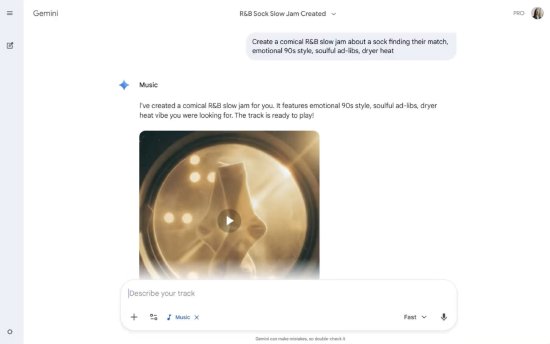
谷歌与苹果加码生成式人工智能 进军音乐创作领域
Xin Lang Cai Jing· 2026-02-18 18:06
Core Insights - Google and Apple are integrating generative AI music features into their core consumer applications, highlighting the mainstream adoption of advanced AI tools [1][4][5] Group 1: Google's Initiatives - Google's Gemini AI assistant can generate 30-second music tracks based on user-uploaded text, photos, or videos using the latest Lyria 3 model from Google DeepMind [1][4] - The new feature will be available to users aged 18 and above and supports multiple languages, initially launching on the Gemini desktop version before rolling out to mobile applications [1][4] - Google's popular image generation model, Nano Banana, will create custom covers for music tracks, enhancing the visual appeal when users share links [1][4] Group 2: Competitive Landscape - The introduction of audio creation tools in mobile applications is expected to strengthen Google's competitive position against OpenAI's ChatGPT [5] - Apple's upcoming feature, "Playlist Playground," will allow users to create playlists in Apple Music using AI, transforming text prompts into playlists with cover images, descriptions, and 25 songs [2][5] - This new functionality is part of the iOS 26.4 beta released on Monday and is set for a broader rollout in spring, positioning Apple Music to compete with similar offerings from Spotify Technology SA [2][5]
“懂你需要”的AI来了!人民日报评阿里千问民生服务能力
Zhong Guo Jing Ji Wang· 2026-02-18 07:45
Core Insights - The article highlights the transition of AI assistants, exemplified by Alibaba's Qianwen, from "recommendation-based services" to "proactive understanding" in daily life, impacting ticket booking, food ordering, government services, and educational support [1][2][4] Group 1: AI Integration in Daily Life - Qianwen's AI capabilities allow users to make complex requests, such as booking flights, with simple commands, significantly reducing the time spent on planning [2][3] - On February 6, Qianwen processed 10 million orders in just 9 hours, showcasing the efficiency of AI in handling consumer transactions [2] - The AI assistant can provide step-by-step explanations for educational purposes and assist in various administrative tasks, such as visa inquiries and document processing [3][4] Group 2: Growth and User Engagement - By the end of 2025, the user base for generative AI in China is projected to reach 602 million, a 141.7% increase from the end of 2024 [4] - Qianwen has over 100 million monthly active users, making it one of the fastest-growing AI-native applications globally [4] - The continuous investment in research and development by Alibaba has led to the creation of over 200,000 derivative models of Qianwen, with downloads exceeding 1 billion [4] Group 3: Future Prospects and Competitive Advantage - The article emphasizes that companies with strong industrial foundations and rich fulfillment ecosystems will hold competitive advantages in the global AI model landscape [4] - The integration of advanced AI technologies into everyday life is seen as a key driver for the digital and intelligent transformation of the economy and society [4]

人工智能,从“猜你喜欢”到“懂你需要”
Xin Lang Cai Jing· 2026-02-18 02:53
智能应用向深向实的背后,是中国人工智能发展底座的不断夯实。以阿里巴巴为例,其过去10年持续加 大科研投入。目前,千问模型的衍生模型数量突破20万个,下载量超过10亿次。 让人工智能具备"向实扎根、向上生长"的潜力,将前沿技术嵌入充满"烟火气"的生活日常。千问人工智 能助手产品负责人郑嗣寿表示,产品将进一步发挥模型与生态优势,连接真实世界,深入日常生活,服 务广大用户。 来源:人民日报 春节前夕,以"一句话点奶茶"为代表的人工智能下单方式吸引了不少消费者踊跃尝试。2月6日,仅9个 小时,千问就接到了1000万张订单。这些订单全部由消费者通过一句话下指令实现。而后,由人工智能 帮助完成从消费决策、交易支付到履约服务的全过程。 "在技术支持下,现在的平台不再是简单的'猜你喜欢',而是'懂你需要'。"淘天集团研究中心主任徐飞 说。在学习、工作、民生服务等场景中,新一代人工智能助手也在大显身手。它可以像老师一样分步讲 解知识点,学生可以随时打断、追问;它能准确识别近百张格式不一的电子发票,提取关键信息,生成 结构清晰的表格。浙江杭州的林先生最近在千问上解锁了新体验,"我问'杭州户口怎么办护照',它就 告诉我需要准备什么 ...