
AI购物助手Rufus

Search documents
大摩称亚马逊(AMZN.US)是“最被低估生成式人工智能赢家” 维持“增持”评级
智通财经网· 2026-02-18 18:21
Core Viewpoint - Morgan Stanley identifies Amazon (AMZN.US) as a top pick, believing that its cloud services and retail business are undervalued beneficiaries of generative artificial intelligence (GenAI) [1] Group 1: Investment Rating and Price Target - Morgan Stanley maintains an "Overweight" rating on Amazon with a target price of $300 [1] - Amazon's current stock price corresponds to a 19x GAAP earnings per share for 2027, implying a forward earnings growth rate of approximately 20% [1] - The stock is trading at a 40% discount compared to peers on a PEG basis [1] Group 2: Key Catalysts for Growth - Amazon Web Services (AWS) is expected to achieve over 30% growth while maintaining strong order backlog, despite short-term growth being constrained by computing power and data center deployment [2] - The company is leveraging an AI shopping assistant, Rufus, to expand its vertical advantages and create synergies with horizontal agents like OpenAI, Gemini, and Meta (META.US) [2] - Enhanced consumer value and penetration are anticipated through comprehensive product and price comparisons, a rich SKU offering, and efficient delivery [2]

AI“军备竞赛”,亚马逊输不起的战争
3 6 Ke· 2026-02-13 03:33
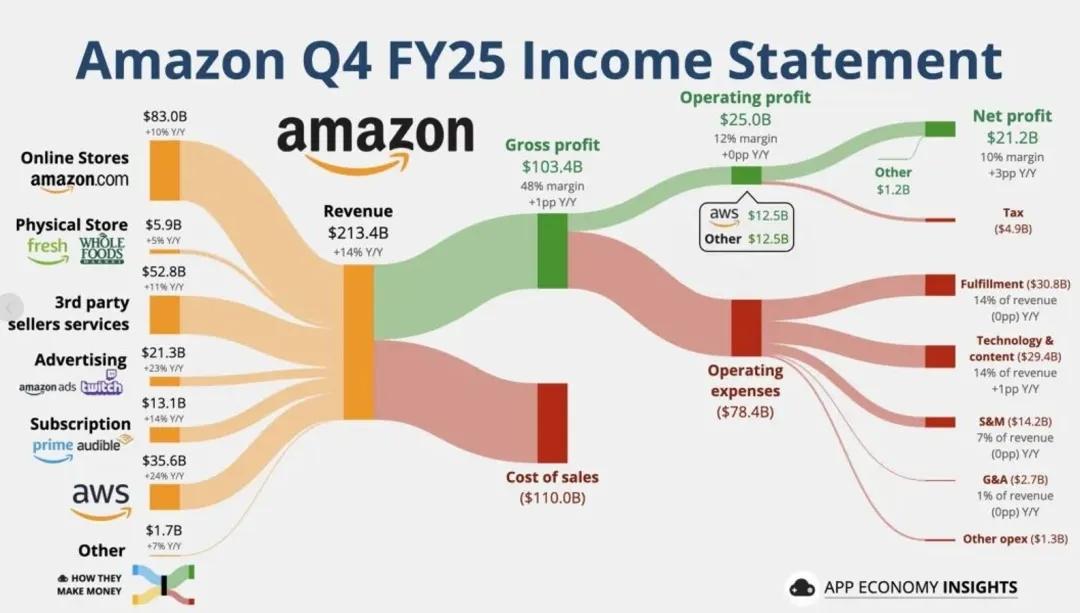
Core Insights - Amazon reported a record revenue of $213.4 billion for Q4 2025, marking a 14% year-over-year increase, and net profit reached $21.2 billion, up 6% [1] - For the full year 2025, Amazon's revenue hit $716.9 billion, a 12% increase, with net profit soaring to $77.7 billion, a 31% rise from 2024 [1] - Amazon's cloud business, AWS, contributed over 60% of the company's operating profit, highlighting its significance as a cash cow [5] Revenue Breakdown - In Q4 2025, Amazon's online store revenue was $82.99 billion, up 10%, while physical stores generated $5.86 billion, a 5% increase [4] - Third-party seller services brought in $42.82 billion, growing 11%, and subscription services earned $13.12 billion, up 14% [4] - Advertising revenue reached $21.32 billion, marking a 23% increase [4] - North America accounted for $127.08 billion in sales, a 10% increase, with operating profit rising 24% to $9.3 billion [4] - International e-commerce revenue was $50.7 billion, up 17%, although operating profit declined 23% to $1 billion due to increased competition and costs [4] Cloud Business Performance - AWS achieved $35.6 billion in revenue for Q4 2025, a 24% increase, marking the highest growth rate in 13 quarters [5] - For the full year, AWS revenue reached $128.7 billion, a 20% increase, representing 18% of total revenue [5] - AWS's operating profit was $12.5 billion, with a profit margin of 35% [5] Capital Expenditure and Future Investments - Amazon plans to invest approximately $200 billion in capital expenditures in 2026, a 52% increase from 2025's $131 billion [14] - The significant capital expenditure includes investments in AI, robotics, and chip development, indicating a strategic focus on enhancing operational efficiency and customer experience [17][21] - Amazon's self-developed AI training chips, Trainium and Graviton, have surpassed $10 billion in annualized revenue, with Trainium 3 already in high demand [17][18] Competitive Landscape - Amazon maintains a leading position in the public cloud market with a 28% market share, followed by Microsoft at 21% and Google at 14% [10] - However, AWS's revenue growth rate is lagging behind competitors like Microsoft Azure and Google Cloud, which are growing at 39% and 48%, respectively [10]

亚马逊(AMZN)FY25Q4 业绩点评及业绩说明会纪要
Huachuang Securities· 2026-02-09 00:40
Investment Rating - The report assigns a positive investment rating to Amazon, indicating strong growth potential in the upcoming quarters [2][3]. Core Insights - Amazon's FY2025Q4 revenue reached $213.4 billion, a 12% year-over-year increase, with operating profit at $25 billion. The company reported a free cash flow of $11.2 billion over the past 12 months, and operating cash flow for the year increased to $139.5 billion, reflecting a 20% growth [3][8]. - The North America segment generated $127.1 billion in revenue, up 10% year-over-year, while the AWS segment saw a revenue increase of 24%, reaching $35.6 billion, marking the fastest growth in 13 quarters [4][11]. - Strategic focuses include advancements in artificial intelligence with proprietary chips, and the successful launch of the Amazon Leo satellite internet service, which aims to enhance connectivity and service offerings [5][10]. Revenue Breakdown - **North America Segment**: Revenue of $127.1 billion, operating profit of $11.5 billion, and a profit margin of 9%. The growth was driven by an increase in essential goods demand and improved delivery efficiency [4][9]. - **International Segment**: Revenue of $50.7 billion, with an operating profit of $1 billion and a profit margin of 2.1%. The company implemented competitive pricing strategies and expanded its physical store investments [4][10]. - **AWS Segment**: Revenue of $35.6 billion, with an operating profit of $12.5 billion and a profit margin of 35%. The growth was attributed to cloud migration and increased demand for AI services [4][11]. - **Advertising and Other Segments**: Revenue reached $21.3 billion, a 22% increase year-over-year, driven by the growth of AI shopping assistant Rufus and record viewership for live events [4][12]. Performance Guidance - For FY2026Q1, Amazon expects revenue between $173.5 billion and $178.5 billion, with operating profit projected between $16.5 billion and $21.5 billion. The company anticipates a favorable impact from currency exchange rates [4][13].
亚马逊(AMZN):25Q4财报点评:云收入继续加速,26年资本开支目标2000亿美元
Guoxin Securities· 2026-02-08 13:24
Investment Rating - The investment rating for the company is "Outperform" [6] Core Insights - The company's overall performance shows steady growth in e-commerce and accelerated growth in cloud revenue, with Q4 2025 revenue at $213.4 billion, up 14% year-over-year, and operating profit at $25 billion, up 18% year-over-year [1][9] - For Q1 2026, the company expects revenue between $173.5 billion and $178.5 billion, representing a year-over-year growth of 11%-15% [1][9] - The company plans to increase capital expenditures to $200 billion in 2026, a 56% year-over-year increase [3][4] Summary by Sections Overall Performance - Q4 2025 revenue reached $213.4 billion, with a net profit of $21.2 billion, reflecting a 6% year-over-year increase [1][9] - The company included $2.44 billion in litigation, impairment, and severance costs in its operating profit [1][9] Retail and Other Businesses - North American revenue was $127.1 billion, up 10% year-over-year, while international revenue was $50.7 billion, up 17% year-over-year [2][21] - Advertising revenue grew by 23% year-over-year, reaching $21.3 billion in Q4 2025 [2][21] - The AI shopping assistant Rufus has 300 million active users, contributing nearly $12 billion in annualized incremental sales [2][29] Cloud Business - AWS revenue for Q4 2025 was $35.6 billion, a 24% year-over-year increase, with an operating profit margin of 35% [3][20] - The company plans significant capital expenditures for AWS, with $38.5 billion spent in Q4 2025, a 48% increase year-over-year [3][20] - The company has delivered over 1.4 million Trainium2 chips, with a 30%-40% improvement in cost-effectiveness compared to similar GPUs [3][27] Financial Forecasts - Revenue projections for 2026 and 2027 are adjusted to $808.5 billion and $904.8 billion, respectively, with net profit forecasts of $86.7 billion and $99.7 billion [4][5] - The company expects an EPS of $8.19 for 2026 and $9.41 for 2027 [5][33]
亚马逊宣布“天量”资本支出:公司2026年的资本支出将达2000亿美元,主要用于AWS业务
Xin Lang Cai Jing· 2026-02-06 06:11
Core Insights - Amazon reported a revenue of $213.4 billion for Q4 of FY2025, marking a 12% year-over-year growth, but the stock price fell over 11% post-announcement [1] - The company anticipates capital expenditures to reach $200 billion in 2026, primarily for AWS, driven by high demand for cloud services [1] Group 1: Financial Performance - AWS revenue for Q4 was $35.6 billion, a 24% increase year-over-year, with an operating profit of $12.5 billion [2] - For the full year, AWS generated $142 billion in revenue [2] - Amazon's backlog orders reached $244 billion, a 40% year-over-year increase and a 22% quarter-over-quarter increase [2] Group 2: Cloud and AI Services - The growth in AWS is attributed to modernization of infrastructure and migration of workloads to the cloud, driven by core and AI services [2] - Amazon's AI shopping assistant, Rufus, has 300 million users, with a 60% higher conversion rate for users [2] - Concerns about external AI services impacting e-commerce traffic were addressed by proposing the concept of "agent-based shopping" [2] Group 3: Satellite Project Progress - Amazon's low Earth orbit satellite project, Amazon Leo, is making rapid progress, aiming to provide connectivity to underserved areas [3] - The Leo Ultra terminal offers up to 1 Gbps download and 400 Mbps upload speeds, with plans for over 20 launches in 2026 and over 30 in 2027 [3] - Amazon has signed multiple commercial agreements, including partnerships with AT&T and JetBlue [3] Group 4: Custom Chip Development - The company is developing its own custom AI chips, Trainium, to address high costs in the AI chip market [4] - Trainium 2 has seen rapid deployment with over 1.4 million chips produced, while Trainium 3 offers a 40% improvement in cost-performance ratio [4] - Supply for Trainium 3 is expected to be nearly fully booked by mid-2026 [4]
利空突袭!科技巨头,暴跌
证券时报· 2026-02-06 04:29
Core Viewpoint - Amazon's significant capital expenditure plan for 2026, projected at $200 billion, has raised concerns among investors, leading to a notable decline in its stock price despite exceeding revenue expectations for Q4 2025 [1][6]. Financial Performance - In Q4 2025, Amazon reported total revenue of $213.39 billion, surpassing analyst expectations of $211.33 billion, while earnings per share (EPS) were $1.95, slightly below the forecast of $1.97 [4]. - Amazon Web Services (AWS) revenue reached $35.58 billion, marking a 24% year-over-year growth, the fastest in 13 quarters [4]. - Advertising revenue was $21.32 billion, exceeding expectations and growing 23% year-over-year [4]. - North America sales grew 10% to $127.1 billion, while international sales increased 17% to $50.7 billion, with a growth rate of 11% when excluding currency fluctuations [4]. Capital Expenditure Plans - Amazon's capital expenditure for 2026 is expected to reach approximately $200 billion, significantly higher than the $131 billion spent in 2025 and exceeding analyst expectations of $146.6 billion [5]. - CEO Andy Jassy attributed the large investment to strong demand for existing services and opportunities in AI, chips, robotics, and low Earth orbit satellites, primarily focusing on AWS infrastructure [5]. - The company has initiated a $11 billion AI data center project, "Project Rainier," to support workloads for Anthropic [5]. Market Reaction - Following the earnings report, Amazon's stock fell 4.56% during regular trading and dropped over 11% in after-hours trading due to concerns about short-term profit pressures and the long-term return on the substantial investment [6]. Future Outlook - For Q1 2026, Amazon expects sales between $173.5 billion and $178.5 billion, indicating a year-over-year growth of 11% to 15%, slightly above analyst expectations [8]. - The company is focusing on integrating AI technology across its business segments, with its AI shopping assistant, Rufus, having 300 million users and a 60% higher conversion rate for users [8]. - Jassy introduced the concept of "Agentic shopping," suggesting that retailers with extensive product offerings and customer trust will have a competitive edge in the AI era [8]. Strategic Initiatives - Amazon is promoting its self-developed chips to address high costs in the AI chip market, with the Trainium series showing rapid deployment and significant revenue growth [10]. - The company is also optimizing its cost structure through workforce reductions, announcing layoffs of approximately 16,000 employees following a previous reduction of 14,000 [12].

亚马逊“接入”独立站,打响“流量入口”保卫战
3 6 Ke· 2026-01-29 07:57
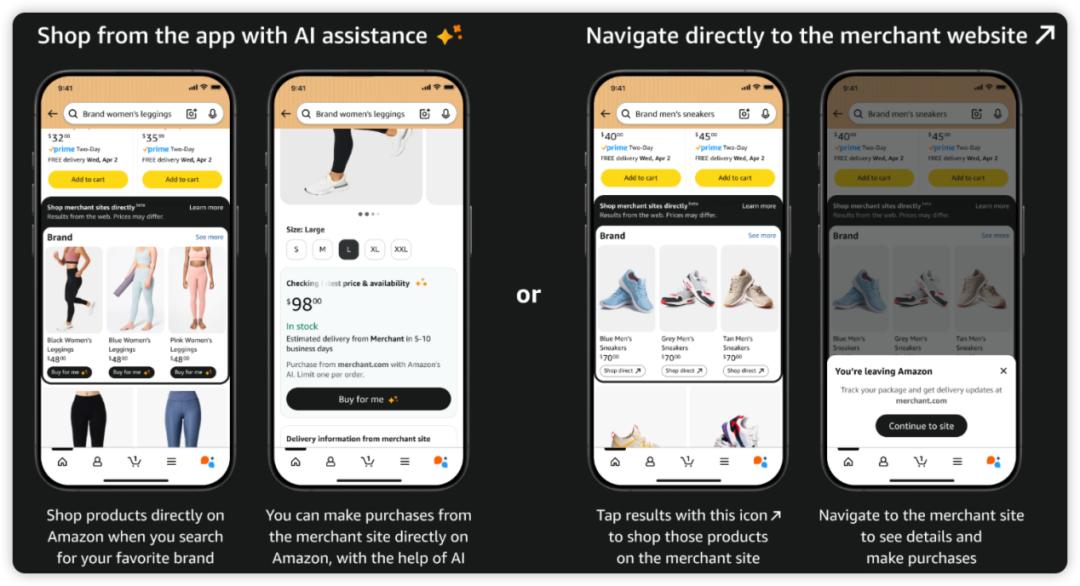
Core Insights - Amazon is testing a new shopping feature called "Shop Direct" aimed at helping consumers purchase products that are not listed on Amazon but are available on independent sites [1][7] - The feature allows users to see links to independent sites when searching for specific products or brands, facilitating a transition to third-party websites for transactions [1][5] - This move is seen as a response to the growing competition from AI-driven e-commerce platforms like ChatGPT and Google Gemini, which are challenging Amazon's dominance as the primary online shopping gateway [7][17] Group 1: Feature Overview - "Shop Direct" is currently in a testing phase and is only available to a limited number of users in the U.S. [1][11] - When users search for a product, they will see a "Shop Direct" button that redirects them to the independent brand's website for purchase [3][5] - This feature is part of a broader strategy to integrate external product offerings into Amazon's ecosystem, enhancing the variety of available SKUs [11][18] Group 2: Competitive Landscape - The introduction of "Shop Direct" is a strategic response to the threat posed by AI models and independent e-commerce platforms that provide a seamless shopping experience without redirecting users [7][17] - Amazon's user base is substantial, with approximately 32 billion users visiting its U.S. site monthly, highlighting its significant market presence [15] - The competition from AI models is reshaping shopping behaviors, prompting Amazon to adapt its platform to retain user engagement [17][21] Group 3: Seller Reactions - Some independent sellers have reported increased sales attributed to the traffic generated by "Shop Direct," indicating a positive impact on their businesses [12][14] - However, there are concerns among sellers about potential future competition from Amazon, as the company may leverage user data to undercut prices [12][14] - Amazon has stated that sellers can opt out of the program if they do not wish to participate, indicating a level of flexibility in its approach [14] Group 4: Future Developments - "Shop Direct" is expected to be integrated into Amazon's upcoming "Buy for me" feature, which allows for in-platform purchasing without leaving Amazon's site [8][11] - The "Buy for me" model is rapidly expanding, with product offerings increasing from 65,000 to over 500,000 by November 2025 [11] - Amazon's ongoing AI initiatives, such as the Rufus shopping assistant, aim to enhance user engagement and streamline the shopping process [19][21]
揭开千问App急切面纱:全面接入阿里生态,能否跑赢AI竞赛?
3 6 Ke· 2026-01-16 00:22
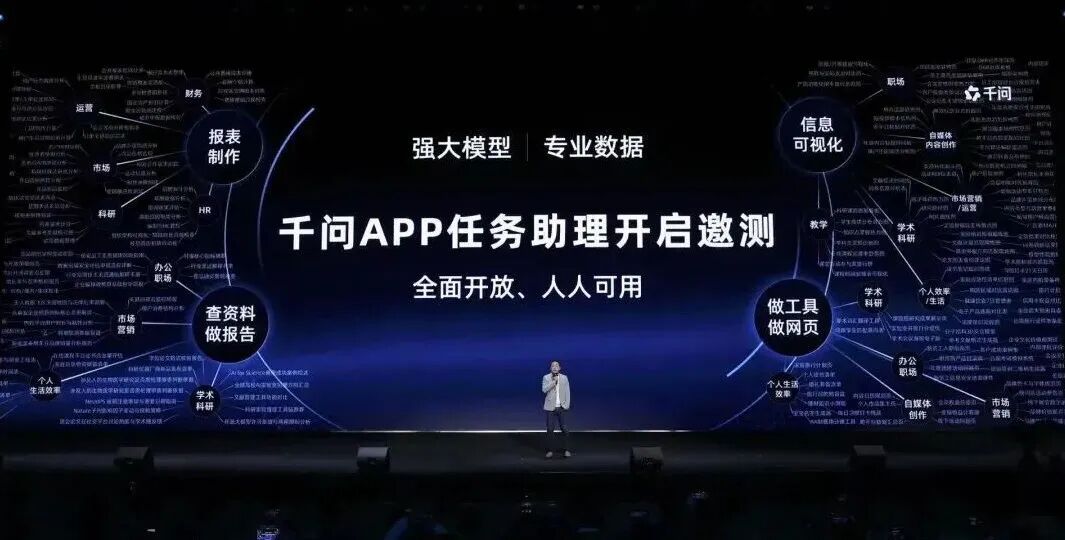
Core Insights - The article discusses the launch of the Qianwen App, which integrates with Alibaba's ecosystem to provide over 400 AI service functions, marking a shift from conversational AI to practical task execution [1][3][12] - The integration allows users to perform complex tasks such as ordering food, booking flights, and accessing government services through natural language commands, showcasing the potential of AI in everyday life [5][6][12] Group 1: AI and E-commerce Integration - The integration of e-commerce and AI agents is becoming increasingly clear, with Qianwen leveraging Alibaba's vast data resources to enhance its AI capabilities [1][7] - Qianwen's AI can provide personalized shopping recommendations based on user needs, utilizing Alibaba's extensive product database and review system [5][12] - The app's ability to execute tasks seamlessly within Alibaba's ecosystem creates a competitive edge, although it currently lacks cross-platform capabilities [1][12] Group 2: Technical Advancements and User Experience - Qianwen's system-level integration with services like Taobao and Alipay allows for a streamlined user experience, enabling users to complete transactions without switching apps [5][12] - The app's underlying technology has improved significantly, allowing for real-time task execution and enhanced understanding of complex user requests [6][12] - The app's "task assistant" feature is being tested, which can handle multi-step planning and various tasks, further enhancing its utility [6][12] Group 3: Market Position and Future Outlook - Analysts suggest that Alibaba's ecosystem will further enhance user retention and advertising conversion rates, positioning Qianwen favorably in the AI e-commerce landscape [14] - The competitive landscape is evolving, with other companies like Amazon and Walmart also investing in AI shopping experiences, indicating a broader trend in the industry [7][9] - Alibaba's ambition to develop advanced AI capabilities is evident, with the Qianwen App serving as a key component in its strategy to dominate the AI market [14][15]

电商Agent来了,谷歌发布UCP,亚马逊拒绝加入,阿里积极拥抱
3 6 Ke· 2026-01-14 02:58
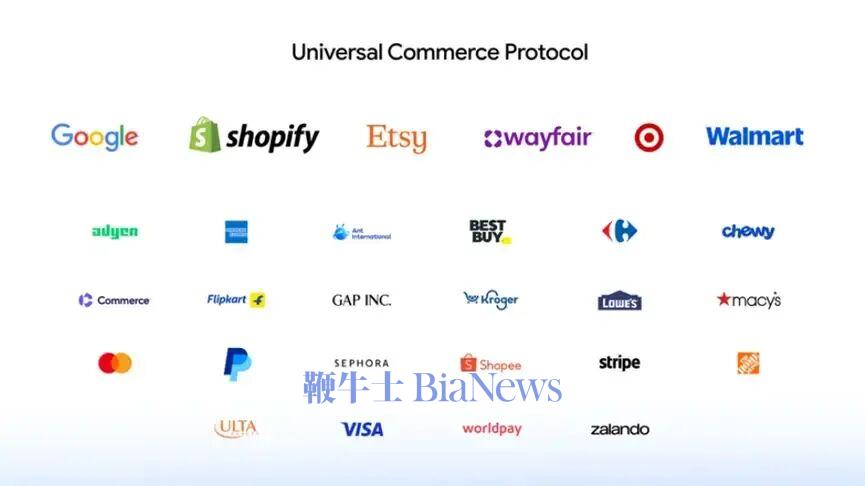
Core Insights - The launch of the Universal Commerce Protocol (UCP) by Google in collaboration with Shopify, Walmart, Target, Visa, and Stripe marks a significant shift in the e-commerce industry towards a new era of "conversation as transaction" [1][6][11] - Traditional e-commerce giants are facing immediate challenges as the UCP aims to standardize interactions that were previously controlled by centralized platforms [2][4][8] Group 1: UCP Overview and Implications - UCP is not just an API specification; it aims to create a universal language for e-commerce transactions, allowing AI agents to interact seamlessly with merchant systems [6][10] - The protocol threatens centralized e-commerce platforms by reducing the necessity for consumers to visit sites like Amazon or Taobao, as they can interact directly with AI agents [6][8] - UCP redefines human-computer interaction from a graphical interface to an intent-based interface, potentially diminishing the value of traditional platform features like homepage traffic and personalized recommendations [8][11] Group 2: Strategic Responses from Major Players - Amazon's absence from the UCP alliance signals a strategic choice to maintain its closed ecosystem, focusing on internal AI developments and reinforcing its control over its platform [13][14] - In contrast, Alibaba's Ant International actively embraces UCP, leveraging its extensive commercial ecosystem and payment capabilities to support AI-driven business growth [19][21] - The differing strategies highlight a fundamental divergence: Amazon seeks to fortify its existing model, while Alibaba aims to become a foundational infrastructure provider within the new open ecosystem [25][31] Group 3: Future Competitive Landscape - The competition in e-commerce will evolve across three levels: entry points dominated by AI assistants, infrastructure provided by companies like Shopify and Ant International, and the transformation of product information and service capabilities to be AI-friendly [27][28][29] - The UCP's establishment signals a shift from platform-centric competition to a broader contest over who can define the next generation of consumer interactions [29][39] - The future of commerce will require businesses to prepare for AI agents, marking a transition from an "attention economy" to an "intention economy" [40][41]

Gemini推出购物功能,AI重塑消费入口的1000天
3 6 Ke· 2026-01-14 01:07
Core Insights - The article discusses the ongoing competition in the AI space, particularly focusing on the integration of AI into retail and e-commerce, highlighting the collaboration between Walmart and Google to enhance shopping capabilities through AI [1][2][3] Group 1: AI Integration in Retail - Walmart and Google announced plans to integrate Walmart and Sam's Club products into Google's Gemini, enhancing AI-driven shopping experiences for users [1] - Google's Universal Commercial Protocol (UCP) was introduced to provide intelligent shopping capabilities within AI chat interfaces, allowing users to browse and purchase products without leaving the chat [1][2] - The rise of AI in shopping is evident, with record online sales of $11.8 billion on Black Friday 2025, driven by AI-assisted consumer decision-making [2] Group 2: Competitive Landscape - The competition has evolved from search engines to e-commerce, with major players like OpenAI and Google vying for dominance in the AI shopping space [2][3] - OpenAI's "Instant Checkout" feature allows users to complete purchases directly within the ChatGPT interface, marking a significant shift in how consumers interact with e-commerce [3][4] - Google's Gemini 3 model has received high praise for its capabilities, including completing complex tasks, indicating Google's commitment to maintaining its competitive edge in AI [9][10] Group 3: Responses from Major Players - Amazon is taking measures to protect its e-commerce platform by restricting AI companies' access to its data, indicating its concern over losing control of the shopping process [11][12] - In contrast, Shopify is embracing AI by collaborating with AI companies to integrate shopping capabilities while ensuring transactions occur within its ecosystem [13][14] - The differing strategies of Amazon and Shopify highlight the varied approaches to AI integration in retail, with Amazon focusing on control and Shopify on collaboration [14][15] Group 4: Future Implications - The article suggests that the integration of AI into shopping is still in its early stages, with challenges such as the "hallucination" problem affecting the reliability of AI recommendations [15] - Despite the current limitations, the potential for AI to reshape the commercial landscape is significant, with ongoing developments indicating a shift in how consumers will engage with e-commerce in the future [15]