
美元储备货币地位

Search documents
短期波动无关霸权!贝森特驳斥“美元贬值削弱全球地位”论调
Jin Shi Shu Ju· 2025-07-04 01:55
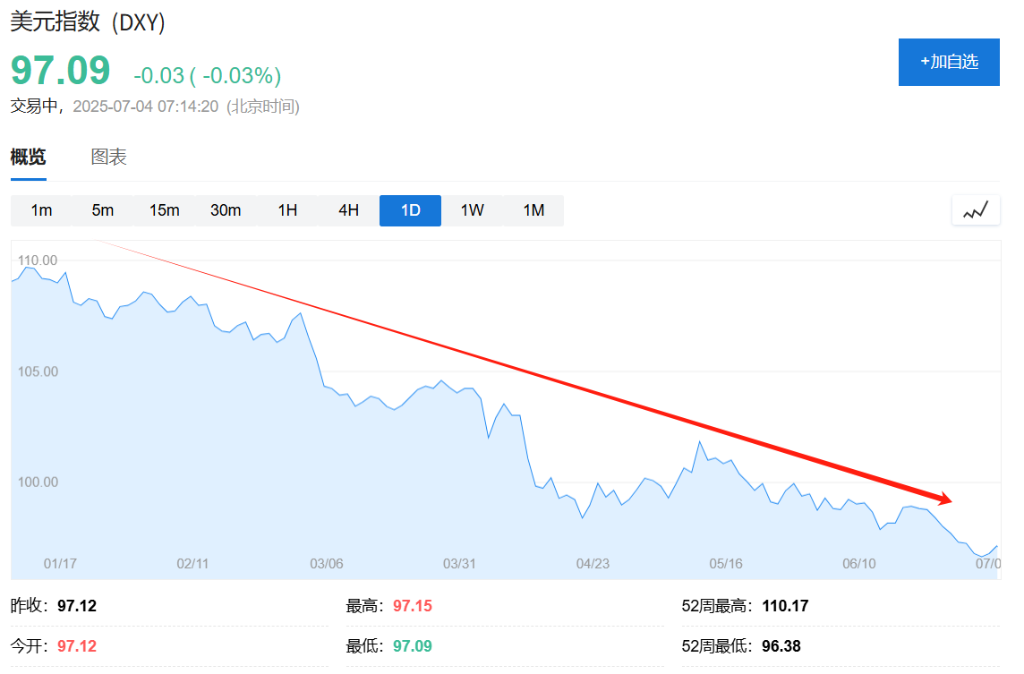
Core Viewpoint - U.S. Treasury Secretary Scott Bessent dismisses concerns about the potential depreciation of the dollar undermining its status as the global reserve currency, emphasizing that the strength of the dollar is not directly linked to its price [1][2] Group 1: Dollar's Status and Policy - The dollar index has dropped nearly 11% in the first half of the year, marking the worst performance since 1973, amid concerns over Trump's policies, including tariffs and diplomatic stances [1] - Bessent asserts that the Trump administration is taking long-term measures to maintain the dollar's status as the world's reserve currency [1] - He questions the notion that the current environment presents an opportunity for reduced reliance on the dollar, emphasizing that a reserve currency must allow for free trading [1] Group 2: Interest Rates and Federal Reserve - Bessent expresses skepticism about the Federal Reserve's interest rate decisions, indicating that the two-year U.S. Treasury yield suggests the benchmark rate is too high [2] - The current target for the Federal Reserve's federal funds rate is between 4.25% and 4.5%, while the two-year Treasury yield is approximately 3.76% [2] - He notes that if the Fed does not lower rates, the potential cut in September could be more significant [2] Group 3: Debt Strategy and Management - Bessent discusses the debt management strategy, indicating that the Treasury will consider the high two-year yield when making decisions about debt repayment [4] - He refrains from commenting on predictions regarding the reduction of the federal deficit by up to $11 trillion over the next decade due to Trump's policies, stating that long-term forecasts are difficult [4] - The next quarterly refinancing meeting is scheduled for July 30, where any changes in debt strategy will be announced [4]
美财长:美元贬值无关“强美元政策” 储备货币地位稳固
Zhi Tong Cai Jing· 2025-07-03 23:48
Core Viewpoint - The U.S. Treasury Secretary has dismissed concerns regarding the recent depreciation of the dollar affecting its status as a global reserve currency, asserting that the dollar's value is unrelated to a "strong dollar policy" [1][2] Group 1: Dollar Performance - The dollar index experienced its worst first half since 1973, with a decline of nearly 11% [1] - The depreciation is attributed to concerns over President Trump's policies, including potential economic impacts from tariff increases and a tough diplomatic stance towards long-time allies [1] Group 2: Economic Policies - The Treasury Secretary emphasized that the Republican tax legislation is creating conditions for economic growth and controlling inflation, positioning the U.S. as a prime destination for global capital investment [1] - There is skepticism regarding the potential for a shift away from dollar dependency in the global financial system, despite discussions about the euro's rising significance [1] Group 3: Euro and Dollar Dynamics - The depreciation of the dollar has led to an increase in the euro's value, with the current exchange rate at 1.175 [1] - Historical context indicates that when the euro strengthens, European Central Bank officials often express concerns about the negative impact on export competitiveness [1]
贝森特否认美元贬值会削弱其全球地位,警告欧元升至1.2将令欧洲"尖叫"
Hua Er Jie Jian Wen· 2025-07-03 23:38
Group 1 - The core argument presented by Treasury Secretary Mnuchin is that the recent decline of the dollar does not threaten its status as the world's primary reserve currency, emphasizing that the "strong dollar policy" focuses on long-term stability rather than short-term fluctuations [1][4]. - Mnuchin highlighted that the dollar index fell nearly 11% in the first half of the year, marking the worst semi-annual performance since the Nixon era, attributing this decline to uncertainties stemming from President Trump's trade policies and pressure on the Federal Reserve to lower interest rates [1][4]. - He reiterated that the Republican tax reform is laying the groundwork for economic growth and that measures are being taken to curb inflation, positioning the U.S. as a prime destination for global capital, which he believes will support the dollar's long-term status [4][7]. Group 2 - Mnuchin warned that if the euro rises to 1.20 against the dollar, it would cause significant concern among Europeans, as a strong euro could undermine the price competitiveness of European exports [4][7]. - He expressed skepticism towards predictions of the dollar's decline as a reserve currency since World War II, asserting that doubters will once again be proven wrong [4]. - The Secretary emphasized that U.S. policymakers recognize the responsibilities that come with being a reserve currency and can tolerate periods of a strong dollar, contrasting this with European perspectives [7].

贝莱德:美元的世界储备货币地位被重新审视
news flash· 2025-07-01 10:46
Core Viewpoint - The report from BlackRock highlights the reevaluation of the US dollar's status as the world's reserve currency amid trade disruptions and increasing US government debt [1] Group 1: Dollar's Status - The weakening of the dollar coincides with significant risk events for the first time since 2002, prompting institutions to reconsider the reliability of US assets [1] - Speculation about the dollar losing its reserve currency status is deemed premature, and a complete "de-dollarization" is still a long way off [1] Group 2: US Government Debt - BlackRock expresses concern over the dangerous state of US government debt, suggesting that if left unchecked, it poses the greatest single risk to the US's "special status" in financial markets [1]

美元贬值背后,鲍威尔如何守护美元储备货币地位?
Sou Hu Cai Jing· 2025-06-30 05:09
Core Viewpoint - Recent economic data from the United States has raised concerns about the future trajectory of the US dollar, leading to a significant decline in its value and prompting a reevaluation of its status as the global reserve currency [1][2]. Economic Data Summary - The core PCE price index for May slightly exceeded expectations, rising by 0.2% month-on-month, but consumer spending fell by 0.3%, marking the largest decline since the beginning of the year [1]. - The final GDP figure for Q1 and new home sales data released on June 25 showed weak performance, further increasing expectations for interest rate cuts [1]. - Market data indicates a 27% probability of a rate cut in July and an 84% probability in September [1]. Dollar Performance Summary - The dollar index has experienced a continuous decline, dropping below the 97 mark, the lowest level since March 2022 [1]. - Year-to-date, the dollar has fallen by 10.34%, with a decline of 4.59% over the past two months [1]. Factors Influencing Dollar Decline - The strong performance of the euro, which accounts for over 60% of the dollar index, has significantly contributed to the dollar's weakness [2]. - A historic agreement among NATO members to significantly increase defense spending is expected to inject new momentum into the European economy, further boosting the euro [2]. - The ongoing Russia-Ukraine conflict and Germany's fiscal stimulus measures are anticipated to increase investments in infrastructure and military sectors in Europe, supporting the euro's exchange rate [2]. Federal Reserve's Stance - Despite rising calls for interest rate cuts, the Federal Reserve has not yet taken action, with Chairman Jerome Powell expressing concerns about inflation risks from trade wars [2][4]. - Powell's recent testimony indicated that while many paths are possible regarding rate cuts, there is no clear timeline, leading to market interpretations of a potential softening stance [4]. - Trump has publicly criticized Powell for not cutting rates, arguing that this has caused the US economy to lag behind Europe [4]. Concerns About Dollar's Reserve Status - Powell has countered concerns about the dollar's status as a safe-haven currency, asserting that it remains the largest safe-haven currency globally [4]. - However, Powell has expressed worries about the unsustainable trajectory of US federal debt, which could materially damage the dollar's reserve currency status [5]. - The recently passed "Big Beautiful Bill" is projected to increase federal debt by $3.8 trillion over the next decade, reaching 125% of GDP, exacerbating the debt issue and potentially impacting the dollar's reserve status [5].

美元储备地位动摇?鲍威尔表态背后的隐忧
Sou Hu Cai Jing· 2025-06-29 07:09
Core Viewpoint - Recent negative economic data from the United States has intensified expectations for a Federal Reserve interest rate cut, leading to a decline in the US dollar's value and raising concerns about its status as the global reserve currency [1][2]. Economic Data Summary - In May, the core PCE price index slightly exceeded expectations with a month-on-month increase of 0.2%, while consumer spending fell by 0.3%, marking the largest decline since the beginning of the year [1]. - The final GDP for Q1 and new home sales data released on June 25 were disappointing, further fueling rate cut expectations [1]. - Market data indicates a 27% probability for a rate cut in July and an 84% probability for September [1]. Dollar Performance Summary - The US dollar index has fallen for five consecutive trading days, dropping below the 97 mark, reaching its lowest point since March 2022 [1]. - Year-to-date, the dollar has depreciated by 10.34%, with a 4.59% decline in the last two months [1]. Factors Influencing Dollar Decline - The strong performance of the euro has exerted direct pressure on the dollar, as the euro accounts for over 60% of the dollar index [1]. - A historic agreement among NATO members to significantly increase defense spending has injected new vitality into the European economy, further supporting the euro's appreciation [1]. Federal Reserve's Stance - Federal Reserve Chairman Jerome Powell has been cautious about rate cuts, citing concerns over inflation pressures from trade wars, and has not provided clear guidance to investors [2]. - Powell's recent comments during a congressional hearing suggested a potential openness to rate cuts, but his statements remain ambiguous [2]. Political Pressure - Former President Trump has expressed strong dissatisfaction with Powell's reluctance to cut rates, arguing that the lack of action has negatively impacted the US economy and contributed to the dollar's decline [4]. - The conflicting economic data in the US has created uncertainty for investors regarding the future value of the dollar, exacerbating its downward trend [4]. Concerns Over Dollar's Reserve Status - Powell defended the dollar's status as a safe-haven currency during congressional hearings, asserting its continued strength as the world's largest reserve currency [4]. - Despite his confidence, there are underlying concerns reflected in his statements regarding the sustainability of US federal debt and the potential impact of the "Big Beautiful Bill" on the dollar's reserve currency status [5].

美联储主席鲍威尔:美元作为储备货币一个持久的平衡,预计将持续很长一段时间。
news flash· 2025-06-25 14:41
Core Viewpoint - Federal Reserve Chairman Jerome Powell stated that the dollar's status as a reserve currency is expected to maintain a lasting balance for a long time [1] Group 1 - The dollar's position as a reserve currency is seen as stable and enduring [1]
国证国际港股晨报-20250625
Guosen International· 2025-06-25 06:33
Group 1: Market Overview - The report highlights an increase in interest rate cut expectations, driven by easing tensions in the Middle East and supportive statements from Federal Reserve officials regarding a potential rate cut in July, positively impacting both US and Hong Kong stock markets [2][3] - The Hang Seng Index opened at 23,832 points and reached a high of 24,229 points, closing at 24,177 points, marking a daily increase of 487 points or 2.06% [2] - The trading volume in the Hong Kong market increased to 240.5 billion HKD, a rise of 21.1% compared to the previous day, with net inflows from the Northbound trading of 2.589 billion HKD [2] Group 2: Company Overview - Yunzhisheng (9678.HK) - Yunzhisheng is an AI solution provider focusing on conversational AI products, with business segments in smart living and smart healthcare, and has been active in the AI field since its establishment in 2012 [6] - The company reported revenue growth from approximately 601 million CNY in 2022 to an estimated 939 million CNY in 2024, with a compound annual growth rate (CAGR) of 23% [6][7] - Despite revenue growth, the company has faced net losses, projected to be approximately 375 million CNY in 2022, 376 million CNY in 2023, and 454 million CNY in 2024, indicating ongoing financial challenges [6][9] Group 3: Industry Outlook - The AI solutions market in China is expected to grow from 42.2 billion CNY in 2019 to 180.4 billion CNY by 2024, with a CAGR of 33.7%, and projected to reach 1,174.9 billion CNY by 2030 [7] - The market is highly fragmented, with Yunzhisheng holding a market share of 0.6%, ranking fourth among AI solution providers in China based on 2024 revenue [7] Group 4: Competitive Advantages and Opportunities - The company possesses strong technical capabilities, with its self-developed "Shanhai" model featuring 60 billion parameters, recognized for its performance in the medical field [8] - Its applications span various scenarios, including smart homes and healthcare AI, serving 166 hospitals and enhancing efficiency in data entry and quality control [8] Group 5: Financial Position and Risks - Yunzhisheng has faced continuous losses over the past three years, with a cash reserve of 156 million CNY by the end of 2024, indicating significant financial pressure [9] - The company faces intense competition from major players like iFlytek, Baidu, and Alibaba, which may lead to price wars and further pressure on profit margins [9] Group 6: IPO Information - The IPO subscription period is from June 20 to June 25, 2025, with trading expected to commence on June 30, 2025 [10] - The company has secured cornerstone investors, including SenseTime Group and Zhenyi Asset, with a total subscription of 95.5 million HKD, representing 29.65%-36.84% of the international placement [11] Group 7: Fundraising and Utilization - The expected net fundraising amount is 177 million HKD, with approximately 45.6% allocated to enhancing R&D capabilities and 47.0% for investing in emerging business opportunities [12][13]
鲍威尔:美元将始终作为储备货币存在
news flash· 2025-06-24 15:38
Core Viewpoint - Federal Reserve Chairman Jerome Powell affirmed that the US dollar will continue to exist as a reserve currency for a long time to come [1] Group 1 - Powell confirmed that US Treasury bonds are considered a safe-haven asset [1]
美联储主席鲍威尔:预计美元长时间内将继续是储备货币
news flash· 2025-06-24 15:36
Core Viewpoint - Federal Reserve Chairman Powell indicates that the US dollar is expected to remain the reserve currency for an extended period, and the US Treasury market is functioning normally [1] Group 1 - The US dollar's status as a reserve currency is projected to persist for a long time [1] - The normal operation of the US Treasury market is highlighted [1]