降杠杆

Search documents
美凯龙(601828)季报点评:25Q3扣非亏损收窄 经营性现金流逐季向好
Ge Long Hui· 2025-11-08 04:59
Core Viewpoint - Meikailong's financial performance in Q1-Q3 2025 shows significant revenue decline and net losses, attributed to weakened demand in the home retail market and increased tenant retention incentives [1][2]. Financial Performance - For Q1-Q3 2025, Meikailong reported revenue of 4.969 billion yuan, a year-on-year decrease of 18.62%, and a net loss attributable to shareholders of 3.143 billion yuan [1]. - In Q3 2025, revenue was 1.632 billion yuan, down 13.24% year-on-year, with a net loss of 1.243 billion yuan [1]. - The company's gross margin improved to 61.89% for Q1-Q3 2025, up 2.47 percentage points year-on-year, and 62.69% for Q3 2025, up 6.07 percentage points year-on-year [2]. Business Operations - The company is accelerating its business model upgrade, with positive developments in new sectors such as appliances, automotive, home decoration design, and lifestyle businesses, contributing to a stabilization in rental rates [2]. - As of September 2025, the occupancy rate of self-operated malls increased from 83.0% at the end of 2024 to 84.7% [2]. - The automotive business area increased by 0.3 percentage points in Q3 2025, reaching a total operational area of 260,000 square meters across 44 cities [2]. Cost and Expenses - The expense ratio for Q1-Q3 2025 was 57.65%, an increase of 2.88 percentage points year-on-year, with specific expense rates for sales, management, R&D, and financial costs reported [3]. - In Q3 2025, the expense ratio rose to 63.19%, up 3.70 percentage points year-on-year [3]. Cash Flow and Future Outlook - Operating cash flow showed significant improvement, with a net inflow of approximately 640 million yuan for the first three quarters of 2025, an increase of about 1.17 billion yuan year-on-year [4]. - The company is expected to continue its "light asset, heavy operation, and deleveraging" strategy, with projected revenues of 6.915 billion yuan, 7.732 billion yuan, and 8.223 billion yuan for 2025-2027, reflecting a year-on-year growth of -11.59%, 11.82%, and 6.34% respectively [4].
美凯龙(601828):25Q3扣非亏损收窄,经营性现金流逐季向好
Guotou Securities· 2025-11-07 04:35
Investment Rating - The investment rating for the company is "Accumulate-A" with a 12-month target price of 3.35 yuan, while the current stock price is 2.77 yuan [6]. Core Insights - The company reported a narrowing of non-recurring losses in Q3 2025, with operating cash flow improving quarter by quarter. For the first three quarters of 2025, the company achieved a revenue of 4.969 billion yuan, a year-on-year decline of 18.62%, and a net profit attributable to shareholders of -3.143 billion yuan [1][11]. - The revenue decline in Q3 2025 was 13.24% year-on-year, with a net profit of -1.243 billion yuan and a non-recurring net profit of -356 million yuan. The decline was attributed to weakened demand in the home retail market and a temporary drop in rental income [1][2]. Summary by Sections Revenue and Profitability - The company’s self-operated and leasing segments saw a revenue decline of 5.8 billion yuan year-on-year, while other segments collectively decreased by 5.6 billion yuan [2]. - The gross profit margin for the first three quarters of 2025 was 61.89%, an increase of 2.47 percentage points year-on-year, and for Q3 2025, it was 62.69%, up 6.07 percentage points [4]. Business Development - The company is accelerating its business model upgrade, with positive developments in new business areas such as appliances, automotive, home design, and lifestyle sectors, contributing to a stabilization in mall occupancy rates, which increased from 83.0% at the end of 2024 to 84.7% by the end of Q3 2025 [3]. - The company has expanded its smart appliance stores to over 150 locations across 115 core cities, and its automotive business has reached a total operating area of 260,000 square meters, covering 44 cities with over 30 partner brands [3]. Financial Forecast - The company is expected to achieve revenues of 6.915 billion yuan, 7.732 billion yuan, and 8.223 billion yuan for 2025, 2026, and 2027 respectively, with year-on-year growth rates of -11.59%, 11.82%, and 6.34% [11]. - The net profit forecast for 2025 is -804 million yuan, with a projected PE ratio of -14.9X, and for 2026, the net profit is expected to be 125 million yuan with a PE ratio of 96.3X [11].
Q3债券基金季报分析:债基规模回落,普遍降杠杆、缩久期、信用适度下沉
Yin He Zheng Quan· 2025-11-05 08:49
1. Report Industry Investment Rating No relevant content provided. 2. Core Viewpoints of the Report - Bond fund scale declined significantly in Q3 2025, with a decrease in the proportion of interest - rate bonds and an increase in credit bonds. The scale of bond funds decreased by 0.25 trillion yuan to 10.56 trillion yuan, while the scale of stock - type funds increased by 1.03 trillion yuan to 5.26 trillion yuan [1][8][9]. - The key indicators of bond funds generally showed a reduction in leverage, a shortening of duration, and a moderate credit downgrade. The performance of bond funds, including average yield, risk - return ratio, and maximum drawdown, also deteriorated [3][4][46]. 3. Summary According to the Directory 3.1 Fund Scale: Bond Fund Scale Declined Significantly 3.1.1 Q3 Bond Fund Scale Converged Significantly. In Terms of Allocation, Interest - Rate Bonds Decreased and Credit Bonds Increased - The total scale of public funds in the market reached 35.4 trillion yuan in Q3 2025, with the proportion of bond funds decreasing by 2.56% (0.25 trillion yuan) to 10.56 trillion yuan. Only bond - type funds' scale decreased significantly, while other types of funds increased, especially stock - type funds [1][8][9]. - In Q3 2025, the new issuance scale of pure - bond funds was 214.12 million yuan (27 new issues), and the maturity scale was 251.82 million yuan (20 matured issues). It is estimated that about 3 pure - bond funds may mature in Q4 2025, with a scale of about 101.4 million yuan [1][13]. - In terms of bond allocation, pure - bond funds mainly held financial bonds, with a decrease in the proportion of interest - rate bonds (- 0.64%) and an increase in credit bonds (+ 1.08%). The market value of bond holdings in pure - bond funds accounted for 96.75% of the total fund value, a decrease of 0.9 percentage points compared with Q2 [1][16][18]. 3.1.2 The Total Scale of Three Types of Pure - Bond Funds Decreased by 0.75 Trillion Yuan, and the Bond Position Decreased by 0.7 - 2.3 Percentage Points - The scale of medium - and long - term pure - bond funds decreased by 0.55 trillion yuan (- 8.5%) to 5.91 trillion yuan, and the bond position decreased by 0.71 percentage points to 97.04%. The main bond types were financial bonds, medium - term notes, and corporate bonds [23][24]. - The scale of short - term pure - bond funds decreased by 0.2 trillion yuan (- 17.4%) to 0.95 trillion yuan, and the bond position decreased by 2.24 percentage points to 95.57%. The main bond types were financial bonds, medium - term notes, and short - term financing bills [31]. - The scale of mixed - type first - level bond funds decreased slightly by 0.003 trillion yuan (- 0.4%) to 0.85 trillion yuan, and the bond position decreased by 0.73 percentage points to 95.9%. The main bond types were financial bonds, medium - term notes, corporate bonds, and convertible bonds [38]. 3.2 Key Indicators of Bond Funds: Generally Reduced Leverage, Shortened Duration, and Moderate Credit Downgrade 3.2.1 Both Yield and Risk - Return Performance Declined, and the Maximum Drawdown Widened - The average quarterly yield of bond funds in Q3 was 0.52%, a decrease of 0.53 percentage points compared with the previous period. Among them, the yield of mixed - type first - level bond funds was 0.57%, better than the overall level [46][47]. - The maximum drawdown of bond funds in Q3 was - 0.54%, a widening of 0.38 percentage points compared with Q2. The maximum drawdown of short - term pure - bond funds widened by 0.06 percentage points to - 0.1%, with the smallest widening amplitude [46][50]. - The Sharpe ratio and Calmar ratio of bond funds in Q3 were - 0.01 and 8.03 respectively, showing a significant decline compared with the previous period. The short - term pure - bond funds performed relatively stably in terms of risk control [46][52]. 3.2.2 Leverage Ratio and Duration Both Declined, the Concentration of Top - Heavy Holdings Increased, and Credit Was Moderately Downgraded - The average leverage ratio of bond funds decreased to 114.53% (a decrease of 3.34 percentage points compared with the previous period). The leverage ratios of different types of pure - bond funds decreased by 2 - 5 percentage points to 111 - 117%, with short - term pure - bond funds having the largest decline [4][55][57]. - The average duration of bond funds decreased to 2.71 years (a decrease of 0.74 years compared with the previous period). The average duration of different types of pure - bond funds decreased by 0.2 - 1.3 years to 0.9 - 3 years, with mixed - type first - level bond funds having the largest decline [4][55][60]. - The concentration of top - heavy holdings of bond funds increased to 40.04% (an increase of 2.79 percentage points compared with the previous period). The concentration of top - heavy holdings of different types of pure - bond funds increased, with short - term pure - bond funds having the largest increase [4][55][63]. - Most pure - bond funds adopted a moderate credit - downgrading strategy. The proportion of AAA - rated bonds in medium - and long - term and short - term pure - bond funds decreased by 2.99 and 3.45 percentage points respectively to 93.43% and 92.32% [4][55][66].

A股两融余额处历史高位 有券商转向“降杠杆”
Di Yi Cai Jing· 2025-10-14 14:06
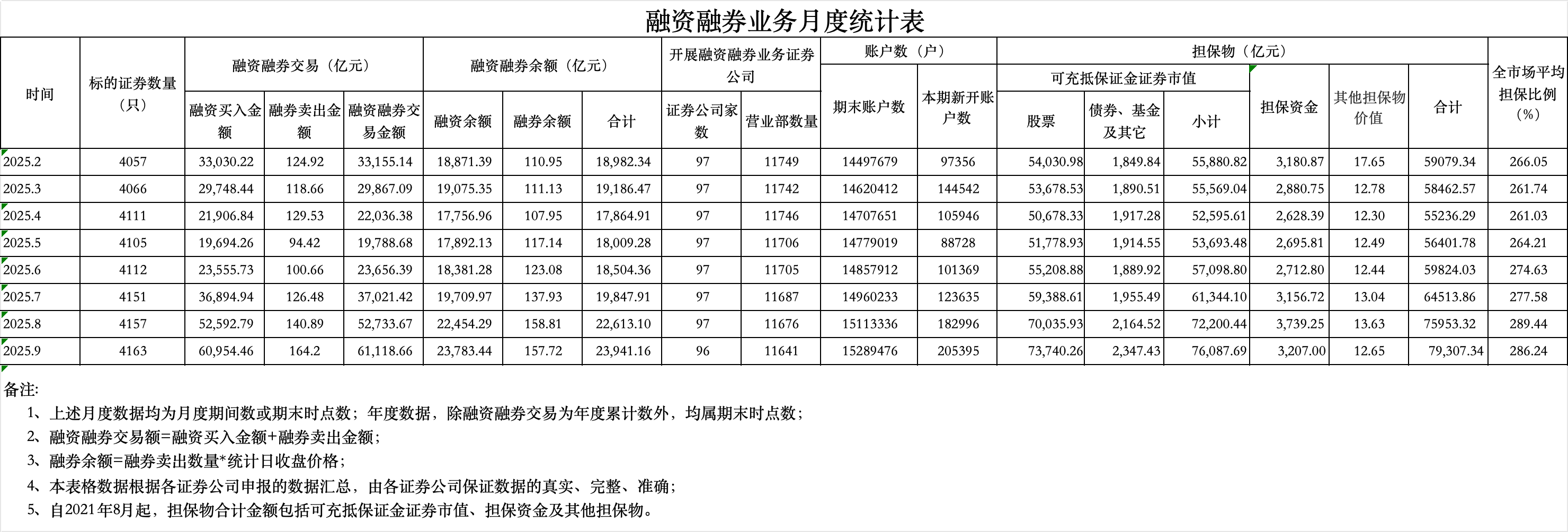
Core Viewpoint - The A-share margin financing scale has reached a historical high, exceeding 2.4 trillion yuan, but recent adjustments in margin requirements by some brokerages have raised concerns about potential risks in the market [1][11]. Group 1: Margin Financing Scale - As of October 13, the margin financing balance reached 2.4444 trillion yuan, with a financing balance of 2.4279 trillion yuan, marking a slight increase of 25.94 billion yuan from the previous day [2][3]. - The margin financing balance has been on an upward trend throughout the year, surpassing 2 trillion yuan for the first time in ten years on August 5, and reaching 2.4455 trillion yuan on October 9 [4][11]. - The number of new margin financing accounts opened in September was the highest for the year, totaling 20.54 million [4]. Group 2: Brokerages' Adjustments - Huayin Securities raised the margin requirement for financing securities from 80% to 100% on October 13, citing rapid growth in financing balances as a reason for this risk management measure [1][8]. - Other brokerages, such as Zheshang Securities and Xingye Securities, have also adjusted their credit business scale upwards to meet market demand [7][8]. - Analysts suggest that the increase in margin requirements may be a response to high financing demand and a strategy to balance business growth with risk control [8][11]. Group 3: Market Trends and Risks - The current margin financing balance is at a historical high, but the overall collateral ratio remains at a median level, indicating that risks are manageable compared to the peak levels seen in 2015 [11][12]. - The proportion of margin financing balance to A-share circulating market value is 2.55%, which is lower than the peak of 4.27% in June 2015 [11][12]. - Market analysts predict a shift in market style towards defensive sectors amid recent adjustments and uncertainties in international relations [13].

A股两融余额处历史高位,有券商转向“降杠杆”
Di Yi Cai Jing· 2025-10-14 13:32
Core Insights - The number of new margin trading accounts opened in September reached a record high for the year, indicating strong market demand for margin trading services [2][3] - The total margin trading balance hit a historical peak of 2.4455 trillion yuan on October 9, 2023, before experiencing a slight decline due to market adjustments [1][3] - Some brokerages have raised the margin requirements for financing, reflecting concerns over rapid growth in margin balances and the need for risk management [1][7] Margin Trading Balance - As of October 13, the margin trading balance was 2.4444 trillion yuan, with a financing balance of 2.4279 trillion yuan, accounting for 2.55% of the A-share market's circulating market value [2][11] - The margin trading balance has shown significant growth throughout the year, surpassing 2 trillion yuan in August and reaching 2.4 trillion yuan by mid-September [3][12] - The average collateral ratio in the market has remained stable, with figures between 261% and 290% from February to September 2023 [12] Brokerages' Actions - Brokerages have been adjusting their credit business limits to meet the increasing demand for margin trading, with some firms like Huayin Securities raising their credit business limits multiple times this year [6][7] - On October 13, Huayin Securities raised the margin requirement for certain securities from 80% to 100%, citing the need for risk control due to rapid growth in financing balances [1][7] - Analysts suggest that the increase in margin requirements may be a response to high demand for financing and a strategy to balance business growth with risk management [7][10] Market Trends - The market has shown a shift in investor preferences, with sectors like non-ferrous metals receiving significant net purchases, while previously favored sectors like electronics and automotive have seen substantial net sales [2][3] - The overall market sentiment has turned defensive, with expectations of a potential shift in market style towards more stable and defensive sectors in the coming months [10][14] - Analysts predict that the market may enter a consolidation phase from October to November, influenced by external factors such as international relations and upcoming earnings reports [13][14]

越秀房托(00405.HK)出售资产背后,一场“降杠杆、提分派”的资本重构
Ge Long Hui· 2025-09-11 01:15
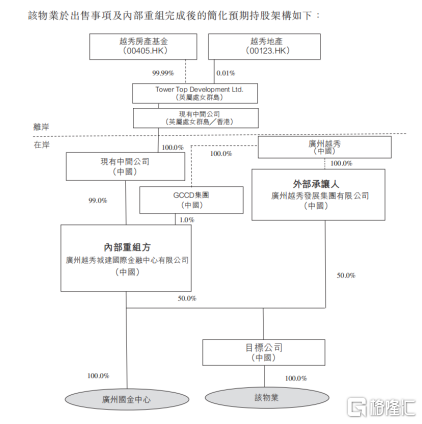
Core Viewpoint - Yuexiu Real Estate Investment Trust (00405.HK) announced a capital restructuring plan involving the sale of 50% equity in Guangzhou Yuexiu Financial Tower for 3.433 billion RMB, aiming to reduce leverage, increase distributions, and optimize structure to create long-term value for unitholders [1][6]. Group 1: Transaction Details - The core asset involved in the transaction is the Guangzhou Yuexiu Financial Tower, a prime 68-story office building located in the central area of Zhujiang New Town, Guangzhou, with a total operating income of 165 million RMB for the first half of 2025 and 362 million RMB for the entire year of 2024 [3]. - The sale of 50% equity to Guangzhou Yuexiu Development Group Co., Ltd. for 3.433 billion RMB not only realizes part of the asset's value but also diversifies the risk associated with a single asset [3][4]. - The remaining 50% equity will be transferred to a non-wholly-owned subsidiary of the fund, creating a joint venture structure that effectively reduces the fund's actual equity to 49.495%, thus removing it from consolidation [5]. Group 2: Financial Implications - The fund's debt ratio is expected to decrease from 48.1% to approximately 41.2% post-transaction, leading to a significant reduction in annual interest expenses [7]. - Despite selling part of the equity, the fund retains 49.495% of the interest, allowing it to continue sharing in the long-term benefits of the property, with an anticipated 8.7% increase in distribution per unit due to reduced interest expenses and increased joint venture distributions [9]. - The transaction is expected to facilitate new bank financing commitments of up to 4 billion RMB, with net proceeds from the sale estimated at around 2.3 billion RMB, all aimed at repaying existing debts [6]. Group 3: Strategic Management - The transaction reflects the proactive management capabilities of the REIT, optimizing asset composition and enhancing operational efficiency amid ongoing market uncertainties [12]. - The sale will diversify the fund's asset portfolio, reducing reliance on office properties from 55% to 46%, thereby improving resilience against market fluctuations [13]. - The strategic approach of retaining partial ownership allows the fund to capitalize on future growth potential in the office asset sector while maintaining its competitive edge in the market [14][16].
龙湖集团(00960.HK):降杠杆、优结构有序推进 开发结算利润率承压
Ge Long Hui· 2025-08-31 10:55
Core Viewpoint - Company reported 1H25 performance in line with market expectations, with revenue increasing by 25% year-on-year to 58.75 billion yuan, primarily due to an increase in development settlement scale, while core net profit attributable to shareholders decreased by 70.9% year-on-year to 1.38 billion yuan [1] Financial Performance - Company declared an interim dividend of 0.07 yuan per share, with a slight increase in payout ratio to 34.2% [1] - Interest-bearing liabilities decreased by 6.5 billion yuan to 169.8 billion yuan compared to the end of 2024, leading to a reduction in net debt ratio and pre-tax debt ratio by 0.5 percentage points and 1.2 percentage points to 51.2% and 56.1%, respectively [1] - Financing costs reduced to 3.58%, with the average loan term extended to 10.95 years [1] Operational and Service Business - Operating business revenue increased by 2.5% year-on-year to 7.01 billion yuan, with shopping center retail sales rising by 17% year-on-year to 40.2 billion yuan [2] - Service business revenue remained stable at 6.26 billion yuan, with property management covering approximately 400 million square meters [2] - Overall, operating and service businesses are expected to contribute approximately 4 billion yuan to core net profit in 1H25 [2] Development and Profitability Trends - Development settlement revenue increased by 35% year-on-year to 45.5 billion yuan, but gross margin was pressured to approximately 0.2% due to a higher proportion of older inventory in the settlement structure [2] - Company aims to further optimize debt structure and cash flow management, projecting a reduction of interest-bearing liabilities by about 20 billion yuan to around 145 billion yuan by the end of 2025 [2] Future Outlook - Company expects rental income growth to normalize starting in 2026, with the opening of 10 new shopping malls in the second half of the year [3] - Operating and service businesses are anticipated to continue serving as a stabilizing factor for cash flow and core net profit [3] Profit Forecast and Valuation - Core net profit forecasts for 2025 and 2026 have been revised down by 45% and 51% to 2.179 billion yuan (down 69% year-on-year) and 2.296 billion yuan (up 5% year-on-year), respectively [3] - Company maintains an outperform rating with a target price of 11.5 HKD, corresponding to 0.46 times the 2025 target P/B and a 9% upside potential [3]

连平:房价还会大幅下跌吗?
Jing Ji Guan Cha Bao· 2025-08-07 06:47
Group 1: Market Overview - The national real estate market has shown signs of stabilization, with a significant narrowing of the decline in sales and prices since the beginning of the year. As of June, the cumulative sales area of commercial housing decreased by 3.5% year-on-year, a reduction of 9.4 percentage points compared to the end of 2024 [1] - New home prices have seen a monthly average decline of 0.2%, while second-hand home prices have decreased by 0.4% on average per month, both showing a smaller decline compared to the monthly average levels of 2024 [1] - The introduction of supportive policies, including a special loan program expanding to 8.5 trillion yuan, has positively impacted risk management for real estate companies [1] Group 2: Performance Disparities Among Developers - There is a notable divergence in performance among real estate companies, with state-owned enterprises and some central enterprises experiencing a sales recovery, with some revenue growth exceeding 30% year-on-year due to their focus on first-tier and key second-tier cities [2] - In contrast, many private and small real estate firms, primarily holding assets in third and fourth-tier cities, have faced significant revenue declines due to weak market demand and financial pressures from asset devaluation [2] - The overall asset-liability ratio of real estate developers remains high, with many companies experiencing a decrease in annual sales capacity and cash flow pressures [2] Group 3: Market Challenges and Adjustments - The real estate market is undergoing a structural adjustment, with changes in supply and demand dynamics. The purchasing power and income expectations of residents have not returned to the levels seen during the "golden era" of real estate [3] - Urbanization is shifting focus from rapid development to more concentrated growth in urban clusters, leading to diminished demand in previously booming third and fourth-tier cities [3] - The slowdown in urban residents' income growth and the decline in financial product yields have negatively impacted buyer confidence, leading to more cautious purchasing behavior [3] Group 4: Future Market Outlook - The real estate market is expected to continue its contraction in the second half of the year, with a projected year-on-year decline in commercial housing sales area of around 5% and new and second-hand home prices expected to drop by 2% to 4% [6] - The ongoing high asset-liability ratios and declining investment returns will continue to pose challenges for real estate companies, with an anticipated investment decline of approximately 10% for the year [6] - The market is unlikely to see a significant rebound in prices, with expectations of a more stable supply-demand relationship emerging over the medium term [6] Group 5: Policy Recommendations - To stabilize the real estate market, it is recommended to implement targeted macro and industrial policies, including lowering mortgage rates and optimizing housing tax incentives [7] - Increasing the supply of residential land in first-tier and key second-tier cities is suggested to meet local housing market demands [8] - The introduction of public REITs and enhancing non-bank financing channels for large real estate firms are recommended to alleviate cash flow and debt pressures [8]
车圈流传的“三大限制”是真的吗?
吴晓波频道· 2025-06-30 14:58
Core Viewpoint - The automotive industry is facing tightening conditions similar to the "three red lines" policy in the real estate sector, but the implications may be misunderstood due to the fundamental differences between the two industries [2][4][12]. Group 1: Impact of "Three Red Lines" on Real Estate - The "three red lines" policy introduced in 2020 aimed to curb excessive expansion in the real estate sector by imposing strict limits on debt levels, which significantly restricted funding sources for real estate companies [2][11]. - Companies that breach these lines face severe restrictions on new debt, leading to rapid financial distress and potential systemic risks [10][11]. Group 2: Differences Between Automotive and Real Estate Industries - Unlike real estate, automobiles are primarily consumer goods, and consumers do not expect vehicles to appreciate in value, which reduces the risk of large-scale financial distress in the automotive sector [12][13]. - Automotive companies typically have lower levels of interest-bearing debt, with major firms reporting less than 10% of their liabilities as interest-bearing, contrasting sharply with the high leverage seen in real estate [13]. Group 3: Current Industry Sentiment and Challenges - Recent rumors about potential restrictions in the automotive sector have created a tense atmosphere, with companies focusing on cost reduction and cash flow management [19][20]. - The automotive industry has been experiencing a shift in discussions from sales and technology to financial management and funding constraints, indicating a growing concern over cash flow and operational sustainability [19][20]. Group 4: Regulatory Environment and Future Outlook - Experts believe that the automotive industry will not face strict "deleveraging" or "capacity control" policies, as it operates under market principles rather than state planning [25][34]. - The focus will likely shift towards stricter industry standards, particularly in areas like intelligent driving and vehicle safety, rather than imposing blanket financial restrictions [37][49]. Group 5: Market Dynamics and Competitive Landscape - The automotive market is characterized by overcapacity, with many companies having production capabilities that exceed actual sales, leading to inefficiencies [45]. - The ongoing price wars in the industry reflect both advancements in production efficiency and the risks of compromising safety and quality standards, highlighting the need for better regulation [50][51]. Group 6: Recommendations for Industry Players - Companies are advised to consider mergers and acquisitions to enhance their market position and spread high R&D costs more effectively [52].

香港郑氏家族,静待875亿「救命钱」
创业家· 2025-06-27 09:59
Core Viewpoint - The Zheng family, led by Zheng Jiachun, is actively working to manage debt and liquidity issues faced by New World Development, a real estate company heavily leveraged with over HKD 151 billion in debt and a net debt ratio of 57.5% [4][9][11]. Group 1: Financial Situation - New World Development is negotiating a refinancing deal of up to HKD 87.5 billion to alleviate its liquidity crisis [4][12]. - As of the end of 2024, the company has total assets of HKD 427.57 billion and cash reserves of only HKD 21.86 billion, while short-term debt exceeds HKD 32 billion [10]. - The company has delayed interest payments on perpetual bonds totaling USD 3.4 billion, which could increase debt costs and complicate refinancing negotiations [11]. Group 2: Management and Strategy - Zheng Jiachun has appointed his daughter, Zheng Zhiwen, to the core management team, indicating a potential succession plan [17]. - The management is focused on reducing leverage and aims to recover HKD 26 billion in funds by selling assets, including several office buildings in Hong Kong [19][20]. - The company is also working on converting agricultural land into developable land to enhance cash flow [20]. Group 3: Market Performance - New World Development's contract sales for the period from July 2024 to May 2025 are projected to reach approximately HKD 24.8 billion, achieving over 95% of its annual sales target [13]. - The mainland market, which contributes 70% of revenue, has shown strong sales performance, prompting management to raise the sales target for the mainland from RMB 11 billion to RMB 14 billion [13][14]. - Despite these positive sales trends, the company reported a revenue decline of 1.6% for the second half of 2024, with a shareholder loss of approximately HKD 6.63 billion [21]. Group 4: Broader Business Context - The Zheng family's business interests span various sectors, including jewelry, retail, and infrastructure, with Chow Tai Fook, a leading jewelry retailer, also facing challenges and planning to raise HKD 8.8 billion through convertible bonds [24]. - Chow Tai Fook's revenue and net profit have declined, with the company closing 905 stores in the past year, although it has seen an increase in average sales per store [25][26]. - The family’s other ventures, such as those managed by Zheng Zhiming, are performing better, with a net profit increase of 15% in the first half of the 2025 fiscal year [30].