
高精尖产业

Search documents
市级孵化器在孵企业不少于30家
Xin Lang Cai Jing· 2026-01-03 22:19
Group 1 - The core focus of the incubators is on the development of high-tech industries and future industries, with capabilities in early-stage venture capital investment, self-funding investment, equity investment matching, and debt investment matching [1] - The newly issued "Management Measures for Technology-based Enterprise Incubators in Beijing" sets standards for municipal-level incubators, requiring them to have independent legal status, be registered and operational for at least one year, and focus on high-tech industry development [1] - The management measures encourage incubators to employ full-time or dedicated technical managers and establish a full-process traceability mechanism for incubation and transformation [1] Group 2 - The effectiveness of incubators will be evaluated based on specific criteria, including having at least 30 incubated enterprises, with no less than 20% of newly registered enterprises in the previous year and at least 40% being technology-based SMEs [1] - At least five enterprises should be nurtured into national high-tech enterprises or unicorns in the previous year, with a review rate of national high-tech enterprises reaching over 75% [1] - A minimum of 30% of incubated enterprises should have a year-on-year revenue or R&D expenditure growth exceeding 20% [1] Group 3 - The application process for the 2025 municipal-level technology-based enterprise incubators has begun, with online applications accepted from January 26 to February 6, 2026 [2] - The recognition of municipal-level incubators is organized annually and is valid for three years, with the 2022 recognition period now expired, requiring re-evaluation according to the new management measures [2]
首个“双万亿区”城市,或在明年出现
Sou Hu Cai Jing· 2025-11-30 01:42
Core Insights - By the end of 2024, 27 cities in China will join the "trillion club," with Shanghai's Pudong New Area and Beijing's Haidian District being the first to surpass a GDP of one trillion [1] - The next candidates for this milestone are Shenzhen's Nanshan District and Beijing's Chaoyang District, both projected to exceed 900 billion in GDP by the end of 2024 [1] - Chaoyang District aims to surpass one trillion in GDP by 2026, potentially making Beijing the first city with two trillion districts [1] Economic Structure - Chaoyang's economy is heavily reliant on the service sector, with the tertiary industry accounting for over 95% of its GDP [3][4] - The district's three-industry structure is 0.03:4.66:95.31, which is 10 percentage points higher than the overall Beijing average [4] - The service sector's contribution to Chaoyang's GDP is significant, with its value added accounting for 20.7% of the city's total [4] Growth Trends - Chaoyang has shown stable GDP growth over the past five years, with growth rates of 6.1%, -1.9%, 7.5%, 0.7%, 5.5%, and 5.0% from 2019 to 2024 [5] - The district's GDP growth for the first three quarters of 2025 is reported at 5.3% [5] Internationalization - Chaoyang serves as a key international hub, hosting nearly 100% of foreign embassies in Beijing and a significant portion of international organizations and businesses [6] - This international presence supports a diversified industrial structure dominated by finance, leasing, and business services [7] Technological Innovation - The district is experiencing rapid growth in technology-driven enterprises, with over 30% of new businesses in 2024 being tech-oriented [9] - Fixed asset investment in scientific research and technical services increased by 3.7 times compared to the previous year [9] Economic Challenges - Despite growth in finance and information sectors, Chaoyang faced a decline in retail sales and foreign trade, with a 4.1% drop in retail sales in 2024 [10] - The total import and export volume also decreased by 3.0% in 2024 [10] Policy and Strategic Focus - Beijing's "14th Five-Year Plan" emphasizes becoming a global benchmark for digital economy and high-precision industries [13][14] - The plan includes developing new industries such as artificial intelligence and green energy, aiming to create trillion-level industry clusters [16] Future Outlook - Chaoyang's digital infrastructure supports various industries, including international business, digital content, and financial technology, positioning it for future growth [17] - The district is expected to provide fertile ground for numerous enterprises seeking growth opportunities [18]


地方政府与城投企业债务风险研究报告:北京篇
Lian He Zi Xin· 2025-11-21 11:21
Report Industry Investment Rating No relevant content provided. Core Viewpoints of the Report - Beijing's economic and fiscal strength is solid, with continuous GDP growth, high - quality fiscal revenue, and a relatively light government debt burden. The city focuses on high - end and digital economy development [4][5]. - There are significant differences in economic and fiscal strength among districts in Beijing. Districts like Haidian, Chaoyang, and Xicheng are leading, while ecological conservation and development districts rely more on superior subsidies [4][17]. - Beijing's bond - issuing urban investment enterprises are mainly of high - level, with a reasonable debt - term structure and strong regional refinancing ability [4][34]. Summary According to the Table of Contents I. Beijing's Economic and Fiscal Strength 1. Beijing's Regional Characteristics and Economic Development - Beijing is the national political, cultural, international exchange, and scientific and technological innovation center, with a large population, rich scientific research, and cultural resources. Its GDP ranks in the upper - middle level nationwide, and per - capita GDP ranks first [5]. - The tertiary industry is the main driving force for economic growth, especially the financial and information technology industries. High - end and digital economy are the key development directions [5][9]. - Beijing has a good transportation network, a large number of scientific research institutions, and high - tech enterprises. It ranks third globally in the international scientific and technological innovation center and first globally in scientific research cities in 2024 [6][8]. 2. Beijing's Fiscal Strength and Government Debt - From 2022 - 2024, Beijing's general public budget revenue increased continuously, with high - quality fiscal revenue and strong fiscal self - sufficiency. Government - funded revenue decreased slightly [13]. - The government debt burden is relatively light, and there is still some financing space within the debt limit. The debt ratio increased continuously from 2022 - 2024, and the debt - to - GDP ratio fluctuated slightly [14]. II. Economic and Fiscal Strength of Districts in Beijing 1. Economic Strength and Industrial Characteristics of Districts in Beijing - There are significant differences in economic strength among districts in Beijing. In 2024, the GDP of all districts increased. Haidian, Chaoyang, and Xicheng are in the leading position, while ecological conservation and development districts are relatively backward [17][24]. - Different functional areas have different development orientations and leading industries. For example, the capital function core area focuses on finance and services, and the ecological conservation and development area focuses on ecological protection [18][22]. 2. Fiscal Strength and Debt Situation of Districts in Beijing - In 2024, Chaoyang, Haidian, and Xicheng had the top three general public budget revenues. Except for Dongcheng, Fangshan, and Huairou, other districts' general public budget revenues increased [27]. - Dongcheng and Xicheng have relatively low government - funded revenues. The ecological conservation and development area relies more on superior subsidies [27]. - By the end of 2024, except for Fengtai and Xicheng, the government debt balance of other districts increased. Fengtai's debt ratio decreased significantly, while Yanqing's debt burden increased significantly [31]. III. Debt - Repayment Ability of Beijing's Urban Investment Enterprises 1. Overview of Beijing's Urban Investment Enterprises - As of the end of September 2025, there are 31 bond - issuing urban investment enterprises in Beijing, mainly of high - level [34]. 2. Bond - Issuing Situation of Urban Investment Enterprises - In 2024, the issuance scale of Beijing's urban investment bonds increased slightly. The city - level, Xicheng, Changping, and Daxing had relatively large issuance scales. Bond financing was net inflow in 2024 and from January - September 2025 [37]. 3. Analysis of Debt - Repayment Ability of Beijing's Urban Investment Enterprises - The debt - term structure of Beijing's bond - issuing urban investment enterprises is reasonable, with low short - term debt - repayment pressure. Most enterprises had net financing inflows in 2024, and the regional refinancing ability is strong [40]. - By the end of June 2025, the total debt of Beijing's bond - issuing urban investment enterprises decreased compared with the end of 2024. The debt burden of most regions is within a reasonable range [40]. 4. Support and Guarantee Ability of District - Level Fiscal Revenues in Beijing for the Debt of Bond - Issuing Urban Investment Enterprises - The proportion of the total debt of Beijing's existing urban investment enterprises in (total debt of bond - issuing urban investment enterprises + local government debt) is 51.76%. In Huairou, Daxing, Yanqing, Tongzhou, and Fangshan, "(total debt of bond - issuing urban investment enterprises + local government debt)/comprehensive fiscal revenue" exceeds 300% [50].
擘画十五五 北京怎么干
Bei Jing Ri Bao Ke Hu Duan· 2025-11-17 22:42
Economic Reform - The city aims to deepen economic and public service reforms to enhance the vitality of various business entities and optimize the business environment [1] - The focus will be on promoting the complementary advantages of different ownership economies and accelerating the market-oriented allocation of resources [1] Technological Innovation - The city plans to enhance its status as an international technology innovation center by focusing on original innovation and key core technology breakthroughs [1] - There will be an emphasis on the deep integration of technological and industrial innovation, along with the establishment of a technology achievement transformation system [1] Education and Talent Development - The education system will expand high-quality educational resources and enhance the integration of education, technology, and talent development [2] - The focus will be on cultivating innovative talents and adapting education to meet the needs of the capital's economic and social development [2] Digital Economy - The city aims to build a global benchmark for the digital economy and develop high-end industries to promote high-quality economic development [3][4] - Plans include creating new trillion-level emerging industry clusters in artificial intelligence and green advanced energy [4] Social Security - The human resources and social security system will prioritize employment and enhance the social security system to ensure reliable and comprehensive protection for citizens [5] Environmental Protection - The city will focus on improving ecological environment quality and promoting green transformation in production and lifestyle [6] Transportation - The transportation system will adopt strategies to optimize and enhance the efficiency of the comprehensive transportation network [7] Urban-Rural Development - The city will implement rural revitalization strategies and promote balanced urban-rural development [9] Cultural Development - The cultural sector will enhance the influence of the cultural center and promote the integration of culture and tourism [10] Health Initiatives - The health sector will focus on improving the healthcare service system and promoting high-quality population development [11] Heritage Protection - The city will strengthen the protection and transmission of historical and cultural heritage [12] Urban Greenery - Plans are underway to develop a garden city with enhanced ecological functions and improved green spaces [14]

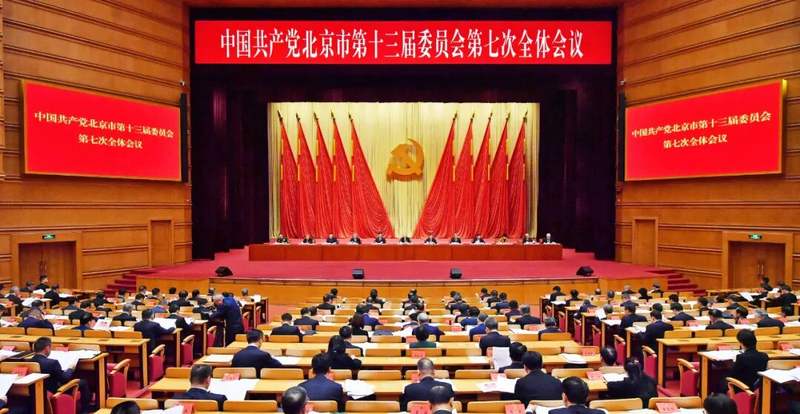
北京市委十三届七次全会召开,描绘“十五五”首都高质量发展新图景
Xin Jing Bao· 2025-11-17 12:33
Core Points - The meeting emphasized the importance of implementing the spirit of the 20th Central Committee's Fourth Plenary Session as a major political task for the current and future periods [3][4][15] - The "14th Five-Year Plan" period is described as extraordinary, with significant achievements in various sectors despite challenges such as the pandemic [4][6] - The meeting outlined the main goals for the "15th Five-Year Plan" period, focusing on enhancing the capital's functions, high-quality development, and improving the quality of life for residents [8][10] Group 1: Economic and Social Development - The meeting highlighted the need for Beijing to play a representative role in the overall modernization process, emphasizing strategic determination and confidence among party members [6][7] - Key objectives for the "15th Five-Year Plan" include improving the capital's service capabilities, economic strength, and international influence by 2035 [8][10] - The meeting stressed the importance of high-quality economic development, innovation, and deepening reform and opening up to enhance development momentum [11][12] Group 2: Governance and Urban Development - The meeting called for a focus on optimizing the capital's functions and enhancing the well-being of residents by addressing urgent social issues [8][10] - It emphasized the need for effective governance in a mega-city context, promoting a modern, livable, and resilient urban environment [14][15] - The meeting also discussed the importance of cultural development and historical preservation as part of the capital's identity [12][13] Group 3: Environmental and Safety Measures - The meeting underscored the commitment to environmental protection and the construction of a green, low-carbon city [14] - It highlighted the need for a comprehensive safety system to ensure social stability and resilience against risks [14][15] - The meeting called for a focus on improving public services and infrastructure to support urban and rural integration [13][14]
聚焦高精尖产业 北京持续丰富科技金融服务生态
Zhong Guo Xin Wen Wang· 2025-10-30 13:13
Group 1: Financial Services for High-Tech Industries - During the "14th Five-Year Plan" period, the banking and insurance sectors in Beijing have provided over 100 financing and insurance products for local industries [1] - As of September 2025, the loan balance for high-tech industries in Beijing is expected to exceed 1 trillion yuan, with an average annual growth rate of nearly 20% over the past three years, which is 10 percentage points higher than the average growth rate of all loans during the same period [1] - From January to September, the insurance sector in Beijing utilized technology insurance to provide risk coverage exceeding 5 trillion yuan for nearly 4 million enterprises, with premium income doubling year-on-year [1] Group 2: Investment in Financial Asset Companies - Beijing is accelerating the pilot implementation of equity investments by financial asset investment companies, with over 30 projects in reserve and an intended scale of nearly 30 billion yuan, leading the nation [2] - The insurance sector in Beijing has approved pilot projects for long-term investment reforms amounting to approximately 21 billion yuan, with nearly half of the projects already in progress, providing stable funding for high-tech industry development [2] Group 3: Intellectual Property Financial Ecosystem - Beijing is expediting the construction of a comprehensive financial ecosystem for intellectual property, aiming to become one of the first national pilot cities for this initiative [3] - The city has introduced the first overseas insurance for intellectual property, providing risk coverage exceeding 100 million yuan for export enterprises, and the balance of intellectual property pledge loans has increased nearly threefold over the past four years [3] - Beijing has established the first commercial aerospace mutual insurance organization in the country, which has shortened the inquiry and underwriting period for rocket and satellite launch projects by 20% [3] Group 4: Enhancing Financial Services for High-Tech Industries - Beijing is addressing the financing challenges faced by enterprises by establishing the Zhongguancun Science and Technology Financial Service Center, which aggregates quality financial institutions and other stakeholders [4] - The center has processed nearly 30 billion yuan in business over the past three years, with over 90% of the supported entities being specialized and innovative enterprises in key sectors such as software information, artificial intelligence, biomedicine, and energy conservation [4] - The Beijing Financial Regulatory Bureau plans to continue directing more financial resources towards key technology sectors to inject stronger financial momentum into the development of high-tech industries [4]
北京十大高精尖产业规模全部达到千亿级 有3个过万亿
Zhong Guo Jing Ying Bao· 2025-10-30 12:33
Core Insights - During the "14th Five-Year Plan" period, Beijing's high-precision and advanced industries have significantly enhanced their capabilities, becoming a crucial contributor to economic growth [1] Industry Overview - By 2024, the scale of Beijing's high-precision and advanced industries is expected to reach nearly 6 trillion yuan, representing a 61% increase compared to 2020 [1] - The added value of high-precision and advanced industries is projected to account for 33.1% of the regional GDP, an increase of 4.5 percentage points from 2020 [1] Industrial Performance - The total industrial output value of large-scale industries is anticipated to exceed 2.5 trillion yuan, with an average growth rate of 5.6% over the first four years of the "14th Five-Year Plan" [1] - The revenue of the information and software industry is expected to surpass 3.3 trillion yuan, constituting one-quarter of the national total, with an average growth rate of 17.1% during the same period [1] - In the first three quarters of this year, the combined added value of the industrial and information software sectors exceeded 1.3 trillion yuan, contributing nearly 60% to economic growth [1] Key Sectors - All ten high-precision and advanced industries are projected to reach a scale of over 100 billion yuan, with the new generation information technology, technology services, and pharmaceutical health sectors exceeding 1 trillion yuan each [1]
北京发布61项地方标准 涵盖高精尖产业等领域
Zhong Guo Xin Wen Wang· 2025-09-29 11:44
Core Points - Beijing has approved the release of 61 local standards to accelerate the construction of a high-quality development standard system, with 38 new standards and 23 revised standards [1][2] Group 1: Key Areas of Standards - The new standards cover various critical areas including human-assisted reproductive technology, services for disabled individuals, laundry services, intelligent perception systems for unmanned platforms, and food safety [1][2] - The "Quality Monitoring and Evaluation Norms for Human-Assisted Reproductive Technology" is the first of its kind in the country, aimed at enhancing the quality management of reproductive technologies [1][2] - The "Service Norms for Care Institutions for Disabled Individuals with Mental Disorders" outlines comprehensive requirements for service quality, facility layout, personnel configuration, safety management, and service processes [1][2] Group 2: Specific Standards and Their Implications - The "Laundry Service Evaluation Norms" set clear requirements for service quality, service items, service processes, and customer rights protection, ensuring a high standard of service in the laundry industry [2] - The "Safety Analysis Technical Norms for Intelligent Perception Systems of Unmanned Platforms" establishes a safety analysis indicator system focusing on detection accuracy and resilience against attacks, supporting the development of high-tech industries [2] - The "Quality Management Norms for Food Production Enterprises" includes specific requirements for low-temperature pasteurized milk and roasted coffee, aiming to enhance food safety and quality control in Beijing's food industry [3]
上半年京津冀GDP同比增长5.4%
Bei Jing Qing Nian Bao· 2025-08-28 01:46
Economic Performance - The GDP of the Beijing-Tianjin-Hebei region reached 5.7 trillion yuan in the first half of the year, with a year-on-year growth of 5.4% at constant prices [2] - The industrial added value for large-scale industries in the three regions grew by 7.0%, 5.1%, and 7.4% respectively, with high-tech manufacturing accounting for 32.9% and 16.4% of the industrial added value in Beijing and Tianjin [2] - The service sector's added value was 4.1 trillion yuan, showing a year-on-year increase of 5.5% [2] - The total retail sales of consumer goods in the region reached 1.60978 trillion yuan, growing by 0.7% year-on-year [2] - Fixed asset investment (excluding rural households) increased by 14.1%, 5.5%, and 6.5% in the three regions respectively [2] Collaborative Development - The region is accelerating collaborative innovation and industrial cooperation, with significant projects like the completion of the Zhangjiakou computing power center and the establishment of the Beijing-Tianjin-Hebei National Technology Innovation Center for smart connected vehicles [3] - In the first half of the year, Tianjin received 99.04 billion yuan in industrial project investments from Beijing and Hebei, accounting for nearly 50% of all industrial project investments [3] - The Beijing sub-center in Tongzhou district saw a GDP growth of 12.5% and fixed asset investment growth of 18.7%, both exceeding the city average [3] Public Services Integration - The transportation network has improved, with the first intercity bus line to Beijing now operational and seamless connections between Hebei and Beijing's transit systems [4] - Medical resources are being shared, with 8.398 million visits for direct settlement of medical expenses in Beijing by insured individuals from Tianjin and Hebei [4] - Educational collaboration has been established, with over 300 schools in Hebei cooperating with Beijing-Tianjin institutions, and 13,000 students enrolled in joint programs [4] Income Growth - The per capita disposable income in the three regions increased by 4.8%, 4.7%, and 5.3% respectively in the first half of the year [5]
上半年北京石景山GDP超696亿元 高水平建设首都城市西大门
Zhong Guo Xin Wen Wang· 2025-08-21 17:44
Economic Performance - In the first half of this year, Shijingshan District achieved a GDP of 69.66 billion, with a year-on-year growth of 7.6%, ranking first among central urban areas [1] - Since the 14th Five-Year Plan, the district's GDP has increased from 97.38 billion in 2020 to a projected 131.29 billion in 2024, with a cumulative fixed asset investment of nearly 180 billion, accounting for 5.2% of the city's total investment [1] Industrial Transformation - Shijingshan District is implementing two rounds of high-precision and high-tech industrial action plans, transitioning its industrial system from "1+3+1" to "2+4+4" [2] - The new industrial system focuses on information technology and modern finance as leading industries, with emerging sectors like artificial intelligence and virtual reality being prioritized [2] Talent Development - The district is actively promoting a talent strategy, focusing on the full chain development of youth talent with 12 tailored measures to support innovation and entrepreneurship [3] - Initiatives include expanding industrial space, creating application scenarios, and building platforms to enhance the entrepreneurial environment for young talents [3]
