AI科技革命

Search documents
历史新高→急跌→反转翻红!“有色”虚晃一枪:资金加速流入,20天14亿,盘中实时再加仓超1.1亿份
Mei Ri Jing Ji Xin Wen· 2026-01-29 03:09
Group 1 - The core viewpoint is that the non-ferrous metal sector is experiencing a significant upward trend, driven by a combination of the "AI leap" and the "century change" narrative, suggesting a super cycle for non-ferrous metals [1] - The popular ETF, Huabao Non-ferrous ETF (159876), saw a peak increase of 4% before a quick decline, followed by a V-shaped recovery, currently up by 0.3% [1] - There has been a substantial inflow of funds into the Huabao Non-ferrous ETF, with over 1.1 million shares net subscribed recently, and a total net inflow exceeding 1.4 billion yuan over the last 20 trading days, bringing the fund's total size to 2.68 billion yuan [1] Group 2 - Historical data indicates that each commodity cycle lasts approximately 25-30 years, with upward trends lasting 8-10 years and downward trends lasting 15-20 years, suggesting a long-term bullish outlook for the non-ferrous metal sector [2] - Institutions generally agree that the non-ferrous metal sector is likely to continue its bullish trend, with expectations of a bull market driven by monetary, demand, and supply factors by 2026 [2] - The Huabao Non-ferrous ETF (159876) and its linked fund (017140) cover a wide range of metals including copper, aluminum, gold, rare earths, and lithium, allowing for better exposure to various market cycles [2]
超级铜周期
2026-01-29 02:43
Summary of Conference Call on Copper Market Dynamics Industry Overview - The discussion centers around the copper market and its dynamics in relation to macroeconomic factors and technological advancements, particularly the impact of the AI revolution on copper demand [2][4][7]. Key Points and Arguments 1. **Copper Price and Macroeconomic Correlation** - Traditionally, copper prices have shown a positive correlation with macroeconomic conditions, but this relationship has diverged since 2023, indicating that new factors, such as the AI technology revolution, are significantly influencing copper demand [2][4]. 2. **Emerging Markets and Currency Correlation** - The positive correlation between emerging market currencies and copper prices has been disrupted since 2020, primarily due to developed countries employing fiscal and monetary policies (MMT) to extend economic growth, which has increased copper demand in these regions [2][5][6]. 3. **AI Era and Electricity Demand** - The AI era is driving a surge in electricity demand, with significant copper usage in electrical equipment construction, positioning copper as the "oil of the AI era" [2][7]. 4. **Investment in Electrical Infrastructure** - Developed and developing countries are simultaneously advancing electrification efforts. For instance, China plans to increase its grid investment by 40% during its "15th Five-Year Plan," totaling approximately 4 trillion RMB [2][8]. 5. **Basic Metals Demand from AI Supply Chain** - The entire AI supply chain requires substantial amounts of basic metals, including aluminum and copper, for data centers, chip manufacturing, and electrical infrastructure [2][9]. 6. **Global Economic Trends and Inequality** - The K-shaped recovery in the global economy is exacerbating wealth inequality, with a notable increase in the wealth concentration among the top 1% in the U.S., which could lead to rising geopolitical risks and populism [2][10]. 7. **Impact of Fiscal and Monetary Policies on Copper Prices** - Developed countries' fiscal and monetary policies have prevented economic downturns, thereby boosting demand for basic metals, including copper. For example, despite a significant price drop in 2023 due to U.S. interest rate hikes, copper prices rebounded following the introduction of multiple fiscal measures [2][11]. 8. **Global Monetary Order and Copper Prices** - The erosion of fiscal discipline is initiating a new global monetary order (Bretton Woods 3.0), challenging the dollar's status as an endogenous currency and accelerating de-dollarization, which is driving up prices of commodities like gold and copper [2][12]. 9. **Geopolitical Risks and Strategic Reserves** - Increasing geopolitical risks are prompting countries to bolster their strategic reserves, with significant growth in imports of copper and rare earths, indicating strong future demand in technology and metals sectors [2][13]. 10. **Resource Nationalism and Supply Constraints** - Resource nationalism is slowing the release of supply, intensifying the supply-demand imbalance in the copper market. Countries like Peru are implementing measures that could restrict copper exports, potentially leading to higher prices [2][14]. 11. **Future Expectations for Copper Market** - The confluence of the AI revolution and significant global changes is expected to usher in a new super cycle for copper. The current price levels, while high, are not yet at the peaks of previous cycles when adjusted for inflation, suggesting a potential increase of around 20% in copper prices within the year [2][15][16]. Additional Important Insights - The discussion highlights the critical role of copper in the context of technological advancements and economic policies, emphasizing its dual nature as both a commodity and a financial asset in the evolving global landscape [2][15].
A股三次大牛市:启动、上涨与终结
泽平宏观· 2026-01-28 16:05
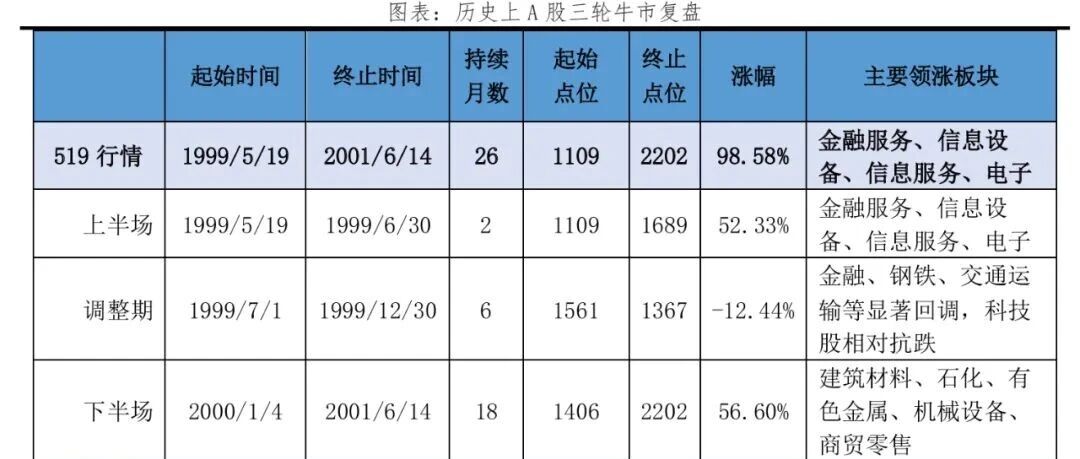
Core Viewpoint - The article analyzes the historical patterns of major bull markets in A-shares, focusing on the recent "confidence bull" market ignited by unprecedented macroeconomic easing policies and the AI technology wave since late September 2024 [2][11]. Group 1: Historical Bull Markets - The three major bull markets in A-shares are identified: the 1999-2001 "519 market," the 2005-2007 cyclical bull market, and the 2014-2015 reform bull and water bull [3][11]. - The "519 market" began during economic downturns with policy stimuli, leading to a 98.6% increase in the Shanghai Composite Index over 26 months, but ended due to valuation bubbles and profit failures [4][17][23]. - The 2005-2007 cyclical bull market was driven by fundamental improvements and lasted 28 months, with a 513.6% increase, ending due to the 2008 financial crisis and tightening policies [5][25][38]. - The 2014-2015 bull market was characterized by policy-driven growth and a lack of fundamental support, resulting in a 148.96% increase over 11 months, concluding with regulatory tightening and profit realizations [6][49][53]. Group 2: Key Discoveries from Bull Markets - Seven key findings from the analysis of past bull markets include the necessity of policy shifts, capital inflows, and low valuations for market initiation, as well as the typical three phases of policy-driven, capital-driven, and fundamental-driven growth [7][55]. - A-shares exhibit characteristics of short bull markets and long bear markets, with an average bull market duration of 17.35 months compared to 27.12 months for bear markets [8][55]. - The first half of bull markets is primarily driven by policy and sentiment, averaging 6.3 months with a 59.41% increase, while the second half relies on fundamental and profit growth, averaging 12.5 months with a 130.25% increase [8][56]. Group 3: Current "Confidence Bull" Market - The current "confidence bull" market shares similarities with previous bull markets, starting from economic downturns and low valuations, driven by macroeconomic easing and a new wave of technological advancements [9][63]. - The bull market is characterized by three strong drivers: continuous policy easing, a new technological revolution, and abundant liquidity, indicating a combination of policy, technology, and liquidity-driven growth [59][61]. - The article emphasizes the importance of maintaining supportive macroeconomic policies, promoting technological innovation, and ensuring the stability of the real estate market to sustain the current bull market [9][63].

大涨3%再创新高!“有色”牛气冲天:连续20个交易日吸金合计超12亿元
Mei Ri Jing Ji Xin Wen· 2026-01-28 02:32
Core Viewpoint - The non-ferrous metal sector is experiencing significant growth, with the Huabao Non-Ferrous ETF (159876) reaching a historical high and attracting substantial net inflows, indicating strong investor interest and confidence in the sector's future performance [1] Group 1: Market Performance - The Huabao Non-Ferrous ETF (159876) surged by 3%, setting a new historical high as of January 28 [1] - The ETF has seen real-time net subscriptions exceeding 1.25 billion units, with a total net inflow of over 1.2 billion yuan in the last 20 trading days, bringing its total fund size to 2.34 billion yuan [1] Group 2: Industry Outlook - China Galaxy Securities suggests capitalizing on the "AI leap + century change" resonance, indicating a super cycle in non-ferrous metals driven by macroeconomic narratives [1] - Historical patterns show that commodity cycles are lengthy, typically lasting 25 to 30 years, with upward trends lasting 8 to 10 years, suggesting a prolonged bullish phase for non-ferrous metals [1] - Institutions widely agree that the non-ferrous metal sector is likely to continue its upward trajectory, with expectations of a bull market driven by monetary, demand, and supply factors by 2026 [1] Group 3: ETF Coverage - The Huabao Non-Ferrous ETF (159876) and its linked fund (017140) comprehensively cover various sectors including copper, aluminum, gold, rare earths, and lithium, allowing for better exposure to the entire sector's beta performance [2]
短短30分钟,实时净申购超1.4亿份!回调间隙,资金加仓有色大提速
Mei Ri Jing Ji Xin Wen· 2026-01-27 02:21
Core Viewpoint - The colored metal sector is experiencing a significant upward trend, with the Huabao Colored ETF (159876) reaching a new historical high and attracting substantial capital inflows, indicating strong investor interest and confidence in the sector [1]. Group 1: Market Performance - The Huabao Colored ETF (159876) saw a net subscription of over 140 million units within the first 30 minutes of trading on January 27, contributing to a total net inflow of over 1 billion yuan in the last 20 trading days, bringing its total fund size to 2.16 billion yuan, a new record high [1]. - The overall sentiment in the colored metal sector is bullish, with institutions widely agreeing that the sector is likely to continue its upward trajectory [1]. Group 2: Industry Insights - China Galaxy Securities suggests capitalizing on the "AI leap + century change" resonance, indicating a super cycle in colored metals driven by the "AI technology revolution" and "global order reshaping," which are seen as significant macro narratives [1]. - Historical patterns indicate that commodity cycles are typically long, lasting 25-30 years, with upward trends lasting 8-10 years and downward trends lasting 15-20 years, suggesting that the current cycle may persist for an extended period [1]. - CICC forecasts that the colored metal industry may enter a bull market driven by monetary, demand, and supply factors by 2026, while CITIC Construction Investment believes the colored metal bull market is poised for further advancement [1]. Group 3: ETF Coverage - The Huabao Colored ETF (159876) and its linked fund (017140) comprehensively cover industries such as copper, aluminum, gold, rare earths, and lithium, encompassing precious metals (hedging), strategic metals (growth), and industrial metals (recovery) across different economic cycles, allowing for better capture of the sector's beta performance [2].
有色疯狂新高!跳空大涨4%
Mei Ri Jing Ji Xin Wen· 2026-01-26 01:57
Group 1 - The core viewpoint is that the non-ferrous metal sector is experiencing a historical high, with the Huabao Non-Ferrous ETF (159876) rising over 4% and reaching a new historical peak, reflecting a year-on-year increase of over 128% in the index it tracks [1] - The Huabao Non-Ferrous ETF has seen a net subscription of over 78 million units in just 10 minutes, with a total net inflow of nearly 900 million yuan in the last 20 trading days [1] - China Galaxy Securities suggests capitalizing on the "AI leap + century change" resonance under the super cycle of non-ferrous metals, indicating that this cycle is supported by strong macro narratives [1] Group 2 - Historical experience indicates that each commodity cycle lasts long, typically 25-30 years, with upward trends lasting 8-10 years and downward trends lasting 15-20 years, suggesting that the current non-ferrous metal cycle is likely to continue for an extended period [2] - Institutions generally agree that the non-ferrous metal sector is expected to maintain a bullish trend, with expectations of a bull market driven by monetary, demand, and supply factors by 2026 [2] - The Huabao Non-Ferrous ETF (159876) and its linked fund (017140) cover a wide range of metals, including copper, aluminum, gold, rare earths, and lithium, allowing for better capture of the sector's beta performance [2]
杨德龙:2026年A股和港股的投资机会依然较多
Xin Lang Cai Jing· 2026-01-23 07:51
Group 1 - The market shows resilience despite recent cooling, with a "spring offensive" anticipated as credit issuance peaks in January, potentially reaching 4 trillion RMB [1][8] - The first quarter is typically a "window" for companies to disclose earnings, allowing for market momentum as most companies do not report formal earnings during this period [1][8] - The discussion around investment returns during the previous year's Spring Festival has created a "wealth effect," attracting more retail investors into the market [1][8] Group 2 - A slow bull market has been established, with investor confidence gradually increasing, and skepticism about the bull market diminishing [2][8] - By 2026, approximately 50 trillion RMB in bank deposits will mature, prompting investors to choose between low-interest renewals or reallocating funds into stocks, bonds, or funds [2][8] - This shift indicates a potential acceleration of capital moving from savings to the stock market, providing additional liquidity [2][8] Group 3 - In 2025, technology stocks are expected to outperform traditional sectors, which are struggling during the economic transition [3][9] - New industries such as AI and semiconductor sectors are thriving, while traditional industries face significant challenges [3][9] Group 4 - The market is expected to deepen in 2026, with more sectors likely to experience rotation, as many traditional stocks are at historical lows and may present investment opportunities [4][10] - Investors will need to decide between high-flying tech stocks and undervalued traditional stocks, leading to diverse investment strategies [4][10] Group 5 - The U.S. financial market is experiencing a simultaneous decline in stocks, bonds, and the dollar, raising concerns about the stability of the dollar [5][11] - The rise in gold prices, nearing $4,800 per ounce, reflects a growing distrust in the dollar, with predictions of further increases in gold prices [5][11] Group 6 - A-shares are expected to outperform Hong Kong stocks, which in turn will outperform U.S. stocks, as domestic investors seek new opportunities in the capital market [6][12] - The potential for a "golden decade" in the A-share market is supported by the shift of residential savings into capital markets [6][12]
近一年涨超120%!有色疯狂新高,有色ETF华宝(159876)连续17个交易日大额吸金
Mei Ri Jing Ji Xin Wen· 2026-01-23 04:12
Group 1 - The core viewpoint is that the non-ferrous metal sector is experiencing a significant bull market, with the Huabao Non-Ferrous ETF (159876) reaching a historical high and a one-year increase of over 120% [1][2] - The Huabao Non-Ferrous ETF has seen a net inflow of approximately 490 million units recently, with a total net inflow of nearly 800 million yuan over the past 17 trading days [1] - Analysts suggest that the current non-ferrous metal super cycle is driven by the "AI leap" and "century change," indicating a strong macro narrative similar to historical phases like post-war reconstruction and China's opening up [1] Group 2 - Historical data indicates that commodity cycles are long, typically lasting 25-30 years, with upward trends lasting 8-10 years and downward trends lasting 15-20 years [2] - There is a consensus among institutions that the non-ferrous metal sector is likely to continue its bullish trend, with expectations of a bull market driven by monetary, demand, and supply factors by 2026 [2] - The Huabao Non-Ferrous ETF and its linked fund comprehensively cover various metals, including copper, aluminum, gold, rare earths, and lithium, allowing for better exposure to different economic cycles [2]
未来五年的投资可聚焦三条主线,“投资于人”可作为防御性资产的新主线
Di Yi Cai Jing· 2026-01-22 05:00
中国眼下深度转型的复杂挑战是实实在在的。一方面,转型的压力在淬炼中国的产业链,使中国制造更 加高效、更加高端、更加物美价廉;另一方面,产能过剩和内需不足的结构性矛盾似乎正在印证马克思 经济学的预言。 从马克思经济危机理论的角度,未来五年至关重要。如何解决长期需求不足的挑战,重塑去房地产化后 的国家资产负债表,在后小康社会打造以内需为主导的经济增长范式,实现以内循环为主导的双循环相 互促进的高质量发展模式,是成功突围的关键。而未来五年的个人投资,则需要顺应宏观大变局,提前 进行战略级调整,才能保证财富保值增值,最大化享有时代红利。 下一个五年,具有极其重大的时空意义 "十五五"处于宏大时空的交汇处,不论对于国家还是个人投资,都是重大的变盘时间,具有极其重大的 时空意义。你的资产组合里装的是什么,五年后可能会有巨大的差异。就像五年前开始的组合里,究竟 是"左手理财,右手地产",还是"左手黄金,右手科技",收益可谓天壤之别。 时空的交汇处,分为时间和空间。 时间的交汇处是"两个一百年":上一个一百年,党诞生以来的一百年已经实现了小康社会,意在"民 富";下一个一百年,新中国成立后的一百年实现现代化国家,意在"国强" ...
有色金属ETF天弘(159157)将于本周五提前结募,新能源转型及全球供应链重构助力有色行情!
Sou Hu Cai Jing· 2026-01-22 04:49
Core Insights - The Tianhong Nonferrous Metals ETF (159157) is set to begin fundraising on January 19, 2026, with the deadline moved up to January 23, 2026, reflecting strong market interest in the nonferrous metals sector [1] - The nonferrous metals sector has shown significant growth, with the CSI Industrial Nonferrous Metals Theme Index rising by 17.19% year-to-date as of January 21, 2026, indicating a bullish market sentiment [1] - The fund focuses on key industrial nonferrous metals such as copper, aluminum, and rare earths, capitalizing on the investment opportunities driven by the AI industry [1] Product Highlights - The Tianhong Nonferrous Metals ETF tracks the CSI Industrial Nonferrous Metals Theme Index, which includes 30 listed companies in the industrial nonferrous metals sector, showcasing high industry concentration [1] - The fund provides a one-stop efficient solution for investors looking to capitalize on the upward cycle of the industrial nonferrous metals sector and policy benefits [1] Market Trends - A significant increase in demand for copper and aluminum is anticipated, with the global AI data centers expected to drive an additional demand of 330,000 tons for copper, expanding the supply-demand gap from 340,000 tons to 670,000 tons [1] - The aluminum market is projected to face a supply gap of 990,000 tons due to increased demand from photovoltaic frames and liquid-cooled servers [1] - Supply-side challenges include production halts in Chile and the Democratic Republic of Congo, as well as discussions in Indonesia regarding bauxite export bans, which further constrict supply [1] Policy Developments - On January 20, 2026, Shanghai released a significant policy aimed at enhancing the global pricing influence of nonferrous metals, promoting market interconnectivity and resource allocation capabilities [2] - The policy supports Shanghai's development as a global center for nonferrous metal commodities, aligning with broader economic goals [2] Institutional Perspectives - China Galaxy Securities recommends leveraging the convergence of the "AI leap" and "century change" to capitalize on the super cycle of nonferrous metals, drawing parallels to historical macroeconomic narratives [2]