太空算力

Search documents
广发证券:太空光伏产业化前期设备厂商率先受益 建议关注HJT/钙钛矿设备供应商及其他环节
智通财经网· 2026-01-22 03:56
Group 1 - The core viewpoint is that space photovoltaics are expected to benefit from the global commercial space boom, with an estimated demand of nearly 10GW for space photovoltaics from existing low Earth orbit satellite plans [1][2] - The successful exploration of reusable rocket technology by companies like SpaceX has led to a rapid decrease in launch costs, creating a golden opportunity for the development of space photovoltaics [1] - The competition in commercial space between the US and China is intensifying, with China planning to submit applications for frequency and orbital resources for 203,000 satellites by December 2025 to secure valuable orbital resources [2] Group 2 - The concept of "computing power in space" has gained consensus, with major AI companies like Google and Amazon planning to deploy data centers in space, which could significantly reduce costs [3] - The deployment of a 40MW AI data center in space is estimated to cost $8.2 million over ten years, which is 95% lower than ground deployment [3] - Space photovoltaics are expected to be a primary energy source for these space-based data centers, with plans to launch 100GW of AI computing power satellites annually [3] Group 3 - Current mainstream space photovoltaic technology is based on gallium arsenide, which has excellent performance but is costly and limited by raw material availability [4] - Heterojunction technology is progressing rapidly and is expected to be applied first in computing satellites due to its simplicity and high yield [4] - Perovskite technology shows potential for future applications in space photovoltaics due to its high power-to-weight ratio, low cost, and flexibility, although large-scale application remains to be seen [4]

A股盘前播报 | 美欧关税警报解除!全球资产集体大涨 中概股指数涨超2%
智通财经网· 2026-01-22 00:55
Industry Insights - The People's Bank of China is accelerating the construction of a cross-border payment system for the renminbi, promoting interconnectivity in cross-border payments and aiming for a diversified and multi-layered development of the payment system [2] - The Ministry of Finance and four other departments announced the establishment of new duty-free shops at 41 ports to boost consumption, facilitating duty-free shopping for incoming travelers [3] - The demand for AI is driving significant revenue growth for several companies in the industry, with storage chip leader Demingli expected to achieve revenue of 10.3 billion to 11.3 billion yuan in 2025, representing a year-on-year increase of 115.82% to 136.77% [4] - The consumer electronics market is showing signs of recovery, with companies like Jin'an Guoji and Baiao Intelligent reporting impressive performance [4] Company Performance - Demingli, a leader in storage chips, anticipates a revenue increase of 115.82% to 136.77% in 2025, projecting revenues between 10.3 billion and 11.3 billion yuan [4] - Tianfu Communication, a core supplier of optical modules, expects a net profit growth of 40% to 60% in 2025 [4] - Jin'an Guoji forecasts a net profit of 280 million to 360 million yuan in 2025, reflecting a year-on-year increase of 655.53% to 871.40% [14] - Daikin Heavy Industries projects a net profit of 1.05 billion to 1.2 billion yuan in 2025, indicating a growth of 121.58% to 153.23% [14]




特斯拉的物理AI芯片路线图
Xin Lang Cai Jing· 2026-01-22 00:02
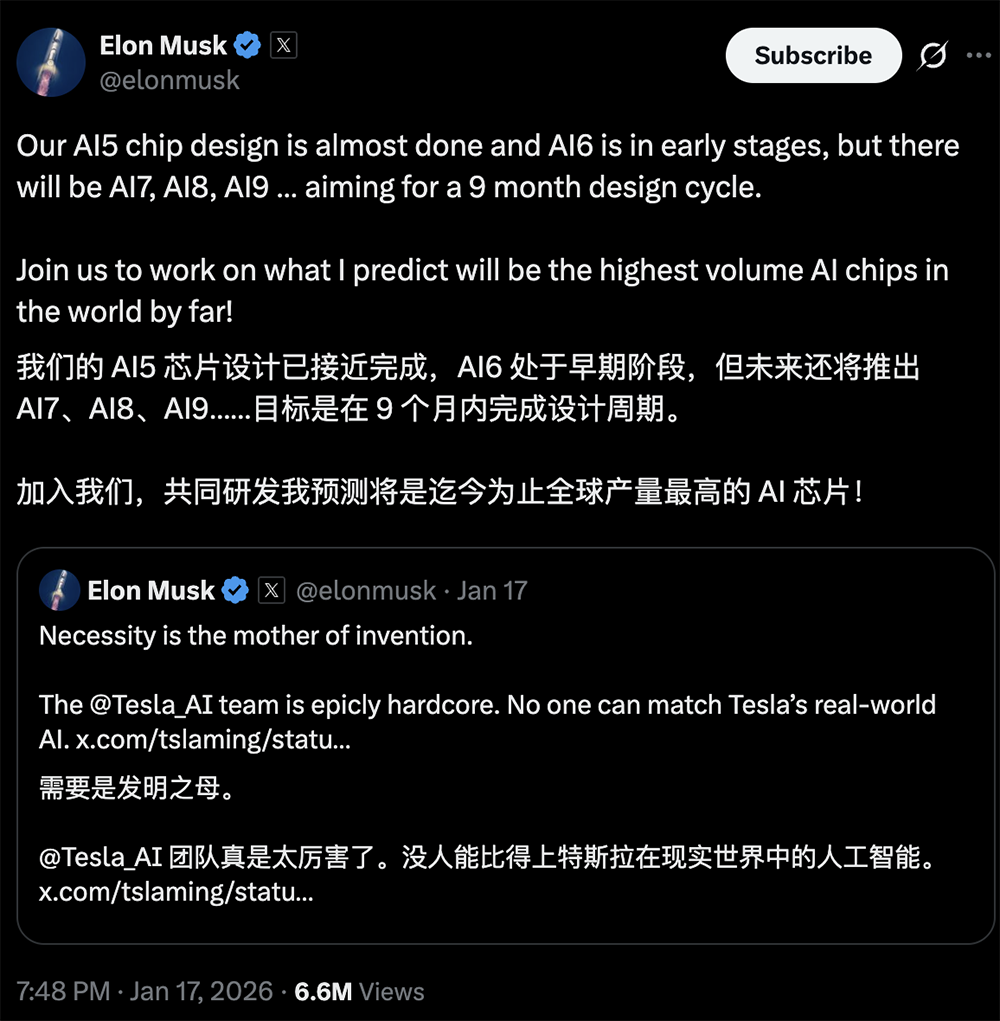
Core Insights - Tesla is shifting its focus towards AI chips, moving from hardware support to a core element that determines product capability limits [1][12] - Elon Musk revealed Tesla's latest AI chip roadmap, with AI5 design nearing completion and AI6 in early stages, aiming to compress chip design cycles to 9 months per generation [1][12] Group 1: AI Chip Development - The goals for Tesla's vehicle chips from HW3/AI3 and HW4/AI4 to the upcoming AI5 focus on providing higher computing power and larger memory for Full Self-Driving (FSD) and allowing redundancy for future complex end-to-end models [3][13] - The AI4 era features a 7nm process with approximately 216 TOPS supporting current FSD V12, which is insufficient for long-term goals of full autonomy and embodied intelligence [3][13] - AI5 is expected to utilize both Samsung's 2nm and TSMC's 3nm processes, with Musk claiming a "50 times performance improvement," combining a 10 times increase in raw computing power and a 9 times increase in memory capacity compared to AI4 [3][13] Group 2: Application and Integration - AI5 targets two core businesses: FSD and the Optimus humanoid robot, with a unified algorithm and hardware platform for both vehicles and robots, creating a unique advantage in embodied intelligence [4][14] - The architecture allows Tesla to view smart cars as "mobile robots" and robots as "walking cars," facilitating collaborative evolution at the foundational level [4][14] - Following AI5, AI6 will expand to support both edge inference and cloud training, with HW series chips deployed in vehicles and Dojo series chips for data center training, indicating a dual technical pathway [4][14] Group 3: Dojo Project and Space Computing - The initial goal of the Dojo project was to provide customized, efficient computing infrastructure for Tesla's autonomous driving training, with the first D1 chip based on a 7nm process [5][15] - AI6 and AI7 are envisioned as versatile AI computing chips that can support both edge inference and data center training, even adapting to space environments [5][15] - Space computing is a significant application for AI7, leveraging collaboration with SpaceX to deploy high-performance computing systems in orbit, taking advantage of potential benefits in latency, coverage, and infrastructure costs [6][16] Group 4: Engineering Solutions and Future Goals - Space computing presents challenges such as radiation, heat dissipation, and energy consumption, requiring higher reliability and power control for chips [7][17] - Musk mentioned AI8 and AI9, with an ambitious goal of shortening chip design cycles to 9 months per generation, aiming to align hardware upgrades with the rapid evolution of AI algorithms [7][17] - Tesla proposes an engineering solution to extend the usable life of older AI3 chips by processing 16-bit data with 8-bit low precision chips, balancing user scale and long-term product lifecycle [7][17] Summary - Tesla's AI chip roadmap indicates aggressive growth in computing power, with a 50 times performance increase from AI4 to AI5, significantly outpacing industry averages [11][21] - The application scope is expanding from vehicle inference to robots, data centers, and space computing, with a significantly compressed iteration cycle to match the rapid evolution of AI models [11][21]


浩瀚深度:自主研发的数字内容深度伪造检测系统已通过中国信通院首批深度合成鉴伪检测能力认证
Ge Long Hui· 2026-01-21 07:51
Group 1 - The company, Haohan Deep (688292.SH), has partnered with Yiwei Aerospace to leverage each other's strengths in space computing capabilities, with Yiwei providing core hardware and Haohan Deep offering data exchange systems and application validation support [1] - The collaboration aims to establish a long-term joint laboratory to create benchmark cases for space computing and build an open industry ecosystem [1] - Haohan Deep is a pioneer in the field of network visualization and AI forgery detection, with its self-developed deep forgery detection system certified by the China Academy of Information and Communications Technology, covering 22 types of generative model detection capabilities [1] Group 2 - The company's subsidiary, Guorui Zhizhi, achieved a "double excellent" rating in video and audio forgery detection during tests conducted by the China Academy of Information and Communications Technology, a rare honor in the industry [1] - The company has successfully won the bid for the AI forgery detection platform project for Jiangxi Telecom, marking a commercial breakthrough [1] - In the L3 autonomous driving sector, the company, through its subsidiary Zhilian Cloud Security, has developed an integrated security protection system and has participated in the formulation of multiple vehicle networking security standards [1] Group 3 - The company has implemented its vehicle-road-cloud intelligent system 1.0 solution in high-level autonomous driving demonstration areas in Beijing, providing services such as traffic situation analysis and signal light anomaly detection [1] - Over the past year, the company has delivered various systems for autonomous driving demonstration areas in multiple cities, ensuring safety for L3 and above autonomous vehicles [1] - The company is actively exploring emerging business opportunities, although these new businesses currently represent a small proportion of overall performance and have not significantly impacted the company's financial results [1]

浩瀚深度(688292.SH):自主研发的数字内容深度伪造检测系统已通过中国信通院首批深度合成鉴伪检测能力认证
Ge Long Hui· 2026-01-21 07:49
Core Viewpoint - The collaboration between Haohan Deep (688292.SH) and Yiwei Aerospace focuses on leveraging each other's strengths in space computing capabilities and data exchange systems, aiming to create a benchmark case in space computing and build an open industrial ecosystem [1] Group 1: Collaboration and Technology Development - The partnership involves Yiwei Aerospace providing core hardware such as onboard servers and computing units, while Haohan Deep contributes its expertise in data exchange and intelligent algorithms [1] - A joint laboratory will serve as a long-term platform for both companies to work together on space computing projects [1] Group 2: AI Forgery Detection Business - Haohan Deep is a pioneer in the field of network visualization and AI forgery detection, with its self-developed digital content deep forgery detection system certified by the China Academy of Information and Communications Technology (CAICT) [1] - The system covers detection capabilities for 22 types of generative models and has achieved "double excellent" ratings in video and audio forgery detection [1] - The company has successfully won a bid for the AI forgery platform project with Jiangxi Telecom, marking a commercial breakthrough [1] Group 3: L3 Autonomous Driving Cloud Business - Through its subsidiary, Zhiliang Cloud Security, the company is building an integrated security protection system for autonomous driving [1] - The company has led and participated in the formulation of multiple vehicle networking security standards under the China Communications Standards Association (CCSA) [1] - The vehicle-road-cloud intelligent system 1.0, based on a "small model + large model + RAG" architecture, has been trialed in high-level autonomous driving demonstration areas in Beijing, providing data intelligence services such as traffic situation analysis and signal light anomaly detection [1] Group 4: Business Outlook - The company is actively exploring emerging business opportunities while noting that these new ventures are still in their early stages and currently represent a small proportion of overall performance [1]
商业航天行业系列五:太空光伏:逐日天穹,叩问千亿星辰市场
GF SECURITIES· 2026-01-21 06:27
Investment Rating - The industry investment rating is "Buy" [2] Core Insights - The report highlights that the development of reusable rocket technology has significantly reduced launch costs, creating a golden opportunity for space photovoltaics [5] - The competition in commercial space between China and the US is accelerating, with low Earth orbit (LEO) communication satellites driving short-term demand for solar wings [5] - AI giants are increasingly recognizing the potential of deploying computing power in space, which is expected to benefit space photovoltaics [5] - The report emphasizes the importance of gallium arsenide as the current mainstream technology for space photovoltaics, while also highlighting the potential of silicon-based batteries and perovskite technology in the long term [5] - Investment recommendations include focusing on HJT/perovskite equipment suppliers and companies covering various segments of the photovoltaic supply chain [5] Summary by Sections 1. Space Photovoltaics: The Main Energy Source in Space - Space photovoltaics convert solar energy into electrical energy in space environments, which are harsher than ground conditions [12][13] - Solar panels are the core component of spacecraft power systems, essential for converting solar energy into the electricity needed for satellite operations [12][13] 2. Downstream Scenarios: Commercial Space Boom Leading to a Trillion-Dollar Market - The report notes a significant increase in global satellite launches since 2020, with a projected 4000 launches by 2025, driven by reduced costs from reusable rockets [38] - The US currently dominates the satellite market, with 11,688 satellites in orbit, while China and Russia lag behind [38] - The competition for orbital resources is intensifying, with both the US and China making substantial satellite deployment plans [44][45] 3. Technology Pathways: Gallium Arsenide as the Current Mainstream, with Potential for Silicon-Based Batteries and Perovskite Breakthroughs - Gallium arsenide solar cells are currently the most efficient option for space applications, with over 30% efficiency [65] - The report discusses the evolution of solar cell technologies, including silicon and multi-junction cells, and the potential for future advancements in perovskite technology [65] 4. Investment Recommendations: Focus on HJT/Perovskite Core Equipment Suppliers - Companies such as Maiwei, Aotwei, and Jiejia Weichuang are highlighted as key players in the HJT/perovskite equipment supply chain [5] - The report suggests monitoring companies that cover the entire photovoltaic supply chain, including polysilicon, batteries, and modules [5]





中泰证券:卫星太阳翼市场持续扩容 钙钛矿电池有望成为主流技术路线
智通财经网· 2026-01-21 02:04
Core Insights - The demand for satellite internet construction is urgent, driven by the rigid application needs in communication, navigation, and remote sensing, with a low completion rate of satellite constellations in China [1] - Space computing is leading to new growth opportunities in satellite demand, with significant advancements in satellite-based computing systems [2] - Solar wings are the only efficient and long-term energy supply solution for near-Earth commercial space, constituting about 12%-24% of satellite value [3] Group 1: Satellite Internet Demand - There is a strong subjective and objective demand for satellite internet construction, with advantages such as wide coverage, strong disaster resistance, and rapid deployment [1] - The International Telecommunication Union (ITU) has established principles for satellite frequency and orbit usage, emphasizing the urgency of satellite internet development in China due to limited low-Earth orbit resources [1] Group 2: Space Computing Advancements - The traditional "ground computing" model is evolving to a "space computing" model to address issues of data latency and processing cycles, with significant projects like Starcloud-1 and SpaceX's Starlink V3 planned for future deployment [2] Group 3: Solar Wing Technology - Solar wings are critical components of satellite energy systems, with increasing surface areas leading to enhanced power supply capabilities [3] - The transition from rigid to flexible solar wings allows for larger deployment areas and improved power output, making them suitable for high-power and multi-satellite launch scenarios [4] Group 4: Technological Differences Between China and the US - The US favors low-cost silicon solutions due to its rocket capabilities, while China is exploring perovskite batteries for higher power-to-weight ratios, aiming to maximize payload space in single launches [5] - Perovskite batteries are expected to become the next mainstream technology for solar wings in China, offering lower costs and higher efficiency [5]

商业航天深度报告:太空光伏大有可为,卫星太阳翼市场持续扩容
ZHONGTAI SECURITIES· 2026-01-21 00:25
Investment Rating - The report does not explicitly state an investment rating for the industry. Core Insights - The demand for satellite internet networking is urgent, and space computing opens new growth opportunities. The construction of satellite internet networks is driven by strong demand due to the advantages of wide coverage, strong disaster resistance, and rapid deployment. The International Telecommunication Union (ITU) has established principles for satellite frequency and orbit usage, leading to a competitive race for low Earth orbit resources. The construction and launch of satellite constellations in China are accelerating, with a significant gap compared to the US [4][16]. - Space computing is leading to increased demand for satellites. The traditional model of "ground computing" is evolving to "space computing," with satellites equipped with AI chips and edge computing modules to process data in orbit, significantly reducing transmission delays and processing times. Major companies are investing in space computing infrastructure, which is expected to drive the demand for satellites [17][19]. - Solar wings are the only efficient and long-term energy supply solution for near-Earth commercial space. Solar wings account for approximately 12%-24% of the satellite's value, and their area is continuously increasing, which enhances the overall power supply capacity of satellites. The transition from rigid to flexible solar wings is a key trend, with different technological routes being adopted in China and the US [4][28][38]. Summary by Sections Satellite Internet Networking - The urgent need for satellite internet networking is driven by the rapid release of rigid application demands in communication, navigation, and remote sensing. The construction of satellite internet networks is becoming increasingly critical due to limited low Earth orbit resources and the competitive landscape [11][16]. - The ITU's "first come, first served" principle has intensified the competition for satellite orbital resources, with China lagging in the completion rate of its satellite constellations compared to the US [16][18]. Space Computing - Space computing is transforming satellite demand by embedding AI capabilities into satellite systems, allowing for in-orbit data processing and reducing the need for ground-based data transmission. This shift is expected to significantly enhance the capabilities and applications of satellites [19][22]. Solar Wings - Solar wings are essential for providing continuous power to satellites, with their value accounting for a significant portion of the satellite's overall worth. The area of solar wings is increasing, which is expected to enhance the power supply capabilities of satellites [28][30]. - The transition from rigid to flexible solar wings allows for greater power generation efficiency and is particularly suited for high-power and multi-satellite launch scenarios. The flexible solar wings can achieve a higher power-to-weight ratio and better space utilization [38][45]. Technology Routes - There are notable differences in the solar wing battery technology routes between China and the US. The US primarily uses silicon solar cells due to their lower costs and established supply chains, while China is exploring gallium arsenide cells for their higher power-to-weight ratios and efficiency [51][62]. - Gallium arsenide cells are being actively explored for cost reduction, and perovskite cells are emerging as a potential next-generation solution for solar wings due to their low cost and high efficiency [65][69].


商业航天资本热潮下的冷思考: 万亿赛道破局亟待技术与商业化双线突围
Zhong Guo Zheng Quan Bao· 2026-01-20 21:52
Core Insights - The commercial aerospace sector is experiencing a capital frenzy, with the commercial aerospace theme index rising nearly 60% in two months, leading to accelerated financing and IPO processes for companies in the industry [1][2] - Despite the enthusiasm, there are signs of rationality emerging, as several mergers and acquisitions in the sector have failed, highlighting the challenges of technological breakthroughs and engineering validation [1][4] Market Trends - The primary market is also witnessing intense competition for commercial aerospace companies, with significant equity financing completed, such as Micro Nano Star's 1.56 billion yuan funding for R&D and capacity expansion [2] - The IPO process for commercial aerospace companies is accelerating, with notable applications like Blue Arrow Aerospace seeking to raise 7.5 billion yuan [2] Financial Performance - Companies in the sector are facing substantial losses despite revenue growth, with Blue Arrow Aerospace reporting revenues of 0.78 million yuan, 0.395 million yuan, and 0.428 million yuan for 2022, 2023, and 2024 respectively, while incurring net losses of 800 million yuan, 1.188 billion yuan, and 876 million yuan [2] Mergers and Acquisitions - Recent attempts at cross-industry mergers and acquisitions have faced obstacles, such as Hualing Cable terminating its agreement with Star Xin Aerospace due to a lack of consensus on core transaction terms [3] - East Pearl Ecology also announced the termination of its acquisition of satellite communication company Kai Rui Xing Tong due to market changes and unresolved commercial terms [3] Technological Challenges - The commercial aerospace industry in China is still in its early stages, with significant challenges in validating low-cost, reusable heavy-lift rocket technology and improving the mass production capabilities of commercial satellites [4] - Recent failures in rocket launches, including two incidents on January 17, underscore the high-risk nature of aerospace development and the difficulties in achieving frequent commercial launches [4] Future Outlook - The long-term development direction of the commercial aerospace industry is becoming clearer, with expectations for significant technological breakthroughs by 2026, particularly in reusable rocket technology [6] - The industry is predicted to transition from quantitative to qualitative changes in commercial rockets, marking China's entry into the era of rocket reusability [6] - The development of integrated space information infrastructure is anticipated to unlock broader application scenarios, following the principle of "infrastructure first, then application" [6]


广发证券:太空算力远期市场空间广阔 太阳翼或为最优通胀环节
智通财经网· 2026-01-20 08:43
Group 1 - The core viewpoint is that the industry has a vast long-term market space due to the active layout of space computing by China and the US, combined with the cost and performance advantages of space computing itself [3][4] - Space computing is transitioning from a "ground-based calculation" model to a "space-based calculation" model, allowing for direct data processing in space [1][3] Group 2 - Space computing has operational cost advantages, with a significant focus on marginal energy costs, which are the core factor in overall operational expenses [2] - For example, a single space-based 40MW computing cluster can operate for 10 years at a total cost of $8.2 million, saving approximately $159 million compared to traditional computing clusters, with over $130 million saved in marginal energy costs [2] Group 3 - The demand for solar wings is expected to increase due to the expansion of power and area requirements driven by space computing, leading to the adoption of flexible technology routes [4] - Flexible solar wings can achieve a weight reduction of 20%-40%, a storage volume reduction of over 60%, and improved performance, making them a key component in the power system [4] Group 4 - Investment recommendations include focusing on companies related to space photovoltaics, such as: - Maiwei Co., Ltd. (300751.SZ), which is expected to become a core equipment supplier for space computing photovoltaic segments [5] - Gaomei Co., Ltd. (688556.SH), which aligns with the cost reduction route for space photovoltaics [5] - Jiejia Weichuang (300724.SZ), which is positioned to benefit from the expansion of flexible solar wings in the space computing sector [5]