适度宽松的货币政策

Search documents
货币市场日报:1月12日
Xin Hua Cai Jing· 2026-01-12 16:58
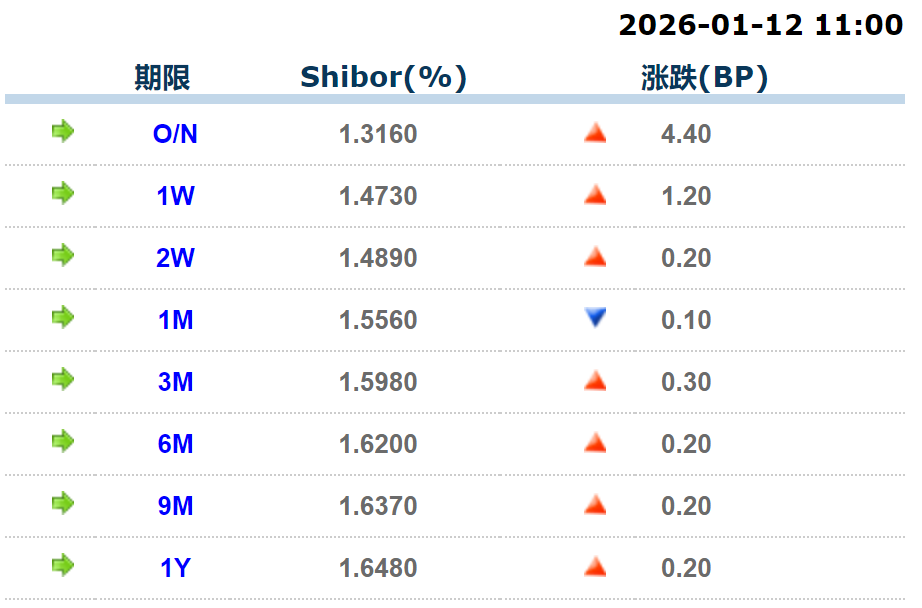
Group 1 - The People's Bank of China conducted a 7-day reverse repurchase operation of 861 billion yuan at an interest rate of 1.40%, maintaining the previous rate, resulting in a net injection of 361 billion yuan after 500 billion yuan of reverse repos matured on the same day [1] - The Shanghai Interbank Offered Rate (Shibor) for short-term instruments saw a slight increase, with the overnight Shibor rising by 4.40 basis points to 1.3160%, the 7-day Shibor increasing by 1.20 basis points to 1.4730%, and the 14-day Shibor up by 0.20 basis points to 1.4890% [1][2][3] Group 2 - In the interbank pledged repo market, various rates increased slightly, with DR001 and R001 weighted average rates rising by 5.4 basis points and 4.1 basis points, respectively, to 1.327% and 1.3895%, while transaction volumes for DR001 increased by 775 billion yuan and decreased by 208 billion yuan for R001 [7][8] - The weighted average rates for DR007 and R007 rose by 1.8 basis points and 0.9 basis points, respectively, to 1.4902% and 1.5249%, with transaction volumes increasing by 246 billion yuan and 1111 billion yuan [7][8] Group 3 - The overall funding situation on January 12 was balanced, with overnight rates for pledged loans trading around 1.45% and deposit certificates around 1.48-1.50%, indicating a slightly tight funding environment [11] - In the secondary market for negotiable certificates of deposit, trading sentiment was relatively subdued, with yields for various maturities showing narrow fluctuations, such as the 1-month yield closing at approximately 1.54% and the 3-month yield at 1.605%, reflecting minor changes from the previous week [12]

央行上海总部:高效落实适度宽松的货币政策
Zheng Quan Shi Bao Wang· 2026-01-12 11:01
人民财讯1月12日电,日前,中国人民银行上海总部召开2026年工作会议指出,2026年,要高效落实适 度宽松的货币政策。引导金融机构贷款合理增长、均衡投放,促进社会综合融资成本低位运行。用好用 足支农支小再贷款政策,灵活合理使用创新工具。 ...
政策周观察第63期:部委年度会议的6大要点
Huachuang Securities· 2026-01-12 07:14
证 券 研 究 报 告 【宏观快评】 部委年度会议的 6 大要点——政策周观察第 63 期 ❖ 近一周,其他值得关注的政策: 1、反内卷:1)1 月 8 日,财政部等关于调整光伏等产品出口退税政策的公告。 自 2026 年 4 月 1 日起,取消光伏等产品增值税出口退税。自 2026 年 4 月 1 日起至 2026 年 12 月 31 日,将电池产品的增值税出口退税率由 9%下调至 6%; 2027 年 1 月 1 日起,取消电池产品增值税出口退税。2)1 月 7 日,工信部等 部门联合召开动力和储能电池行业座谈会,部署规范产业竞争秩序工作。 2、1 月 8 日,工信部等印发《"人工智能+制造"专项行动实施意见》。提出到 2027 年,推动 3-5 个通用大模型在制造业深度应用,推出 1000 个高水平工业 智能体。 ❖ 风险提示:政策更新不及时。 ❖ 宏观研究 邮箱:zhangyu3@hcyjs.com 执业编号:S0360518090001 证券分析师:陆银波 邮箱:luyinbo@hcyjs.com 执业编号:S0360519100003 证券分析师:袁玲玲 邮箱:yuanlingling@hcyjs ...
螺纹开启累库,期价震荡走势
Tong Guan Jin Yuan Qi Huo· 2026-01-12 01:20
1. Report Industry Investment Rating - Not mentioned in the provided content 2. Core Viewpoints of the Report - The industry's prosperity has weakened, with a significant drop in the apparent demand for construction steel, indicating deepening off - season demand. The production has increased slightly, and the industry has entered the inventory accumulation stage. The hot - rolled coil data has changed little, with slow inventory reduction at a high level, and the demand is resilient but still under great pressure. The short - term bullish market sentiment has subsided, and the market is expected to return to a volatile pattern. Attention should be paid to the inventory accumulation rhythm [1][5] 3. Summary by Relevant Catalogs 3.1 Transaction Data | Contract | Closing Price | Change | Change Rate (%) | Total Trading Volume (lots) | Total Open Interest (lots) | Price Unit | | --- | --- | --- | --- | --- | --- | --- | | SHFE Rebar | 3144 | 22 | 0.70 | 6567825 | 2367759 | Yuan/ton | | SHFE Hot - rolled Coil | 3294 | 24 | 0.73 | 2987286 | 1440895 | Yuan/ton | | DCE Iron Ore | 814.5 | 25.0 | 3.17 | 1706517 | 636674 | Yuan/ton | | DCE Coking Coal | 1195.5 | 80.5 | 7.22 | 7162354 | 621167 | Yuan/ton | | DCE Coke | 1748.0 | 55.0 | 3.25 | 158354 | 39551 | Yuan/ton | [2] 3.2 Market Review - Last week, steel futures fluctuated and rose, with a sharp rise and fall during the week, affected by the fluctuations of coking coal and coke. In the spot market, the price of Tangshan billet was 2980 (+50) Yuan/ton, Shanghai rebar was quoted at 3290 (-10) Yuan/ton, and Shanghai hot - rolled coil was 3270 (0) Yuan/ton [4] - The People's Bank of China's 2026 work conference emphasized continuing to implement a moderately loose monetary policy, using multiple monetary policy tools such as reserve requirement ratio cuts and interest rate cuts to maintain ample liquidity. On December 26, 2025, Vietnam's Ministry of Industry and Trade issued an affirmative final ruling on the anti - dumping sunset review of cold - rolled carbon steel coils originating from China [4] 3.3 Industry News - On December 26, 2025, Vietnam's Ministry of Industry and Trade issued an affirmative final ruling on the anti - dumping sunset review of cold - rolled carbon steel coils with a width of less than 1600 mm and a thickness of 0.108 - 2.55 mm originating from China [6][7] - The 2026 People's Bank of China work conference emphasized continuing to implement a moderately loose monetary policy, increasing counter - cyclical and cross - cyclical adjustment efforts, and maintaining ample liquidity [10] - In December 2025, the total transaction (signing) area of newly built commercial housing in 10 key cities was 10.3266 million square meters, a month - on - month increase of 52.5% and a year - on - year decrease of 28.5%. The total transaction (signing) area of second - hand housing in 10 key cities was 9.7901 million square meters, a month - on - month increase of 7.1% and a year - on - year decrease of 27% [10] - The survey of key coal mines in Shaanxi and Inner Mongolia showed that no formal documents or official notices related to production capacity reduction have been received, and market news has not had a substantial impact on the coal mine production and sales. According to the Futures Daily, 26 coal mines in Yulin were removed from the coal supply guarantee list and their production capacity was reduced by 19 million tons, accounting for about 3% of the local planned production in 2025. The production capacity increase of the remaining 26 coal mines was temporarily retained and will be adjusted dynamically according to the performance of medium - and long - term coal contracts [10] - The State Council executive meeting deployed a package of policies to promote domestic demand through fiscal and financial coordination, including optimizing loan discount policies for service - industry business entities and personal consumption loans, implementing loan discount policies for small and medium - sized enterprises, establishing a special guarantee plan for private investment, establishing a risk - sharing mechanism for private enterprise bonds, and optimizing the fiscal discount policy for equipment renewal loans [10] 3.4 Relevant Charts - The report provides multiple charts, including the trend of rebar futures and monthly spreads, the trend of hot - rolled coil futures and monthly spreads, rebar basis trend, hot - rolled coil basis trend, rebar spot regional price difference trend, hot - rolled coil spot regional price difference trend, long - process steel mill smelting profit, short - process electric furnace profit in East China, national 247 blast furnace operating rate, 247 steel mills' daily average hot metal output, rebar production, hot - rolled coil production, rebar social inventory, rebar factory inventory, hot - rolled coil factory inventory, rebar total inventory, hot - rolled coil total inventory, rebar apparent consumption, and hot - rolled coil apparent consumption [8][11][20]
【策略周报】沪指站上4100点,如何把握春季行情?
华宝财富魔方· 2026-01-11 13:37
Key Points Summary Important Events Review - On January 3, 2026, U.S. President Trump announced a military operation in Venezuela, capturing President Nicolás Maduro and his wife, claiming they would face criminal charges in New York, and stated that the U.S. would "temporarily run" Venezuela [2] - The People's Bank of China held a work meeting on January 5-6, 2026, emphasizing the continuation of a moderately loose monetary policy to enhance financial services for high-quality economic development [2] - The Ministry of Finance announced plans for the issuance of government bonds in the first quarter of 2026, with a total planned scale of approximately 1.54 trillion yuan, reflecting a proactive fiscal policy stance [2] - The China Securities Regulatory Commission revised the regulations on sales fees for public securities investment funds, reducing costs for investors and shortening the redemption fee exemption period for institutional investors from six months to one month [2] Weekly Market Review - The bond market performed poorly due to significant capital diversion to the stock market, which saw indices surpass 4100 points, and the central bank's bond purchases were lower than expected, with December 2025 purchases at only 50 billion yuan [5] - The central bank's work meeting in 2026 reiterated the commitment to a moderately loose monetary policy, indicating that while rate cuts are still possible, the extent and certainty are relatively low, which may weaken early-year rate cut expectations [6] - The A-share market experienced a significant rise, with the manufacturing PMI for December 2025 rebounding to 50.1, indicating a return to expansion and increasing market expectations for economic recovery [7]

山东:推动金融业扩能提质 用足用好适度宽松的货币政策
Xin Lang Cai Jing· 2026-01-10 06:08
格隆汇1月10日|山东全省金融系统工作会议在济南召开,总结2025年金融工作,安排部署2026年重点 任务。会议要求,要有力有序有效防风险,稳妥推动中小金融机构改革,防范打击非法金融活动,统筹 化解各类交织风险。要巩固和强化金融监管,严把准入关口,严格监管执法,严肃追责问责。要全力以 赴促进高质量发展,推动金融业扩能提质,用足用好适度宽松的货币政策,实施上市资源培育"十百 千"计划,加强对扩大内需、科技创新、中小微企业等重点领域金融支持。 ...
螺矿产业链周度报告-20260109
Zhong Hang Qi Huo· 2026-01-09 11:51
Group 1: Report Summary - Market focus includes China's central bank continuing a moderately loose monetary policy, the US GDP growth accelerating in 2026, the EU carbon tariff implementation increasing steel export costs, and no substantial impact on coal mines from market rumors [6] - Key data shows an increase in US initial jobless claims, a decline in Chinese steel mills' crude steel output and inventory in late December, and a rise in Tangshan billet prices [7] - In the first week of 2026, the steel price reached the upper limit of the range with limited further upside, and the iron ore price is expected to be strong and volatile [8] Group 2: Bull - Bear Focus Bull - bear factors for rebar - Bullish factors are the improvement in December's manufacturing sentiment, the central bank's loose monetary policy, and enhanced cost support [11] - Bearish factors include seasonal decline in steel demand, inventory accumulation, increased steel production, and uncertain impact of export licenses [11] Bull - bear factors for iron ore - Bullish factors are the Fed's interest - rate cut, positive domestic policies, an expanded CPI increase in November, and low steel mill inventories with restocking expectations [12] - Bearish factors are the continuous accumulation of port inventories, seasonal decline in hot metal production, and increased shipments in the current week [12] Group 3: Data Analysis Macroeconomic data - China's December manufacturing PMI rose to 50.1%, and non - manufacturing business activity index returned to the expansion range [13] - China's CPI increase continued to expand in December, and PPI's year - on - year decline narrowed [17] - In the US, the manufacturing sentiment declined in December 2025, while the service industry was strong. Attention should be paid to the December non - farm payroll data [19] Rebar data - Rebar spot prices were stable, and the basis narrowed [21] - Steel mill profitability decreased slightly, with the profitability rate dropping to 37.66% [23] - The blast furnace and electric furnace operating rates increased, with the blast furnace rate rising to 79.31% and the electric furnace rate to 72.97% [25] - Steel output continued to rise, with five types of building materials reaching 818.59 (+3.41) million tons [29] - Steel apparent demand was in a seasonal decline, with five types of building materials at 796.82 (-44.2) million tons [30] - Rebar inventory accumulated, with the total inventory reaching 438.11 (+16.08) million tons [34] Iron ore data - Iron ore spot prices rose, and the basis fluctuated narrowly [35] - In November, China's iron ore imports decreased, and the initial 2026 shipments also declined [39] - Iron ore arrivals increased in the week from December 29, 2025, to January 4, 2026 [40] - Hot metal production remained resilient, with an average daily output of 229.5 million tons [42] - Port inventories continued to accumulate as the port clearance volume decreased [46] - Steel mills' iron ore consumption and inventory increased simultaneously, with the inventory reaching 8989.59 million tons [48] Group 4: Market Outlook - For steel, the upward space is limited, and it will continue to operate within the range. Attention should be paid to the inventory accumulation during the Spring Festival and the impact of export licenses [51] - For iron ore, the short - term drivers are mostly positive, and it is expected to be in a strong and volatile state [53]
钢矿剧烈波动后,走势回归基本面
Ge Lin Qi Huo· 2026-01-09 11:25
Report Summary 1. Report Industry Investment Rating No relevant information provided. 2. Core Viewpoints - Steel: The production of the five major steel products increased slightly week - on - week, consumption in the off - season continued to decline, and inventory increased seasonally. After the profit of rebar recovered, production continued to rise and inventory accumulated significantly. Hot - rolled coil production increased slightly, and the total inventory decreased. The spread between hot - rolled coil and rebar may be repaired in the short term. The macro - environment has a neutral impact. As the market enters the winter storage period, there will be an increase in demand. The futures market traded the winter storage logic in advance and rebounded, and the rebound space depends on the intensity of winter storage [4]. - Iron ore: The daily average pig iron output this week was 2.295 million tons, an increase of 20,700 tons from last week and 51,300 tons from last year, increasing for the third consecutive week. It is expected to continue to rise. The iron ore shipment volume in December reached a record high, which will lead to a high arrival volume later, and the supply is expected to increase. After the end of market restocking and the arrival of a large number of shipments, there is still a risk of price correction [4]. - Trading strategy: Short - term operation [4]. 3. Summary by Related Content Steel and Iron Ore Market Performance - This week, steel and iron ore reached new highs and then declined [8]. Steel Products - Supply: The supply of the five major steel products this period was 8.1859 million tons, an increase of 73,800 tons week - on - week. Rebar production and inventory both increased, while hot - rolled coil production increased and inventory decreased. Currently, rebar production is still lower than the same period in previous years, hot - rolled coil is roughly the same as in previous years, and medium - thick plate is still higher than in previous years [14]. - Inventory: The social inventory of rebar this week was 4.6663 million tons, an increase of 113,100 tons week - on - week, a decrease of 558,400 tons month - on - month, an increase of 69,700 tons year - on - year (Gregorian calendar), and an increase of 211,500 tons year - on - year (lunar calendar) [14]. Iron Ore - Pig iron output: The daily average pig iron output of 247 steel mills was 2.295 million tons, an increase of 20,700 tons from last week and 51,300 tons from last year. The blast furnace operating rate was 79.31%, an increase of 0.37 percentage points from last week and 2.13 percentage points from last year; the blast furnace iron - making capacity utilization rate was 86.04%, an increase of 0.78 percentage points from last week and 1.80 percentage points from last year; the steel mill profitability rate was 37.66%, a decrease of 0.44 percentage points from last week and 12.99 percentage points from last year [18]. - Shipment and arrival: From December 29, 2025, to January 4, 2026, the global iron ore shipment volume was 32.137 million tons, a decrease of 4.634 million tons week - on - week. The shipment volume from Australia and Brazil was 27.427 million tons, a decrease of 3.169 million tons week - on - week. The arrival volume at 47 ports in China was 28.247 million tons, an increase of 969,000 tons week - on - week [18]. - Port inventory: The total inventory of imported iron ore at 47 ports in China was 170.4444 million tons, an increase of 3.2265 million tons week - on - week; the daily average port clearance volume was 3.3696 million tons, a decrease of 32,500 tons [18]. Important News - On January 5, the State Council Information Office held a press conference, and the person - in - charge of the Comprehensive Planning Department of the Ministry of Transport said that it would vigorously implement the renewal and digital and intelligent transformation of water transport infrastructure [5]. - According to data released by Clarksons on January 7, in 2025, the global cumulative new ship order volume was 2,036 vessels with 56.43 million compensated gross tons (CGT), a 27% decrease compared to 76.78 million CGT in 2024. Chinese shipyards received 1,421 orders with 35.37 million CGT, a 35% decrease year - on - year, ranking first globally with a market share of 63%; South Korean shipyards received 247 orders with 11.6 million CGT, an 8% increase year - on - year, ranking second with a market share of 21% [5]. - In 2025, mergers and acquisitions in the steel industry were frequent, and many enterprises optimized their layouts through equity acquisitions and asset swaps, and regional integration accelerated [6]. - From December 29, 2025, to January 4, 2026, the total transaction (signing) area of newly - built commercial housing in 10 key cities was 2.3394 million square meters, a 20.3% decrease week - on - week and a 10.9% decrease year - on - year [6]. - The 2026 Work Conference of the People's Bank of China was held from January 5th to 6th. The meeting emphasized continuing to implement a moderately loose monetary policy, giving play to the integrated effect of incremental and stock policies, and increasing counter - cyclical and cross - cyclical adjustment. It will flexibly and efficiently use various monetary policy tools such as reserve requirement ratio cuts and interest rate cuts to maintain sufficient liquidity [6]. - The Ministry of Industry and Information Technology and other departments jointly held a symposium on the power and energy storage battery industry to deploy work on standardizing industrial competition order [7]. - The Ministry of Commerce and other 9 departments promoted green consumption of automobiles and supported consumers to purchase new energy vehicles [7].
北京地区,经营贷利率最低降至2.35%!
Zhong Guo Jing Ying Bao· 2026-01-09 09:20
Core Viewpoint - The personal business loan interest rates in Beijing and Shenzhen have decreased to a minimum of 2.35% as of January 1, 2026, indicating a trend of declining loan rates in the market [1][2][3]. Interest Rate Adjustments - In Beijing, a bank has lowered its personal business loan interest rate from a previous minimum of 2.40% to 2.35%, effective January 1, 2026, with the requirement that this rate applies to new customers [2]. - The interest rates for personal business loans in Beijing currently range from 2.35% to 2.55%, depending on big data assessments, with the last reduction occurring in the fourth quarter of 2025 [2]. - In Shenzhen, banks have also set the minimum personal business loan interest rate at 2.35%, requiring borrowers to have a company and property [3]. - In Fujian, the interest rates for personal business loans range from 3.00% to 4.00%, but can be as low as 2.60% with certain discounts [3]. Future Trends - The trend of declining personal business loan interest rates is expected to continue, influenced by the downward movement of the Loan Prime Rate (LPR) [4]. - Analysts predict that the central bank may implement a new round of interest rate cuts in the first quarter of 2026, which would further lower loan rates for businesses and residents [4]. - The People's Bank of China has committed to maintaining a moderately loose monetary policy in 2026, aiming to keep the overall financing costs low [4].
第三篇钟才平,来了
财联社· 2026-01-09 03:36
Core Viewpoint - The article emphasizes the importance of integrated macroeconomic policies to enhance governance effectiveness and support sustainable economic growth in China [1]. Group 1: Macroeconomic Policy Overview - Macroeconomic policies are crucial for maintaining stable economic operations and achieving high-quality development in China. The implementation of a more proactive fiscal policy and moderately loose monetary policy in 2025 is highlighted as a key driver for economic recovery [2]. - The central economic work conference outlines that in 2026, macroeconomic policies will focus on stability and quality improvement, continuing to implement proactive policies while enhancing counter-cyclical and cross-cyclical adjustments [2]. Group 2: Fiscal Policy - The proactive fiscal policy aims to increase efficiency through targeted support for key projects and significant investment in basic research. In 2025, the fiscal deficit rate will be raised, and larger government bonds will be issued to support local governments and manage hidden debts [3]. - The article stresses the need for effective fiscal management, optimizing expenditure structures, and ensuring that public funds are used efficiently to support growth and social welfare [4]. Group 3: Monetary Policy - A flexible and effective monetary policy is essential, with measures such as timely interest rate cuts and targeted support for key sectors introduced in 2025 to create a conducive financial environment for economic recovery [5]. - The central economic work conference emphasizes the importance of maintaining liquidity and managing social financing costs to support economic growth and price stability [5]. Group 4: Policy Coordination - The article highlights the necessity of enhancing the consistency and effectiveness of macroeconomic policies to avoid conflicts and ensure that various measures work synergistically [7]. - It calls for a systematic approach to policy evaluation, integrating economic and non-economic policies, and ensuring collaboration between fiscal and monetary policies to achieve cohesive economic management [8].