碳达峰碳中和

Search documents
“秸”尽其用 乡村能源转型升级勾勒冬季暖景
Ren Min Wang· 2025-11-21 06:45
Core Viewpoint - The article highlights the transformation of straw utilization in Northeast China from waste to a valuable resource, driven by technological innovation, national policy guidance, and a robust agricultural industry system [1][2][3]. Group 1: Straw Utilization and Economic Impact - The annual straw production in Heilongjiang Province is approximately 90 million tons, with a collection capacity of about 77 million tons, accounting for roughly 10% of the national total, and a comprehensive utilization rate of 95.07% [2][3]. - The transition from coal to straw for heating in Heilun City has resulted in significant cost savings, with the use of a straw boiler reducing heating costs from 5.346 million yuan to around 2.34 million yuan, a decrease of 56.2% [2][3]. - The energy transformation in rural areas is supported by policies aimed at promoting clean heating and reducing costs for heating equipment, which is essential for high-quality development in the rural energy sector [3][5]. Group 2: Environmental and Policy Support - The Chinese government emphasizes the importance of green development, aiming for carbon peak and neutrality, which aligns with the promotion of clean heating and the utilization of agricultural waste [2][4]. - The integration of biomass resources into the energy system is seen as a key strategy for improving rural living conditions and advancing agricultural green development [5]. - The establishment of a circular economy for agricultural waste, including straw, is crucial for achieving sustainable rural revitalization and environmental protection [4][5]. Group 3: Challenges and Future Directions - Despite the advantages of straw as a heating source, challenges remain regarding the uneven supply of straw, which needs to be addressed for the sustainable development of straw heating and power generation [4]. - The potential for producing biogas from agricultural waste is significant, estimated at 94.5 billion cubic meters per year, which could help meet energy demands [5]. - The development of a collaborative industrial model that integrates biomass fuel production with agricultural benefits is essential for creating a sustainable energy ecosystem [5].
刚果(布)经济学家:中国“十五五”规划将为刚中合作开辟广阔前景
Xin Hua She· 2025-11-20 13:08
Core Viewpoint - The article emphasizes that China's "14th Five-Year Plan" will open up new economic and technological cooperation opportunities for the Republic of Congo (Brazzaville) [1] Economic and Technological Cooperation - China's "14th Five-Year Plan" focuses on innovation, modern industrial systems, and green transformation, indicating a shift towards quality enhancement and technological independence in China's economic development model [1] - This shift is expected to promote long-term cooperation between China and the Republic of Congo, particularly in the energy, industrial, and infrastructure sectors [1] Opportunities in Specific Sectors - During the "14th Five-Year Plan" period, China will significantly develop artificial intelligence and renewable energy, creating new opportunities for the Republic of Congo to undertake technology transfer and develop local manufacturing [1] - China's commitment to carbon peak and carbon neutrality will facilitate cooperation in hydropower and solar energy, which is likely to enhance electrification in rural areas of the Republic of Congo [1] Financing and Global Integration - The emphasis on open cooperation in the "14th Five-Year Plan" suggests that South-South cooperation will provide new financing channels for the Republic of Congo, aiding its integration into the global economic network [1] Talent Development - Talent cultivation is highlighted as a key support for a new round of cooperation between China and the Republic of Congo, with collaboration in technical training, university partnerships, and the establishment of joint research centers contributing to the diversification of the Republic of Congo's economy [1]
以更高标准扎实推进美丽北京建设
Bei Jing Wan Bao· 2025-11-20 07:45
Group 1 - The central ecological environment protection inspection team has been deployed to Beijing to implement the spirit of the 20th National Congress of the Communist Party of China and related meetings [1][5] - The inspection aims to ensure the implementation of Xi Jinping's ecological civilization thought and to improve ecological environment quality, promoting the construction of a beautiful China [2][5] - The inspection will focus on the implementation of major decisions and policies from the central government, including pollution prevention and control, and the promotion of green transformation in economic and social development [6][7] Group 2 - The inspection will also emphasize the protection and utilization of the Grand Canal culture, assessing the implementation of relevant planning and addressing ecological issues related to cultural heritage [7][8] - The inspection period is set for one month, from November 19 to December 19, 2025, with a dedicated hotline and postal address for public reporting of ecological issues [9] - Local authorities are urged to enhance their political awareness and actively cooperate with the inspection team to ensure effective outcomes [8][9]
2026年《中国能源报》火热征订中!
中国能源报· 2025-11-20 07:06
Core Viewpoint - The article emphasizes the role of China Energy News as a leading media platform in the energy sector, promoting high-quality development and supporting the carbon peak and carbon neutrality goals set by the government [1]. Group 1: Overview of China Energy News - China Energy News was established on June 1, 2009, and is the first mainstream economic newspaper in China covering the entire energy industry chain [1]. - The publication serves as an authoritative platform for interpreting President Xi Jinping's important discourses on energy work and showcases the high-quality development of the energy industry [1]. - It has become a media benchmark for the energy sector, fostering innovation and integration within industry media [1]. Group 2: Audience and Partnerships - The readership of China Energy News spans the entire energy industry chain, making it a preferred industry publication for professionals in various sub-sectors [1]. - Many readers habitually save and collect issues of China Energy News, indicating its value and relevance in the industry [1]. - The publication has established strong partnerships with numerous government agencies, enterprises, and think tanks, enhancing its influence and reach [1]. Group 3: Collaboration and Brand Building - China Energy News aims to collaborate deeply with energy enterprises, leveraging its multi-dimensional media platform to support brand building and enhancement [1]. - The publication invites professional readers to join its efforts in promoting high-quality development in the energy sector and contributing to the achievement of carbon neutrality goals [1].

中国华电、国家能源集团、中国中煤,中央生态环境保护督察组实现进驻,举报方式公布!
中国能源报· 2025-11-19 11:43
Core Viewpoint - The article emphasizes the importance of ecological civilization and environmental protection in China's development strategy, highlighting the central government's commitment to these initiatives through various inspections and directives [2][5]. Group 1: Central Environmental Protection Inspections - All 10 central ecological environment protection inspection teams have successfully entered their designated areas for inspection, marking a significant step in the third round of inspections [1]. - The inspections are part of a broader strategy to ensure compliance with ecological and environmental standards, reflecting the central government's focus on sustainable development [5]. Group 2: Government Directives and Strategic Importance - The central government, under the leadership of Xi Jinping, has prioritized ecological civilization as a key component of national development, aiming for a historic transformation in environmental protection [2]. - The 20th National Congress of the Communist Party of China outlined goals for a green transition in economic and social development, emphasizing the need for a new energy system and pollution prevention [2]. Group 3: Regional Development Initiatives - Xi Jinping has consistently highlighted the importance of coordinated development in the Beijing-Tianjin-Hebei region, advocating for ecological protection and resource conservation [3]. - The government aims to achieve breakthroughs in green transformation while promoting high-quality development in the Xiong'an New Area [3]. Group 4: Cultural Heritage and Environmental Responsibility - The article discusses the significance of protecting the Grand Canal as a cultural heritage site, with Xi Jinping stressing the collective responsibility of regions along the canal to preserve and utilize this resource [4]. - The Grand Canal is recognized as a vital part of China's cultural heritage, and efforts are being made to enhance its protection and promote its cultural significance [4]. Group 5: Inspection Team Details - The article provides a detailed list of the inspection teams, including their leaders, the entities being inspected, and the duration of their inspections, which typically last one month for regular inspections and two weeks for special inspections [6][7]. - Each inspection team has established dedicated communication channels for receiving reports and feedback related to environmental protection from the inspected entities [6].




四川全口径外送电量超1.9万亿千瓦时
Zhong Guo Fa Zhan Wang· 2025-11-19 08:40
Core Viewpoint - Sichuan's total electricity export has exceeded 1.9 trillion kilowatt-hours, equivalent to the annual electricity consumption of Jiangsu, Zhejiang, and Anhui provinces combined, marking significant achievements in the "West-East Power Transmission" energy strategy and optimizing the allocation of clean energy nationwide [1][3]. Group 1: Electricity Export Achievements - Sichuan's electricity export capacity has reached 62.6 million kilowatts, ranking first in the country [1]. - Since the implementation of the "West-East Power Transmission" strategy, Sichuan has cumulatively exported clean electricity equivalent to replacing approximately 570 million tons of coal, contributing to a reduction of about 1.09 billion tons of carbon dioxide emissions [3]. Group 2: Clean Energy Base - Sichuan has established itself as a major clean energy base in the country, with a total installed power generation capacity of approximately 150 million kilowatts, of which hydropower accounts for about 100 million kilowatts, representing two-thirds of the total [5]. Group 3: Infrastructure Development - The continuous improvement of cross-regional and cross-provincial electricity export channels supports Sichuan's large-scale electricity exports, with significant investments in ultra-high voltage transmission lines [8]. - Key projects such as the Yacheng-Jiangxi and Baihetan-Jiangsu ±800 kV ultra-high voltage direct current transmission projects have been completed, enhancing the electricity supply and resource allocation capabilities [8]. Group 4: Market Mechanism - The Sichuan electricity trading system has entered a new phase, responding to the national unified electricity market system, coordinating renewable and conventional energy generation [8]. - The Sichuan electricity spot market has begun trial settlement operations, indicating a maturing market mechanism that supports stable clean energy exports [8].
孙金龙书记接受新华社权威访谈:努力推动美丽中国建设取得新的重大进展
Xin Hua She· 2025-11-19 06:16
Core Viewpoint - The construction of a beautiful China is a significant goal for the comprehensive modernization of the socialist nation and is essential for the realization of the Chinese Dream of national rejuvenation [1][2] Group 1: Strategic Importance - The "15th Five-Year Plan" emphasizes the acceleration of green transformation in economic and social development, highlighting the central government's commitment to ecological civilization [2] - This initiative is seen as a necessary path for achieving modernization in a way that harmonizes human and nature, moving away from the pollution-first model [2] Group 2: Achievements in Ecological Construction - Since the 18th National Congress, significant progress has been made in ecological civilization, with a 56% reduction in PM2.5 levels in key cities compared to ten years ago and an increase in the proportion of good-quality surface water from 64.1% to 90.4% [4] - The establishment of the world's largest clean energy supply and clean steel production systems, along with leading global sales in new energy vehicles for ten consecutive years, marks a shift towards green low-carbon industries [4] Group 3: Future Challenges and Opportunities - The "15th Five-Year Plan" period presents both challenges, such as the difficulty in improving ecological quality and the pressure to balance development and protection, and opportunities due to a stable economic foundation and rapid development of green productivity [6] - The commitment to peak carbon emissions by 2035 is expected to reverse the trend of resource consumption and pollution growth, aiding in the continuous improvement of ecological quality [6] Group 4: Key Focus Areas for Implementation - The ecological environment department will focus on strengthening leadership in beautiful China construction, enhancing pollution prevention efforts, and promoting ecological protection and restoration [7][8] - Specific measures include implementing a dual control system for carbon emissions, expanding the carbon trading market, and promoting green production and lifestyle practices [9]
努力推动美丽中国建设取得新的重大进展——访生态环境部党组书记孙金龙
Xin Hua She· 2025-11-19 05:33
Core Viewpoint - The construction of a beautiful China is a significant goal for the comprehensive modernization of the country and is essential for achieving the great rejuvenation of the Chinese nation [1] Group 1: Strategic Importance - The "15th Five-Year Plan" emphasizes the acceleration of green transformation in economic and social development, highlighting the central government's commitment to ecological civilization [2] - The construction of a beautiful China is seen as a necessary path for modernizing China in a way that harmonizes human and nature [2] Group 2: Achievements in Beautiful China Construction - Since the 18th National Congress, significant strategic deployments have led to historical changes in ecological civilization, with notable improvements in environmental quality [4] - PM2.5 average concentration in key cities has decreased by 56% compared to ten years ago, and the proportion of good-quality surface water has increased from 64.1% to 90.4% [4] Group 3: Green and Low-Carbon Transition - China has established the world's largest clean power supply and clean steel production systems, with renewable energy development leading globally [5] - The forest coverage rate has increased to over 25%, and a comprehensive ecological protection system has been established [5] Group 4: Global Environmental Governance - China has made commitments to peak carbon emissions and achieve carbon neutrality, contributing to global biodiversity frameworks and promoting green initiatives [6] Group 5: Challenges and Opportunities in the 15th Five-Year Plan - The 15th Five-Year Plan presents both challenges and opportunities for ecological protection, with increasing pressure to balance development and protection [7] - The robust economic foundation and rapid development of green productivity provide favorable conditions for high-level ecological protection [7] Group 6: Key Focus Areas for Beautiful China Construction - The ecological environment department will focus on strengthening leadership, pollution prevention, ecological protection, carbon peak realization, and promoting green lifestyles [8][9] - Specific measures include enhancing ecological protection systems, implementing carbon emission controls, and promoting green consumption [9]
中煤能源20251118
2025-11-19 01:47
Summary of China Coal Energy Conference Call Company Overview - **Company**: China Coal Energy - **Period**: First ten months of 2025 Key Points Industry Overview - **Coal Market**: In October, the thermal coal market experienced price increases due to tight supply, rising costs, and winter expectations. The spot price for thermal coal at ports is projected to range between 800-860 RMB/ton in November [2][6][10] - **Coking Coal Market**: Influenced by environmental regulations and winter storage, the coking coal market is expected to show a strong performance in November [2][6] - **Urea Market**: Prices fell in October due to delayed agricultural sowing and rising inventories, with expectations of weak fluctuations in November, pricing between 1,550-1,650 RMB/ton [2][7] - **Polyolefins Market**: Sales prices decreased due to falling international oil prices and oversupply, with expectations of weak performance in November [2][8] - **Methanol Market**: Prices increased in the first ten months due to rising downstream demand and low inventories, but are expected to weaken in November, with prices in the northwest ranging from 1,800-2,000 RMB/ton [2][8] Production and Sales Data - **Coal Production**: In the first ten months of 2025, China Coal Energy produced 113 million tons of commercial coal, a decrease of 630,000 tons year-on-year. Sales reached 212 million tons, down 18.37 million tons [4] - **Chemical Products**: - Olefins and polyolefins production was 1.122 million tons, down 146,000 tons year-on-year; sales were 1.107 million tons, down 158,000 tons [4] - Urea production increased by 274,000 tons to 1.775 million tons; sales increased by 359,000 tons to 2.015 million tons [4] - Methanol production rose by 201,300 tons to 1.6 million tons; sales increased by 26 tons to 1.618 million tons [4] Future Outlook - **Capital Expenditure**: Expected to remain high at approximately 20 billion RMB in 2026, primarily for ongoing projects and equipment upgrades [4][11] - **Coal Supply Stability**: The coal supply is expected to stabilize over the next two years, with a long-term outlook suggesting domestic coal supply may plateau at 5 billion tons [4][14] - **New Energy Initiatives**: The company is focusing on developing wind and solar energy based on its own resources and exploring the potential of abandoned mines for energy storage and carbon capture [4][15] Pricing and Contractual Arrangements - **Long-term Contracts**: 75% of the company's resources are secured through long-term contracts, with stable pricing around 680 RMB, limiting the impact on downstream users [4][10][12] - **Pricing Mechanism**: The pricing mechanism for electricity coal is expected to maintain a base price plus floating price model, with adjustments to the floating reference index to better respond to market changes [4][10] Additional Insights - **Market Dynamics**: The coal price increase is attributed to multiple factors, including supply constraints, demand changes, and seasonal variations in hydropower [4][12] - **Industry Trends**: The cyclical nature of the coal industry is expected to weaken, with a focus on actual conditions and external environmental changes [4][14] This summary encapsulates the key insights from the conference call, providing a comprehensive overview of China Coal Energy's performance, market conditions, and future strategies.
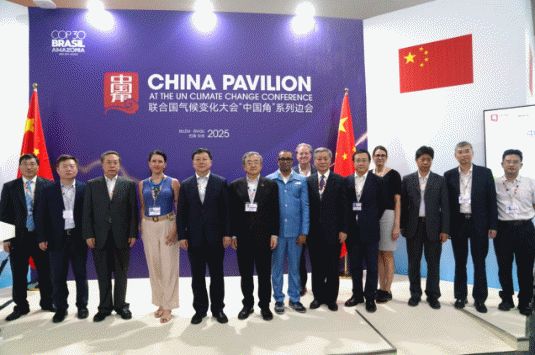
“中国碳达峰碳中和之路”主题边会在COP30中国角举办
Zhong Guo Jing Ji Wang· 2025-11-18 09:07
Core Points - The event "China's Path to Carbon Peaking and Carbon Neutrality" was successfully held in Brazil during COP30, showcasing China's commitment to global climate governance [1][5][13] - China aims to accelerate its energy transition and achieve carbon peaking and carbon neutrality, contributing significantly to global climate governance [5][11][20] Group 1: National Actions - China has established a comprehensive carbon reduction policy framework, with provincial governments implementing local carbon peaking plans [11][18] - Over the past five years, China has cultivated more than 6,400 green factories and over 490 green industrial parks, leading the world in new energy vehicle production and sales [11][25] - By the end of 2024, China's cumulative installed capacity of renewable energy is expected to reach approximately 1.41 billion kilowatts, surpassing coal power capacity [25] Group 2: International Cooperation - Brazil recognizes China's achievements in green transition and views its practices as valuable references for developing countries [7][31] - China is willing to share its green transition experiences with the international community to promote global climate action [9][13] Group 3: Circular Economy - The circular economy is identified as a crucial approach to achieving carbon neutrality, with an expected contribution rate of 30% to carbon reduction during China's 14th Five-Year Plan [9][22] - Recommendations include improving legal frameworks and establishing a classification system for recycled resources to enhance circular economy practices [22] Group 4: Corporate Responsibility - Companies are encouraged to adopt green technologies and practices, with examples of successful initiatives in renewable energy and circular economy [34][38] - The transition to a low-carbon economy presents both opportunities and challenges for businesses, particularly for small and medium-sized enterprises [41][46]