
金融供给侧结构性改革

Search documents
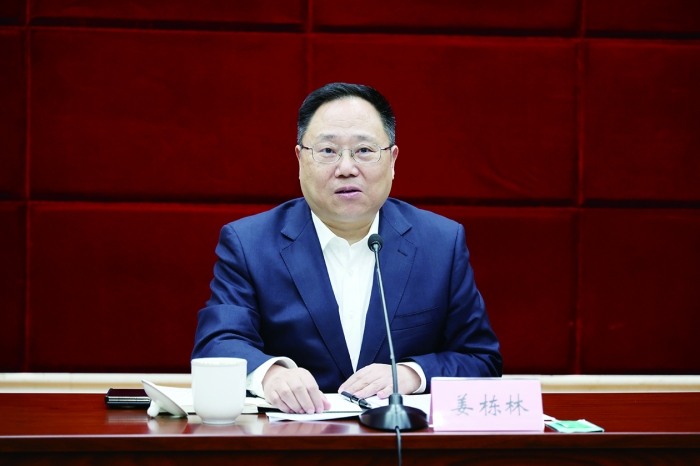
西南证券董事长姜栋林:主动融入改革大局 打造“投资+投行+研究”的大投行生态圈
Shang Hai Zheng Quan Bao· 2025-05-28 18:11
在债市"科技板"建设中大有可为 姜栋林 ◎记者 王彦琳 近期,中国人民银行、国家金融监督管理总局、中国证监会联合推出一揽子金融政策,从货币政策、金 融监管、资本市场建设等多维度发力,贯彻落实中央政治局会议"持续稳定和活跃资本市场"的决策部 署。 西南证券党委书记、董事长姜栋林在接受上海证券报记者专访时表示,近期出台的系列资本市场改革政 策,围绕"稳定市场,服务实体,深化改革"主线,形成多层次、立体化的政策"组合拳",对资本市场高 质量发展将产生深远、积极的影响。 券商作为资本市场"看门人"和"服务商",未来如何担当作为?姜栋林表示,西南证券将坚定不移贯彻党 中央决策部署,全力服务国家战略、护航投资者权益、赋能实体经济升级,为构建规范、透明、开放、 有活力、有韧性的资本市场贡献更大力量。 主动融入改革大局 姜栋林表示,此次资本市场新政的出台,是深化金融供给侧结构性改革、服务国家战略的关键举措。作 为资本市场的重要力量,证券行业必须主动融入改革大局。具体来说: 一是坚持服务国家战略,当好科技创新的"助推器"。券商应深度聚焦集成电路、人工智能、新能源等战 略性新兴产业,打造"投资+投行+研究"的大投行生态圈,建立科 ...


“芯”赛道里的金融突围:“硬核”输血半导体与新能源
经济观察报· 2025-05-25 06:26
Core Viewpoint - A financial transformation is occurring where banks are proactively identifying financial needs in the technology sector rather than passively waiting for companies to approach them, thus providing crucial support for the growth of technology-oriented private enterprises [1][4]. Group 1: Financial Transformation in Technology Sector - Banks are shifting from a passive role to actively exploring financial needs in the technology sector, particularly for private enterprises [4]. - This transformation is essential for addressing the financing difficulties faced by technology companies and the lending challenges faced by banks [4]. Group 2: Case Studies of Successful Financing - Victory Nano (胜科纳米) faced initial financing challenges but received a 3 million yuan loan from Agricultural Bank of China (农行) that helped it overcome cash flow issues [6][7]. - Over the years, Agricultural Bank increased its credit support to Victory Nano, culminating in a 1 billion yuan loan for the establishment of a reliability analysis service platform for the semiconductor industry [7][8]. - In 2024, Victory Nano's revenue reached 415 million yuan, a 147% increase from 2021, with net profit rising from 27.5 million yuan in 2021 to 81.18 million yuan in 2024, marking a 195% increase [8]. Group 3: Comprehensive Financial Services - InnoSilicon (英诺赛科) received significant credit support from Agricultural Bank for its expansion projects, including a 200 million yuan loan for its first phase and 650 million yuan for the second phase [10][11]. - Agricultural Bank is adapting its services to meet the evolving needs of technology companies, offering a range of financial products beyond traditional loans, including supply chain finance and international settlement services [11][12]. Group 4: Challenges in Identifying and Approving Loans - The complexity of technology sectors like semiconductors and renewable energy requires banks to enhance their understanding of industry trends and technical processes to accurately assess companies' potential [15]. - Agricultural Bank has established a specialized team to support technology companies, ensuring continuity in client relationships and effective service delivery [15][16]. Group 5: Growth in Technology Finance - Agricultural Bank's strategic emerging industry loan balance reached 3.2 trillion yuan, with a growth rate of 24.1%, while loans to technology companies increased by over 250 billion yuan [16].

悦读·思享丨吕诚伦:把握金融结构演变规律, 深化金融供给侧结构性改革
Sou Hu Cai Jing· 2025-05-23 06:49
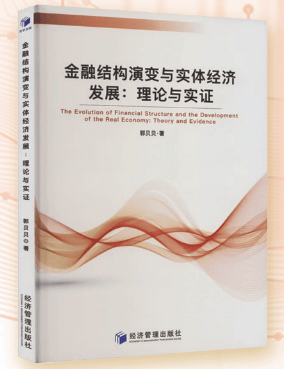
■吕诚伦 高质量发展是全面建设社会主义现代化国家的首要任务,金融要为经济社会发展提供高质量服务。党的 二十届三中全会对进一步全面深化改革作出系统部署,明确提出"深化金融体制改革",强调"完善金融 机构定位和治理,健全服务实体经济的激励约束机制。发展多元股权融资,加快多层次债券市场发展, 提高直接融资比重"。这与2023年中央金融工作会议所强调的"坚持深化金融供给侧结构性改革"要求一 脉相承。由此可见,推进金融供给侧结构性改革仍是未来深化金融体制改革的重点内容,需要着力打造 现代金融机构和市场体系,疏通资金进入实体经济的渠道,更好地服务构建新发展格局和实现经济高质 量发展。 为更好深入理解与把握金融结构演变规律和服务实体经济发展逻辑,中共天津市委党校(天津行政学 院)郭贝贝博士撰写的《金融结构演变与实体经济发展:理论与实证》一书,由经济管理出版社出版发 行。该书从理论与实践双重维度、金融与实体双重视角,尝试构建金融中介、金融市场、实体部门"三 部门"金融服务实体经济增长内生模型,系统阐释了金融结构演变的理论路径、传导机制与渠道作用, 以及实体基础与均衡形态,旨在探索走出一条符合中国国情的金融结构优化之路,对准确 ...
稳企业 全力以赴纾困解难(评论员观察)——以高质量发展的确定性应对外部环境急剧变化的不确定性②
Ren Min Ri Bao· 2025-05-19 21:58
Group 1 - The article emphasizes the importance of adapting to changing global trade conditions and highlights the proactive measures taken by companies in regions like Dongguan and Jinjiang to maintain competitiveness and innovation [1][4] - Companies are encouraged to diversify their markets, innovate products, and enhance brand recognition to navigate external challenges effectively [1][4] - The Chinese government is focusing on stabilizing enterprises as a key strategy for economic growth, with initiatives aimed at providing support and alleviating difficulties faced by businesses [2][5] Group 2 - The article discusses the need for precise policies to address the specific challenges faced by different foreign trade enterprises, such as standardization and sales channel development [3] - It highlights the importance of integrating domestic and foreign trade to allow companies to adapt to market changes smoothly, as outlined in government measures from 2023 [4] - Financial reforms are being implemented to improve the financing environment for small and private enterprises, with significant loan disbursements reported [5] Group 3 - The experience of a Sichuan company illustrates the resilience of foreign trade enterprises in the face of external pressures, emphasizing the need for innovation and strategic adjustments [6][7] - Companies are encouraged to enhance their research and development efforts, leading to significant improvements in production efficiency and cost reduction [7]
降低非利息成本 让民企融资“体感”更好
Zheng Quan Ri Bao· 2025-05-19 16:53
■苏向杲 民营企业在推动经济增长、促进技术创新、增加就业、改善民生等方面发挥了不可替代的作用。当前, 进一步加大对民营企业的金融支持力度对促进我国经济高质量发展意义重大。2月17日召开的民营企业 座谈会提出,继续下大气力解决民营企业融资难融资贵问题。 其二,金融机构需持续完善激励考核机制。 民营企业中小微企业占绝大多数,这类企业普遍存在抵押物不足、违约成本低等特征。银行对这类企业 贷款时要求担保介入的一大原因是信贷员头顶追责机制的达摩克利斯之剑。因此,完善激励考核机制对 降低非息融资成本也至关重要。当然,完善激励考核机制不是忽略商业可持续性,而是在不放松风控的 前提下,不断提升容错纠错机制。当银行从业者在放贷时既能获得正当激励,也能确保尽职免责,民营 企业的非利息融资成本有望持续压缩。 其三,强化监管,形成政策合力。 5月20日起正式实施的《中华人民共和国民营经济促进法》提到,金融机构在依法合规前提下,按照市 场化、可持续发展原则开发和提供适合民营经济特点的金融产品和服务,为资信良好的民营经济组织融 资提供便利条件,增强信贷供给、贷款周期与民营经济组织融资需求、资金使用周期的适配性,提升金 融服务可获得性和便 ...
如何为扩大消费营造良好金融环境
2 1 Shi Ji Jing Ji Bao Dao· 2025-05-13 17:08
Core Viewpoint - The recent "Q1 2025 China Monetary Policy Implementation Report" emphasizes the dual function of monetary policy tools to support consumption expansion and address structural issues in the economy [1][2] Group 1: Monetary Policy Measures - The People's Bank of China (PBOC) announced a comprehensive set of ten financial policies aimed at stabilizing the market and expectations, including a 500 billion yuan "service consumption and elderly re-loan" at a low interest rate of 1.5% to encourage banks to increase credit support for service consumption and elderly care [1][2] - The PBOC's current monetary policy focuses on three aspects: total liquidity policies through reserve requirement ratio (RRR) and interest rate cuts, targeted structural financial tools, and continuous improvement of market mechanisms to boost consumption [2][3] Group 2: Economic Indicators - In Q1, China's retail sales of consumer goods increased by 4.6% year-on-year, an improvement of 1.1 percentage points compared to the previous year, while per capita consumption expenditure rose by 5.3% year-on-year [2] - Despite the recovery in consumption, challenges remain, such as slowing growth in traditional goods consumption and structural gaps in service consumption, particularly in high-quality and personalized services [2] Group 3: Financial Innovation and Support - The PBOC is developing innovative financial tools to lower funding costs and support key consumption areas, including extending credit support for traditional goods and enhancing financial backing for service sectors like accommodation, entertainment, and elderly care [4] - The establishment of a multi-tiered consumption finance system is underway, which includes supporting auto finance and consumer finance companies to issue bonds and enhancing the transparency of financing costs for consumers [5] Group 4: Future Directions - The focus is on how financial innovation can transition consumption from "restorative growth" to "sustainable expansion," with an emphasis on managing external uncertainties and ensuring consistency in domestic macro policy coordination [6]
任期内亏损近13%!知名经济学家邓海清卸任基金经理
Sou Hu Cai Jing· 2025-05-13 05:41
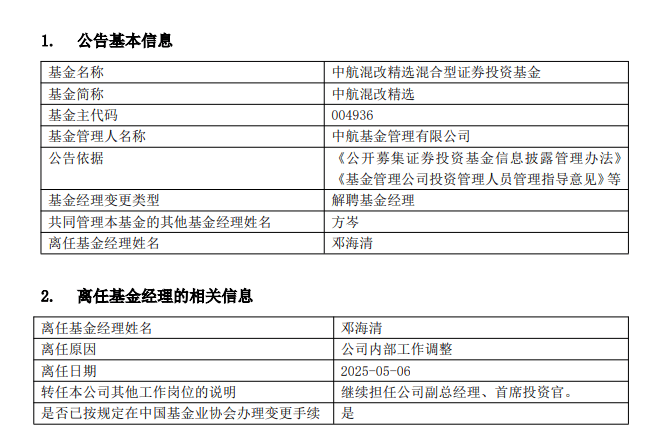
Core Viewpoint - Recent personnel changes at AVIC Fund have sparked discussions in the financial sector, particularly the resignation of economist Deng Haiqing as the manager of the AVIC Mixed Reform Selected Fund (004936), which will now be managed solely by Fang Cen [1][4]. Group 1: Personnel Changes - Deng Haiqing served as the fund manager for 1.5 years, having taken the position on December 4, 2023 [2]. - Deng will continue to hold the positions of Deputy General Manager and Chief Investment Officer at AVIC Fund, but he will no longer manage any funds [1][4]. - The change was attributed to internal adjustments within the company [4]. Group 2: Fund Performance - Under Deng's management, the AVIC Mixed Reform Selected Fund experienced a decline of 5.71% year-to-date as of May 6, with a nearly 21.94% drop over the past six months [4]. - The fund recorded a total loss of 12.90% during Deng's 1.5-year tenure [4]. - The fund's heavy investment in the real estate sector led to criticism, with investors referring to it as a "real estate industry fund," failing to reflect the intended "mixed reform" theme [5][8]. Group 3: Market Context and Reforms - Speculation arose regarding the timing of Deng's departure in relation to a new policy from the China Securities Regulatory Commission (CSRC) that ties fund manager compensation to long-term performance, announced just one day after his resignation [6][7]. - Deng commented on the CSRC's action plan, suggesting it aims to reform the public fund industry by addressing profit models and restructuring income sources, which he believes will have a profound impact on the financial ecosystem [7].
跨境金融更好服务企业“走出去”
Jing Ji Ri Bao· 2025-05-11 22:02
Core Viewpoint - The People's Bank of China and other departments have issued an action plan to enhance cross-border financial services in Shanghai, focusing on improving efficiency, optimizing services, and supporting enterprises in international competition and cooperation [1][2][3]. Group 1: Key Measures - The action plan proposes five key measures: improving cross-border settlement efficiency, optimizing foreign exchange management, strengthening financing services, enhancing insurance protection, and refining comprehensive financial services [1][2]. - Measures to improve cross-border settlement efficiency and optimize foreign exchange management will reduce time and costs for enterprises engaged in cross-border transactions, thereby enhancing their funding management efficiency and expanding financing channels [2][3]. Group 2: Impact on Enterprises - As more Chinese enterprises expand internationally, there is a growing demand for integrated financial solutions that encompass investment, financing, risk management, and consulting tailored to specific market and industry characteristics [1][3]. - Enhanced foreign exchange risk management and insurance services will help enterprises better cope with risks associated with cross-border operations, boosting their confidence and capability in international economic cooperation [2][3]. Group 3: Financial Institutions' Opportunities - The facilitation of cross-border financial services presents significant development opportunities for Chinese financial institutions, enabling them to provide more efficient services to enterprises going global and to innovate financial products [3]. - The action plan aims to attract more international financial institutions to participate in the construction of Shanghai as an international financial center, thereby enhancing the openness of Shanghai's financial services and promoting financial cooperation with other countries and regions [2][3]. Group 4: Implementation and Future Outlook - The implementation of the action plan is seen as a crucial step in deepening high-level financial openness and promoting structural reforms in the financial supply side, which is essential for expanding international trade cooperation and supporting high-quality economic development [3]. - Financial regulatory authorities and local governments are urged to ensure that the measures translate into tangible benefits for enterprises, thereby injecting more financial resources into their global development [3].
天风证券定增获上交所审核通过 深化国企改革再迈关键一步
Xin Lang Zheng Quan· 2025-05-10 06:56
Core Viewpoint - Tianfeng Securities has received approval from the Shanghai Stock Exchange for its non-public stock issuance, marking a significant breakthrough in its efforts to deepen state-owned enterprise reform and optimize its capital structure [1][2]. Group 1: Company Developments - The approval of the non-public stock issuance is seen as a reinforcement of Tianfeng Securities' strategic foundation as a state-controlled entity, indicating a new phase in the reform process of state-owned enterprises [1]. - The company is focusing on enhancing its capital strength and risk resistance through this capital injection, which will also support its strategic layout in the financial services sector [1][2]. - Tianfeng Securities is committed to deepening its reform efforts, improving corporate governance, and enhancing operational efficiency through various measures, including establishing a research procedure led by the party committee and strengthening internal supervision [2]. Group 2: Strategic Focus - The company aims to align its operations with the strategic goals of the Hubei provincial government, which emphasizes the transformation towards a market-oriented and securities-based model by 2025 [1]. - Tianfeng Securities is pursuing three main strategies: focusing on its core responsibilities, enhancing services for the real economy and wealth growth for residents, and expanding its influence from Hubei to the entire nation [2]. - The company plans to leverage the approval of the stock issuance to further its role as a new type of securities firm with strong management, excellent performance, and extensive service capabilities [2].

丰富货币工具 加强信贷保障 活跃资本市场 金融政策“组合拳”支持稳市场稳预期
Jing Ji Ri Bao· 2025-05-07 22:11
Core Viewpoint - The Chinese government is implementing a series of structural monetary policy tools to support economic recovery and stabilize market expectations, with a focus on enhancing financial support for key sectors and improving the overall financial environment [1][2]. Monetary Policy Tools - The People's Bank of China (PBOC) has introduced various structural monetary policy tools, with a total of nine tools currently in use, focusing on key areas of the national economy, major strategies, and weak links, with a total balance of approximately 5.9 trillion yuan, accounting for 13% of the PBOC's balance sheet [1][2]. - A reduction in the interest rates of several structural monetary policy tools by 0.25 percentage points, lowering rates from 1.75% to 1.5% for specific loans, and from 2.25% to 2% for policy financial institutions' pledged supplementary loans (PSL) [2][3]. - Establishment of a 500 billion yuan service consumption and elderly care re-loan to enhance financial support for key service sectors and the elderly care industry [2]. Support for Key Sectors - The quota for technology innovation and technological transformation re-loans has been increased from 500 billion yuan to 800 billion yuan to support the expansion of the "two new" policies [3]. - An additional 300 billion yuan has been allocated to the agricultural and small business re-loans, bringing the total quota for these loans to 3 trillion yuan [3]. Real Estate and Stock Market Stability - The government is actively working to stabilize the real estate and stock markets, which are crucial for boosting social expectations and facilitating domestic demand [3][4]. - As of now, the approved "white list" loans from commercial banks have increased to 6.7 trillion yuan, supporting the construction and delivery of over 16 million residential units [3]. - In the first quarter of this year, the balance of real estate loans increased by over 750 billion yuan, with new personal housing loans reaching the largest quarterly increase since 2022, and housing rental loans growing by 28% year-on-year [3]. Capital Market Performance - The capital market is showing signs of stability, with the Shanghai Composite Index maintaining around 3,300 points and the bond market self-correcting due to improved economic confidence [4]. - The onshore and offshore RMB has appreciated by approximately 1% against the US dollar since the end of last year, indicating balanced cross-border capital flows [4]. Technological Innovation Financing - The establishment of a technology innovation bond risk-sharing tool is aimed at supporting the issuance of low-cost, long-term bonds for technology innovation enterprises and equity investment institutions [5].