
市场流动性

Search documents
央行,连续两个大动作来了
Sou Hu Cai Jing· 2025-08-08 01:40
其一,最新的数据显示,7月末中国黄金储备为7396万盎司,这个比6月末的7390万盎司增加了6万盎司,这就说央行7月份增持黄金了; 央行最近的动作真大,昨天出现了两件事值得重视: 其二,为了保持银行系统的流动性,今天央行将开展7000亿元买断式逆回购操作,期限为3个月,看到这个大家都会想,央妈真是亲 妈,看到股市即将突破3674点了,今天直接给市场注入流动性,我想这是大家可能误会了,应该说央行的操作跟股市没有关系。 这件事怎么讲呢?因为这个月有4000亿元3个月期和5000亿元6个月期的买断式逆回购到期,而此时投放7000亿元买断式逆回购是为了对 冲目前到期的逆回购给市场流动性带来紧张的局面,目前看即便央行今天操作7000亿元买断式逆回购,实际的结果是目前依然会形成 2000亿元的净回笼,就是说以目前的状态,8月份市场的流动性是处于收缩的状态。 当然,央行目前的政策是要保持市场的流动性充裕,后期估计还会有相关的操作的出现,总之央行的加量续作会持续。 这也就能够解释为什么这两天A股这么强,尽管央行的操作是为了应对到期的逆回购,而7000亿元逆回购则让市场误会为这是央行释放 流动性的信号,反正咋说呢,市场好的时候 ...


央行开展7000亿元买断式逆回购操作 保持银行体系流动性充裕
Zheng Quan Ri Bao· 2025-08-07 16:27
Group 1 - The People's Bank of China (PBOC) announced a 700 billion yuan reverse repo operation to maintain liquidity in the banking system, with a maturity of 3 months (91 days) [1] - After the reverse repo operation, there will be a net withdrawal of 200 billion yuan, considering the maturity of 400 billion yuan in 3-month reverse repos and 500 billion yuan in 6-month reverse repos [1] - Analysts expect that the scale of reverse repo operations in August will not decrease, with expectations of additional 6-month reverse repo operations and a total of over 900 billion yuan in maturity [1][2] Group 2 - The Central Political Bureau meeting emphasized accelerating government bond issuance, indicating a peak period for government bond issuance in August [2] - There is a significant amount of certificates of deposit maturing in August, and regulators are urging financial institutions to increase monetary credit [2] - The PBOC is expected to inject medium-term liquidity through MLF and reverse repo operations to maintain liquidity during the government bond issuance peak [2] Group 3 - The PBOC is likely to continue its net injection operations through reverse repos, maintaining liquidity while observing external fluctuations and economic growth dynamics [3] - The probability of a reserve requirement ratio cut or resuming government bond trading is low in the short term, with a focus on using MLF and reverse repos to ensure liquidity [3]
央行预告:明日 7000亿元
Shang Hai Zheng Quan Bao· 2025-08-07 14:17
为平滑财政缴税高峰、提前对冲季末流动性压力,央行将于8月8日开展7000亿元3个月期买断式逆回购 操作。 业内人士判断,央行将继续通过逆回购、买断式逆回购、中期借贷便利(MLF)等多种货币政策工 具,加强对中短期流动性的调节,保持流动性充裕,进一步实施好适度宽松的货币政策。不排除下半年 通过适时降准向市场投放长期流动性的可能。 月内或有第二次买断式逆回购操作 央行8月7日公告,为保持银行体系流动性充裕,8月8日,将以固定数量、利率招标、多重价位中标方式 开展7000亿元买断式逆回购操作,期限为3个月(91天)。 此次操作不仅将覆盖季度末关键时点,也引发了市场对后续流动性操作节奏的关注。 一个月内开展两次买断式逆回购操作已有先例。比如,今年6月,央行分别在月初和月中两次开展买断 式逆回购操作并提前公开操作信息,加强对市场预期和信心的引导提振。 "2024年10月,央行宣布在公开市场操作中启用买断式逆回购工具。买断式逆回购的推出,使央行可以 更加及时、精准地调节市场流动性,从而更好地维护金融市场稳定,促进经济回升向好。"董希淼说。 中国邮政储蓄银行研究员娄飞鹏认为,8月为财政缴税高峰,市场流动性或阶段性趋紧。此次 ...
7000亿买断式逆回购来了
第一财经· 2025-08-07 12:58
Core Viewpoint - The People's Bank of China (PBOC) is expected to maintain liquidity in the banking system through various monetary policy tools, including reverse repos and medium-term lending facilities (MLF), amid a high issuance of government bonds and significant maturity of financial instruments in August [2][3]. Group 1: Monetary Policy Actions - On August 8, the PBOC will conduct a reverse repo operation of 700 billion yuan with a term of 3 months to ensure ample liquidity in the banking system [2]. - There are 4 trillion yuan of 3-month and 5 trillion yuan of 6-month reverse repos maturing in August, indicating that despite a net withdrawal of 200 billion yuan, the PBOC may not reduce the scale of reverse repos [2]. - Analysts predict that the PBOC will likely continue its net injection strategy through reverse repos and MLF to address liquidity needs, especially given the pressure from government bond issuances and maturing financial products [3]. Group 2: Economic Context and Expectations - The Central Political Bureau's meeting on July 30 emphasized accelerating government bond issuance, which is expected to peak in August, contributing to liquidity pressures [3]. - The short-term market liquidity is expected to remain stable, while mid-term liquidity may face tightening pressures, prompting the PBOC to inject liquidity through MLF and reverse repos [3]. - The manufacturing PMI index has shown signs of contraction, indicating increased economic downward pressure, which may lead to potential rate cuts in the fourth quarter [3].
央行:8月8日将开展7000亿元买断式逆回购操作|快讯
Sou Hu Cai Jing· 2025-08-07 10:55
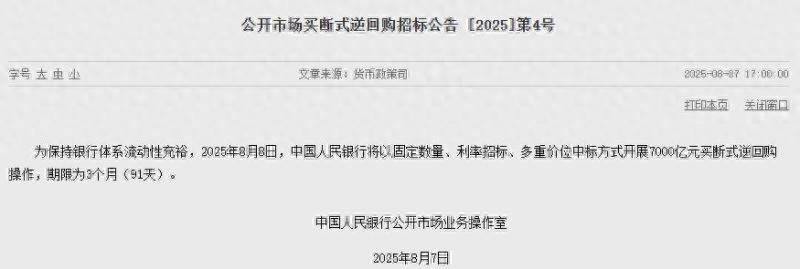
文/刘佳 据央行官网消息,8月7日央行发布公告,为保持银行体系流动性充裕,2025年8月8日,中国人民银行将以固定数 量、利率招标、多重价位中标方式开展7000亿元买断式逆回购操作,期限为3个月(91天)。 "在上半年宏观经济偏中偏强,三季度外部波动及经济增长动能变化有待进一步观察的背景下,短期内降准和恢复 国债买卖的概率不大,央行更可能通过MLF和买断式逆回购等政策工具保持市场流动性充裕。不过,7月制造业 PMI指数在收缩区间再度下行,结束了此前两个月的回升过程。这意味着近期经济下行压力有所加大。"王青对 《华夏时报》记者分析称,预计四季度央行有可能再度实施降准降息。 在业内分析人士看来,因8月分别有4000亿元3个月期和5000亿元6个月期买断式逆回购到期。8日央行开展7000亿 元3个月期逆回购,并不意味着本月买断式逆回购缩量,很可能意味着月内央行还将开展一次6月个月期逆回购操 作,预计当月两个期限品种的合计操作金额会在9000亿元到期量之上。另外,8月还有3000亿元MLF到期,预计 央行也会加量续作。 编辑:冯樱子 东方金诚首席分析师王青认为,整体上看,8月市场流动性不会延续7月下旬开始的持续收紧过 ...
流动性7月第5期:美债收益率下行,股票型基金发行提速
Yong Xing Zheng Quan· 2025-08-07 08:55
Group 1 - The report indicates a decline in the 2-year and 10-year Treasury yields in the US, with the 10-year yield falling to 4.23% and the 2-year yield to 3.69% during the week of July 28 to August 1 [3][22][23] - The report highlights a significant net inflow of southbound funds, totaling 819.5 billion yuan year-to-date, with major inflows into non-bank financials (+13 billion yuan), pharmaceuticals (+10.66 billion yuan), and electronics (+3.79 billion yuan) [6][44][47] - The report notes a decrease in financing buy-in amounts, averaging 189.3 billion yuan, which represents a 0.4% week-on-week decline, while the proportion of financing buy-in to total A-share trading volume increased [7][51] Group 2 - In July, 135 new funds were established, with 78 being equity funds, totaling approximately 35.5 billion units issued, compared to 83 funds in July 2024 [6][29][33] - The report states that 32 new equity ETFs were launched in July, with a total issuance of 13.9 billion units, reflecting a significant increase from the previous year [6][35][39] - The report mentions that the IPO activity in July included 8 companies raising approximately 24.2 billion yuan, with a total equity financing scale of about 66.2 billion yuan [7][56]
产业观察|196万新开户数,A股市场的“热”与“势”
Sou Hu Cai Jing· 2025-08-05 11:12
Group 1 - The core viewpoint of the articles highlights the significant increase in new A-share accounts, with 1.96 million new accounts opened in July 2025, reflecting a 71% year-on-year growth and a 19% month-on-month increase, indicating strong market enthusiasm and confidence [2][3][4] - The A-share market has shown a positive trend, with the Shanghai Composite Index reaching above 3600 points and a total trading volume of 1.01 trillion yuan in half a day, suggesting a robust market environment [2][3] - The increase in new accounts is driven by the market's profitability effect, as major indices have seen substantial monthly gains, with the Shanghai Composite Index rising by 3.74% and the ChiNext Index by 8.14% in July [3] Group 2 - The influx of new accounts is expected to enhance market liquidity and attract more domestic and international funds, improving the overall investor structure and market efficiency [3][4] - Despite the positive trends, there is a need for rationality regarding the growth of new accounts, as short-term market volatility is anticipated, and a healthy market development requires ongoing improvements in market regulations and company quality [3][4] - The increase in new accounts serves as a confirmation of the current market's profitability and development prospects, while also emphasizing the importance of risk management for investors [4]

华泰期货流动性日报-20250805
Hua Tai Qi Huo· 2025-08-05 05:07
Report Investment Rating - No relevant information is provided in the report. Core View - The report presents the trading data of various market sectors on August 4, 2025, including trading volume, holding amount, trading - to - holding ratio, and their changes compared to the previous trading day, to reflect the market liquidity status of each sector [1][2]. Summary by Directory 1. Plate Liquidity - There are figures showing the trading - to - holding ratio, trading volume change rate, holding volume, holding amount, trading volume, and trading amount of each sector, with data sources from Flush and Huatai Futures Research Institute [4][5][8] 2. Stock Index Plate - On August 4, 2025, the trading volume was 468.061 billion yuan, a - 14.90% change from the previous trading day; the holding amount was 1092.886 billion yuan, a - 0.92% change; the trading - to - holding ratio was 42.46%. There are also figures showing the price change rate, trading - to - holding ratio, and other data of each variety in the stock index plate [1][5][9] 3. Treasury Bond Plate - On August 4, 2025, the trading volume was 493.629 billion yuan, a + 29.04% change from the previous trading day; the holding amount was 861.900 billion yuan, a - 0.40% change; the trading - to - holding ratio was 58.05%. There are figures showing the price change rate, trading - to - holding ratio, and other data of each variety in the treasury bond plate [1][5][20] 4. Basic Metals and Precious Metals (Metal Plate) - On August 4, 2025, the trading volume of the basic metals plate was 334.901 billion yuan, a - 25.45% change from the previous trading day; the holding amount was 478.307 billion yuan, a - 0.95% change; the trading - to - holding ratio was 85.90%. The trading volume of the precious metals plate was 369.771 billion yuan, a + 32.65% change; the holding amount was 447.563 billion yuan, a + 2.00% change; the trading - to - holding ratio was 87.67%. There are figures showing the price change rate, trading - to - holding ratio, and other data of each variety in the metal plate [1][5][29] 5. Energy and Chemical Plate - On August 4, 2025, the trading volume was 448.094 billion yuan, a + 0.13% change from the previous trading day; the holding amount was 410.891 billion yuan, a - 0.86% change; the trading - to - holding ratio was 91.33%. There are figures showing the price change rate, trading - to - holding ratio, and other data of the main varieties in the energy and chemical plate [1][5][43] 6. Agricultural Products Plate - On August 4, 2025, the trading volume was 325.261 billion yuan, a + 1.39% change from the previous trading day; the holding amount was 568.594 billion yuan, a - 0.59% change; the trading - to - holding ratio was 50.40%. There are figures showing the price change rate, trading - to - holding ratio, and other data of the main varieties in the agricultural products plate [1][5][52] 7. Black Building Materials Plate - On August 4, 2025, the trading volume was 397.885 billion yuan, a - 19.64% change from the previous trading day; the holding amount was 376.535 billion yuan, a + 0.97% change; the trading - to - holding ratio was 99.13%. There are figures showing the price change rate, trading - to - holding ratio, and other data of each variety in the black building materials plate [2][5][57]
各板块市场流动性:2025.8.1成交持仓多呈下降态势
Sou Hu Cai Jing· 2025-08-03 07:21
【2025年8月1日市场各板块成交持仓情况公布】2025 - 08 - 01,股指板块成交5500.37亿元,较上一变动 - 26.82%;持仓金额11030.66亿元,较上一变动 - 3.12%;成交持仓比为49.35%。 国债板块成交3825.29 亿元,较上一变动 - 7.03%;持仓金额8653.29亿元,较上一变动 - 0.25%;成交持仓比为44.77%。 基本 金属板块成交4492.04亿元,较上一变动 - 25.58%;持仓金额4829.03亿元,较上一变动 - 1.72%;成交持 仓比为107.44%。 贵金属板块成交2787.66亿元,较上一变动 - 36.55%;持仓金额4387.86亿元,较上一 变动 - 0.28%;成交持仓比为82.47%。 能源化工板块成交4474.96亿元,较上一变动 - 12.28%;持仓金额 4144.50亿元,较上一变动 - 1.19%;成交持仓比为93.58%。 农产品板块成交3208.12亿元,较上一变动 - 0.97%;持仓金额5719.80亿元,较上一变动 + 0.67%;成交持仓比为49.16%。 黑色建材板块成交 4951.17亿元,较上一变动 ...
市场流动性:2025.8.1多板块成交持仓有变动
Sou Hu Cai Jing· 2025-08-03 07:21
Summary of Market Transactions and Positions as of August 1, 2025 Core Insights - The report provides a detailed overview of transaction volumes and positions across various market sectors, indicating significant changes in trading activity compared to previous periods [1]. Group 1: Stock Index Sector - Stock index transactions amounted to 550.37 billion yuan, showing a decrease of 26.82% from the previous period [1] - The holding amount in this sector was 1103.066 billion yuan, reflecting a decline of 3.12% [1] - The transaction-to-holding ratio stood at 49.35% [1] Group 2: Government Bonds Sector - Government bond transactions totaled 382.529 billion yuan, down by 7.03% [1] - The holding amount for government bonds was 865.329 billion yuan, with a slight decrease of 0.25% [1] - The transaction-to-holding ratio was recorded at 44.77% [1] Group 3: Base Metals Sector - Base metals transactions reached 449.204 billion yuan, a significant drop of 25.58% [1] - The holding amount in this sector was 482.903 billion yuan, decreasing by 1.72% [1] - The transaction-to-holding ratio was notably high at 107.44% [1] Group 4: Precious Metals Sector - Precious metals transactions were 278.766 billion yuan, reflecting a substantial decline of 36.55% [1] - The holding amount for precious metals was 438.786 billion yuan, with a minor decrease of 0.28% [1] - The transaction-to-holding ratio was 82.47% [1] Group 5: Energy and Chemicals Sector - Energy and chemicals transactions totaled 447.496 billion yuan, down by 12.28% [1] - The holding amount in this sector was 414.450 billion yuan, showing a slight decrease of 1.19% [1] - The transaction-to-holding ratio was 93.58% [1] Group 6: Agricultural Products Sector - Agricultural products transactions amounted to 320.812 billion yuan, with a minor decrease of 0.97% [1] - The holding amount for agricultural products was 571.980 billion yuan, reflecting a slight increase of 0.67% [1] - The transaction-to-holding ratio was 49.16% [1] Group 7: Black Building Materials Sector - Black building materials transactions reached 495.117 billion yuan, down by 9.48% [1] - The holding amount in this sector was 372.928 billion yuan, decreasing by 1.44% [1] - The transaction-to-holding ratio was notably high at 125.45% [1]