电动化转型

Search documents
突然爆雷 法拉利“崩了”
Mei Ri Jing Ji Xin Wen· 2025-10-09 17:11
Group 1: Market Overview - On October 9, U.S. stock markets opened lower, with all three major indices in the red [1] - Nvidia's stock rose by as much as 3%, reaching a new market capitalization high of $4.7 trillion [2] Group 2: Nvidia Developments - The U.S. has approved the export of Nvidia chips worth several billion dollars to the UAE, marking a significant step in a controversial agreement that could shape U.S. AI diplomacy [4] - Nvidia's CEO expressed excitement over a $20 billion investment in Elon Musk's AI company xAI, indicating a strong interest in Musk's ventures [4] Group 3: Ferrari's Performance - Ferrari's stock plummeted by 14.64%, resulting in a market cap loss of $12.7 billion (approximately 90 billion RMB), with the current market cap at $72.898 billion [4] - The decline was attributed to Ferrari's 2030 performance guidance falling short of Wall Street expectations and a downward revision of its electrification targets [6] - Ferrari raised its 2025 net revenue forecast from "over €7 billion" to "at least €7.1 billion," while setting a 2030 net revenue target of approximately €9 billion [6] Group 4: Analyst Insights on Ferrari - UBS analysts noted that Ferrari's projected 2030 revenue of €9 billion and EBITDA of €3.6 billion imply a compound annual growth rate significantly lower than the previously predicted 10% growth trajectory [6] - Citigroup analysts commented that Ferrari's guidance reflects a conservative management outlook, suggesting potential risks to the company's earnings per share and valuation multiples [6] Group 5: Ferrari's Electrification Strategy - Ferrari announced a revision of its 2030 product line composition, reducing the target for electric vehicle sales from 40% to 20%, while maintaining 40% for both internal combustion and hybrid vehicles [7] - This adjustment aligns with a broader trend among automakers facing challenges such as a lack of affordable models and slow charging infrastructure development [7] Group 6: Broader Market Trends - The Nasdaq Golden Dragon China Index fell over 1.9%, with notable declines in stocks like Xpeng, Baidu, NIO, and Alibaba [7] - Federal Reserve officials indicated a potential for further interest rate cuts in response to risks of a labor market slowdown, with the New York Fed president supporting this view [8]


利空突袭!法拉利“崩了”
Zhong Guo Ji Jin Bao· 2025-10-09 15:20
【导读】法拉利股价"跳水" UBS分析师Narayan指出,管理层预测的2030年收入90亿欧元和EBITDA 36亿欧元,隐含的年复合增长 率远低于2022年预测的10%增长轨迹。 花旗分析师在研报中表示,法拉利的指引"低于我们资本市场日预览中的'低增长情形'预估,反映出管 理层的保守态度"。考虑到指引虽然保守但暗示未来周期中运营杠杆有限,"我们认为近期公司每股收益 和估值倍数都存在一定风险"。 同时,法拉利还宣布调整电动化战略。 法拉利宣布调整其2030年产品线构成目标:40%内燃机汽车、40%混合动力汽车和20%纯电动汽车,较 此前40%电动汽车销售目标大幅下调。2030年电动汽车销售占比目标从40%下调至20%。 下跌源于法拉利2030年业绩指引未达华尔街预期,同时公司还下调了电动化转型目标。 法拉利将2025年净收入预期从此前的"超过70亿欧元"上调至"至少71亿欧元",并设定2030年净收入目标 约为90亿欧元。 具体来看,2025年调整后息税折旧摊销前利润(EBITDA)预计至少为27.2亿欧元,实际为26.8亿欧 元,预计为27.3亿欧元;预计2025年收入至少为71亿欧元,预计收入超过70亿 ...
利空突袭!法拉利“崩了”
中国基金报· 2025-10-09 15:20
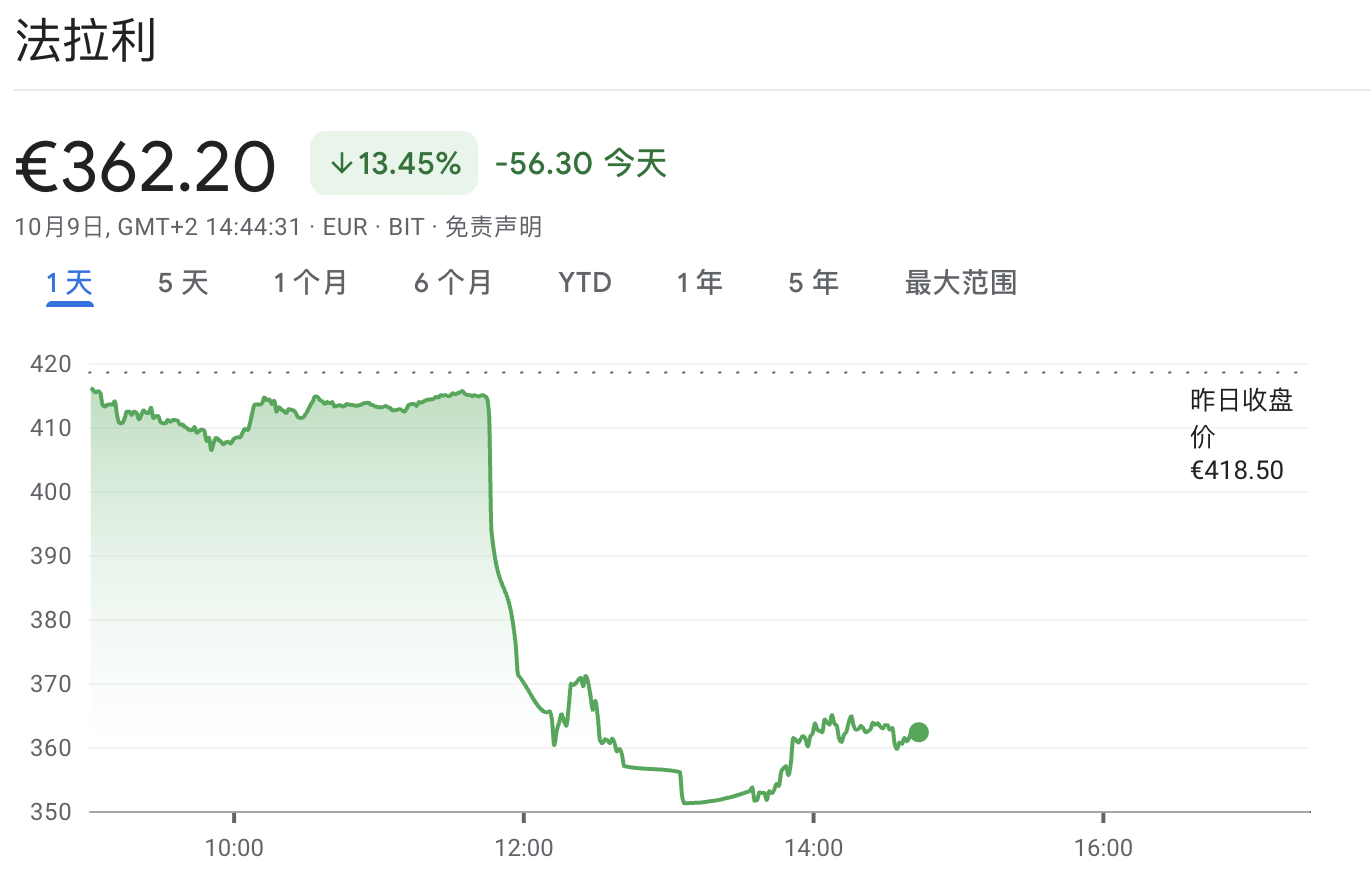
【导读】法拉利股价 " 跳水 " 中国基金报记者 储是 法拉利股票遭抛售!法拉利发布的业绩展望不及预期,电车计划 " 受挫 " ,美股欧股股价暴 跌。 10 月 9 日,法拉利发布的业绩展望不及华尔街预期。同时,公司下调了电动化转型目标,将 2030 年电动汽车销售占比目标从 40% 下调至 20% 。 美股盘前,法拉利股价 跳水 超 13% 。欧股盘中一度下跌超 16% ,创下上市以来的最大跌 幅。 | < W | | 法拉利 | | | | | | --- | --- | --- | --- | --- | --- | --- | | | | RACE.N | | | | | | 416.860 = 158.8万 | | 股本 | 2.42亿 市盈 | 53.8 | 万得 | | | -62.350 -13.01% 换 | | 0.89% 市值 | 1007亿 市净 | 0.00 | 200 | | | 盘中 ▼ 五日 | 日K | 周K | 月K | 白天 | | | | 叠加 | | | 均价:419.219 | | | | | 543.310 | | | 13.38% | 卖一 416.980 | ...

法拉利(RACE.US)大跌逾12% 2030年业绩指引不及预期
Zhi Tong Cai Jing· 2025-10-09 14:40
周四,法拉利(RACE.US)大跌逾12%,报419.16美元。消息面上,法拉利2030年业绩指引未达华尔街预 期,同时公司还下调了电动化转型目标。法拉利将2025年净收入预期从此前的"超过70亿欧元"上调 至"至少71亿欧元",并设定2030年净收入目标约为90亿欧元。然而,分析师普遍认为这一长期指引过于 保守。分析师迈克尔.迪恩(Michael Dean)表示,法拉利预计2030年调整后EBITDA利润率将超40%,而 分析师的平均预期为42%。 另外,法拉利还宣布调整电动化战略,将2030年电动汽车销售占比目标从40%下调至20%。 花旗分析师在研报中表示,法拉利的指引"低于我们资本市场日预览中的'低增长情形'预估,反映出管理 层的保守态度"。他们补充说,考虑到指引虽然保守但暗示未来周期中运营杠杆有限,"我们认为近期共 识每股收益和估值倍数都存在一定风险"。 ...

德系豪华车,失守中国市场
Di Yi Cai Jing· 2025-10-09 14:08
Group 1 - The performance of German luxury car manufacturers in the Chinese market has not improved in Q3 after a decline in sales during the first half of the year [2] - BMW's global sales increased by 8.8% year-on-year in Q3, while Mercedes-Benz and Porsche experienced a decline in sales [2] - In China, BMW's sales decreased by 0.4% to 147,000 units, while Mercedes-Benz and Porsche's sales fell by 27% and 20.7% respectively [2] Group 2 - Mercedes-Benz faced significant challenges in the Chinese market, with a 40% month-on-month decline in retail sales in July, marking the first time in five years that monthly sales fell below 28,000 units [2] - Porsche's sales in China have been on a downward trend, with a 15% decline in 2023 and a projected 28% drop in 2024 [3] - The competitive landscape in the luxury car segment in China has intensified, with local brands like AITO and Li Auto gaining market share [4] Group 3 - The traditional reliance on mechanical performance and brand premium by luxury brands is becoming insufficient in the era of smart electric vehicles [4] - BMW is the only German luxury brand with a notable presence in the electric vehicle market, while Mercedes-Benz, Audi, and Porsche have underperformed [4] - Porsche has adjusted its product strategy to focus more on fuel and hybrid vehicles, slowing down the pace of electric vehicle development [5]
“失望”业绩展望引发抛盘,法拉利股价重挫16%,创2016年以来最大跌幅
Hua Er Jie Jian Wen· 2025-10-09 12:57
同时,法拉利还宣布调整电动化战略,将2030年电动汽车销售占比目标从40%下调至20%,同时展示了其首款纯电动车"elettrica"的技术细节,该车型计划 于2026年底开始交付。 法拉利股价周四一度暴跌16%,创下该公司2016年在米兰证交所上市以来的最大单日跌幅,这一剧烈下跌源于其2030年业绩指引未达华尔街预期,同时公司 还下调了电动化转型目标。 周四,法拉利将2025年净收入预期从此前的"超过70亿欧元"上调至"至少71亿欧元",并设定2030年净收入目标约为90亿欧元。然而,分析师普遍认为这一 长期指引过于保守。 花旗分析师在研报中表示,法拉利的指引"低于我们资本市场日预览中的'低增长情形'预估,反映出管理层的保守态度"。他们补充说,考虑到指引虽然保守 但暗示未来周期中运营杠杆有限,"我们认为近期共识每股收益和估值倍数都存在一定风险"。 2025年指引小幅上调,2030年目标增长放缓 业绩指引方面,具体来看: 令投资者失望的是2030年长期目标,据RBC Capital Markets分析师Tom Narayan团队表示,法拉利更新的2030年指引低于共识预期。UBS分析师Narayan指 出,管 ...
继吉利后,奇瑞也将与雷诺“牵手”在南美生产汽车? 雷诺中国:确有沟通
经济观察报· 2025-10-09 10:41
Core Viewpoint - Chery Automobile is in talks with Renault to establish a manufacturing and sales partnership in South America, focusing on Colombia and Argentina, which could enhance both companies' market presence in the region [2][3]. Group 1: Partnership Details - Chery plans to utilize Renault's factory facilities in Colombia for producing fuel vehicles, with most vehicles branded as Renault and a smaller portion retaining the Chery brand [2][3]. - In Argentina, Chery is considering investing in a hybrid pickup production line at Renault's Córdoba factory, with Renault managing the distribution [2][3]. - The collaboration aims for Chery to provide products and technology while Renault offers factory space and sales channels, allowing Chery to operate with a light asset model [3][4]. Group 2: Market Context - The domestic automotive market in China is experiencing slower growth, prompting Chinese automakers to accelerate their global expansion, particularly in South America, which has significant market potential and a gap in the electric vehicle sector [2][3]. - Chery has been a leader in export sales among Chinese automakers, with overseas sales projected to reach 1.145 million units in 2024, a 21.4% increase year-on-year [3][5]. Group 3: Competitive Landscape - Renault is a key player in the South American market, with established factories in Colombia and Argentina, which could facilitate Chery's entry into these markets [3][4]. - The partnership is expected to enhance Renault's product line and reduce costs, helping it to compete more effectively in the rapidly growing South American electric vehicle market [4][5]. Group 4: Financial Performance - Chery's sales from January to August reached 1.727 million vehicles, a year-on-year increase of over 14%, with exports accounting for 798,800 units, up 10.8% [5]. - Chery's recent IPO on the Hong Kong Stock Exchange raised HKD 9.14 billion, marking it as the largest IPO for an automotive company in the Hong Kong market this year, which may further boost its interest in collaborating with Renault [5].

电动困局,BBA折戟!电车沦为杂牌,差在哪儿?
Sou Hu Cai Jing· 2025-10-03 14:46
Core Insights - BBA (BMW, Benz, Audi) is facing significant challenges in the electric vehicle (EV) market, with drastic declines in sales and profits, particularly in China [1][2][4] - The perception of BBA brands as outdated and less appealing compared to new entrants like Tesla and NIO is contributing to their struggles [2][4] - Price reductions have not effectively boosted sales and have instead harmed brand value, leading consumers to consider domestic alternatives [2][4] Sales Performance - BMW's net profit plummeted by 83.8%, Mercedes-Benz by 55.8%, and Audi by 37.5% [1] - In China, BMW's sales dropped by 15.5%, Mercedes-Benz by 14%, and Audi by 10.2% [1] - Electric vehicle sales for Mercedes-Benz fell by 31%, and Audi by 23.5%, while BMW saw an 18.5% increase in electric sales, though this was not enough to offset overall declines [1] Brand Perception - Consumers still view BBA as leaders in traditional fuel vehicles, while their electric offerings are seen as makeshift [2] - New energy brands are perceived as more innovative and appealing, leading to a shift in consumer loyalty [2][4] Product Issues - BBA's electric vehicles are primarily based on modified internal combustion platforms, leading to inherent design flaws [4] - Features that are standard in domestic competitors, such as air suspension and advanced driver assistance systems, are often optional in BBA vehicles, making them less competitive [4] - Technical issues, such as poor wiring and frequent motor failures, have raised doubts about BBA's engineering quality [4] Strategic Responses - BBA is attempting to adapt by accelerating localization and collaborating with tech companies for smart driving solutions [6] - Mercedes-Benz has revised its electrification goals, aiming for a maximum of 50% of its models to be new energy vehicles [6] - Audi is partnering with Huawei to enhance its intelligent driving systems [6] Market Outlook - The penetration rate of new energy vehicles in China is expected to exceed 50% by 2025, intensifying competition [6] - New energy brands are focusing on user experience and technology, while BBA must innovate to avoid marginalization [6][7]
中国摩都,电动车产量半年激增近59%
2 1 Shi Ji Jing Ji Bao Dao· 2025-10-03 00:50
Core Insights - Chongqing is transforming into a global hub for smart electric vehicles, aiming for an annual production of over 15 million electric two-wheelers by 2027, with a projected output of 2.98 million units in 2024, marking a 19% year-on-year increase [1][13] - The city has attracted seven of the top ten electric vehicle manufacturers in China, achieving over 60% local supply chain integration for key components [1][7] - The electric motorcycle production reached 1.45 million units in the first seven months of this year, reflecting a 34% year-on-year growth, indicating a rapid shift towards electrification [2][6] Industry Transformation - The traditional motorcycle giants in Chongqing, such as Lifan and Longxin, are facing challenges, with only Zongshen remaining strong, while the overall motorcycle production in Chongqing still accounts for over one-third of the national total [2][6] - The shift from fuel motorcycles to electric models is driven by urban policies restricting traditional motorcycles, leading to a significant market transformation [6][9] - The local government is promoting a dual strategy to deepen domestic electric motorcycle markets while targeting Southeast Asia, Africa, and Latin America for expansion [2][6] Technological Advancements - The focus is shifting from traditional components to advanced technologies like lithium and sodium batteries, as well as smart control systems [8][10] - Companies are integrating smart technologies into their products, with examples like Tailin's electric motorcycle featuring Huawei's HarmonyOS for enhanced user experience [11][12] - The industry is moving towards a model where electric vehicles are not just functional but also smart terminals, emphasizing the importance of intelligent features for market competitiveness [9][10] Global Expansion - With the domestic market reaching saturation, Chongqing's motorcycle manufacturers are looking to international markets, particularly in Southeast Asia, where the market size is approximately $20 billion [14][17] - The local government is supporting this international push by enhancing logistics networks and addressing technical challenges in key areas like electromagnetic compatibility and braking performance [16][17] - Companies are adopting diverse strategies for international markets, such as focusing on small-displacement motorcycles or customizing products for specific regional needs [18][19]
中国摩都 电动车产量半年激增近59%
2 1 Shi Ji Jing Ji Bao Dao· 2025-10-03 00:23
Core Viewpoint - Chongqing is transforming into a global hub for smart electric vehicles, with ambitious production targets and a focus on electric two-wheelers, aiming for an annual output of over 15 million units by 2027 [1][2][19]. Group 1: Industry Transformation - Chongqing's electric two-wheeler production is projected to reach 2.98 million units in 2024, a 19% increase year-on-year, and 2.1975 million units in the first half of 2025, marking a 58.6% surge [1]. - The city has attracted seven of the top ten electric vehicle companies in China, achieving over 60% local supply chain integration for key components [2]. - The electric motorcycle production from January to July 2023 reached 1.45 million units, reflecting a 34% year-on-year growth [2]. Group 2: Historical Context - The first civilian motorcycle in China, the "Jialing CJ50," was produced in Chongqing in 1979, marking the beginning of the city's motorcycle manufacturing legacy [4]. - Chongqing was once home to three major motorcycle manufacturers: Jialing, Longxin, and Zongshen, with Jialing being the industry leader [8]. Group 3: Challenges and Shifts - The motorcycle industry faced challenges from government policies limiting motorcycle use, leading to a decline in traditional fuel motorcycle sales [9][10]. - The rise of electric two-wheelers has shifted the competitive landscape, with electric models rapidly replacing fuel motorcycles due to lower operating costs [10][11]. Group 4: Smart Vehicle Development - The focus is shifting from mere electrification to smart vehicle technology, with companies like Tailin integrating advanced systems such as Huawei's HarmonyOS for enhanced user experience [16]. - The Chongqing government is promoting the development of a smart electric vehicle data service system to support future innovations in battery swapping and shared mobility [13][14]. Group 5: Global Expansion - With domestic markets reaching saturation, Chongqing's motorcycle companies are looking to expand internationally, particularly in Southeast Asia, Africa, and Latin America [2][19]. - The logistics network in Chongqing is being enhanced to support global distribution, with efficient routes established to Southeast Asia and Europe [22]. Group 6: Competitive Landscape - Chongqing manufacturers face competition from established Japanese brands in the Southeast Asian market, where electric motorcycles are still relatively expensive compared to traditional fuel models [23][24]. - Companies are adopting various strategies to differentiate themselves, such as focusing on small-displacement motorcycles or customized models for specific markets [25][26].