大模型

Search documents
太突然!中国知名AI公司,拿下7亿美元融资,估值超百亿美元,阿里、腾讯都投了!90后创始人:持有现金超100亿元,“不以上市为目的”
Mei Ri Jing Ji Xin Wen· 2026-02-17 07:30
Core Insights - Kimi, a company under Moonshot AI, is set to complete a new funding round of over $700 million, following a previous $500 million round just over a month ago, with a valuation expected to exceed $10 billion [1][2] - The recent funding rounds have raised a total of over $1.2 billion, marking the highest funding amount in the large model industry in the past year [2] - Kimi's founder, Yang Zhilin, indicated that the company is not in a hurry to go public, preferring to raise more funds from the primary market instead [4] Funding and Valuation - Kimi's latest valuation has doubled to over $10 billion, with the total amount raised in consecutive funding rounds exceeding $1.2 billion [2] - The recent funding round was led by existing investors including Alibaba, Wuyuan, and Jiuyuan, with Tencent also participating [1] Business Strategy and Growth - Kimi plans to use the funds from the C round to aggressively expand GPU resources and accelerate the training and development of the K3 model [5] - The company has seen a significant increase in paid users, with a monthly growth rate of over 170% from September to November [4] - Kimi aims to enhance its K3 model through technological improvements and scaling, focusing on creating unique capabilities that differentiate it from competitors [6] Talent Acquisition and Market Competition - The company is preparing to significantly increase employee incentives and stock buyback plans in 2026, reflecting the competitive landscape for AI talent [5] - The demand for AI positions has surged, with a tenfold increase in job openings in the first seven months of 2025, highlighting the ongoing talent war in the industry [5]


印度首次举办超大规模AI峰会,25万人将涌入,仍缺全球领先大模型
Di Yi Cai Jing Zi Xun· 2026-02-17 07:05
Group 1 - The AI Impact Summit in India is the largest of its kind in the country, expecting 250,000 attendees from around the world [1] - Major tech companies like Google, Microsoft, and Amazon plan to invest a total of $68 billion in AI and cloud infrastructure in India by 2030 [1] - Key speakers at the summit include leaders from Google, OpenAI, Anthropic, and DeepMind, highlighting India's commitment to leveraging AI for human-centric missions [3] Group 2 - India has not yet developed a globally dominant AI model, with the US and China leading in large model technology [3] - The Indian government is encouraged to focus on "innovative applications" rather than investing heavily in developing new large models [3] - India has a significant potential consumer market for AI, with over 72 million daily ChatGPT users expected by the end of 2025, making it one of OpenAI's largest user markets [3] Group 3 - The Indian IT industry, valued at nearly $300 billion, faces challenges from AI adoption, with call centers potentially experiencing a 50% revenue loss by 2030 [4] - The rise of Global Capability Centers (GCCs) in India is shifting focus towards AI, data, digital engineering, and product development, with over 60% of new GCCs established in these areas [4] - It is projected that over 80% of GCCs will be AI-driven within the next 6 to 8 months [4] Group 4 - India is actively seeking to establish domestic supply chains to attract investments from major tech companies, recently approving a $18 billion semiconductor investment project [5] - Government support for technology is seen as a guarantee for multinational companies to diversify their operations in India [5] - The summit is expected to lead to significant announcements of investments in AI data centers and large-scale infrastructure agreements [5]

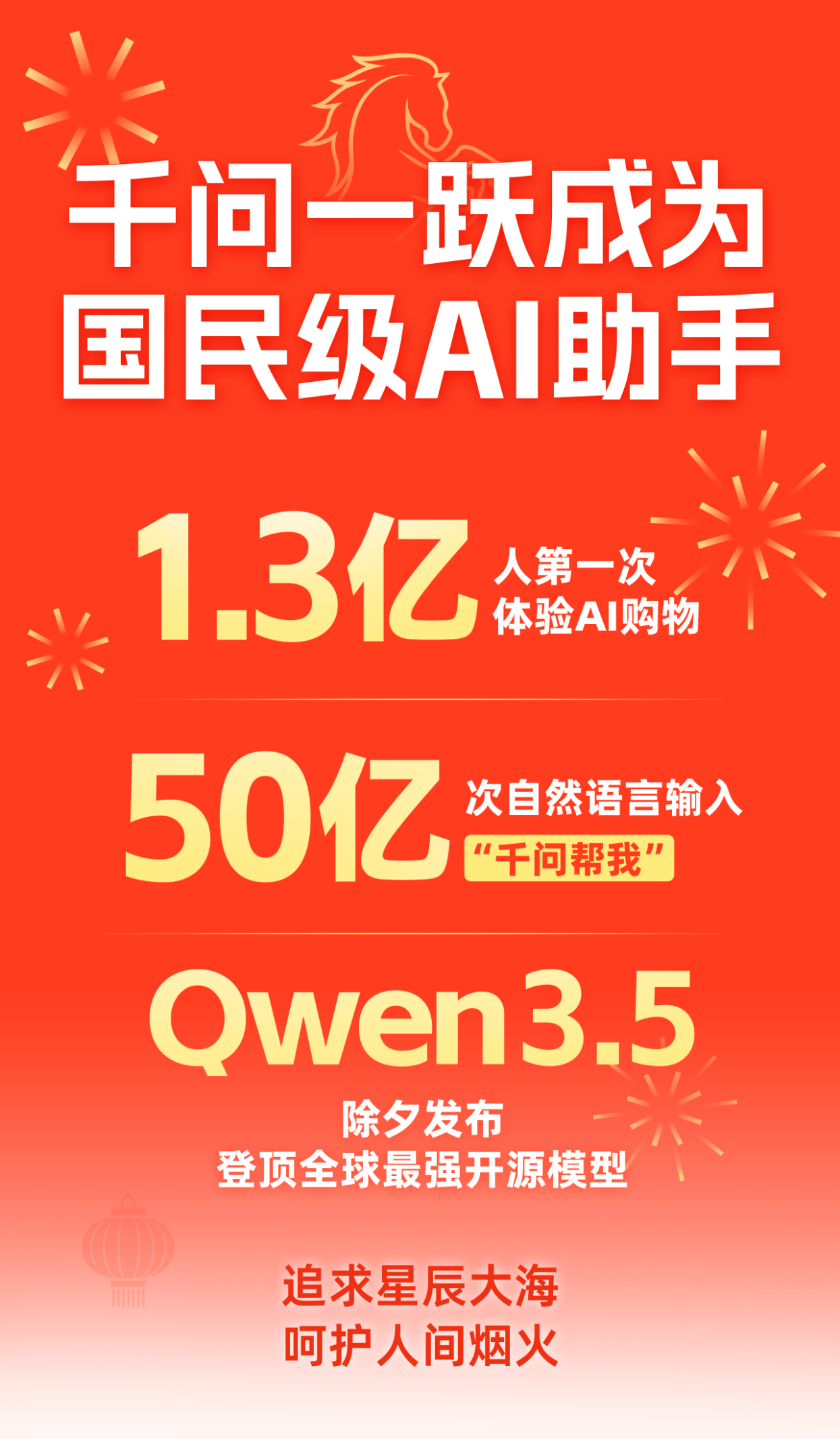
千万发布数据:1.3亿人春节首次体验AI购物
Huan Qiu Wang· 2026-02-17 05:00
Group 1 - During the Spring Festival, over 130 million people experienced AI shopping for the first time, making 5 billion requests using "Qianwen help me" [1] - Orders for AI ticket purchases increased by 22 times, while AI bookings for flights and other transportation tickets grew over 7 times; movie ticket orders surged by 372 times, particularly from third and fourth-tier cities, which saw an increase of 782 times [1] - Nearly half of all AI orders originated from county-level cities, with around 4 million users aged 60 and above engaging in AI shopping [1] Group 2 - Alibaba launched the new generation open-source model Qwen 3.5-Plus on New Year's Eve, which is comparable in performance to Gemini 3 Pro, making it the strongest open-source model globally [2][4] - The AI application saw significant growth during the Spring Festival, indicating a dual explosion in both open-source model capabilities and app usage [2]

字节跳动在春节点亮自己的 ChatGPT 时刻
晚点LatePost· 2026-02-17 04:11
Core Viewpoint - The article discusses the strategic shift of ByteDance towards becoming a technology company, emphasizing the importance of AI in its growth and product development, particularly during the 2026 Spring Festival [3][6][15]. Group 1: AI Competition and Innovations - In early February 2026, Tencent and Alibaba initiated a new AI competition, with Tencent offering 1 billion yuan in cash incentives and Alibaba providing 3 billion yuan for user engagement [3]. - ByteDance's Seedance 2.0 video generation model gained significant attention, leading to its prominence in discussions around AI innovations [3][5]. - ByteDance's CEO set the 2026 goal as "climbing to the peak," indicating a focus on seizing opportunities in the AI era [6]. Group 2: Integration of AI in Cultural Events - ByteDance integrated AI into the Spring Festival Gala, showcasing its technology through visual effects and interactive features, marking a significant presence in a major cultural event [7][12]. - The AI capabilities were utilized to enhance the performance quality, including the creation of dynamic visuals that adhered to traditional art styles [9][10]. - The interaction model for the audience changed, requiring users to generate content using AI before participating in traditional activities like receiving red envelopes [12][13]. Group 3: Challenges and Solutions in AI Deployment - The computational demands for AI interactions surged, with a single user request requiring 10 TOPS of processing power, a significant increase from previous requirements [13]. - ByteDance utilized its Volcano Engine to manage computational resources effectively during peak usage times, demonstrating advanced resource allocation strategies [14]. - The integration of various AI models and technologies was crucial for maintaining performance and quality during high-demand events [11][12]. Group 4: Shifting Growth Strategies in the AI Era - The article highlights a shift in growth strategies, indicating that traditional methods of user acquisition through subsidies are becoming less effective in the AI landscape [15][17]. - AI products do not benefit from the same user growth dynamics as traditional internet products, as increased user numbers do not necessarily enhance model performance [16][17]. - The focus is now on improving the underlying model capabilities rather than relying solely on user growth for product enhancement [18][19]. Group 5: Long-term Commitment to Technology Development - ByteDance is committed to long-term investments in foundational AI research, establishing projects like "Seed Edge" to explore advanced AI technologies [22]. - The company recognizes the importance of continuous improvement in model capabilities and user experience as key to maintaining competitive advantage [20][21]. - Historical examples from other tech companies illustrate the necessity of innovation and technical excellence in achieving market leadership [23][24].

春晚张杰《驭风歌》背后的马,是Seedance 2.0做的!
量子位· 2026-02-17 03:58
Core Viewpoint - The article highlights the significant advancements in AI technology showcased during the Spring Festival Gala, particularly focusing on the capabilities of the Seedance 2.0 model and its integration with various AI applications in performance and interaction [2][42]. Group 1: AI Technology in Performance - The performance of "Yufeng Song" by Zhang Jie featured a background video created using the Seedance 2.0 model, which successfully interpreted and animated traditional Chinese ink painting styles, a task that many foreign models struggled with [4][5]. - Seedance 2.0 was utilized in multiple performances, including the creative dance show "He Huashen," where it demonstrated micro-control capabilities to create detailed visual effects [7][10]. - The model's ability to follow physical and biomechanical principles allowed for realistic animations of galloping horses, showcasing its advanced command-following and multi-modal material reference capabilities [8][10]. Group 2: Video Quality Enhancement - The collaboration with the Volcano Engine video cloud team enabled the enhancement of video quality to meet the Spring Festival Gala's high standards, utilizing super-resolution algorithms to upscale 720P to 8K and frame interpolation to increase frame rates from 24 to 50 FPS [15][17]. - The integration of 4D Gaussian splashing technology allowed for the creation of immersive visual experiences, where virtual dancers interacted seamlessly with real stage lighting [20][22]. Group 3: AI Interaction and User Engagement - The Spring Festival Gala introduced AI-driven interactive features through the Doubao app, allowing users to generate personalized avatars and greetings, marking a shift from traditional transactional interactions to more complex, computationally intensive engagements [28][30]. - The Ark platform played a crucial role in managing the high traffic during the event, utilizing a federated system to optimize resource allocation and ensure rapid response times for user requests [31][29]. Group 4: Broader Implications and Industry Impact - The article emphasizes the widespread adoption of Doubao's AI models across various industries, including automotive, mobile, and robotics, highlighting its robust partnerships with major companies [40][41]. - The successful implementation of AI technologies during the Spring Festival Gala serves as a demonstration of their practical value and potential for real-world applications, reinforcing the notion that effective AI solutions can deliver tangible benefits [43][44].

中国科技公司押注“春节档” 除夕再迎重磅开源模型
Zhong Guo Xin Wen Wang· 2026-02-17 03:03
Core Insights - Chinese technology companies are launching new AI models, with Alibaba's Qwen3.5-Plus being a significant highlight, featuring 397 billion parameters and a cost-effective API pricing of 0.8 yuan per million tokens, which is 1/18 of Gemini3 Pro's price [1][2] - The trend in AI model development is shifting from sheer size to efficiency and intelligence, as demonstrated by Qwen3.5's ability to perform well with a smaller model while maintaining high performance [2][3] Group 1: Model Launches and Features - Alibaba launched the Qwen3.5-Plus model on New Year's Eve, which has 397 billion total parameters and 170 billion activated parameters, achieving a 60% reduction in deployment memory usage [1] - Other companies like Zhiyun, iFlytek, and MiniMax have also introduced new models, including GLM-5, Xinghuo X2, and M2.5, showcasing advancements in decision-making capabilities [1][2] Group 2: Performance and Efficiency - Qwen3.5 has shown exceptional performance in various benchmark tests, achieving results comparable to Gemini3 Pro and excelling in visual understanding assessments [1][2] - The new models are designed to be more practical and efficient, with a focus on multi-modal capabilities and reduced resource requirements, leading to increased deployment efficiency [2][3] Group 3: Open Source and Global Impact - The number of open-source models related to Qwen has exceeded 400, with over 200,000 derivative models and downloads surpassing 1 billion, indicating a strong global presence [3] - China is emerging as a leading provider of open-source large models, with significant contributions from companies like Qwen and DeepSeek, which rank highly on AI model evaluation platforms [3]
1.3亿人春节首次体验AI购物,千问一跃成为国民级AI助手
Xin Lang Cai Jing· 2026-02-17 00:46
Core Insights - During the Spring Festival period, over 130 million people experienced AI shopping for the first time, with "Qianwen help me" being invoked 5 billion times, establishing Qianwen as a national-level AI assistant [1] User Engagement and Growth - In the past two days, AI ticket purchasing orders increased by 22 times, while AI orders for flight tickets and other transportation tickets surged over 7 times [4] - The demand for AI movie ticket purchases saw a staggering 372-fold increase, with orders from third and fourth-tier cities skyrocketing by 782 times [4] - Nearly half of all AI orders originated from county-level cities, highlighting the accessibility of AI shopping [4] - Approximately 4 million users aged 60 and above engaged with AI shopping, indicating a broad demographic reach [4] Ecosystem Integration - Qianwen can leverage the entire Alibaba ecosystem to serve users, integrating platforms such as Taobao, Alipay, Taobao Flash Sale, Fliggy, Gaode, and Damai, with plans to introduce features like AI ride-hailing and mobile recharge [4] User Activity Metrics - On February 7, Qianwen's daily active users (DAU) reached 73.52 million, nearing Doubao's 78.71 million, achieving in three months what Doubao took three years to accomplish [4] - This shift signifies a change in user habits towards AI, moving from chat-based interactions to task execution through agents [4] Technological Advancements - On New Year's Eve, Alibaba released the new generation model Qianwen Qwen 3.5-Plus, which performs comparably to Gemini 3 Pro [4]
【财经早报】阿里巴巴,开源新一代大模型
Xin Lang Cai Jing· 2026-02-17 00:43
重要新闻提示 阿里巴巴开源全新一代大模型千问Qwen3.5-Plus 春运前15天我国交通出行人数预计超35亿人次 截至2月16日23时10分,2026年电影春节档(2月15日至2月23日)票房(含预售)已突破7亿元 ...
陆家嘴财经早餐2026年2月17日星期二
Wind万得· 2026-02-17 00:17
Group 1 - The 2026 CCTV Spring Festival Gala featured a variety of robots performing alongside artists, showcasing advanced skills and technology [3] - The Hong Kong stock market saw a positive close on the last trading day before the Lunar New Year, with the Hang Seng Index rising by 0.52% and AI application stocks experiencing significant gains, such as Haizhi Technology Group increasing nearly 30% [3][4] Group 2 - OpenAI announced the recruitment of Peter Steinberger, founder of the open-source AI agent OpenClaw, indicating a strategic shift towards collaborative AI ecosystems [4] - Alibaba released a new generation of the Qwen 3.5 model, which competes with Gemini 3 Pro, achieving a significant performance leap and reducing API costs to 0.8 yuan per million tokens [4] Group 3 - The demand for GLM-5 has surged, prompting Zhipu to initiate a "computing power partner" recruitment plan to enhance service capabilities [11] - The storage chip price increase is intensifying, with Kioxia predicting a 50% rise in average selling prices starting in Q1 2026 [11] Group 4 - The Hong Kong property market saw a 7.33% increase in prices during the Year of the Snake, marking the largest rise in nearly eight lunar years [8] - The U.S. stock market is expected to experience a significant capital expenditure increase in AI, projected to reach $740 billion in 2026, which may lead to a shift in investment patterns [16]

正面硬刚Gemini 3 Pro,阿里开源Qwen3.5-Plus|甲子光年
Sou Hu Cai Jing· 2026-02-16 15:57
Core Insights - Alibaba has officially open-sourced its new foundational model, Qwen3.5-Plus, which boasts 397 billion parameters but only activates 17 billion for inference, challenging existing models like Google's Gemini 3 Pro and OpenAI's GPT-5.2 [2][4] - The model represents a significant shift towards a more efficient architecture, moving away from traditional dense models to a sparse mixture of experts (MoE) approach, which drastically reduces computational resource requirements [5][6] Group 1: Architectural Innovations - Qwen3.5-Plus achieves a balance of performance and efficiency by integrating linear attention mechanisms with sparse MoE architecture, allowing for a significant reduction in memory usage and increased inference speed [6][8] - Compared to its predecessor, Qwen3-Max, Qwen3.5-Plus reduces deployment memory usage by 60% and increases inference throughput by up to 19 times in long-context scenarios [6][8] - The model's ability to dynamically allocate attention resources allows it to focus on important information while reducing computational complexity, enhancing its overall efficiency [8] Group 2: Native Multimodal Capabilities - Qwen3.5-Plus features a native multimodal design that integrates visual and textual data from the pre-training phase, enabling it to perform complex tasks without the typical losses associated with separate modality processing [9][10] - This capability allows the model to execute tasks such as converting sketches into runnable code or providing code fixes based on UI screenshots, marking a significant advancement in AI's practical applications [10][11] - The model's enhanced video understanding capabilities enable it to process long videos for analysis and summarization, showcasing its potential in embodied intelligence applications [12][13] Group 3: Market Impact and Strategy - The aggressive pricing strategy of Qwen3.5-Plus, with API call costs as low as 0.8 RMB per million tokens, positions it as a disruptive force in the global AI market, significantly undercutting competitors [16][17] - Alibaba's open-source model ecosystem has grown to over 400 models, with more than 20,000 derivative models developed by the community, establishing a robust and active foundation for AI development [17] - The model's support for 201 languages and dialects, with a vocabulary expansion from 150,000 to 250,000, enhances its accessibility and efficiency for low-resource languages, further embedding it in emerging markets [17][18] Group 4: Future Implications - Qwen3.5-Plus sets a new benchmark for open-source models, demonstrating that the path to AGI does not solely rely on closed-source solutions, but can also thrive in an open ecosystem [19][20] - The model's release signifies a shift from a parameter race to a competition based on architectural efficiency, emphasizing the importance of cost-effectiveness, transparency, and collaboration in AI development [18][19] - As the model continues to evolve, it is poised to become a preferred choice for enterprise-level localized deployments, marking a significant milestone in the journey towards AGI [21][24]