
液冷技术

Search documents
通信行业点评:液冷技术再突破,IDC热管理“变纪元”开启
Minsheng Securities· 2025-09-28 07:29
Investment Rating - The report maintains a "Recommended" rating for Invec, Gaolan Co., and a "Cautious Recommendation" for Kexin New Source [4]. Core Insights - Microsoft's breakthrough in liquid cooling technology, specifically in-chip microfluidic cooling, significantly enhances heat removal efficiency by 2-3 times compared to traditional methods, allowing for stable high-frequency operation of chips and reducing peak temperature by 65% [2][3]. - The introduction of this technology is expected to reshape the IDC liquid cooling landscape, potentially leading to a "second impact" on the industry as more chip servers may come with built-in liquid cooling systems [2]. - The global electricity demand for data centers is projected to double from approximately 460 TWh in 2024 to over 1000 TWh by 2030, indicating a substantial increase in infrastructure energy consumption [3]. Summary by Sections Liquid Cooling Technology - Microsoft's new liquid cooling method utilizes microfluidic technology, which involves etching micron-level channels on the back of chips to directly cool heat sources, improving operational efficiency and sustainability [2]. - The potential for a 20%-30% improvement in Power Usage Effectiveness (PUE) could lead to significant reductions in data center operational costs [2]. Market Opportunities - The report highlights the growing need for advanced cooling solutions as AI development continues to drive demand for higher computing power, positioning liquid cooling as a critical technology to address power constraints [3]. - Companies to watch include Invec, Gaolan Co., and Kexin New Source, which are expected to benefit from these advancements in cooling technology [3]. Financial Projections - The report provides earnings per share (EPS) forecasts for key companies, with Invec projected to have an EPS of 0.61 in 2024, while Gaolan Co. is expected to recover from a loss to an EPS of 0.09 in 2025 [4].

润滑油巨头嘉实多押宝液冷,瞄准中国数据中心能效升级需求
2 1 Shi Ji Jing Ji Bao Dao· 2025-09-28 06:33
Core Viewpoint - BP's subsidiary Castrol is betting on the Chinese liquid cooling server market by launching an end-to-end liquid cooling solution aimed at enhancing the efficiency of data centers in China [1][4]. Group 1: Market Trends - The data center industry is facing significant energy consumption challenges, particularly with the rise of AI applications, leading to increased power demands from high-end GPU/AI chips, which have surged from approximately 500-700W to levels of 1000W and even 2000W [1][3]. - The power density of server cabinets has exceeded 50kW, with leading AI cabinets commonly reaching over 100kW, making liquid cooling the only viable solution for effective heat management beyond this threshold [1][3]. - The Chinese data center market is rapidly transitioning to liquid cooling, with IDC forecasting a market size of $2.37 billion in 2024, representing a 67% increase from 2023 [7]. Group 2: Technical Insights - Liquid cooling technology is seen as a major upgrade for data centers, addressing the need for improved energy efficiency and lower operational energy consumption, with PUE (Power Usage Effectiveness) being a critical metric [5][6]. - The cooling liquid is a unique medium that interacts with all components of the data center infrastructure, necessitating in-depth research and understanding of its properties, including material compatibility and lifecycle changes [4][6]. - Castrol emphasizes an end-to-end solution that integrates the entire system, addressing the complexities of liquid cooling deployment, operation, and retirement while ensuring compatibility with existing equipment [4][6]. Group 3: Financial Considerations - The cost structure of liquid cooling can be divided into CAPEX (capital expenditures) and OPEX (operational expenditures), with CAPEX covering design, hardware, and deployment, while OPEX benefits from reduced energy and maintenance costs due to improved efficiency [6]. - The company is investing heavily in compatibility testing for various chip and server types to ensure confidence among clients and facilitate the adoption of liquid cooling solutions [6]. Group 4: Strategic Importance of China - China is identified as a key strategic market for Castrol due to its competitive supply chain and partnerships with local firms like Inspur and Yixin Technology [7]. - The liquid cooling server market in China is projected to grow at a compound annual growth rate (CAGR) of 46.8% from 2024 to 2029, with the market size expected to reach $16.2 billion by 2029 [7].


润滑油巨头嘉实多押宝液冷 瞄准中国数据中心能效升级需求
2 1 Shi Ji Jing Ji Bao Dao· 2025-09-28 06:28
Core Insights - BP's subsidiary Castrol is betting on the Chinese liquid cooling server market by launching an end-to-end liquid cooling solution tailored for data centers in China [1][6] - The data center industry faces significant energy consumption challenges, exacerbated by the rise of AI applications, with GPU/AI chip power consumption increasing dramatically [1][3] - Liquid cooling is becoming essential for managing heat in high-density server environments, especially as power density exceeds 100kW [1][5] Group 1: Market Dynamics - The Chinese data center market is projected to see a rapid increase in electricity consumption, with a forecasted total of approximately 2.7 trillion kilowatt-hours in 2022, marking a year-on-year growth of about 24.7% [3] - The Ministry of Industry and Information Technology in China has set a target for new large data centers to achieve a Power Usage Effectiveness (PUE) of less than or equal to 1.3 by 2025 [3] - The liquid cooling server market in China is expected to grow to $2.37 billion in 2024, representing a 67% increase from 2023 [6] Group 2: Technical Insights - Castrol's liquid cooling solutions emphasize an "end-to-end" approach, integrating the entire system from deployment to operation and decommissioning [2] - Liquid cooling technology is seen as a significant upgrade for data centers, requiring changes in supply chains, design solutions, and standards [3][4] - The company is focusing on compatibility testing with various chip and server types to ensure effective integration of liquid cooling systems [4] Group 3: Financial Considerations - The primary costs for data centers remain in GPU and server hardware, while liquid cooling is viewed as an infrastructure enhancement to manage increased heat loads [5] - Liquid cooling costs can be categorized into capital expenditures (CAPEX) and operational expenditures (OPEX), with potential reductions in energy and maintenance costs due to improved efficiency [5]
英伟达vs阿里云,决战数据之巅?
首席商业评论· 2025-09-27 03:40
英伟达与英特尔出人意料地携手。根据合作协议,双方将在个人电脑(PC)和数据中心领域共同开发芯片,旨在将英伟达领先的图形处理器(GPU)与英特尔的 中央处理器(CPU)及封装技术深度结合。 合作的主菜,业界的关注点,除了对于PC的AI芯片的共同研发和晶圆工艺代工方向的热切瞩目,正如英特尔CEO在X中官宣的一句话:"要联合开发用于PC和数据 中心的AI芯片。"而英伟达黄仁勋的回应则更带着一份战略笃定者的态度:"人工智能正在推动一场新的工业革命,并重塑计算堆栈的每一层——从芯片到系统再 到软件。这场重塑的核心是英伟达的CUDA架构。这次历史性的合作将英伟达的AI和加速计算堆栈与英特尔的CPU以及庞大的x86生态系统紧密结合——这是两个 世界级平台的融合。我们将共同扩展我们的生态系统,并为下一个计算时代奠定基础。" 老黄的这句话,揭示着"得数据者得下一个计算时代"的现状。而数据又不仅仅是数据,而是能"转起来"的数据,能创造商业价值的数据。 以下是本文逻辑: 一、 英伟达的向下穿透,和阿里云的向上攻克 二、 国内数据中心的AI转型 三、 新算力时代的数据之战,怎么打? 2024年中国IT服务市场整体规模达525.6亿美 ...



利和兴孙公司完成经营范围变更 强化半导体/电子材料等领域布局
Ju Chao Zi Xun· 2025-09-27 01:03
Core Viewpoint - The announcement by Lihexing regarding the operational scope change of its subsidiary, Lirong Electronics, signals a strategic shift towards high-tech sectors such as semiconductors, AI computing power, and new energy, enhancing its competitive position in these emerging markets [1][3][4] Group 1: Business Expansion - Lirong Electronics has expanded its operational scope to include sales of electronic components, integrated circuit chips, semiconductor devices, and manufacturing of electronic specialized equipment, indicating a focus on high-tech fields [3][4] - The company has been a qualified supplier for Huawei since 2013, deepening its collaboration with Huawei and its affiliates, which has led to a market share of over 10% in the smart terminal testing sector [3][4] Group 2: Strategic Partnerships - The partnership with Huawei has evolved from mobile smart terminals to include 5G base stations, new energy vehicles, and digital energy, showcasing the company's adaptability and growth potential in various cutting-edge fields [3][4] - Lihexing is a key manufacturer for Huawei's liquid-cooled ultra-fast charging equipment and is involved in critical manufacturing tasks for Huawei's fully automated charging robot project [3][4] Group 3: Market Opportunities - The adjustment in operational scope allows the company to respond more flexibly to market demands and integrate industry chain resources, thereby enhancing its competitiveness in smart manufacturing and high-end electronic equipment [4] - Analysts believe that Lihexing's deep ties with technology giants like Huawei position it well for a new round of business expansion and performance growth, particularly in semiconductor and energy electronics sectors [4]
金智科技(002090.SZ):自身未从事液冷技术相关技术研发或产品生产
Ge Long Hui· 2025-09-26 08:48
Core Viewpoint - The company, Jinzhit Technology (002090.SZ), has clarified that it is not engaged in the research and development or production of liquid cooling technology [1] Group 1 - The company has stated that it does not participate in any activities related to liquid cooling technology [1]

一文讲透美股公司之:Vertiv,全球液冷龙头
Sou Hu Cai Jing· 2025-09-26 05:47
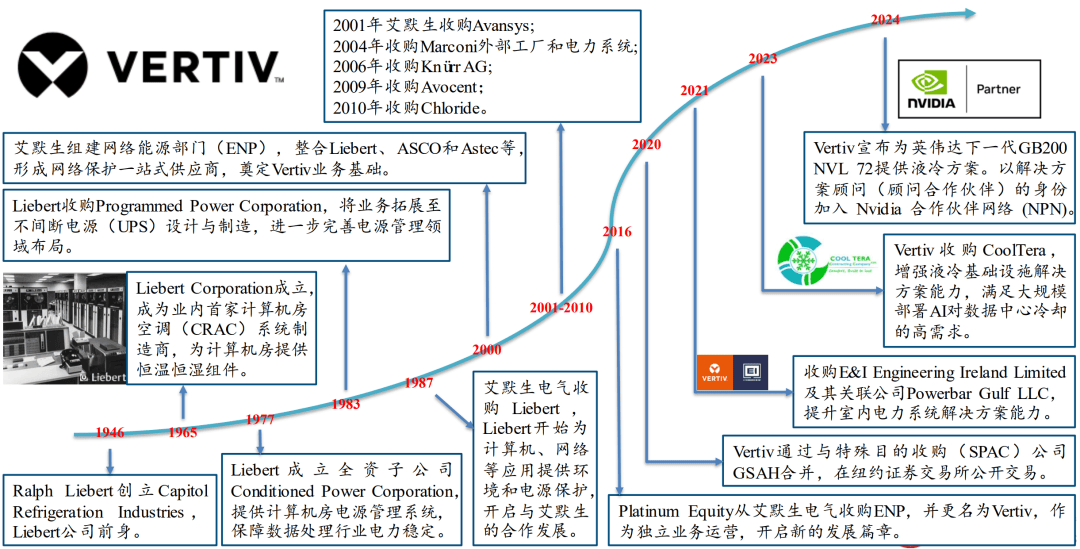
Company Background - Vertiv is one of the largest providers of liquid cooling and power management solutions globally, positioned as a rare asset in the AI infrastructure sector [2] - The company generates approximately 80% of its revenue from data center operations, significantly higher than its peers, allowing it to benefit maximally from the AI computing power construction wave [3][12] Liquid Cooling as a Necessity - The AI computing revolution is rapidly increasing chip power consumption, making liquid cooling technology a core driver of this transition from an optional to a mandatory solution [10] - For instance, NVIDIA's Blackwell platform has a single chip power consumption of 1.4kW, with cabinet power reaching 140kW, surpassing traditional air cooling limits [11] - By 2025, the liquid cooling sector is expected to experience a breakthrough, driven by AI demand, positioning Vertiv as a key beneficiary in this field [10] Core Business and AI Strategy - Vertiv's business structure is highly focused, with three main segments: data centers, communication networks, and commercial & industrial, where data center operations are the core, contributing 80% of revenue [11][12] - The company has established a robust product and service matrix, including power management, thermal management, and infrastructure services [12] Financial Performance - Vertiv has experienced rapid revenue and profit growth over the past three years, with a significant profitability surge expected in 2023 and further acceleration in 2025 due to AI demand [25] - Revenue is projected to grow from $6.86 billion in 2023 to approximately $10 billion in 2025, with a growth rate of around 25% expected in 2025 [26] - Adjusted EPS is anticipated to rise from $1.77 in 2023 to $3.82 in 2025, indicating strong operational leverage and profit elasticity [27] Competitive Landscape - Vertiv, Schneider Electric, and Eaton are the three giants in the data center infrastructure sector, each with distinct core strategies and market positions [31] - Vertiv's revenue from data center operations is 80%, compared to 21% for Schneider and 18% for Eaton, highlighting its focused business model [32][33] - The company holds a competitive edge in liquid cooling technology and high-voltage direct current (HVDC) solutions, positioning it favorably for the next generation of data centers [34]

液冷专题20250924
2025-09-26 02:29
Summary of Liquid Cooling Industry Conference Call Industry Overview - The global liquid cooling market is expected to reach 100 billion RMB by 2026 and potentially 200 billion RMB by 2028, driven by accelerated shipments of A4 chips to 200 billion RMB, indicating significant growth potential in the coming years [2][3] - The liquid cooling technology is rapidly evolving, with trends such as microchannel design and chip-integrated microfluidic cooling becoming prominent, leading to increased demand for customized products like liquid cooling plates and CDU (Cooling Distribution Units) [2][5][6] Key Players - InnoTek is positioned as a leading domestic player in the liquid cooling sector, benefiting from large orders from Meta and its technological advantages, which are expected to help maintain its leading position [2][4][12] - Other domestic companies are actively entering the global liquid cooling market through OEM partnerships, indicating a competitive landscape [4] Market Dynamics - The liquid cooling market is in a high-growth phase, with a projected market size of approximately 10 billion RMB in 2024 and a penetration rate of less than 10%. The market is expected to grow tenfold in the next two to three years and potentially twentyfold in three to four years [3] - Major manufacturers like Meta are expected to start large-scale adoption of liquid cooling solutions by early 2026, which will drive demand for cabinet-level liquid cooling solutions [9][10] Industry Value Chain - The liquid cooling industry value chain includes critical components such as liquid cooling plates, CDU, piping, and connectors. Liquid cooling plates and CDU account for approximately 30% to 40% of the total value, while connectors represent about 10% [7] - High technical barriers exist in the connector segment, which requires ensuring leak-proof performance during multiple insertions and removals [7] Domestic Opportunities - Domestic companies have significant opportunities in the global ASIC supply chain, especially as NVIDIA is more willing to introduce new suppliers due to existing suppliers facing capacity issues [8] - If domestic companies capture 20% of the global market, they could generate revenues of 40 billion RMB and profits of 8 billion RMB; capturing 40% could lead to revenues of 80 billion RMB and profits of 16 billion RMB, with a potential market capitalization increase of 500 billion RMB [8] Future Growth Drivers - The domestic liquid cooling industry is expected to see a significant increase in market share, with various segments such as switches and optical module connectors gradually adopting liquid cooling technology [11] - Companies like InnoTek and Eaton Electronics have secured orders, with noticeable revenue growth anticipated by Q4 2025 [11] Company-Specific Insights - Dingtong Technology is expected to benefit from increased penetration of IO liquid cooling connectors and rising demand for internal connectors in cabinets, projecting high revenue and gross margin growth in 2026 and 2027 [17] - Dingtong's growth logic revolves around the transition from air cooling to liquid cooling in AI data centers, significantly increasing the value of their connectors [14] - Yidong Electronics has recently expanded into GPU liquid cooling plate business, generating stable revenue with optimistic projections for future orders [18][19] Conclusion - The liquid cooling industry is poised for rapid growth, driven by technological advancements and increasing adoption by major tech companies. Key players like InnoTek, Dingtong Technology, and Yidong Electronics are well-positioned to capitalize on these trends, with significant revenue and market share growth expected in the coming years [2][12][18]

曙光数创20250925
2025-09-26 02:28
Summary of Shuguang Data Creation Conference Call Company Overview - **Company**: Shuguang Data Creation - **Industry**: Liquid Cooling Technology for Data Centers Key Points Industry Insights - The penetration rate of liquid cooling technology is increasing, with the Chinese liquid cooling data center market expected to exceed 100 billion yuan by 2027, growing at a compound annual growth rate (CAGR) of over 50% [2][8][30]. - The demand for AI computing power and carbon neutrality policies are driving market expansion [2][8]. Company Performance - In the first half of 2025, Shuguang Data Creation achieved revenue of 140 million yuan, a year-on-year increase of 43% [3]. - The company’s silent phase change liquid cooling technology has a minimum Power Usage Effectiveness (PUE) of 1.04, significantly lower than traditional air cooling systems, aligning with national requirements for data centers [2][9]. - The gross margin for silent liquid cooling data center infrastructure products reached 40% in 2023, accounting for 58% of the company's revenue [11]. Product Development - The company launched the C7,000 phase change liquid cooling solution in June 2025, enhancing cooling capacity by 15% [6]. - The silent liquid cooling product revenue grew by 212% year-on-year in the first half of 2025, indicating strong recovery momentum [12][20]. Market Expansion - Shuguang Data Creation is actively expanding into overseas markets, with projects established in Malaysia and Japan, and plans to enter Europe, the Middle East, and South Korea [2][7][25]. - The company won a bid for a 61 MW liquid cooling equipment procurement project in Malaysia in 2024 and established a wholly-owned subsidiary in Singapore [7][25]. Customer Concentration - The top five customers accounted for 88% of total revenue in the first half of 2025, with the largest customer contributing nearly 54.7% [5][15]. - Transactions with the controlling shareholder, Zhongke Shuguang, represented 56% of total revenue [5][15]. Future Projections - Revenue growth is projected at approximately 69% for 2025, with profit growth expected to exceed 70% [5][18]. - The company anticipates significant growth opportunities driven by the increasing number of large data centers and the penetration of AI applications [21][38]. Competitive Advantages - Shuguang Data Creation is the only company in China to achieve large-scale deployment of immersion phase change liquid cooling technology, holding a 61.3% market share in 2023 [20]. - The company has a high technical barrier in liquid cooling technology, requiring expertise in fluid mechanics, thermodynamics, and materials science [19]. Regulatory Environment - The Chinese government mandates that new large data centers must achieve a PUE of less than 1.25 by 2025, which supports the demand for liquid cooling solutions [9][28]. Financial Performance - The company’s net profit margin has fluctuated, with a decrease to 12.13% in 2024, but is expected to recover with projected profits of 105 million, 150 million, and 195 million yuan from 2025 to 2027 [36][37]. Technological Achievements - Shuguang Data Creation has made significant advancements in technology, holding 48 software copyrights and numerous patents, and has been recognized with several industry awards [22][38]. Strategic Mergers and Acquisitions - The recent acquisition of Shuguang Data Creation by Haiguang Information is expected to enhance its strategic position within the domestic computing power ecosystem [4][39]. This summary encapsulates the key insights and developments regarding Shuguang Data Creation and the liquid cooling technology industry, highlighting the company's growth trajectory, market strategies, and competitive advantages.
申菱环境20250925
2025-09-26 02:28
Summary of Shunling Environment Conference Call Company Overview - Shunling Environment has over 20 years of experience in the professional temperature control equipment sector, transitioning from a device seller to a vertically integrated solution provider, focusing on four main scenarios: data services, industrial applications, and special workpieces [2][4][5] Financial Performance - In the first half of 2025, the company reported revenue of 1.68 billion yuan, a year-on-year increase of 29%, with the data services segment accounting for over 50% of total revenue, growing by 43.77% year-on-year [2][6] - The net profit attributable to shareholders was 150 million yuan, up 36% year-on-year, indicating significant recovery in profitability [2][6] - New orders from January to August increased by 200% year-on-year [2][6] Future Revenue Projections - Revenue projections for 2025 to 2027 are 4.4 billion yuan, 6.4 billion yuan, and 8.3 billion yuan, respectively, with a compound annual growth rate (CAGR) of nearly 40% [3][4] - Net profit forecasts for the same period are 290 million yuan, 420 million yuan, and 670 million yuan [3][4] Market Position and Competitive Advantage - Shunling Environment holds a leading position in the domestic data center temperature control market, similar to the role of Xiaowei [3] - The company has made breakthroughs in overseas markets, indicating significant future market potential [3] - The company differentiates itself by providing not only products but also operational services and comprehensive energy consumption management solutions for data centers [9] Data Center Trends - The data center segment is expected to benefit from the increasing proportion of intelligent computing centers and rapid development in chip computing power [7] - By 2026, global data center computing power demand is projected to reach 96 GW, with AI accounting for 40 GW [7] Liquid Cooling Technology - The transition from air cooling to liquid cooling is seen as a significant trend, with Shunling Environment having developed a full-chain solution since 2011 [8] - Current market focus on liquid cooling is primarily on GPU and CPU, but other components also require cooling [8] Energy Management in Data Centers - Energy management is critical for data centers, especially in meeting PUE (Power Usage Effectiveness) standards [10] - The company has developed a series of vertical solutions for energy planning, system design, and lifecycle monitoring to enhance energy efficiency [11] Client Base - Major clients include China Mobile, China Telecom, China Unicom, Huawei, ByteDance, Tencent, Alibaba, Meituan, Kuaishou, and JD.com, with strong collaboration and revenue growth from these key accounts [13] Other Focus Areas - Besides data services, the company is also targeting industrial and special scenarios for thermal management, with a focus on distributed energy and nuclear power [14] Risks to Monitor - Potential risks include lower-than-expected computing power demand, chip supply issues, international trade friction, and intensified industry competition [16]