美元指数

Search documents
美元指数短线拉升,机构:中期下行趋势不变
21世纪经济报道· 2026-01-05 06:26
美国对委内瑞拉的政治行动正成为扰动全球金融市场的新变量。 记者丨林汉垚 见习记者冯紫彤 编辑丨周炎炎 据新华社消息,美国东部时间3日晚,载有委内瑞拉总统马杜罗及其夫人的飞机抵达纽约州斯 图尔特空军国民警卫队基地。美国总统特朗普称,美国将"管理"委内瑞拉直至该国实现"安 全"过渡。 受此事件影响,市场避险情绪升温。截至1月5日13时20分,美元指数短线拉升,上涨0.26%, 报98.7196。 SFC 出品丨21财经客户端 21世纪经济报道 编辑丨金珊 美国闪击全球最大石油储量国,全球油市会否变天 特朗普号称美国"掌控"委内瑞拉 委内瑞拉代理总统"喊话"特朗普,邀请美国制定合作议程 21君荐读 东方证券研报指出,当前全球地缘局势仍处于升温阶段,委内瑞拉事件后,不确定性预期显 著上升,全球市场高波动性可能延续。 该机构认为,此类事件可能导致美元指数短期走强, 但是中期下行趋势不会变化,市场风险偏好受到的影响短期非常有限 。 这一判断与2025年末以来多家主流机构的看空观点一致。德意志银行、高盛、瑞银等机构此 前对2026年美元走势持谨慎预期。当前,随着就业市场降温与通胀压力缓解,美联储货币政 策趋向宽松,政策重心 ...

纸白银多头重回主导 美元压制与降息支撑博弈
Jin Tou Wang· 2026-01-05 04:01
Group 1 - The core viewpoint of the articles indicates that silver prices are experiencing fluctuations, with paper silver trading above 16.864, opening at 16.926, and showing a 4.69% increase [1] - The dollar index has continued its rebound, reaching a near two-week high, which is putting pressure on silver prices [1] - The market is anticipating key economic data, particularly the non-farm payroll report, to assess the true state of the U.S. economy and the Federal Reserve's policy direction [1] Group 2 - The current discussion around interest rate cuts, alongside concerns about U.S. debt risks and trade policies, is contributing to the macro backdrop that supports the rise in silver prices [1] - Technical analysis shows that paper silver prices are in an upward trend, with the Bollinger Bands indicating a reduction in upward momentum [2] - Support levels for paper silver are noted between 15.50 and 16.50, while resistance levels are identified between 16.70 and 17.50 [2]
复旦大学经济学院教授沈国兵:人民币升值未必是坏事,传统“汇率贬值促进出口”已然失效
Sou Hu Cai Jing· 2026-01-05 02:40
Core Viewpoint - The recent discussions on the RMB exchange rate highlight a shift in the traditional understanding of currency depreciation and its impact on exports, suggesting that the previous assumptions may no longer hold true in the current geopolitical and economic landscape [1][4][8]. Group 1: RMB Exchange Rate Dynamics - The recent appreciation of the RMB is attributed to year-end settlement demands and a weakening US dollar index, influenced by the Federal Reserve's shift towards a dual focus on employment and inflation [2][12]. - The traditional theory that currency depreciation boosts exports is being challenged, as external factors like US tariff policies impose rigid constraints on the effectiveness of such depreciation [4][8]. - The RMB's future trajectory will be influenced by multiple factors, including the interest rate differential between China and the US, tariff policies, and the fundamental economic conditions in China [2][14]. Group 2: Financial Power and RMB Internationalization - China is recognized as a "financial power," but still has a significant gap to bridge to become a "financial strong power," with limitations in RMB convertibility and international financial influence [2][16]. - The current RMB internationalization process is hindered by low gold reserves and insufficient influence in the international financial order, which are critical for establishing a strong currency [2][16][17]. - The need for structural reforms in China's financial system is emphasized to enhance the convenience of financial services and strengthen currency credibility, which are essential for achieving the status of a financial strong power [2][17][18]. Group 3: Future Outlook and Strategic Considerations - The RMB exchange rate is expected to remain volatile, with potential for appreciation in the short term, but uncertainties will increase post-October 2026 due to evolving US-China relations and tariff negotiations [14][15]. - The ongoing capital outflow and the trend of Chinese companies expanding overseas are likely to create upward pressure on the RMB, complicating its appreciation prospects [15][16]. - The discussion around RMB's role in the global financial system underscores the importance of financial liberalization and the need for China to enhance its financial market's openness to transition from a financial power to a financial strong power [17][18].
人民币“破7”冷思考 2026年升值动能与回调压力并存
2 1 Shi Ji Jing Ji Bao Dao· 2026-01-05 00:34
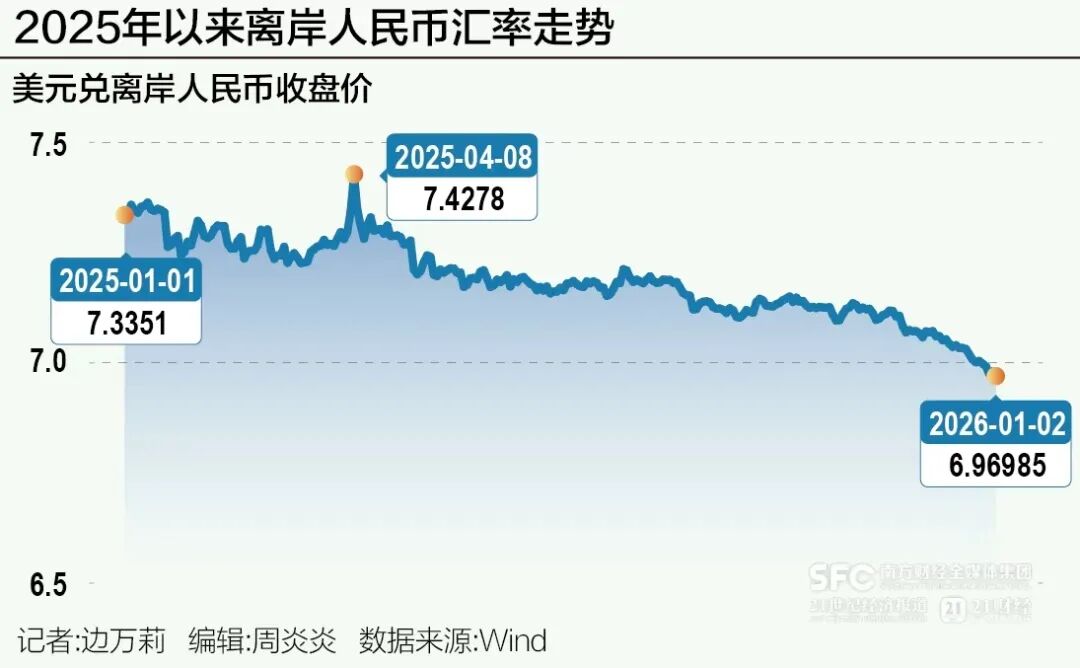
Core Viewpoint - The RMB/USD exchange rate is expected to experience both appreciation momentum and adjustment pressure in 2026, influenced by various economic factors and external uncertainties [1][8]. Group 1: Exchange Rate Trends - In 2025, the RMB/USD exchange rate exhibited a "weak first, strong later" trend, fluctuating between 7.30 and 7.35 until early April, before turning to an upward trend [1][2]. - By the end of 2025, both offshore and onshore RMB rates broke the psychological barrier of "7", reaching new highs since September 2024 and May 2023, respectively [1][3]. - The appreciation of the RMB is attributed to a weaker USD, stable Chinese economic fundamentals, and increased demand for currency settlement at year-end [1][2][3]. Group 2: Factors Influencing RMB Appreciation - The weakening of the USD is identified as a primary driver for the recent RMB appreciation, with the USD index dropping significantly after peaking above 100 in November [3][6]. - Seasonal factors also play a role, as historical trends show that the RMB tends to appreciate at the end of the year due to increased currency settlement needs from exporters [4][5]. - The strong performance of exports and the attractiveness of RMB-denominated assets have further supported the RMB's rise [6][8]. Group 3: Future Outlook - The People's Bank of China (PBOC) aims to maintain the RMB exchange rate at a reasonable and balanced level, emphasizing the prevention of excessive fluctuations [7][8]. - In 2026, the RMB is likely to experience a dual-directional fluctuation rather than a one-sided trend, with potential appreciation driven by favorable domestic and international conditions [1][8][9]. - Analysts predict that the RMB/USD exchange rate will likely remain within the range of 6.9 to 7.3, influenced by various economic factors and market dynamics [9].
人民币汇率破7背后
2 1 Shi Ji Jing Ji Bao Dao· 2026-01-04 14:56
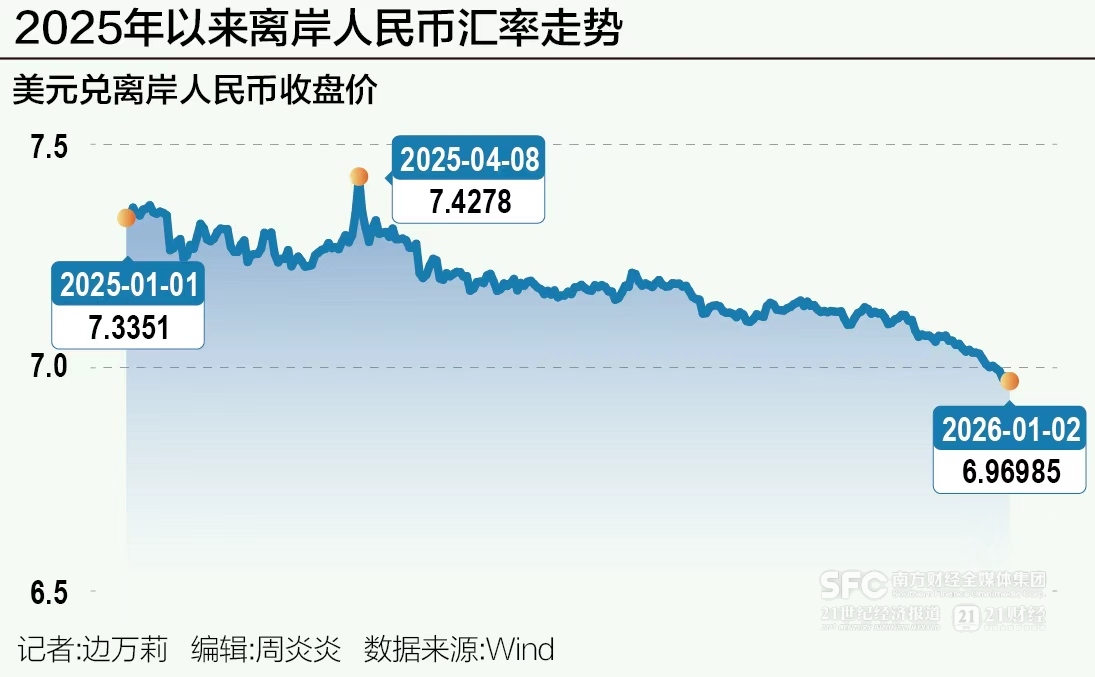
Core Viewpoint - The RMB/USD exchange rate is expected to experience a "weak first, strong later" trend in 2025, with the rate fluctuating between 7.30 and 7.35 until early April, followed by a significant appreciation towards the end of the year, breaking the key psychological level of "7" [1][4][6]. Group 1: Factors Influencing RMB Appreciation - The recent appreciation of the RMB is attributed to multiple factors, including a weakening USD, a stable Chinese economic fundamental, and increased demand for currency settlement at year-end [1][6][8]. - The RMB's rise is supported by the resilience of exports and the attractiveness of RMB-denominated assets, which have contributed to the upward pressure on the currency [8][10]. - The correlation between the USD index and the RMB exchange rate indicates that a 3% depreciation in the USD typically corresponds to a 1% appreciation in the RMB, highlighting the impact of USD movements on RMB valuation [6][8]. Group 2: Seasonal and Market Dynamics - Seasonal factors also play a role in the RMB's appreciation, with historical trends showing stronger appreciation at the end of the year due to increased settlement needs from exporters [7][8]. - The end-of-year settlement demand from export enterprises has been identified as a significant driver for the RMB's rise, as companies accelerate currency conversion to avoid exchange losses [8][10]. - The market sentiment has shifted, with previously bearish views on the RMB reversing as Chinese assets become more attractive compared to US assets, leading to a reversal of previously held foreign capital [8][10]. Group 3: Outlook for 2026 - The People's Bank of China (PBOC) aims to maintain the RMB exchange rate at a reasonable and balanced level, emphasizing the prevention of excessive fluctuations and the need for a stable monetary policy [10][11]. - Factors that may support the RMB in 2026 include a potential weakening of the USD due to economic pressures and a rebound in the Chinese economy, which could sustain the RMB's appreciation momentum [11][12]. - The RMB is expected to maintain a dual-directional fluctuation pattern, with projections indicating a trading range between 6.9 and 7.3 against the USD throughout 2026 [12].
深度|人民币“破7”冷思考
2 1 Shi Ji Jing Ji Bao Dao· 2026-01-04 14:18
Core Viewpoint - The RMB/USD exchange rate is expected to exhibit a "weak first, strong later" trend in 2025, with a significant appreciation towards the end of the year, breaking the key psychological level of "7" due to multiple factors including a weakening dollar and a stable Chinese economy [1][5][10]. Group 1: Exchange Rate Trends - From early 2025 to early April, the RMB/USD exchange rate fluctuated weakly around 7.30-7.35, before turning to a trend of appreciation starting in April [1][4]. - By December 25, the offshore RMB broke the 7 mark, reaching a new high since September 2024, while the onshore RMB also surpassed 7.0, marking its highest level since May 2023 [4][5]. - The RMB's appreciation is attributed to a weakening dollar, a stable economic performance in China, and increased demand for currency settlement at year-end [5][6]. Group 2: Factors Influencing Exchange Rate - The weakening of the dollar is identified as a primary driver for the RMB's appreciation, with the dollar index dropping significantly in the latter part of 2025 [5][6]. - Seasonal factors also play a role, as historical trends show that the RMB tends to appreciate at the end of the year due to increased settlement needs from exporters [6][7]. - The interplay between the RMB's appreciation and the settlement behavior of export enterprises creates a positive feedback loop, further supporting the currency's strength [7][8]. Group 3: Future Outlook - The People's Bank of China aims to maintain the RMB's stability at a reasonable and balanced level, with a focus on preventing excessive fluctuations and ensuring a dual-directional volatility in the exchange rate [8][9]. - In 2026, the RMB is expected to experience dual-directional fluctuations, influenced by the relative strength of the US and Chinese economies, changes in dollar interest rates, and the evolution of China's foreign trade relationships [1][10]. - Analysts predict that the RMB will likely remain within the range of 6.9-7.3, with various factors contributing to its stability and potential appreciation [10][11].
人民币汇率破7背后
21世纪经济报道· 2026-01-04 14:18
Core Viewpoint - The article discusses the "weak then strong" trend of the RMB against the USD in 2025, highlighting a significant appreciation towards the end of the year due to multiple factors including a weakening USD, stable Chinese economic fundamentals, and increased demand for currency settlement [1][5][6]. Summary by Sections RMB Exchange Rate Trend - In 2025, the RMB/USD exchange rate showed a "weak then strong" trend, fluctuating around 7.35 until early April, before reversing to an upward trend [5][6]. - By December 25, the offshore RMB broke the 7 mark, reaching a new high since September 2024, while the onshore RMB also surpassed 7.0, marking the highest level since May 2023 [6][7]. Factors Driving RMB Appreciation - The appreciation of the RMB is attributed to a weaker USD, a resilient Chinese economy, and increased year-end currency settlement demands [6][7][9]. - The correlation between the USD index and RMB exchange rate indicates that for every 3% depreciation of the USD, the RMB appreciates by approximately 1% [7][8]. Seasonal and Market Dynamics - Seasonal factors contribute to RMB appreciation, particularly at year-end when exporters have higher settlement needs, which boosts demand for RMB [8][9]. - The article notes that the strong performance of exports and the attractiveness of RMB-denominated assets also play significant roles in the recent appreciation [9][10]. Future Outlook for 2026 - The outlook for 2026 suggests that the RMB will likely experience two-way fluctuations rather than a one-sided trend, influenced by the relative strength of the US and Chinese economies, changes in USD interest rates, and the evolution of China's foreign trade relationships [1][11][12]. - Analysts predict that the RMB will maintain a stable range between 6.9 and 7.3, with potential for appreciation if the USD continues to weaken [13][14].

年初人民币冲高!2026年有望偏强运行,单边走势难持续
Bei Jing Shang Bao· 2026-01-04 12:24
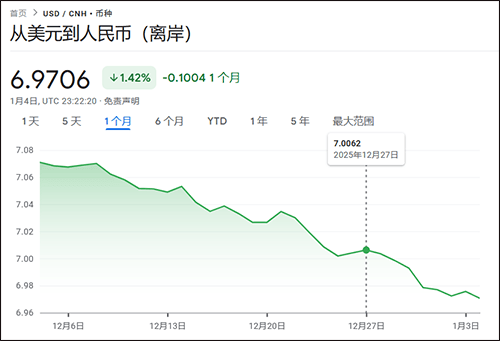
北京商报讯(记者 岳品瑜 董晗萱)新年伊始,人民币延续上年末升值走势。2026年1月2日,离岸人民币对 美元汇率时隔两年半首次升破6.97,最高升至6.9664,创2023年5月以来新高。 数据显示,在岸人民币对美元全年累计涨幅约为4.3%,离岸人民币累计升值幅度4.9%;人民币对美元中间价 总计调升1596个基点。 不过同时可以看到,2025全年CFETS等三大人民币对一篮子货币汇率指数分别比上年末下降2.2%至3.8%。东 方金诚首席宏观分析师王青解释道,这种分化背后的主要原因在于,包括美国在全球范围内大幅加征关税在 内,2025年特朗普政府上台后推出一系列重大内外政策,市场对美元信心出现动摇,全年美元指数下跌 9.4%。这就导致2025年非美货币对美元普遍升值,也推升了人民币对美元汇价。这样来看,2025年4月以来 人民币对美元汇价从7.35一路升值到"破7",主要是美元大幅走低带来的被动升值效应所致。2025年人民币对 美元中间价升值2.2%,升值幅度明显低于在岸、离岸市场汇价,波动幅度较小,主要源于中间价在汇市波动 加剧阶段有效发挥了稳汇价作用。 展望未来,王青预测,考虑到春节前企业结汇需求有可能持 ...

管涛:人民币汇率升值加快,但结汇潮仍缺乏数据支持|立方大家谈
Sou Hu Cai Jing· 2026-01-04 11:04
Core Viewpoint - The foreign exchange market in China showed signs of stability in November 2025, with the RMB appreciating against the USD, while market expectations remained stable despite fluctuations in the USD index and interest rate predictions from the Federal Reserve [1][2]. Exchange Rate Trends - In November, the USD index fell by 0.3% to 99.4, while the RMB appreciated, with the onshore spot rate rising by 341 basis points to 7.0794, marking a new high since mid-October 2024 [1] - The RMB's appreciation trend continued, with the average spot exchange rate increasing for the ninth consecutive month, up 0.9%, the highest in four months [2] - The RMB multilateral exchange rate index continued to rise, although the rate of increase slowed compared to previous months [3] Cross-Border Capital Flows - There was a significant decrease in the net inflow of cross-border capital, with the surplus from bank foreign exchange payments dropping from $51.1 billion to $17.8 billion [9] - The trade surplus in goods increased to $111.7 billion, the third highest on record, despite a widening gap with foreign exchange payment surpluses [9] - Foreign investment in RMB-denominated bonds continued to decline, with a reduction of 116.7 billion RMB, marking the seventh consecutive month of decrease [10] Market Participation and Sentiment - Foreign investors showed a cautious approach towards the Chinese stock market, with net outflows reaching $6.9 billion in November, indicating a lack of confidence [10][11] - Despite the cautious sentiment, international institutions have raised their economic growth forecasts for China, suggesting potential future inflows into the market [11] Currency Management and Corporate Behavior - Companies have increasingly utilized foreign exchange derivatives to manage currency risk, with the scale reaching $1.75 trillion, and the hedging ratio rising to 30.2%, a historical high [2] - The willingness of market participants to convert currencies remains weak, with foreign exchange deposits reaching a record high of $879.4 billion [19] Policy and Economic Outlook - The central economic work conference emphasized maintaining the RMB exchange rate at a reasonable and balanced level, reflecting a shift in policy focus towards stability [29] - The International Monetary Fund (IMF) suggested that China's low inflation relative to trading partners has led to a significant depreciation of the real exchange rate, recommending more expansive macroeconomic policies [28]
国联民生宏观:人民币交易指南2026
Xin Lang Cai Jing· 2026-01-04 09:37
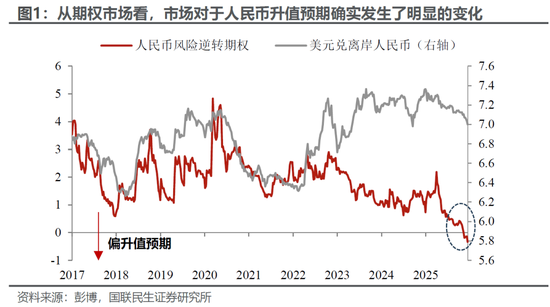
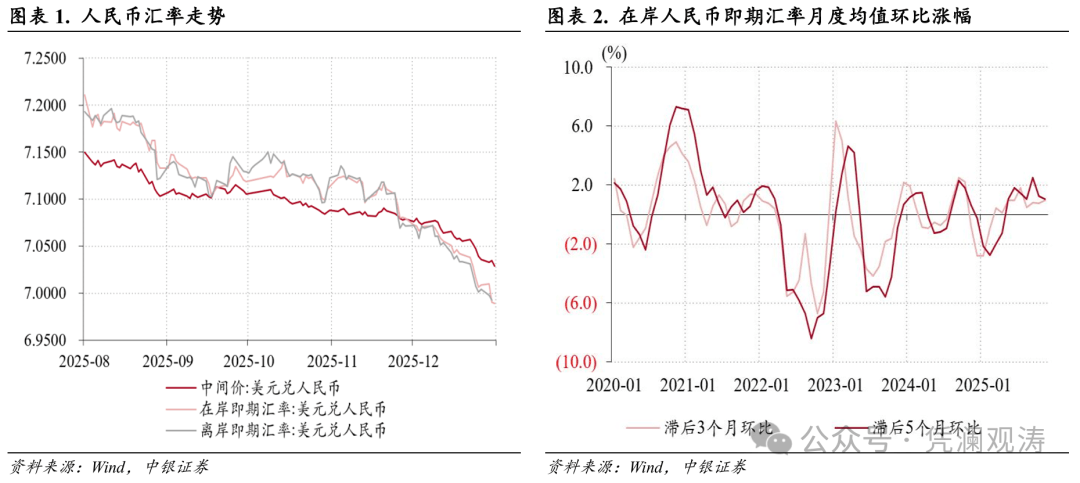
Core Viewpoint - The RMB exchange rate is expected to trend back to the "6" range in 2026, which could significantly impact the economy, policies, and market logic, marking a shift from 2025 when the exchange rate expectations began to change [1][44]. Group 1: RMB Exchange Rate Assessment - Evaluating whether the RMB is overvalued or undervalued is complex and can yield different conclusions based on various dimensions [3][46]. - The financial market and asset price dimensions suggest that the current appreciation of the RMB may be reasonable, as the US dollar index has dropped over 10% since its peak in January 2025 [3][46]. - The narrowing of the 2-year China-US interest rate differential by approximately 110 basis points since the beginning of the year indicates a decrease in the attractiveness of the RMB as a financing currency [4][47]. Group 2: Trade Dimension - The trade perspective supports the argument for RMB undervaluation, especially given China's strong export performance in recent years [7][51]. - The RMB exchange rate index remains at a relatively low level compared to recent years, despite its appreciation against the US dollar [7][51]. - There is a positive correlation between RMB depreciation and the expansion of bilateral surplus shares, indicating that trade dynamics are closely linked to exchange rate movements [7][51]. Group 3: Inflation Impact - The significant gap between the nominal effective exchange rate and the real effective exchange rate since 2022 reflects lower domestic inflation compared to global levels [11][54]. - The real exchange rate is a crucial indicator of a country's export price competitiveness, with lower real exchange rates generally favoring exports [15][58]. - Maintaining a stable real effective exchange rate while allowing for slight nominal depreciation could help avoid unnecessary trade frictions and manage surpluses effectively [15][58]. Group 4: Central Bank's Role in Exchange Rate Management - Historical patterns suggest that the RMB may experience significant appreciation during periods of US dollar depreciation, with the central bank likely to intervene to maintain stability [17][25]. - The central bank's approach to managing the exchange rate involves a balance of maintaining stability while allowing for necessary adjustments based on market conditions [17][27]. - The central bank has been gradually increasing its efforts to manage the RMB's appreciation, particularly in response to rapid increases in the exchange rate [25][27]. Group 5: Market Impact of Exchange Rate Changes - The market has adapted to the constraints imposed by RMB depreciation on monetary policy and liquidity, with expectations of a shift in sentiment during periods of appreciation [31][33]. - Generally, a normal appreciation of the RMB is associated with economic growth, positively impacting the stock market while potentially putting pressure on the bond market [35][36]. - In contrast, during periods of excessive appreciation, the stock market may underperform due to negative economic impacts, while the bond market could benefit [36][37].