
AI硬件

Search documents
招商策略:10月重点关注五大具备边际改善的赛道
Zheng Quan Shi Bao Wang· 2025-10-20 15:03
Core Insights - The article emphasizes the importance of focusing on five key sectors in October that show marginal improvements: AI applications, AI hardware, electrical equipment, non-ferrous metals, and innovative pharmaceuticals [1] Sector Summaries - **AI Applications**: This sector is highlighted for its potential growth and improvements in the short term [1] - **AI Hardware**: Similar to AI applications, this area is expected to see marginal enhancements, making it a focal point for investment [1] - **Electrical Equipment**: The electrical equipment sector is identified as another area with potential for improvement, warranting attention from investors [1] - **Non-Ferrous Metals**: This sector is also noted for its marginal improvements, indicating possible investment opportunities [1] - **Innovative Pharmaceuticals**: The innovative drug sector is recognized for its potential growth, making it a key area for investment focus [1]
深指、创业板收跌超3%,近4800只个股下跌
Sou Hu Cai Jing· 2025-10-17 07:35
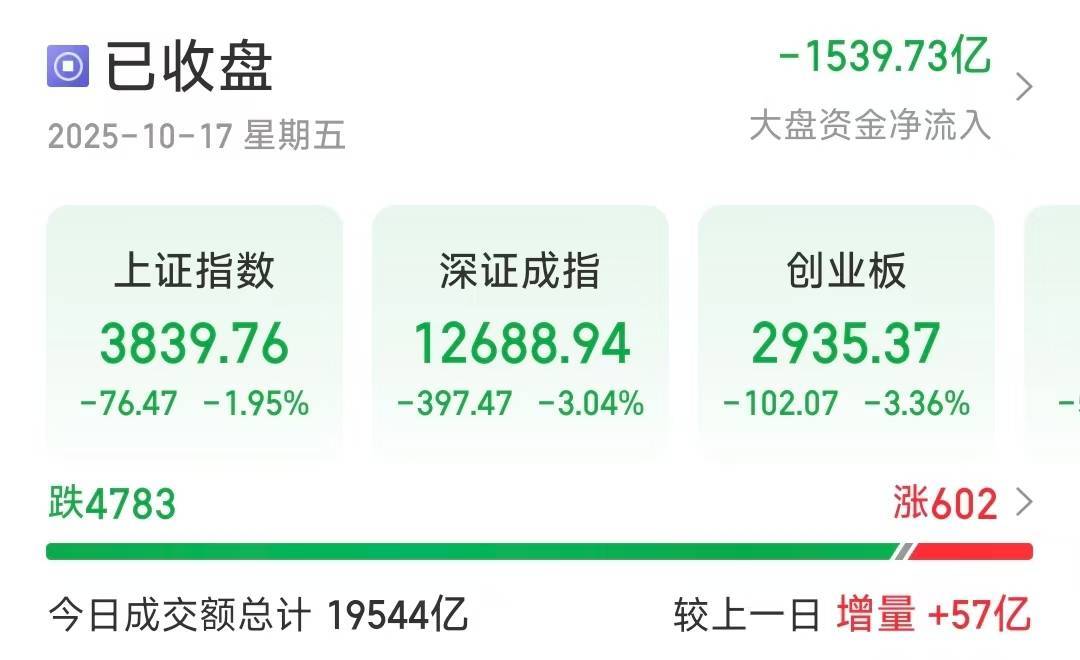
Market Overview - The A-share market continues to adjust, with the Shanghai Composite Index falling by 1.95%, dropping below 3900 points, while the Shenzhen Component Index and the ChiNext Index decreased by 3.04% and 3.36% respectively [1] - The total trading volume in the Shanghai and Shenzhen markets was 1.95 trillion yuan, marking the second consecutive trading day below 2 trillion yuan [1] Sector Performance - The Hainan sector experienced a brief surge in the afternoon, with Haixia Co. hitting the daily limit, Hainan Airport rising over 5%, and Hainan Highway and Hainan Shipping Group also seeing significant gains [1] - The Ministry of Finance and other departments announced adjustments to the duty-free shopping policy for travelers in Hainan, set to take effect on November 1 [1] New Energy Sector - The new energy sector faced a significant pullback, with solar energy, charging piles, and energy storage experiencing collective declines. Notable stocks such as Igor, Kelu Electronics, and Tongrun Equipment hit the daily limit down, while Sunshine Power dropped by 10% and EVE Energy fell by nearly 9% [1] - Popular concepts in consumer electronics, HBM, liquid cooling, and copper-clad boards also saw substantial adjustments, with multiple stocks including ZTE Communications, Deep Technology, Huazheng New Materials, and Invec hitting the daily limit down [1] - A total of 4783 stocks in the market experienced declines [1]



OPPO 发布年度旗舰Find X9系列,打造全新一代“旅拍神器”
Jing Ji Wang· 2025-10-17 07:00
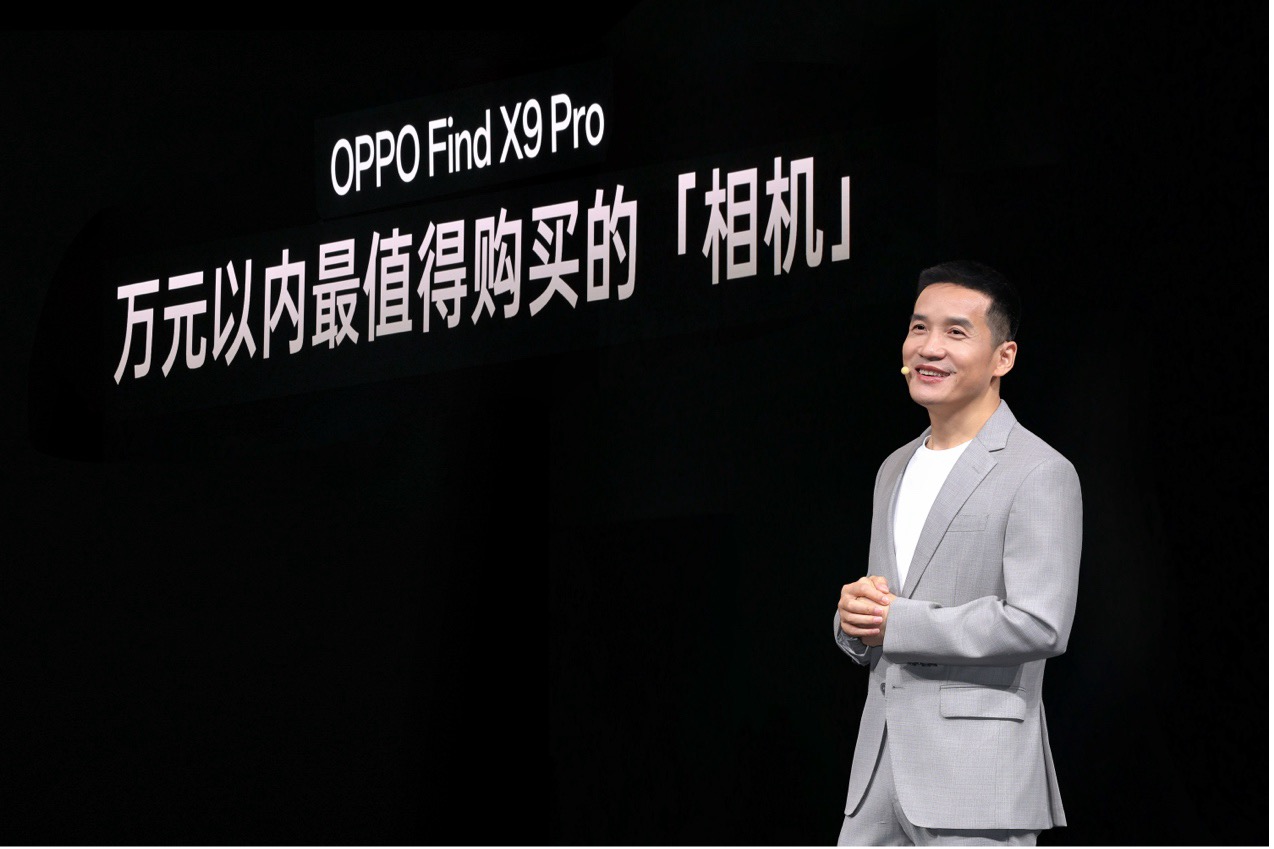
Core Viewpoint - OPPO has launched the Find X9 series, emphasizing significant upgrades in imaging, battery life, display, and interaction, marking a milestone in the company's 30-year history [1] Imaging Technology - The Find X9 series introduces Hasselblad 8K ultra-clear photos, allowing users to capture high-quality images without additional operations, addressing the issue of pixelation in high-resolution photos [3] - The Find X9 Pro features a groundbreaking "Hasselblad True 200 Million" long-focus lens, utilizing AOA active optical calibration technology to enhance resolution by 15% [4] - The series incorporates the LUMO super pixel engine for processing up to 200 million pixels, enabling high-quality images that can rival top medium-format cameras [4] - OPPO has deepened its collaboration with Hasselblad, introducing a professional imaging kit that supports up to 40X optical zoom, enhancing the experience for concert photography [5] Color and Video Capabilities - The Find X9 Pro is equipped with advanced fourth-generation color restoration technology, ensuring accurate color representation across various lighting conditions [7] - The series supports 4K 120fps Dolby Vision and 10bit Log video recording, catering to professional content creators [8] Performance and Battery Life - The Find X9 series is powered by the Dimensity 9500 chip, featuring a large capacity battery of 7500 mAh for the Pro model, utilizing self-developed materials for enhanced longevity [11] - The series includes a self-developed communication chip for optimized network connectivity during travel [11] Display Technology - The Find X9 series features a groundbreaking 1nit eye-care display, significantly improving visibility in low-light conditions [12] Software and User Experience - The series debuts with ColorOS 16, enhancing performance and connectivity across devices, including seamless integration with Apple products [13] Design and Durability - The Find X9 series showcases a refined design with a focus on comfort and durability, featuring IP66/68/69 water resistance and SGS five-star drop resistance certification [13] Pricing and Availability - The starting price for the Find X9 series is 4399 yuan, with the Hasselblad professional imaging kit priced at 1699 yuan [14]
创业板跌超3%,银行股逆势飘红,中兴通讯跌停,恒科指跌超3%,沪金突破千元大关
Sou Hu Cai Jing· 2025-10-17 06:49
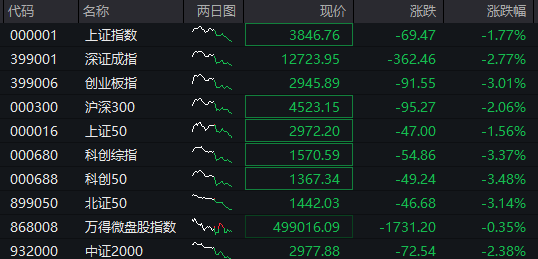
Market Overview - A-shares continued to decline in the afternoon, with the Shanghai Composite Index down nearly 2% and the ChiNext Index down over 3% [1] - The Hang Seng Index fell over 3%, with tech stocks and semiconductor shares experiencing widespread declines [1][4] - Government bonds rebounded, with the 30-year futures contract rising nearly 0.6% [2][3] Sector Performance - The banking sector showed resilience, with several banks, including Agricultural Bank of China, hitting new highs [1][24][31] - New energy sectors, including photovoltaic and energy storage concepts, saw significant declines, with stocks like Shenghong Co. and Igor falling to their limits [17][18] - Semiconductor stocks also faced pressure, with major players like SMIC and BYD Electronics dropping significantly [10][12][20] Commodity Market - Domestic commodity futures showed divergence, with gold prices surging over 3% due to international price increases, while other commodities like lithium carbonate and coking coal also saw gains [2][5][38] - The gold futures contract broke the 1000 yuan mark, marking a significant increase of over 60% year-to-date [8] Trading Volume and Market Sentiment - The overall market sentiment was bearish, with approximately 4000 stocks in the Shanghai and Shenzhen markets declining [14][22] - The trading volume decreased, with the total market turnover dropping by 32.6 billion yuan compared to the previous trading day [14] Notable Stock Movements - ZTE Corporation hit the daily limit down with a trading volume exceeding 14.8 billion yuan, while its Hong Kong counterpart fell over 12% [6] - Major tech stocks like Baidu and Alibaba also experienced declines of over 3% [11][12]


ETF午评 | A股三大指数集体下跌,新能源板块跌幅居前,储能电池ETF跌5%,黄金ETF涨3.22%,消电ETF跌3.69%
Sou Hu Cai Jing· 2025-10-17 04:50
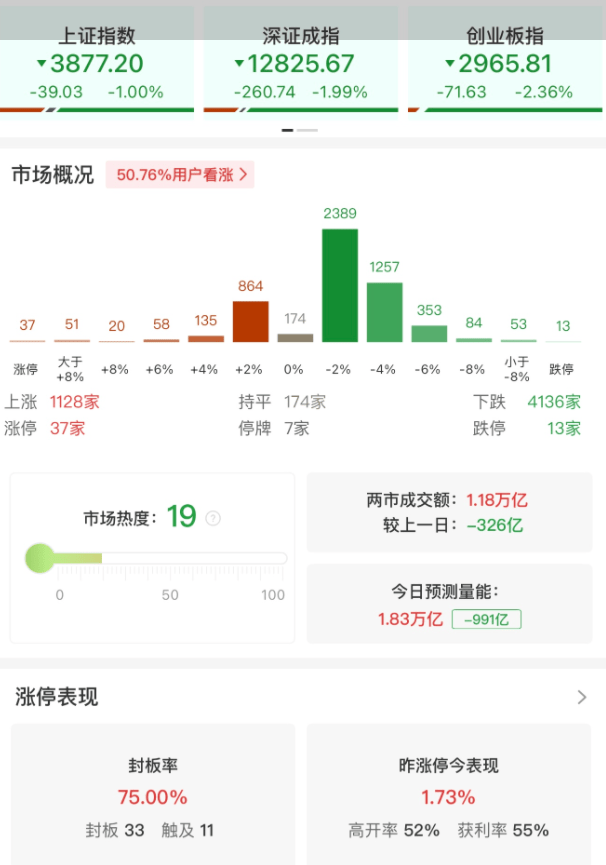
Market Overview - The three major A-share indices experienced a collective decline in the morning session, with the Shanghai Composite Index down by 1%, the Shenzhen Component Index down by 1.99%, and the ChiNext Index down by 2.37% [1] - The total trading volume in the Shanghai, Shenzhen, and Beijing markets reached 1.189 trillion yuan, a decrease of 34 billion yuan compared to the previous day [1] - Over 4,100 stocks in the market fell, indicating a broad-based decline [1] Sector Performance - The photovoltaic, energy storage, and charging pile concepts saw significant declines, with the leading energy storage battery ETF and photovoltaic ETF down by 5.07% and 4.96%, respectively [4] - The AI hardware sector also experienced a widespread pullback, with related stocks collectively retreating [1] - Conversely, the Fujian sector and gas stocks performed well, with the latter reaching historical highs [1] ETF Performance - International gold prices reached new highs for five consecutive days, leading to gains in gold ETFs, with Huaan Fund's gold ETF and Bank of China Shanghai Gold ETF rising by 3.22% and 3.21%, respectively [3] - Gold stocks also showed strong performance, with various gold stock ETFs increasing by 1.59%, 1.44%, and 1.37% [3] - Dividend strategy ETFs saw slight increases, with the China Construction Bank's CSI 300 Dividend ETF and the low-volatility dividend ETF rising by 0.62% and 0.57%, respectively [3]
ETF午评 | 新能源板块跌幅居前,储能电池ETF跌5%
Ge Long Hui· 2025-10-17 04:05
Market Overview - The three major A-share indices collectively declined in the morning session, with the Shanghai Composite Index down by 1%, the Shenzhen Component Index down by 1.99%, and the ChiNext Index down by 2.37% [1] - The total trading volume in the Shanghai, Shenzhen, and Beijing markets reached 11,890 billion yuan, a decrease of 340 billion yuan compared to the previous day [1] - Over 4,100 stocks in the market experienced declines [1] Sector Performance - The new energy sector saw a significant downturn, with photovoltaic, energy storage, and charging pile concepts leading the declines [1] - AI hardware-related stocks also faced widespread declines, including copper-clad laminates, liquid cooling, and HBM concepts [1] - The Fujian sector performed well against the trend, with banking and gas stocks also showing resilience, while Agricultural Bank reached a historical high [1] ETF and Commodity Performance - International gold prices reached new highs for five consecutive days, with Huaan Fund's Gold ETF and Bank of China Shanghai Gold ETF rising by 3.22% and 3.21% respectively [1] - Gold stocks performed strongly, with ICBC Credit Suisse Fund's Gold Stock ETF, Yongying Fund's Gold Stock ETF, and Huaxia Fund's Gold Stock ETF increasing by 1.59%, 1.44%, and 1.37% respectively [1] - Dividend strategy ETFs saw slight increases, with Jianxin Fund's CSI 300 Dividend ETF and Dividend Low Volatility ETF rising by 0.62% and 0.57% respectively [1] Specific Sector Declines - The new energy sector faced substantial declines, with the energy storage battery ETF and photovoltaic ETF leading the drops at 5.07% and 4.96% respectively [1] - The consumer electronics sector also declined, with the consumer electronics ETF falling by 3.69% [1]
国产Scale-up/Scale-out硬件商业化提速,聚焦AI运力产业投资机遇 | 投研报告
Zhong Guo Neng Yuan Wang· 2025-10-16 01:55
Core Insights - The report highlights the growing demand for Scale up switching chips in data centers, with a projected global market size nearing $18 billion by 2030 and an annual CAGR of approximately 28% from 2022 to 2030 [1][3] - The development of AI hardware capabilities is driven by three key components: computing power, storage capacity, and communication capacity, with a focus on domestic solutions for communication capacity [2] - The traditional computing architecture is insufficient for the demands of AI training, leading to the trend of super nodes and large clusters, which significantly boost the demand for Scale up hardware [3] Industry Trends - The collaboration of computing power, storage, and communication is essential for enhancing AI hardware capabilities, with a particular emphasis on domestic advancements in communication capacity [2] - The emergence of super nodes is reshaping the market, as they enhance single-node computing capabilities and drive the demand for Scale up hardware [3] - Different communication protocols are being developed for Scale up and Scale out scenarios, with major companies focusing on proprietary protocols while smaller firms promote public protocols [4] Market Opportunities - The low domestic production rate of communication hardware presents a significant opportunity for domestic companies to fill the gap, particularly in the switching chip market where major players like Broadcom and Marvell dominate [5] - Companies such as Shudao Technology and Shengke Communication are making strides in product commercialization, indicating a growing domestic market for communication hardware [5] - Investment opportunities are identified in companies benefiting from PCIe hardware and Ethernet hardware, including Wantong Development and ZTE [6]
苹果M5「夜袭」高通英特尔,AI算力狂飙400%,Pro三剑客火速上新
3 6 Ke· 2025-10-16 00:39
Core Insights - Apple has quietly launched three new products featuring the new M5 chip: the 14-inch MacBook Pro, iPad Pro, and Vision Pro, maintaining the same pricing as the previous M4 versions while significantly enhancing AI capabilities [1][12]. Group 1: MacBook Pro - The new 14-inch MacBook Pro is highlighted as the main product, showcasing the M5 chip's capabilities [3]. - The M5 chip is manufactured using a third-generation 3nm process, resulting in major upgrades in AI performance, graphics processing, neural network engine, and energy efficiency [5]. - Graphics performance has improved by 45%, making the entry-level M5 model highly cost-effective compared to the already strong M4 [8]. - The starting price for the new M5 MacBook Pro is 12,999 yuan, with options for up to 4TB of storage, which is significant for creative professionals [11]. Group 2: iPad Pro - The new iPad Pro features the M5 chip, offering a 3.5 times increase in AI performance compared to the M4 and 5.6 times compared to the M1 [13]. - It supports Wi-Fi 7 technology and has a cellular modem that enhances mobile network speeds by up to 50% [13]. - The iPad Pro is positioned as a professional productivity tool, capable of handling complex tasks in applications like Adobe Illustrator and SketchUp [15]. - Performance metrics show significant improvements in 3D rendering, video transcoding, and AI tasks compared to previous models [17][19]. Group 3: Vision Pro - The Vision Pro, equipped with the M5 chip, enhances its micro-OLED display capabilities, increasing pixel rendering by 10% and refresh rates to 120Hz [25]. - The device has access to over 1 million applications, with more than 3,000 specifically designed for visionOS [27]. - The integration of the R1 chip allows for real-time processing of inputs from multiple sensors, enhancing the overall user experience [28]. - The Vision Pro is being utilized in various industries, including healthcare, to improve efficiency and patient care [32]. Group 4: M5 Chip Features - The M5 chip features a revolutionary 10-core GPU architecture, with each core containing a dedicated neural network accelerator, resulting in over 4 times the peak GPU computing performance compared to the M4 [34][35]. - The unified memory architecture has been expanded by nearly 30%, achieving a bandwidth of 153GB/s, which allows for the execution of large AI models directly on the device [47].


独家丨人人车创始人李健再创业,瞄准智能影像
雷峰网· 2025-10-16 00:30
Core Viewpoint - The article discusses the recent entry of Li Jian, a former CEO of Renrenche and a senior vice president at 58 Group, into the AI hardware sector by establishing Beijing Shantong Intelligent Technology Co., Ltd., focusing on smart imaging that combines software and hardware [3][5]. Company Overview - Beijing Shantong Intelligent Technology Co., Ltd. was established on June 25, 2025, with Li Jian becoming a key member and changing the legal representative from Liu Fengli to himself on August 15, 2025 [4]. - The company also opened a branch in Shenzhen on August 6, 2025, with Li Hui as the head [4]. Leadership Background - Li Jian has a rich background in the internet industry, having worked at Baidu, 58 Tongcheng, and Microsoft Asia Engineering Institute, where he held various significant roles [5]. - He co-founded Renrenche in 2014, leading it to become a leading second-hand car trading platform in China before stepping away in 2020 to explore the food industry [5]. Industry Trends - There is a growing trend of executives from major internet companies transitioning to entrepreneurship in the AI hardware space, with over 20 executives leaving their positions between 2023 and 2025 to pursue this path [6]. - Notable examples include the founders of Looki and Haivivi, who are developing AI wearable devices and toys, respectively, and have secured significant funding from various investment firms [6].

ETF收评 |汽车零部件板拉升,汽车零部件ETF涨4%
Sou Hu Cai Jing· 2025-10-15 08:15
Market Performance - The Shanghai Composite Index rose by 1.22% to close at 3912.21 points, while the Shenzhen Component Index increased by 1.73% and the ChiNext Index surged by 2.36% [1] - Over 4300 stocks showed gains throughout the day, although trading volume decreased by over 500 billion [1] Sector Performance - Strong recovery was observed in sectors such as robotics, electrical equipment, and consumer electronics, with AI hardware also showing signs of stabilization after prior adjustments [1] - Leading sectors included aviation, charging piles, and CRO concepts, while sectors like photolithography machines, rare earths, and seed industry stocks experienced declines [1] ETF Movements - The automotive parts sector saw significant gains, with the Automotive Parts ETF and Automotive Components ETF rising by 4.2% and 3.52% respectively [1] - The Hong Kong medical sector also performed well, with the Hong Kong Medical ETF and Hong Kong Stock Connect Medical ETF increasing by 3.86% and 3.63% respectively [1] - The lithium battery sector strengthened, with the Battery 50 ETF rising by 3.65% [1] - Conversely, the Shanghai 180 ETF index fell by 3%, and the Science and Technology Innovation 50 ETF from Invesco decreased by 1.47% [1] - Rare metals ETFs and rare metals ETF funds both declined by 1% [1]