
实体经济

Search documents
浙商银行合肥分行助力企业跨境融资落地
Zhong Guo Jin Rong Xin Xi Wang· 2025-09-19 11:51
Core Viewpoint - Zhejiang Merchants Bank Hefei Branch successfully provided a total of 300 million yuan in "Internal Guarantee Free Trade Loans" to Anhui Jiatong Radial Tire Co., Ltd, addressing the company's overseas funding needs and supporting its international sales recovery [1][1]. Company Summary - Anhui Jiatong Radial Tire Co., Ltd is one of the three major production bases established by Jiatong Group in China, with annual sales revenue exceeding 5 billion yuan and products exported to over 130 countries and regions [1][1]. - The company is the largest tire production base of the group within China and represents a significant player in the internationalization of Chinese manufacturing [1][1]. Financial Service Summary - Zhejiang Merchants Bank Hefei Branch actively recommended "Internal Guarantee Free Trade Loans" and "Cross-Border Asset Pools" after thoroughly understanding the company's situation, providing comprehensive services from account opening to financing implementation [1][1]. - The collaboration has been positively received by Anhui Jiatong Radial Tire Co., Ltd, highlighting the efficiency and attentiveness of the bank's services, which has strengthened the company's confidence in future cooperation [1][1]. Industry Development Summary - This collaboration marks another beneficial exploration by Zhejiang Merchants Bank Hefei Branch in the field of cross-border financial services for the manufacturing industry [1][1]. - The bank aims to continue leveraging its professional advantages to prioritize financial consumers and support the high-quality development of the local manufacturing sector [1][1].

青农商行(002958) - 002958青农商行投资者关系管理信息20250918
2025-09-18 10:48
Group 1: Credit Strategy and Focus - The bank will continue to focus on supporting the real economy and rural revitalization, increasing credit investment in agriculture and small micro enterprises [2] - Emphasis on "supporting agriculture and small businesses" as the main strategic positioning, with ongoing adjustments to credit structure to align with financial industry trends [2] Group 2: Services for Small and Micro Enterprises - The bank aims to enhance the quality and efficiency of financial services for small and micro enterprises through systematic measures [2] - Specific initiatives include ensuring a dedicated credit plan for small and micro enterprises, promoting the "Thousand Villages and Ten Thousand Households" initiative, and improving service reach [2][3] Group 3: Risk Management and Innovation - Implementation of a due diligence exemption system and risk tolerance for small micro loans to boost confidence among loan officers [3] - Focus on product innovation and scenario marketing to enhance the accessibility of financial products for small and micro enterprises [3] Group 4: Digital Transformation - The bank is committed to improving digital lending capabilities by developing online credit products and leveraging digital platforms for inclusive finance [3]

AI加速落地实体经济,蚂蚁数科在外滩大会签约14家机构
Zheng Quan Shi Bao Wang· 2025-09-15 06:18
Group 1 - Ant Group's Ant Technology continues to drive the application of AI technology across various sectors, including energy, data, healthcare, and transportation, showcasing the potential of AI in enhancing the real economy [1][2] - In the data industry, Ant Technology collaborates with the Wuhan Qiaokou District Government to establish a "data industry base" and partners with Shanghai Data Development Technology Co., Ltd. to advance a "high-quality data set project," aiming to improve data circulation efficiency [1] - In the green energy sector, Ant Technology has formed partnerships with multiple companies to promote innovative applications such as virtual power plants and AI models for electricity trading, enhancing the efficiency of the energy industry [1] Group 2 - In smart transportation, Ant Technology collaborates with various companies to enhance two-wheeled transportation technology and deepens cooperation with Nanjing Public Transport Group on a network optimization and passenger flow prediction project [2] - In public services, Ant Technology partners with Jinan Yunhu Gongji Health Management Co., Ltd. to upgrade intelligent traditional Chinese medicine services and develops an "AI digital employment integration machine" with Shanghai Xiaozhuan Network Technology Co., Ltd. to improve employment services [2] - Ant Technology's EnergyTS model has significantly improved efficiency in power generation forecasting and operational strategy generation, enhancing investment decision-making efficiency by over 60 times [2]
新华社权威快报 | 8月企业新发放贷款利率保持历史低位
Xin Hua She· 2025-09-12 11:57
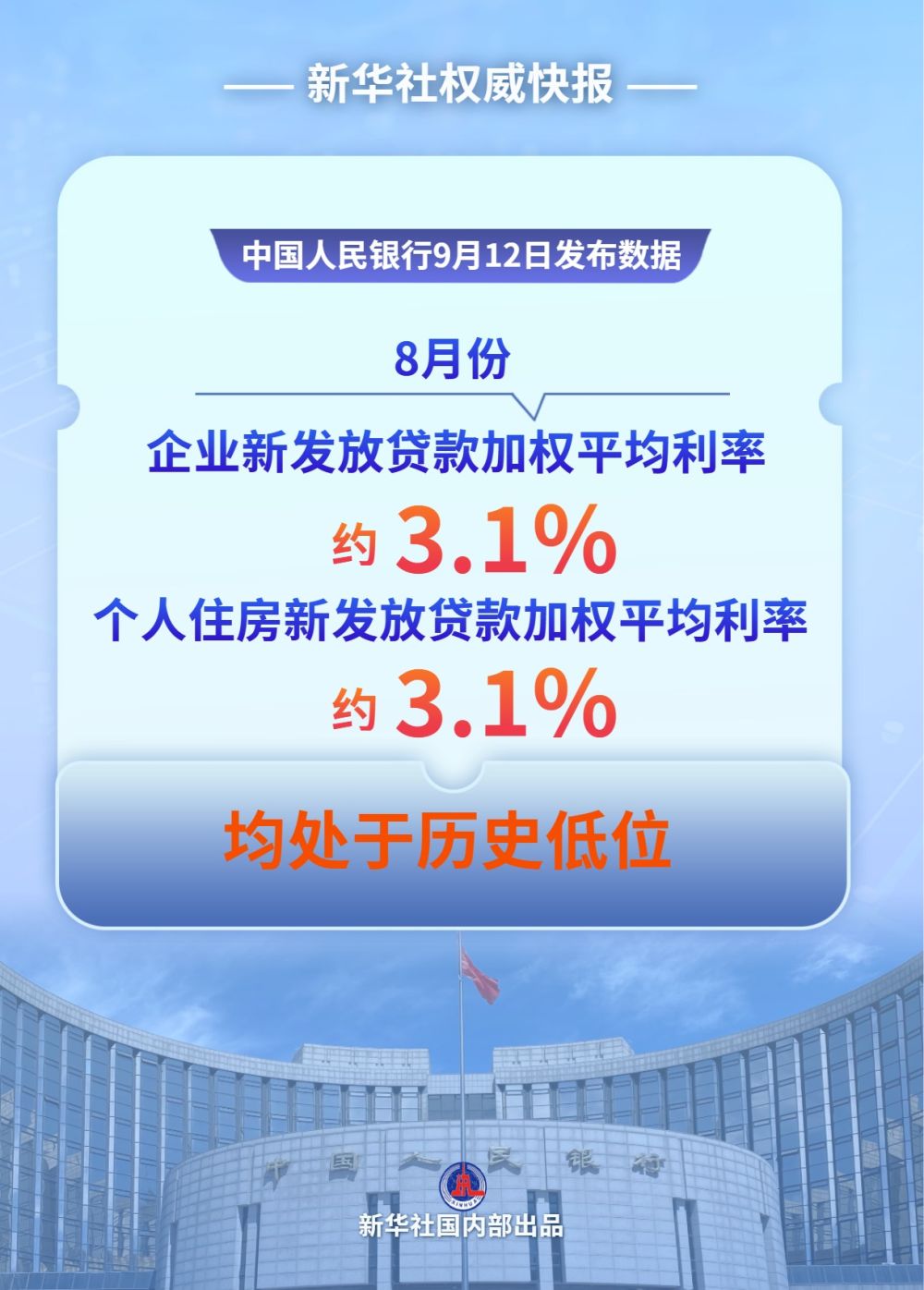
Group 1 - The People's Bank of China reported that the weighted average interest rate for new corporate loans in August was approximately 3.1%, slightly down from the previous month and about 40 basis points lower than the same period last year [2][3] - The weighted average interest rate for new personal housing loans was also around 3.1%, which is 25 basis points lower compared to the same month last year, indicating historically low rates [3] - In the first eight months of the year, the total increase in RMB loans amounted to 13.46 trillion yuan, demonstrating a solid support for the real economy [3] Group 2 - As of the end of August, the broad money supply (M2) balance reached 331.98 trillion yuan, reflecting a year-on-year growth of 8.8%, indicating ample liquidity in the market [3] - The growth rate of social financing remained at a high level, suggesting sustained financial support for economic activities [3]

央行最新发布:8月两大重要金融指标均增8.8% 资金活化进一步提高
Sou Hu Cai Jing· 2025-09-12 11:32
Group 1 - The People's Bank of China reported that in the first eight months, RMB loans increased by 13.46 trillion yuan, and the social financing scale increased by 26.56 trillion yuan, indicating a supportive financial environment for the real economy [1][2] - As of the end of August, the growth rates of social financing stock and M2 remained high at 8.8%, reflecting strong financial support for the real economy [1][3] - The loan growth structure shows that manufacturing loans have significantly increased, with high-tech and equipment manufacturing sectors experiencing a notable rise in financing demand [2][3] Group 2 - The weighted average interest rate for newly issued corporate loans in August was approximately 3.1%, which is 40 basis points lower than the same period last year, indicating a favorable borrowing environment [3] - The narrowing gap between M1 and M2 growth rates suggests improved liquidity and efficiency in the financial system, with M1 growth reaching 6% by the end of August [4][5] - The government's proactive fiscal policies and moderately loose monetary policies have worked together to maintain high financing growth, supporting M2 growth [3][6] Group 3 - Future monetary policy should focus on optimizing the structure of financial support rather than just maintaining total volume, enhancing the ability of financial institutions to support key sectors [6][7] - There is a call for macro policies to address deeper issues, such as improving social security and optimizing tax systems, which can help stabilize the economy in the long term while boosting consumption in the short term [6][7]
传达学习习近平总书记重要讲话重要指示精神研究部署对外开放航空产业链群发展等工作
Xi An Ri Bao· 2025-09-12 03:19
Group 1 - The meeting emphasized the importance of implementing Xi Jinping's recent important speeches and directives, focusing on enhancing the city's international openness and economic level [1][2] - The city aims to leverage its advantages to expand its international "friend circle" and actively participate in international investment and trade, particularly in artificial intelligence and its integration with the real economy [2][3] - There is a strong focus on strengthening the aviation industry chain, optimizing innovation and industrial ecosystems, and enhancing the capabilities of large aircraft support [3] Group 2 - The meeting highlighted the need for effective communication and cooperation with neighboring countries to contribute positively to regional community building [2] - It was noted that the construction of a professional and capable leadership team is essential, with an emphasis on practical performance and results [3] - The meeting also addressed the importance of maintaining social harmony and stability through effective public grievance handling [3]
蚂蚁集团CEO韩歆毅:通证经济的未来必须深深植根于实体经济
Zheng Quan Shi Bao Wang· 2025-09-11 07:59
Core Viewpoint - The CEO of Ant Group, Han Xinyi, emphasized that the token economy must transition from being a mere object of value storage and speculative trading in the virtual world to a tool that addresses trust, efficiency, and cost issues in the real economy to create a sustainable and valuable ecosystem [1] Group 1 - The future of the token economy must be deeply rooted in the real economy to truly unleash its value [1] - The exploration of tokenization should balance the pursuit of value in the token economy with risk prevention [1]
21社论丨加快建设全国统一大市场,治理非理性竞争
2 1 Shi Ji Jing Ji Bao Dao· 2025-09-10 23:05
Group 1 - The Ministry of Industry and Information Technology emphasizes that irrational competition can destroy enterprises and industries overnight, which is intolerable [1] - Irrational competition, particularly "involution-style" competition, has emerged in various sectors in China, leading to disordered competition as the economy transitions to innovation-driven development [1][2] - Price competition is prevalent in low-value-added sectors, while high-value-added sectors rely on technological differentiation and brand building for competitive advantage [1] Group 2 - Non-rational competition leads to a vicious cycle where companies cut production costs and lower product quality to gain price advantages, squeezing profit margins across the industry [2] - This situation not only affects the sustainability of enterprises but also damages consumer trust and distorts resource allocation efficiency, ultimately hindering innovation [2][3] - The transition from high-speed to high-quality development in China necessitates a focus on technological innovation to enhance manufacturing competitiveness and create a modern industrial system with global competitiveness [2][3] Group 3 - Innovation is crucial for economic circulation, driving productivity and creating new industries, which in turn increases household wealth and government revenue for public services [3] - However, widespread irrational competition undermines this cycle by leading to low profits in manufacturing, making it difficult to attract investment for innovation [3] - Addressing irrational competition is essential for the fate of industries and the ability to achieve a new development pattern and establish a self-circulating economy [3]
持续提升产业创新能力 筑牢实体经济发展根基
Ren Min Ri Bao· 2025-09-10 22:13
Group 1 - The core viewpoint emphasizes the integration of technological innovation and industrial innovation to enhance industrial innovation capabilities and develop new quality productivity [1][2] - The focus is on strengthening the role of enterprises in innovation, encouraging increased investment in R&D, and creating a supportive environment for original technology development [1][2] - There is a call to cultivate a gradient nurturing system for leading enterprises with strong core technology capabilities and to promote the growth of specialized and innovative small and medium-sized enterprises [1][2] Group 2 - The emphasis is on leading with technological innovation and grounding in the real economy to continuously advance industrial innovation [2] - There is a need to enhance application-oriented basic research and frontier research to support key common technologies and disruptive technology innovations [2] - The importance of establishing high-level industrial service platforms to improve public service capabilities and accelerate the transformation of innovative achievements into productive forces is highlighted [2]
张国清在四川调研时强调 持续提升产业创新能力 筑牢实体经济发展根基
Xin Hua Wang· 2025-09-10 13:54
其间,张国清还来到四川天味食品集团调研食品安全工作。他强调,要将"四个最严"要求贯穿于食品生 产、流通、储存、消费各环节,抓在日常、严在平时,强化全链条监管,筑牢食品安全防线。 责任编辑:何俊熹 新华社成都9月10日电 中共中央政治局委员、国务院副总理张国清8日至10日在四川调研产业创新等工 作。他强调,要深入贯彻习近平总书记重要指示批示精神,落实党中央、国务院决策部署,推动科技创 新和产业创新深度融合,持续提升产业创新能力,因地制宜发展新质生产力,不断培育高质量发展新动 能新优势。 在成都市和绵阳市,张国清先后来到中国东方电气集团、四川凌空天行科技有限公司、长虹智能制造产 业园等企业,深入实验室、工厂车间,详细了解生产经营、研发创新、转型升级等情况。他强调,要强 化企业创新主体地位,促进各类创新要素向企业集聚,引导企业不断加大技术研发投入,完善激励保障 措施,着力打造原创技术策源地、产业创新生力军。要健全梯度培育体系,培育一批核心技术能力突 出、集成创新能力强的产业领军企业,发展壮大专精特新中小企业,打造更多制造业单项冠军企业、独 角兽企业,形成大中小企业融通创新、协同发展的良好生态。 张国清强调,要以科技 ...