情绪价值

Search documents
Soul App联合上海市青少年研究中心发布情绪消费报告
Sou Hu Cai Jing· 2025-09-05 13:17
Core Insights - The report highlights the rising trend of "emotional consumption" among the Z generation, indicating a shift from material preferences to emotional satisfaction as a primary consumer behavior [1][4][12] - Emotional value is recognized by over 90% of young people, with nearly 60% willing to pay for it, reflecting a significant increase of 16.2% compared to 2024 [4][11][12] Group 1: Emotional Consumption Trends - The report indicates that emotional consumption is becoming a core driver in the Z generation's market, with 56.3% of young consumers engaging in "happy consumption" [11][12] - Monthly spending on emotional consumption averages 949 yuan, with 18.1% of youth willing to spend over 2000 yuan monthly [16][12] - Emotional consumption is often triggered by both positive and negative emotions, with 48.4% of youth actively consuming to stabilize their emotions [30][12] Group 2: Demographics and Preferences - The Z generation, particularly those born after 1995, constitutes about 70% of the respondents, with a notable preference for emotional value derived from social interactions [4][11] - Male consumers tend to seek understanding and recognition, while female consumers are more inclined towards self-reward and self-care [23][24] - The report shows that younger individuals are increasingly willing to pay for social relationships and digital experiences, with the highest average spending in these categories [24][27] Group 3: Emotional Value Perception - Over 70% of young people believe that the standards for obtaining emotional value through consumption are rising, with many seeking more customized and immersive experiences [36][12] - The emotional value is perceived as essential for mental health and life motivation, indicating a shift in consumer priorities towards emotional well-being [12][36] - The report identifies a growing trend where young consumers are more selective, preferring higher quality and more meaningful products [36][12]

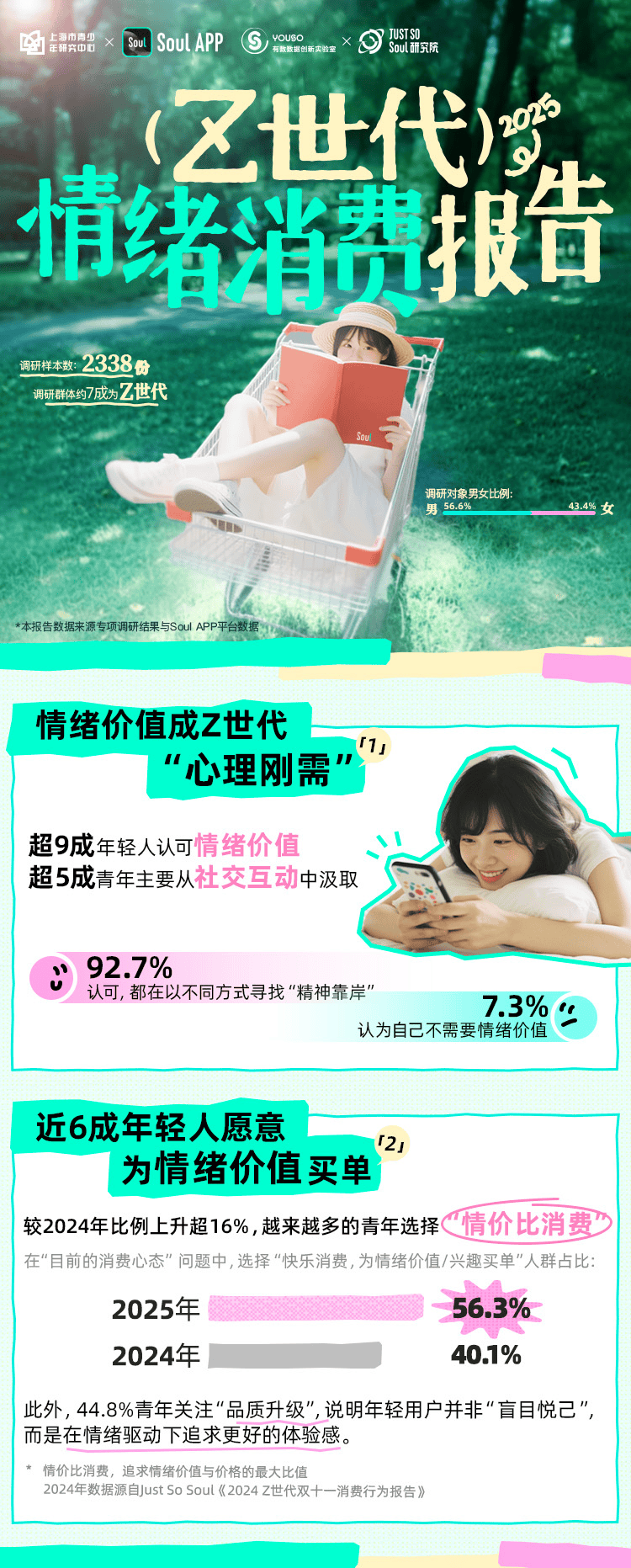
Soul App联合上海市青少年研究中心发布《2025 Z世代情绪消费报告》
Zheng Quan Ri Bao Wang· 2025-09-05 12:49
Group 1 - The report highlights the rising trend of "emotional consumption" among the younger generation, particularly focusing on Generation Z, which includes individuals born after 1995 [1][3] - Over 90% of young people recognize the concept of "emotional value," with nearly 80% attributing this value to understanding and response within intimate relationships [3] - More than 60% of young individuals are willing to pay for emotional value, marking a 16.2% increase compared to 2024, indicating a shift in consumer attitudes [3] Group 2 - The average monthly expenditure on emotional consumption among young people is 949 yuan, with 20% identified as "daily active users" of emotional consumption [3] - The shift from "material preference" to "emotional satisfaction" reflects a new approach to addressing feelings of loneliness, stress, and anxiety, reshaping consumption patterns and creating new market opportunities [3] - The report emphasizes the rational development of emotional consumption perspectives among youth and the importance of building diverse emotional support networks for long-term emotional health resilience [3]
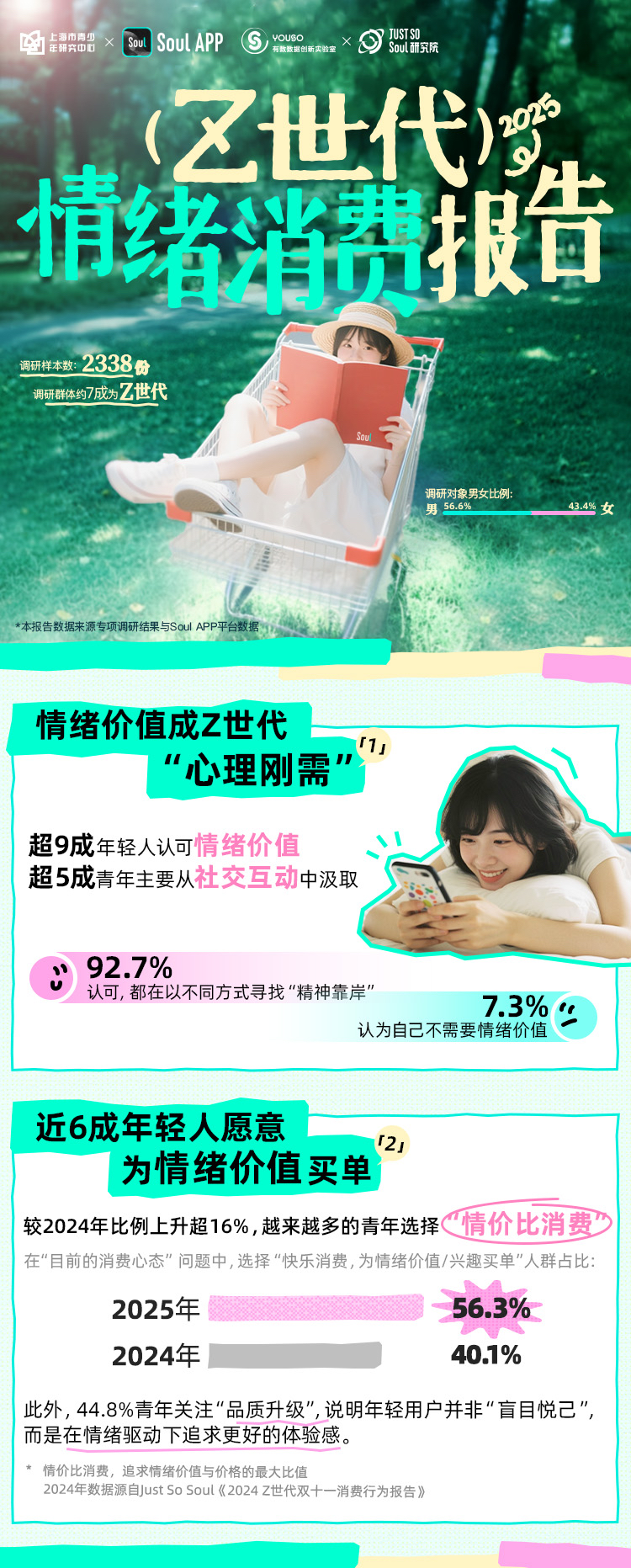
Soul &上海青少年研究中心报告:近6成青年为情绪价值买单
Qi Lu Wan Bao· 2025-09-05 12:22
Core Insights - The report highlights the rising trend of "emotional consumption" among young people, emphasizing the importance of emotional value in their purchasing decisions [1][4] - Over 90% of young individuals recognize the concept of emotional value, with nearly 60% willing to pay for it, indicating a significant shift in consumer attitudes [4][8] Group 1: Emotional Consumption Trends - More than 90% of young people have experienced paying for emotional value, with nearly 40% identified as frequent consumers [12] - The average monthly expenditure on emotional consumption among young people is 949 yuan, with 18.1% willing to spend over 2000 yuan monthly [12] - Emotional consumption is primarily driven by social interactions, with over 50% of young individuals deriving emotional value from these interactions [8][12] Group 2: Demographics and Preferences - The majority of emotional consumers are from the post-90s and post-00s generations, with a higher concentration in new first-tier cities [5][6] - Young individuals with stable incomes are more inclined to engage in emotional consumption, with over 70% indicating a preference for spending on emotional value [6] - Female consumers tend to focus on self-reward and aesthetic appeal, while male consumers seek understanding and recognition through their purchases [17][28] Group 3: Types of Emotional Consumption - The top categories for emotional consumption include physical goods (40.7%), experiential services (39.4%), social relationships (28.1%), and digital products (27.7%) [13][18] - Younger consumers, particularly those born after 2005, show a higher preference for spending on social relationships and digital services [18] Group 4: Changing Standards and Expectations - Over 70% of young people believe that the standards for obtaining emotional value through consumption are rising, with many expressing that ordinary products no longer suffice [28] - There is a growing demand for customized and immersive experiences, with a notable shift towards higher quality and more expensive products [28]
金融业进入AI first时代,场景认知将成重要方向
Di Yi Cai Jing· 2025-09-05 11:51
Core Insights - The application of large models in the financial industry is accelerating, transitioning from concept validation to large-scale implementation in business processes, customer service, and organizational structures [1][2] - Experts at the "Zhaoshang Bank Pujiang Digital Financial Ecosystem Conference" discussed the opportunities and challenges of large models, emphasizing the importance of scene cognition and emerging fields like embodied intelligence and emotional value for integrating AI into core financial operations [1] Industry Developments - The rapid development of domestic large models has led to significant changes in the financial sector, with a notable shift from concept validation to practical applications [2] - OpenAI's release of GPT-5 in August has improved foundational model capabilities, although it has not fully met market expectations [2] - The financial industry is witnessing a revolution in efficiency and scale due to the advent of Agent-based AI, which can operate autonomously [2] Challenges and Solutions - Challenges in implementing large models include the need for precise adaptation to financial business logic, better suppression of hallucinations, and ensuring that technology development aligns with business needs [3] - Key strategies for enhancing the effectiveness of large models in solving professional problems include context engineering, enterprise-level knowledge management, and post-training [3] Future Trends - Future applications of generative models are expected to extend beyond digital content into the physical world, requiring models to possess greater adaptability and generalization capabilities [3] - The financial sector anticipates that once safety, trust, and compliance issues are resolved, AI models can be confidently integrated across various business functions [3] Investment Opportunities - Areas such as embodied intelligence, life sciences, industry models, AI agents, and AI hardware are beginning to generate revenue, indicating significant industry potential [4] - Scene cognition is identified as a crucial direction in the AI-first era, with a shift towards proactive AI that can autonomously understand and respond to environments [4] - The banking sector is moving towards personalized financial services, enabling a "thousand faces" approach where each customer receives tailored services [4] Strategic Initiatives - Many banks have launched AI banking strategies, with institutions like WeBank transitioning to AI-native banks and ICBC reporting that AI will replace over 42,000 jobs annually by 2024 [5] - Zhaoshang Bank has adopted an "AI First" philosophy, prioritizing investments in talent, finance, and computing power, with a significant increase in R&D personnel and technology investment [5]
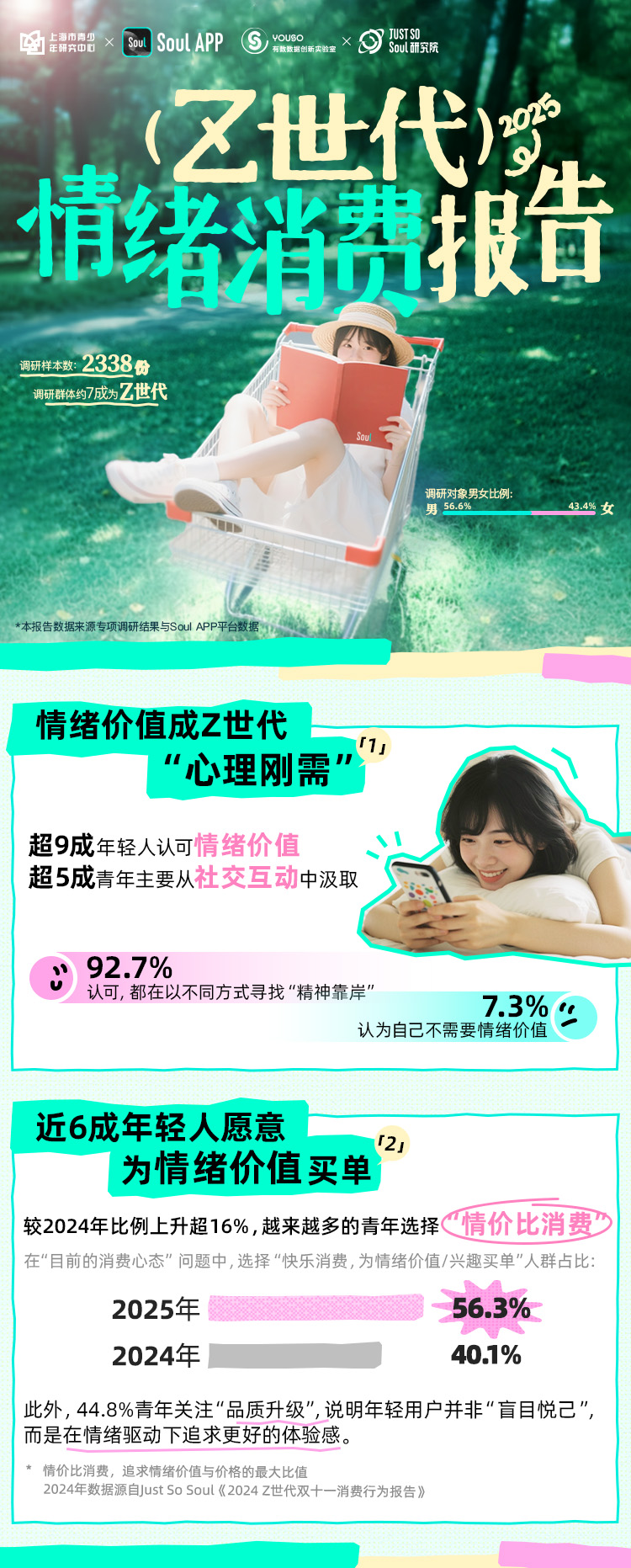
Soul App联合上海市青少年研究中心发布《2025 Z世代情绪消费报告》: 近6成青年愿意为情绪价值买单,较2024年增长16.2%
Bei Jing Shang Bao· 2025-09-05 09:35
Core Insights - The report highlights the rising trend of "emotional consumption" among the Z generation, indicating a shift from material preferences to emotional satisfaction as a primary consumer motivation [1][3][8] Group 1: Emotional Value Recognition - Over 90% of young people recognize "emotional value," with nearly 80% believing it primarily comes from understanding and responding within intimate relationships [3][7] - More than 60% of youth are willing to pay for emotional value, reflecting a 16.2% increase from 2024 [3][7] - The average monthly expenditure on emotional consumption among young people is 949 yuan, with 20% identified as "daily active users" of emotional consumption [11][21] Group 2: Consumption Patterns and Motivations - The key motivations for young people to pay for emotional value include value resonance (37.6%), self-healing (34.2%), and creating a sense of ritual (32.3%) [12][13] - The top categories for emotional consumption include physical goods (40.7%), experiential consumption (39.4%), social relationships (28.1%), and digital consumption (27.7%) [16][12] - Younger individuals (post-2005) show a higher preference for spending on social relationships/services, while those born after 2000 prefer digital consumption [16][19] Group 3: Emotional Consumption Timing and Triggers - Emotional consumption peaks during late-night hours (22:00 and after) and during work breaks, indicating a reliance on consumption for psychological maintenance [20][21] - Young people engage in emotional consumption both to celebrate happiness (34.9%) and to cope with negative emotions (48.4%) [20][21] - The report suggests that emotional consumption serves as a solution for the Z generation to achieve "spiritual self-consistency" amidst societal pressures [21][24] Group 4: Evolving Consumer Expectations - Over 70% of young people believe the threshold for obtaining emotional value through consumption is rising, with many indicating that ordinary products no longer suffice [24] - There is a notable distinction in preferences between genders, with males leaning towards deep interaction and customization, while females are more critical of experiential details [24]
质价比/情绪价值/出海成为新趋势,港股消费ETF(513230)现涨近1%
Mei Ri Jing Ji Xin Wen· 2025-09-05 03:05
Group 1 - The Hong Kong stock market opened higher on September 5, with the Hang Seng Index rising by 0.31% and the Hang Seng Tech Index increasing by 0.42%, driven by strong performance in the technology and new energy sectors [1] - The latest "Automobile Consumption Index" released by the China Automobile Dealers Association indicates that the index for August 2025 is 83.3, higher than the previous month, with expectations for September automobile sales to exceed those of August [1] - September marks the peak season for automobile consumption, driven by wedding and school seasons, as well as increased demand for self-driving trips during the National Day holiday [1] Group 2 - Huachuang Securities reports that the domestic consumption market is entering a new phase characterized by slowing product growth and ongoing service prosperity, with trends focusing on quality-price ratio, emotional value, and overseas expansion, alongside AI applications driving product transformation and efficiency [1] - The current investment themes in the service industry include: 1) Restructuring of offline formats, with supply chain maturity becoming key to success in chain consumption [1] 2) Implementation of AI applications across various scenarios [1] 3) High demand for experiential consumption, particularly in sectors like cultural tourism and sports [1] Group 3 - The Hong Kong Consumption ETF (513230) tracks the CSI Hong Kong Stock Connect Consumption Theme Index, encompassing leading companies in internet e-commerce and new consumption, including Pop Mart, Lao Pu Gold, and Miniso, as well as tech giants like Tencent, Kuaishou, Alibaba, and Xiaomi, highlighting a strong tech-consumption attribute [2]
华创证券:消费市场供需两端酝酿新变 关注线下重塑、AI应用、体验消费三条主线
智通财经网· 2025-09-05 02:21
Core Viewpoint - The domestic consumption market is entering a new phase characterized by slowing product growth and ongoing prosperity in services, with trends such as value-for-money, emotional value, and overseas expansion emerging as key themes [1] Demand Side - Service consumption is overall prosperous, with value-for-money, emotional value, and overseas expansion becoming new trends. The domestic consumption market is experiencing a slowdown in product growth, while service consumption is being emphasized as a crucial driver for overall market growth [1] - Changes in income expectations and generational shifts among consumers are leading to a heightened focus on cost-effectiveness, while also driving demand towards more segmented offerings [1] - The "Guochao" (national trend) brands, which leverage local creativity, are gaining favor among domestic consumers and are expected to lead in establishing brand recognition in overseas markets [1] Supply Side - Offline consumption is accelerating towards chain operations, with local life and comprehensive e-commerce platforms enhancing fulfillment capabilities and deepening integration with offline consumption scenarios [2] - Leading chain dining enterprises are increasingly focusing on vertical integration within their supply chains, while competition is also driven by product-oriented strategies that emphasize differentiated scenarios, services, and content IP [2] - The application of AI is providing new momentum for product transformation and efficiency improvements in sectors such as enterprise services and education [2] Business Models - Service consumption reflects a deep integration of scenarios and services, leading to the emergence of different business models based on the complexity of service content and scenarios [3] - Three main business models are identified: 1. Chain operations focused on organizational efficiency and overall supply chain efficiency 2. Complex standalone operations centered around scarce scenarios and intricate service content 3. Service distribution and empowerment platforms leveraging traffic, scale, and technological advantages [3] - The industry is expected to undergo a reshuffling, with leading companies emerging that can solidify their barriers and potentially navigate through economic cycles [3]
报告:近六成青年愿意为情绪价值买单
Zhong Guo Xin Wen Wang· 2025-09-04 23:20
Core Insights - The report indicates that nearly 60% of young people are willing to pay for emotional value, reflecting a significant shift in consumer behavior towards "emotional consumption" as a new lifestyle and focus in the market [2][3] Group 1: Consumer Behavior - 56.3% of youth choose to engage in "happy consumption" for emotional value or interests, marking a 16.2 percentage point increase compared to 2024 [2] - 44.8% of young people are focused on "quality upgrades," indicating a desire for better experiences driven by emotional needs rather than blind self-indulgence [2] - The average monthly expenditure on emotional consumption among youth is 949 yuan, with 18.1% willing to spend over 2000 yuan monthly [3] Group 2: Motivations and Trends - Core motivations for emotional consumption include emotional tuning and understanding, with significant gender differences: 52.6% of women prioritize happiness and relaxation compared to 42.1% of men [3] - Over 20% of youth are classified as "active emotional consumers," with 43.4% engaging in emotional purchases multiple times a week [3] - Emotional consumption is characterized by three main trends: seeking emotional healing and stress relief, obtaining immediate satisfaction and emotional companionship, and expressing identity within subcultural circles [3] Group 3: Societal Context - The Shanghai Youth Research Center highlights the emotional belonging crisis faced by youth, exacerbated by urbanization and weakened traditional connections [4] - As real-life social interactions fail to provide stable emotional support, youth turn to consumption as a substitute, leading to the notion that "consumption equals companionship" [4] - Promoting rational consumption, enhancing psychological adjustment methods, and building diverse social networks are essential for maintaining the long-term emotional health of youth [4]
开心了买 不开心更要买?Z世代情绪消费月均支出949元
Nan Fang Du Shi Bao· 2025-09-04 15:15
Core Insights - The report highlights the rise of emotional consumption among the "post-95" generation, indicating a 16.2 percentage point increase in young people willing to pay for emotional value compared to last year's Double Eleven shopping festival [1] - Emotional value has evolved from temporary comfort to a vital source for maintaining mental health and life motivation for young people, becoming a core engine of the Z generation's consumption market [1] Emotional Consumption Trends - Key emotional consumption keywords include concerts, AI companions, and Labubu, with significant growth in related discussions and searches, such as a 1894-fold increase in posts about AI companions and a 3133.2% increase for Labubu [2] - Nearly 40% of consumers are willing to pay for "value resonance," reflecting a strong demand for spiritual recognition among young people [2] Spending Patterns - Over 40% of young people engage in physical and experiential consumption, with more than 50% spending between 100-300 yuan monthly on physical goods [3] - Social relationship consumption accounts for 28.1%, while digital consumption makes up 27.7%, indicating a polarized spending pattern [3] Psychological Aspects of Consumption - Emotional consumption serves dual purposes: 34.9% of young people spend to celebrate happiness, while 48.4% consume to stabilize emotions during low points [5] - The average monthly expenditure on emotional consumption is 949 yuan, with a notable gender difference in motivations for spending [7] Identity and Social Pressure - Emotional consumption narratives are driven by the need for personalization and community recognition, allowing young people to express their identities and establish a sense of belonging [7] - The pressures of modern society lead to emotional consumption becoming a solution for the Z generation's mental autonomy, shifting consumption behavior from functional satisfaction to emotional repair [7]

小而不倒II
远川研究所· 2025-09-04 13:08
Core Viewpoint - The article discusses the emergence of "emotional value" in consumer behavior, highlighting a shift from functional and practical consumption to a focus on individual expression and emotional satisfaction in the context of economic changes [4][18]. Group 1: Emotional Value - Emotional value refers to the additional value of a product beyond its functionality and practicality, often tied to design and aesthetic appeal [4][5]. - The current consumer market reflects a transition to a "third consumption era," where the focus shifts from basic necessities to personalized and segmented demands [4][18]. - Emotional value is characterized by a detachment from functional attributes, allowing for premium pricing based on consumer sentiment rather than utility [5][19]. Group 2: Market Dynamics - The rise of companies like Pop Mart illustrates a significant change in consumer preferences, where emotional value can drive sales even in a downturn [5][20]. - The traditional logic of basic consumer goods, which relies on quantifiable metrics, contrasts sharply with the more subjective nature of emotional value [6][16]. - The phenomenon of "useless premium" emerges during economic downturns, where consumers still seek non-essential items for psychological comfort, despite a general trend towards frugality [10][12]. Group 3: Consumer Behavior - Younger consumers are increasingly willing to pay for non-functional items, reflecting a desire for self-expression and emotional fulfillment [19][25]. - The concept of "lipstick effect" is mentioned, suggesting that consumers may indulge in small luxuries during tough economic times, although this idea lacks empirical support [12]. - The article posits that as economic conditions worsen, the appeal of emotional value may grow, providing a channel for the release of existing wealth [15][25]. Group 4: Case Studies - Pop Mart's success is attributed not only to its product design but also to the founder's genuine passion for the collectible toy market, emphasizing the importance of emotional connection in business [23]. - The article contrasts the performance of luxury brands like BMW, which continue to thrive despite economic challenges, with more traditional consumer goods that face risks of being "replaced" or "segmented" [20][21]. - Lululemon's strategy of extracting abstract value from functional products demonstrates how brands can successfully navigate the shift towards emotional value [20].