
粮食安全

Search documents
李强在二十国集团领导人第二十次峰会上的讲话
证监会发布· 2025-11-24 06:43
Group 1 - The theme of the G20 summit is "Unity, Equality, Sustainability," emphasizing the importance of unity in addressing global challenges [2] - The G20 was established in response to the Asian financial crisis in 1999 and has evolved to address various global economic issues, highlighting the need for cooperation among diverse member states [2][3] - Current global challenges include unilateralism and protectionism, which hinder international cooperation and require the G20 to seek common ground and resolve conflicts through dialogue [3] Group 2 - China has proposed initiatives to support industrialization in Africa and alleviate debt in developing countries, demonstrating a commitment to global development [4] - The G20 should enhance ecological cooperation to address climate change and promote sustainable development, with China announcing new national contributions to climate goals [5] - Strengthening green energy cooperation is essential for a fair transition to renewable energy, with China leading in renewable energy systems and reducing carbon emissions significantly [6] Group 3 - Food security is a pressing issue, with over 700 million people facing hunger; the G20 must optimize global food supply chains and enhance agricultural cooperation [6] - The rapid advancement of technology presents both opportunities and challenges, necessitating equitable access to development and the benefits of new technologies for all nations [7] - The G20 should promote cooperation in critical minerals to ensure sustainable supply and resource security, while also supporting the development of emerging economies [8]


守好龙江“大粮仓” 做好秋粮收购金融服务
Zheng Quan Ri Bao Zhi Sheng· 2025-11-24 00:38
Group 1 - Heilongjiang province has achieved a record high in grain production, with over 228 million acres planted, maintaining its position as the top grain-producing province in China [1] - The harvest of major crops such as soybeans, rice, and corn has been completed earlier than last year, with yields reaching historical highs, marking the 20th consecutive year of increased grain production [1] - Financial institutions, particularly Agricultural Development Bank, have played a crucial role in supporting local grain purchasing, with a loan of 59 million yuan allocated to two leading rice processing companies in Wuchang City [1][2] Group 2 - The two companies supported by the loan are key players in the rice processing industry, contributing significantly to local employment and the connection between grain production and sales [2] - The Agricultural Development Bank has implemented a "green channel" for credit services, optimizing approval processes to address financing challenges during peak purchasing seasons [2] - In the Jian Sanjiang area, the Construction Bank has also enhanced its financial services and agricultural credit products, increasing loan disbursement to meet diverse financial needs of farmers [2][3] Group 3 - Advanced agricultural machinery, such as smart rice harvesters, has significantly improved production efficiency and reduced costs, becoming essential for successful harvests [3] - The Construction Bank's "Kengqu Fast Loan" program has enabled farmers to upgrade their machinery, ensuring smooth harvesting operations [3] - The Agricultural Development Bank plans to continue focusing on food security by increasing financial support across the entire agricultural supply chain, enhancing service quality and precision in credit allocation [3]

绿色增粮绘就好“丰景”
Ren Min Ri Bao· 2025-11-23 22:20
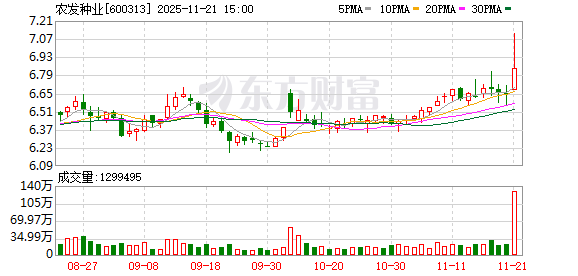
Core Insights - The article highlights the importance of seed quality and innovation in agriculture, particularly focusing on the role of Zhongnongfa Seed Industry Group in promoting green and efficient agricultural practices [1][2] Group 1: Company Overview - Zhongnongfa Seed Industry Group is recognized as a leading player in China's seed industry, focusing on seed quality improvement, brand development, and standardized production [1] - The company has invested a total of 340 million yuan in research and development over the past three years, targeting the cultivation of water-saving, fertilizer-saving, and pesticide-saving green specialty varieties [1] Group 2: Agricultural Practices - The company emphasizes the integration of green development concepts throughout the agricultural production process, exemplified by the establishment of a smart agricultural information system in Licheng, Shanxi, which has achieved a 50% reduction in pesticide use and over 90% in water usage [2] - Zhongnongfa Seed Industry Group is actively expanding its order-based agriculture model by collaborating with downstream processing enterprises to ensure quality control from farm to table [1] Group 3: Market Position and Goals - The company ranks fourth among over 8,000 seed enterprises in China, with a target to achieve a market share of 6.1% for its proprietary varieties by 2025 [2] - The company aims to enhance the supply of green and high-quality products, thereby contributing to food security and rural industrial development through the promotion of specialty varieties [2]

农发种业推广绿色专用新品种 绿色增粮绘就好“丰景”
Ren Min Ri Bao· 2025-11-23 21:45
Group 1 - The core viewpoint emphasizes the importance of seed quality and innovation in agriculture, highlighting the role of Zhongnongfa Seed Industry Group in promoting green production and enhancing crop yields through advanced seed varieties [2][3] - The company has invested 340 million yuan in research and development over the past three years, focusing on key technologies for breeding water-saving, fertilizer-saving, and pesticide-saving green specialty varieties [2] - Zhongnongfa Seed Industry Group is positioned as a leading player in the seed industry, ranking fourth among over 8,000 seed companies in China, with a target market share of 6.1% for its proprietary varieties by 2025 [3] Group 2 - The company is implementing a comprehensive green development strategy throughout the agricultural production process, including the establishment of a smart agricultural information system in Licheng, Shanxi, which has achieved a 50% reduction in pesticide use and over 90% in water savings [3] - The company is expanding its order agriculture model by collaborating with downstream processing enterprises to ensure quality control from farm to table, thereby meeting the increasing demand for green certified agricultural products [2] - Zhongnongfa Seed Industry Group aims to enhance the supply of green quality products and empower food security and rural industrial development through the promotion of specialty varieties and a full industry chain order service system [3]
产能去化逐步显现,10月全国能繁降至4000万头以下:农林牧渔
Huafu Securities· 2025-11-23 13:29
Investment Rating - The industry rating is "Outperform the Market" indicating that the overall return of the industry is expected to exceed the market benchmark index by more than 5% in the next 6 to 12 months [78]. Core Insights - The report highlights a gradual reduction in production capacity in the pig farming sector, with the number of breeding sows in China dropping below 40 million as of October, reflecting a decrease of over 350,000 from September [2][35]. - The report suggests that the recent losses in pig farming, combined with capacity control policies, are likely to enhance expectations for production capacity reduction, which may lead to a long-term increase in pig prices [2][35]. - The report recommends focusing on companies such as TianKang Biological, Muyuan Foods, Wens Foodstuff Group, and Dekang Agriculture [2][35]. Summary by Sections Pig Farming - Pig prices initially declined but showed slight recovery later in the week, with an average price of 11.62 CNY/kg as of November 21, reflecting a week-on-week decrease of 0.04 CNY/kg [11]. - The average weight of pigs sold increased to 128.81 kg, up by 0.33 kg week-on-week, driven by improved weight gain due to lower temperatures [24][35]. - The report indicates that the industry is currently facing losses, but the expected reduction in production capacity may lead to higher long-term price stability for quality pig farming companies [35]. Cattle Farming - Short-term prices for beef cattle have slightly decreased, with the price of fattened bulls at 25.58 CNY/kg, down 0.16% week-on-week, while calf prices increased to 32 CNY/kg, up 0.63% week-on-week [38]. - The report notes that the supply of beef cattle is expected to tighten in the medium to long term, with prices anticipated to enter an upward cycle between 2026 and 2027 [38]. Dairy Farming - The price of raw milk is currently at a low point, recorded at 3.03 CNY/kg, which is a 31% decrease from the peak [39]. - The ongoing losses in the dairy sector are expected to continue driving production capacity reduction, with a potential stabilization and recovery in raw milk prices anticipated as supply contracts [39]. Poultry Farming - The report indicates a decrease in the enthusiasm for restocking broiler chickens, with the price of white feather broilers at 7.15 CNY/kg, showing a slight increase of 0.03 CNY/kg week-on-week [46]. - The price of chicken eggs averaged 6.25 CNY/kg, down 0.24 CNY/kg week-on-week, with expectations for future price recovery due to supply constraints from ongoing avian influenza outbreaks [46][49]. Agricultural Products - The report notes a correction in soybean meal prices following the USDA report, with spot prices at 3070 CNY/ton, down 28 CNY/ton week-on-week [62]. - The report emphasizes the importance of monitoring actual soybean purchases and planting weather in South America for future price movements [62].
二十国集团南非峰会:领导人宣言(摘译)
Xin Hua She· 2025-11-23 12:32
新华社约翰内斯堡11月23日电 二十国集团南非峰会:领导人宣言(摘译) 序言 我们,2025年11月22日至23日相聚于南非约翰内斯堡的二十国集团领导人,出席南非主席国在非洲 大陆举行的首次历史性峰会,应对主要全球挑战,探讨促进以团结、平等、可持续为关键支撑的包容性 增长。 我们谴责一切形式和表现的恐怖主义。 我们一致认为,在《联合国宪章》宗旨和原则的全面指引下,我们将致力于在苏丹、刚果(金)、 巴勒斯坦被占领土、乌克兰实现公正、全面和持久的和平,并结束全球其他冲突与战争。只有在和平之 下,我们才能实现可持续发展和繁荣。 加强灾害韧性和应对 我们强调采取综合、包容、以人为本、全面的减灾方法至关重要。我们注意到需要加强灾害韧性和 灾害应对能力,包括采取协调行动减少地震、极端高温、洪涝、干旱、野火及荒漠化等灾害的频率和负 面影响,确保在必要时做好相互援助的准备。我们欢迎采用基于自然的解决方案和基于生态系统的方 法,在提供生态系统服务的同时,既最大限度降低风险,又增强应对特定灾害的韧性。 采取行动确保低收入国家债务可持续性 我们重申致力于以有效、全面和系统的方式支持中、低收入国家应对债务脆弱性问题。我们核准 202 ...
美国农业部:阿尔及利亚大麦产量跃升至阿拉伯国家第二
Shang Wu Bu Wang Zhan· 2025-11-21 15:21
Core Insights - Algeria's barley production for the 2024/2025 season is projected to reach 1.2 million tons, making it the second-largest producer in the Arab world and the 16th globally, following Iraq's 1.4 million tons [1] Group 1: Production Rankings - In the Arab region, the top ten barley producers are Iraq, Algeria, Syria, Morocco, Tunisia, Libya, Egypt, Yemen, Lebanon, and Jordan [1] - Syria's barley production is also at 1.2 million tons, ranking it alongside Algeria globally [1] - Morocco and Tunisia produce 660,000 tons and 272,000 tons of barley, respectively [1] Group 2: Global Market Dynamics - The global barley market is dominated by the EU, Russia, and Australia, which together account for over half of the total production [1] - The EU leads with 50.33 million tons, representing 35% of global production, followed by Russia and Australia with 16.25 million tons and 13.27 million tons, respectively [1] Group 3: Agricultural Policy Impact - Algeria's increase in barley production is seen as a sign of the effectiveness of its agricultural development policies aimed at enhancing food security and reducing import dependency [1]
联合国机构报告警示极端高温对农业构成多重风险
Xin Hua Wang· 2025-11-21 10:58
联合国粮农组织和世界气象组织20日在巴西联合发布《极端高温与农业》报告,强调极端高温对农业与 食物系统(农食系统)构成多重风险,指出迫切需要以科学为依据的解决方案来增强农业的韧性和可持 续性。 这份报告在巴西贝伦举行的《联合国气候变化框架公约》第三十次缔约方大会(COP30)的一场主题 为"通过气候科学改造农食系统"的边会上发布。报告说,极端高温损害农牧业,使渔业资源衰退,并威 胁着全球约12.3亿人的生计。气候变化还大幅增加了农业劳动者因高温作业而死亡的风险。据统计, 2021年全球因极端高温损失4700亿工时。 联合国政府间气候变化专门委员会主席吉姆·斯基在一份公报中说,农食系统是受气候变化影响最严重 的行业之一,干旱和极端高温已经使传统的风险管理措施不堪重负。他强调,气候变化正在改变作物产 量、牲畜生产力、水资源供应和生态系统功能等,而所有这些都对粮食安全、生计、营养和生物多样性 产生直接影响。 该报告还研究了巴基斯坦、摩洛哥、智利和葡萄牙等国关于极端高温带来连锁反应的案例,并提出风险 治理办法,例如实施可持续灌溉措施,以及通过气候科学和信息指引下的相关实践来减缓气候变化等。 (文章来源:新华网) 报告 ...
生物育种实验室仪器配置清单
仪器信息网· 2025-11-21 09:06
Core Viewpoint - The article emphasizes the importance of biological breeding as a key component in agricultural development, highlighting China's strategic focus on advancing biological breeding and biotechnology to ensure food security and promote rural revitalization [2][3]. Summary by Sections Biological Breeding Strategy - China has established a priority development strategy for biological breeding, aiming to accelerate major technological plans in this field as part of the "15th Five-Year Plan" [2]. - The integration of agriculture and technology is crucial for ensuring food security and advancing the construction of an agricultural powerhouse [3]. Challenges in Breeding Technology - The article outlines significant challenges in breeding technology, including high precision requirements for gene editing, long breeding cycles, and uncertainties due to climate change [3]. - There is an urgent need to build high-level research platforms to address these challenges and improve breeding techniques [3]. Development of Provincial Laboratories - As of the end of 2024, several provinces, including Guangdong, Hunan, Hubei, and others, have established biological breeding provincial laboratories, which are becoming important members of regional innovation systems [3]. - The article lists 12 provincial laboratories, detailing their establishment dates, construction areas, and funding investments [4][5]. Instrumentation in Biological Breeding Laboratories - The article provides a detailed list of high-frequency configured instruments essential for biological breeding laboratories, including automated nucleic acid extraction workstations, PCR instruments, and various analytical platforms [6][7][8]. - The instruments are categorized into different platforms, such as genotyping analysis, phenomics, and sample preparation, highlighting the diverse technological needs in biological breeding research [7][8][9].

秋粮收购超亿吨 筑牢粮食安全“压舱石”
Zhong Guo Jing Ji Wang· 2025-11-21 07:42
Core Insights - The national autumn grain purchase volume has exceeded 100 million tons, reflecting a robust harvest and providing a critical support for national food security [1][3] - Autumn grain accounts for three-quarters of the annual grain production, making its procurement vital for farmers' income and national grain reserve security [1] Group 1: Market Characteristics - The procurement progress is rapid, with regions like Northeast China harvesting corn earlier than last year and overall quality being satisfactory [1] - The market is active, with state-owned grain enterprises playing a key role, alongside private companies and grain processing firms joining the purchasing efforts [1][2] - There is a strong demand for high-protein soybeans, with prices significantly higher than ordinary varieties, while rice supply is ample with clear quality-price characteristics [1] Group 2: Policy and Support Measures - The government has implemented minimum purchase price plans in provinces such as Henan, Hunan, and Heilongjiang, with storage capacity exceeding 10 million tons to meet farmers' selling needs [1] - Quality improvement incentives are being explored, such as subsidies for high-quality rice in Jiangsu, guiding farmers towards producing high-quality grains [1][2] Group 3: Technological Advancements - Technology is enhancing grain procurement efficiency, with innovations like autonomous robots in grain storage and AI monitoring systems improving safety and operational efficiency [2] - Farmers' selling experience has improved significantly, with streamlined processes allowing for quick sampling and sales [2] Group 4: Market Dynamics - A market-oriented procurement model is being established, supported by policy reserves, enhancing market vitality and ensuring a stable supply chain [2] - State-owned enterprises focus on reserve grain procurement, while deep processing companies actively participate in the market, creating a cooperative purchasing environment [2]