绿色制造

Search documents
专访机械联叶定达:调结构优供给,妥善化解重点行业结构性矛盾
2 1 Shi Ji Jing Ji Bao Dao· 2025-07-31 08:52
叶定达表示,当前,我国机械工业部分领域仍存在亟待化解的结构性矛盾,与此同时,一些行业的"内卷式"竞争日益加剧,已 严重制约行业整体竞争力的提升和可持续高质量发展,妥善解决这些问题至关重要。我国正处在加快转型升级步伐、奋力推进 高质量发展的关键阶段,接下来,我国机械工业的重点改革方向需以培育和发展新质生产力为核心导向。面对新阶段的新任 务,政策工具需要更加精准、更加市场化、更注重长效机制,一是强化政策的"精准滴灌",二是强化市场机制与公平竞争,三 是注重需求侧拉动与场景驱动,四是提升政策协同性与稳定性。 提升优质供给能力 《21世纪》:如何看待上半年的工业经济运行情况?对下半年的工业经济运行有哪些展望? 叶定达:今年以来,存量政策与增量政策协同发力,宏观政策"组合拳"效用显现,工业经济运行平稳,主要经济指标总量和增 速稳步提升,其中,装备制造业重点行业支撑作用明显。今年上半年,我国装备制造业延续较好增势,充分发挥了工业发展"稳 定器"的作用,呈现"量质齐升、向优向新"发展态势。规上装备制造业增加值拉动全部规上工业增长3.4个百分点,占全部规上工 业的35.5%,较去年提高了0.9个百分点。规上高技术制造业增加值 ...

以产业新特征为锚 重塑上市公司产业投资价值
申万宏源研究· 2025-07-29 07:08
Core Viewpoint - The article emphasizes the importance of industry investment value as a comprehensive measure of a company's collaborative ability, technological potential, and long-term development prospects within the industrial chain ecosystem, especially in the context of rapid digital economic growth and technological revolution in China [1][2]. Group 1: Understanding Industry Investment Value - Industry investment value is a core basis for evaluating and making decisions by industry investors, focusing on sustainable technological evolution and the ability to integrate into the industrial ecosystem [3][4]. - Many traditional industry-listed companies have not received reasonable industry investment valuations due to static categorization and labeling by investors, which often overlooks their innovative capabilities [4][5]. - The evaluation logic of industry investment value is evolving dynamically due to profound changes in the industrial landscape driven by technological innovation and the digital economy [4][5]. Group 2: Seizing Opportunities in the Digital Economy - The digital economy is reshaping industrial organization and competition, creating opportunities for companies to enhance their investment value by embedding themselves into the new industrial structure [6][7]. - Traditional companies should actively identify their roles within the new "three-stage" digital economy ecosystem, focusing on application scenarios to redefine their industry identity and expand their value boundaries [6][7]. Group 3: Adapting to New Demand Characteristics - The shift from a linear "demand leads supply" model to a dynamic interplay of "demand leads supply" and "supply creates demand" necessitates that companies actively engage with evolving consumer needs [8][9]. - Companies should align with terminal-driven industry chains, enhancing their value creation by embedding themselves within these chains and responding to market changes [9][10]. Group 4: Leveraging Network Hub Advantages - In the information age, companies must transform their flow resources into core competitive advantages, enhancing their investment value through effective flow management [12][13]. - Network hub companies should capitalize on their existing infrastructure and resource aggregation capabilities to transition towards digital value high grounds [12][13][14]. Group 5: Navigating the Transition Between Traditional and Emerging Industries - Traditional industry companies must redefine their identities and break free from outdated perceptions to adapt to the evolving landscape of new business models and high-value emerging industries [15][16]. - Emerging industry companies need to maintain their innovation momentum to avoid falling into the trap of becoming "new traditional industries" as they mature [18][19].
研判2025!中国氯丁橡胶(CR)行业产量、开工率及进出口分析:行业需求持续增长,多领域应用推动发展潜力释放[图]
Chan Ye Xin Xi Wang· 2025-07-28 01:03
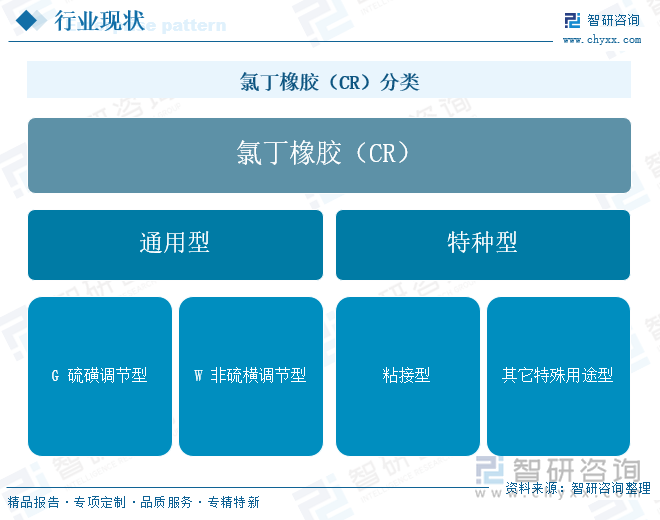
内容概况:作为全球最大的氯丁橡胶生产国和消费国之一,中国氯丁橡胶(CR)行业在汽车、建筑、 电子、医疗等多个下游领域需求持续增长的推动下,展现出较强的发展潜力。2025年1-5月,中国氯丁 橡胶(CR)产量为2.72万吨,同比增长15.80%;氯丁橡胶(CR)消费量为2.17万吨,同比增长 30.67%。 相关上市企业:中策橡胶(603049)、中化国际(600500)、海南橡胶(601118) 相关企业:中国石油化工股份有限公司、中国石油天然气股份有限公司、华新树脂(惠州)有限公司、 深圳市宝昌隆树脂有限公司、天津科恩建筑技术有限公司、北京鼎固伟业工程材料有限公司、常州强力 电子新材料股份有限公司、圣奥化学科技有限公司、山东尚舜化工有限公司、四川国光农化股份有限公 司、常州天晟新材料股份有限公司、河北华密新材科技股份有限公司、浙江仙通橡塑股份有限公司、中 策橡胶集团股份有限公司 关键词:氯丁橡胶(CR)、氯丁橡胶(CR)市场规模、氯丁橡胶(CR)行业现状、氯丁橡胶(CR) 发展趋势 一、行业概述 起步阶段(1951年至1959年)。1951年,东北科学院(中国科学院长春应用化学研究所前身)在实验室 合成出氯 ...
一块钢板看转型
Liao Ning Ri Bao· 2025-07-27 22:30
Core Viewpoint - The company is focusing on high-end product development to enhance its core competitiveness and address challenges in the steel industry, achieving significant sales growth and quality improvements in its product offerings [1][2]. Group 1: Product Development and Sales Performance - The company has launched 32 new product projects in the first half of the year, achieving sales of 173,900 tons and an increase in profit of 22.72 million yuan [1]. - The sales of flagship products increased by 3.72% year-on-year, while automotive steel sales rose by 5.69% year-on-year [1]. - The quality index, a recognized measure of steel quality in the domestic industry, improved by 13.95% year-on-year [1]. Group 2: Strategic Initiatives for High-End Development - The company is implementing a dual strategy of "technology leadership + product leap" to drive high-end development and transformation [2]. - A core technology list of 56 items has been established, with ongoing technical breakthroughs and monthly progress tracking [2]. - The company has optimized cost indicators in the ironmaking process, achieving the best fuel ratio in nearly a decade and the highest coke ratio in historical terms [2]. Group 3: Smart and Green Manufacturing Practices - The company is advancing smart factory construction and deep data application to enhance operational efficiency, with 26 robotic systems deployed and an 88% CNC rate in key processes [3]. - The company has implemented energy-saving and emission-reduction initiatives, achieving carbon footprint certification for six types of automotive steel products [3]. - The comprehensive energy consumption per ton of steel has reached the highest level in historical terms [3].

东南电子收盘上涨1.52%,滚动市盈率54.87倍,总市值25.67亿元
Sou Hu Cai Jing· 2025-07-25 10:02
Group 1 - The core business of the company is the design, research and development, production, and sales of micro switches, with main products including household appliance micro switches, automotive micro switches, power tool micro switches, and smart low-voltage micro switches [2] - The company has received multiple honors, including being recognized as a "Provincial High-tech Enterprise R&D Center" in 2018 and a "National Green Manufacturing Factory" in 2024 [2] - As of July 25, the company's stock closed at 21.36 yuan, with a rolling PE ratio of 54.87, which is lower than the industry average of 66.23 [1][3] Group 2 - In the latest quarterly report for Q1 2025, the company achieved a revenue of 69.92 million yuan, representing a year-on-year increase of 15.91%, and a net profit of 11.07 million yuan, up 9.21% year-on-year [3] - The company's sales gross margin stands at 27.78% [3] - The company ranks 84th in the electronic components industry based on PE ratio, with the industry median at 57.54 [1][3]
研判2025!中国木浆行业产业链、产量及消费量分析:纸业扩张与废纸限令共驱木浆需求,国产增量仍需进口补位[图]
Chan Ye Xin Xi Wang· 2025-07-24 01:32
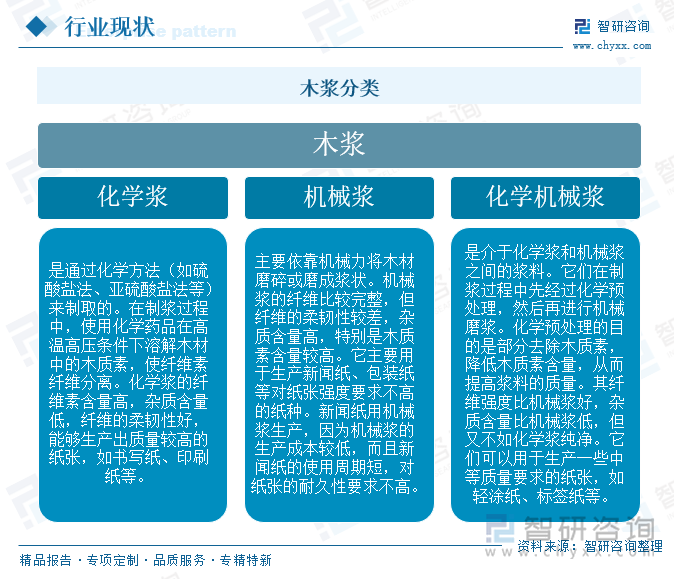
Industry Overview - The demand for wood pulp in China is continuously increasing due to the rising production of paper and cardboard, along with restrictions on waste paper imports [1][12] - In 2024, China's wood pulp production is projected to reach 26.26 million tons, a year-on-year increase of 13.58%, while consumption is expected to be 51.39 million tons, up 4.22% [1][12] - The industry is highly dependent on imports to meet downstream demand due to limited domestic wood resources [1][12] Industry Development History - The Chinese wood pulp industry has undergone five stages of development, from a nascent phase (1950-1978) dominated by state-owned enterprises to a rapid growth phase (2000-2010) following China's WTO accession [4][5] - The current phase (2021-present) focuses on green manufacturing and circular economy, driven by dual carbon goals and technological advancements [5] Industry Chain - The upstream of the wood pulp industry includes raw materials (mainly wood) and production equipment, while the midstream involves wood pulp manufacturing [8] - Downstream applications encompass various paper products, including household paper, cultural paper, packaging paper, and specialty paper [8] Current Industry Status - The wood pulp industry in China is transitioning from "import dependence" to "domestic dominance," with domestic wood pulp consumption expected to reach 25.95 million tons in 2024, a 15.49% increase [14] - The market share of major players like Asia Pacific Forest Products and Chenming Paper has increased due to investments and technological upgrades [14][16] Key Companies' Performance - The industry is characterized by "oligopolistic competition" with high market concentration among five major companies, including Asia Pacific Forest Products and Chenming Paper [16] - Chenming Paper's revenue from chemical pulp is projected to reach 1.519 billion yuan in 2024, a significant increase of 175.29% [18] Industry Development Trends - The industry is accelerating its transition towards green and sustainable development, with policies promoting the use of biomass fuels and efficient equipment [22] - Technological innovations, such as continuous cooking processes and digital production systems, are expected to enhance wood utilization rates and product quality [23] - Companies are expanding their global presence and forming regional partnerships to enhance supply chain resilience [24]



推动产业转型升级 青岛高新区发力绿色工厂建设
Zhong Guo Chan Ye Jing Ji Xin Xi Wang· 2025-07-23 23:20
Core Viewpoint - Qingdao High-tech Zone has successfully selected 7 enterprises as green factories for 2025, reflecting significant progress in promoting green manufacturing and industrial transformation [1] Group 1: Green Factory Selection - The 7 selected enterprises include Qingdao Boning Futen Intelligent Transportation Technology Development Co., Ltd., TPV Technology (Qingdao) Co., Ltd., Phase Change Energy Technology (Qingdao) Co., Ltd., Qingdao Pangu Intelligent Manufacturing Co., Ltd., Qingdao Kejie Robot Co., Ltd., Aoyuan Jin (Qingdao) Metal Container Co., Ltd., and Qingdao Oubo Fang Pharmaceutical Technology Co., Ltd. [1] - The selection is a recognition of the enterprises' green development practices and the effective construction of a green manufacturing system in Qingdao High-tech Zone [1] Group 2: Energy Efficiency and Environmental Impact - TPV Technology has invested 42 million yuan in five major energy-saving projects, achieving an annual energy saving of 3.4 million kWh and a reduction of approximately 3,300 tons of CO2 emissions [2] - Phase Change Energy Technology focuses on developing high-performance phase change energy storage materials, enhancing energy utilization efficiency [2] - Pangu Intelligent integrates green design throughout the lifecycle of its wind power lubrication systems, improving operational reliability and reducing carbon emissions during maintenance [2] Group 3: Support and Training Initiatives - Qingdao High-tech Zone provides data support for enterprises' energy consumption and carbon emissions monitoring, and organizes training sessions to foster a collaborative learning environment [2] - The zone invites industry experts to address core issues faced by enterprises in the green manufacturing assessment process [2] Group 4: Green Factory Development Trends - Qingdao High-tech Zone has established a tiered development pattern for green factories, with 7 national green factories accounting for 10.3% of the city's total [3] - The newly added green factories are distributed across key industries such as information technology, high-end equipment manufacturing, and biomedicine, marking a shift towards high-end, intelligent, and green industrial transformation [3] Group 5: Integration of New Technologies - The zone actively promotes the integration of AI, IoT, and big data with green manufacturing, aiming to create benchmarks for low-carbon transformation in the industrial sector [4] - Qingdao High-tech Zone is leveraging green factories to drive the entire industrial ecosystem towards green, low-carbon, and high-end upgrades, contributing to the city's dual carbon goals [4]
“与中国合作,就是投资未来”(见证·中国机遇)
Ren Min Ri Bao· 2025-07-23 22:03
Group 1: Overview of Sino-German Cooperation - Bavaria is Germany's largest and economically developed federal state, with China as its top global trading partner and a significant investment source, hosting around 500 Chinese companies [5][13] - The historical context of Sino-German relations dates back to 1975, marked by Franz Josef Strauss's visit to China, which laid the foundation for ongoing political, economic, and social exchanges [6][7] - The collaboration between China and Bavaria has yielded fruitful results, emphasizing mutual benefits and cultural exchanges [7][8] Group 2: Industry Developments - Klaus-Maffei Group, a leading manufacturer in plastic and rubber machinery, has established a new headquarters in Bavaria, featuring advanced production technologies that significantly reduce carbon emissions and waste [10][11] - Since its acquisition by China National Chemical Corporation, Klaus-Maffei has undergone structural changes, focusing on green manufacturing and digital operations, which have enhanced its market presence [11][12] - NIO, a Chinese electric vehicle company, has established multiple battery swap stations in Bavaria, highlighting the region's commitment to innovative solutions in electric mobility [13][14] Group 3: Future Prospects - Bavaria aims to attract more Chinese investments in emerging industries such as smart manufacturing and renewable energy, leveraging its robust infrastructure and skilled workforce [13][14] - The region's ongoing collaboration with Chinese enterprises is expected to contribute to local economic growth, job creation, and technological advancements [12][14] - The importance of open dialogue and cooperation between Germany and China is emphasized, especially in the context of global geopolitical changes [15]
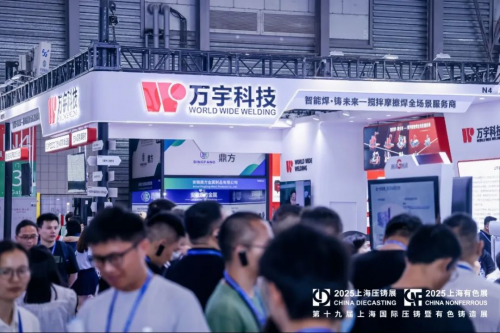
智能焊 铸未来——搅拌摩擦焊全场景服务商
Zhong Guo Chan Ye Jing Ji Xin Xi Wang· 2025-07-23 07:12
Core Viewpoint - The 19th Shanghai International Die Casting and Nonferrous Casting Exhibition showcased the latest technologies and trends in the die casting industry, with a record exhibition area of 49,200 square meters and participation from 583 top global companies [1] Group 1: Industry Challenges and Solutions - At the "Die Casting Industry Chain Technology Development Forum," Dr. Lv Zongliang from Wanyu Technology presented a comprehensive solution addressing six major challenges in friction stir welding (FSW) within the die casting industry, including issues like burrs, internal tunnel defects, and low welding efficiency [3] - Wanyu Technology proposed a one-stop technical response plan to tackle these challenges effectively [3] Group 2: Product Highlights - The 50-bridge dynamic gantry FSW equipment, designed specifically for aluminum casting welding, occupies only 2.5×2.0 meters and can weld aluminum materials up to 10mm thick, integrating constant torque, constant pressure, and cost reduction for various applications [5] - An intelligent non-destructive testing robot was developed in collaboration with leading industry companies to identify internal defects in weld seams, achieving precision superior to X-ray methods [7] - Wanyu Technology introduced a specialized FSW welding solution for magnesium alloy castings, successfully transitioning from laboratory testing to mass production, with notable products displayed at the exhibition [9] Group 3: Welding Tools and Cost Reduction - Wanyu Technology has developed over 1,000 types of stirring heads, which are crucial for the performance and efficiency of welding joints, and has implemented diverse cost reduction strategies to significantly lower the production costs of welding consumables [11] - A special promotion for stirring heads was launched to celebrate the company's tenth anniversary, offering a "trade-in" program for used parts [11] Group 4: Industry Trends and Future Directions - The exhibition not only highlighted cutting-edge technologies in the die casting industry but also facilitated deeper integration across the industry chain through various activities, promoting the advancement of green and intelligent manufacturing [13] - The Chinese die casting industry is progressing towards the high end of the global value chain, providing essential support for strategic sectors such as automotive lightweighting and aerospace [13]
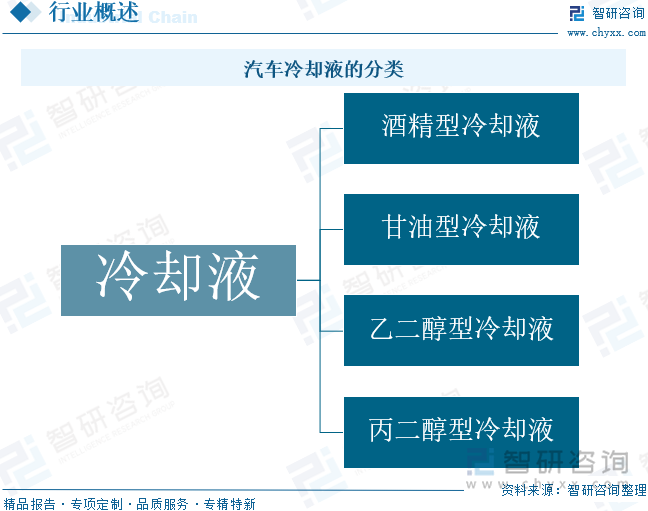
趋势研判!2025年中国汽车冷却液行业发展历程、产业链、发展现状、竞争格局及发展前景展望:汽车保有量持续增长,推动汽车冷却液规模超百亿元[图]
Chan Ye Xin Xi Wang· 2025-07-23 01:29
Core Viewpoint - The automotive coolant market in China is experiencing significant growth, with the market size projected to increase from 9.628 billion yuan in 2016 to 28.49 billion yuan in 2024, representing a compound annual growth rate (CAGR) of 14.52% [1][14]. Industry Overview - Automotive coolant, also known as antifreeze, is essential for maintaining engine temperature and preventing overheating, corrosion, and scale formation [3][5]. - The composition of automotive coolant includes antifreeze agents, corrosion inhibitors, and other additives to enhance heat absorption and transfer [3]. Market Growth - The automotive coolant market in China is driven by the rapid growth of the automotive sector, with the number of vehicles expected to rise from 217 million in 2017 to 353 million by 2024, a CAGR of 7.2% [11]. - The sales volume of automotive coolant is projected to reach approximately 1.8793 million tons in 2024, reflecting an 8% year-on-year growth [13]. Industry Development History - The development of automotive coolant began in the 1840s, with significant advancements in the 1920s when ethylene glycol-based coolants were introduced [7]. - The 21st century has seen the introduction of propylene glycol coolants, which are now being promoted for their safety and environmental benefits [7]. Industry Chain - The upstream of the automotive coolant industry includes raw materials such as water, antifreeze agents, and corrosion inhibitors, which are processed to create specialized coolant products [9]. - The downstream market serves both traditional fuel vehicles and electric vehicles, with increasing demands for efficient thermal management systems in the latter [9]. Competitive Landscape - The automotive coolant market features numerous participants, including international brands like Shell and ExxonMobil, as well as domestic brands such as Longpan Technology and Kangputon [17][19]. - Despite the late start of China's automotive coolant industry, local companies are improving their technology and product quality, leading to a trend towards higher quality products [19]. Future Trends - The automotive coolant industry is expected to focus on environmental sustainability, with a shift towards bio-based coolants and low-toxicity formulations [25]. - There is a growing demand for high-efficiency coolants due to advancements in automotive power systems, with new additives enhancing thermal conductivity and corrosion resistance [26]. - The integration of smart technologies for monitoring coolant parameters and optimizing formulations is anticipated to drive the industry's digital transformation [27].