
美债收益率

Search documents
两年期美债收益率于美国CPI通胀数据发布日跌超3.7个基点
Sou Hu Cai Jing· 2025-08-12 22:46
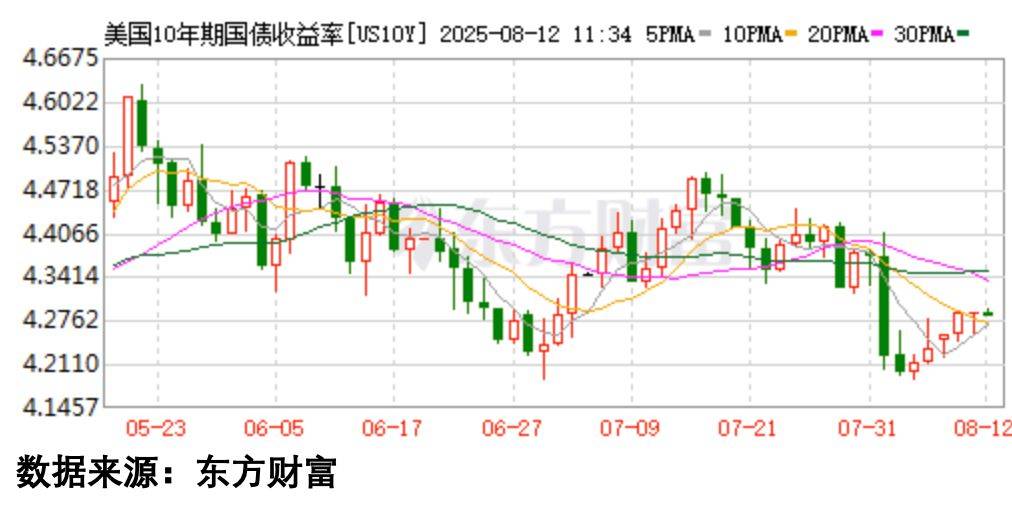
周二(8月12日)纽约尾盘,美国10年期基准国债收益率涨0.39个基点,报4.2888%,北京时间20:30发 布美国CPI通胀数据时,从4.28%上方的平盘跳水至4.24%下方刷新日低,随后反弹,在22:17涨至 4.3160%刷新日高。两年期美债收益率跌3.76个基点,报3.7308%,日内交投于3.7745%-3.7018%区间, CPI数据出炉时也从3.77%下方的平盘跳水并刷新日低,后续持续低位震荡。20年期美债收益率涨2.56个 基点,报4.8545%,数据发布时跌至4.7948%刷新日低,随后反弹至4.8802%刷新日高;30年期美债收益 率涨2.62个基点,报4.8786%。 三年期美债收益率跌3.06个基点,五年期美债收益率跌1.40个基点,七 年期美债收益率跌0.52个基点。三个月期国库券/10年期美债收益率利差涨2.420个基点,报+5.155个基 点。02/10年期美债收益率利差涨4.146个基点,报+55.586个基点,20:30跌至+48.092个基点刷新日低, 随后反弹至57.414个基点刷新日高。02/30年期美债收益率利差涨6.382个基点,05/30年期美债收益率利 差涨4 ...
美债收益率涨跌不一,10年期美债收益率涨0.97个基点
Mei Ri Jing Ji Xin Wen· 2025-08-12 22:19
Group 1 - The core point of the article highlights the mixed performance of U.S. Treasury yields on August 12, with short-term yields declining while long-term yields increased [1][2] Group 2 - The 2-year Treasury yield decreased by 2.93 basis points to 3.727% [1] - The 3-year Treasury yield fell by 2.50 basis points to 3.703% [1] - The 5-year Treasury yield dropped by 0.70 basis points to 3.824% [1] - The 10-year Treasury yield rose by 0.97 basis points to 4.291% [1] - The 30-year Treasury yield increased by 3.13 basis points to 4.882% [1]
美债收益率高企,竟是A股持续走牛关键!
Sou Hu Cai Jing· 2025-08-12 08:34
Group 1 - The core viewpoint is that the current high yields in the US Treasury market indicate underlying economic conditions that may not align with the Federal Reserve's intentions to lower interest rates, which could create investment opportunities in the A-share market [3][5] - The importance of data over subjective analysis is emphasized, suggesting that understanding the real market pulse through quantitative data is crucial for making informed investment decisions [3][19] - The article highlights that not all stocks benefit equally in a bull market, and effective capital utilization is key to achieving superior returns [5][6] Group 2 - The concept of "shakeout" is introduced, indicating that healthy stock price increases are often accompanied by periods of volatility, which can mislead less experienced investors [10][18] - Quantitative tools are presented as essential for retail investors to navigate the market effectively, as they provide objective insights into market trends and institutional behaviors [19] - The article suggests that understanding the dynamics of US Treasury yields and their impact on global investment flows can provide strategic advantages for investors in the A-share market [3][19]


人民币汇率较快回调 保持基本稳定有支撑
Xin Hua Wang· 2025-08-12 06:27
近日,人民币对美元汇率连续较快回调。 国家外汇管理局副局长、新闻发言人王春英近日表示,将密切关注外汇市场形势,加强跨境资金流动宏 观审慎管理,引导跨境资本有序流动,处理好内部均衡和外部均衡的平衡,保持人民币汇率在合理均衡 水平上基本稳定。 业内人士分析,人民币汇率可能因市场供求变化继续回调,但人民币汇率总体仍处于较高水平,未来在 贸易维持顺差及中美实际利差仍处高位情况下,人民币汇率出现持续性单边回调的概率不大,预计人民 币汇率弹性将进一步增大。 美债利率上行 近期,10年期美债收益率快速逼近3%关口。数据显示,4月20日10年期美债收益率最高升至2.98%,距 3.0%仅"一步之遥";30年期美债收益率最高升至3.03%,创出2019年4月以来新高。 机构人士认为,美债收益率快速上行与美国通胀预期高企、加息预期强烈有关。美联储近期公布的3月 议息会议纪要显示,不排除5月启动"缩表"可能,还可能扩大单次加息幅度。 平安证券首席经济学家钟正生分析,市场预期美联储加息节奏加快、加息上限上移刺激实际利率上行。 美联储"缩表"路径逐渐明朗,10年期美债市场供给或进一步释放,这将推升实际利率上行。 有机构人士分析,在美联 ...
美债收益率集体下跌,10年期美债收益率跌0.58个基点
Mei Ri Jing Ji Xin Wen· 2025-08-11 22:24
(文章来源:每日经济新闻) 每经AI快讯,周一(8月11日),美债收益率集体下跌,2年期美债收益率跌0.64个基点报3.756%,3年 期美债收益率跌0.28个基点报3.728%,5年期美债收益率跌0.18个基点报3.831%,10年期美债收益率跌 0.58个基点报4.281%,30年期美债收益率跌0.30个基点报4.850%。 ...
高盛称5年期美债收益率已触及2021年来最极端水平!
Sou Hu Cai Jing· 2025-08-07 01:59
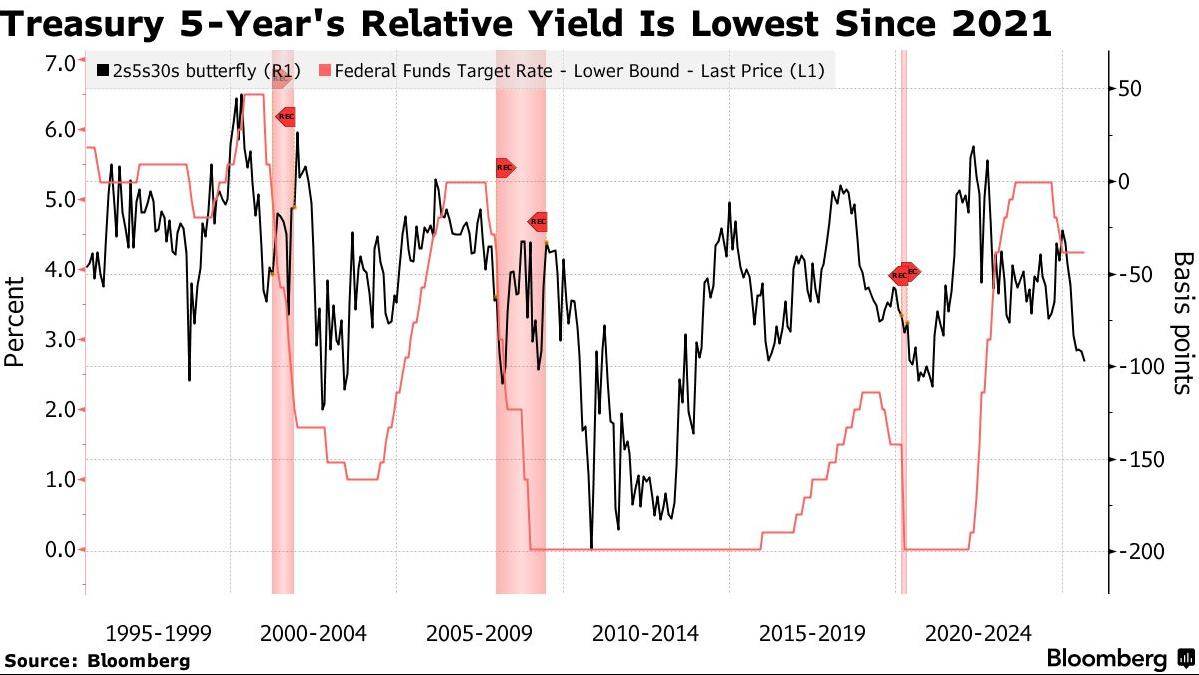
Core Insights - Goldman Sachs' interest rate strategy team highlights that the current valuation level of five-year U.S. Treasury bonds is historically rare unless the Federal Reserve lowers the benchmark interest rate to zero [1] - The five-year Treasury yield is reported at 3.78%, close to the high range since early 2022 when the Fed's policy rate was at zero [1] - The relative value assessment model indicates that the yield on five-year bonds is at a historic high, with the current result of the butterfly spread model approaching -100 basis points, reaching the lower limit of the volatility range since early 2021 [1] Market Expectations - The valuation phenomenon is closely tied to market expectations regarding the timing and magnitude of Fed rate cuts, which are difficult to sustain in the long term [4] - Since the beginning of the year, the market has increasingly priced in more short-term rate cut expectations, anticipating a larger cumulative cut [4] - To alter the steepening yield curve trend and alleviate the overvaluation of five-year bonds, the market needs to shift towards clearer forward pricing [4] Performance Analysis - The five-year Treasury bond has been the best-performing segment this year, primarily supported by rate cut expectations, while long-term bonds face upward yield risks due to persistent inflation pressures and expanding U.S. budget deficits [4] - Since the end of last year, the five-year Treasury yield has decreased by 60 basis points, while the two-year yield has fallen by 52 basis points, and the thirty-year yield has remained relatively unchanged, highlighting the relative advantage of mid-term bonds under the influence of rate cut expectations [4]
投资者评估最新经济数据 美债收益率在创阶段新低后小幅反弹
Xin Hua Cai Jing· 2025-08-06 01:33
Group 1 - The US Treasury yields saw a slight rebound, with the 10-year yield rising approximately 1 basis point to 4.20%, after hitting a three-month low [1] - The ISM non-manufacturing index for July was reported at 50.1, below the expected 51.5 and the previous value of 50.8, indicating challenges in the US service sector [1] - The new orders index fell to 50.3, nearly approaching stagnation, while the employment index dropped to 46.4, suggesting a contraction in job growth [1] Group 2 - The Markit composite PMI for July was reported at 55.1, higher than the initial value of 54.6 and June's 52.9, indicating stronger economic activity [2] - The Markit services PMI for July reached 55.7, the highest in seven months, reflecting a rebound in service sector activity [2] - The increase in service sector activity has led to a rise in unfinished orders, prompting companies to resume hiring, although there remains cautious sentiment due to rising costs and declining confidence in future prospects [3] Group 3 - President Trump announced plans to introduce new tariffs on semiconductors, chips, and pharmaceuticals, with potential increases up to 250% over the next year and a half [3] - The US Treasury plans to auction $100 billion in short-term debt, marking a historic high, with expectations of continued marginal growth in short-term debt supply [4]
美债遭遇“史上最惨五年”
财联社· 2025-08-05 13:54
Core Viewpoint - The article highlights the significant rise in the 10-year U.S. Treasury yield from its historical low of 0.51% on August 4, 2020, to nearly 400 basis points higher, marking the worst rolling five-year total return in recorded history for U.S. Treasuries [1][4]. Group 1 - The 10-year U.S. Treasury yield reached an unprecedented low of 0.51% on August 4, 2020, which is the lowest since records began in 1790 [1]. - Since that low point, the yield has increased significantly, leading to a decline in bond prices due to the inverse relationship between yield and price [1]. - The rolling five-year nominal total return for 10-year U.S. Treasuries has only seen a few instances of negative returns in the past 230 years, with the current period being one of the worst [4][5]. Group 2 - The only periods with worse real returns (nominal returns adjusted for inflation) than the past five years were the 1790s, post-World War I, and the five years leading up to 1981 [5][6]. - The 1981-1986 period saw the second-best five-year rolling real return for 10-year U.S. Treasuries, with an annual return of approximately 20% [7]. - Current yields are around 4.25%, which is close to the long-term average, making it unlikely to replicate the historical performance seen in the early 1980s [7]. Group 3 - The past five years have been characterized by a correction of long-term overvaluation in the Treasury market, with current prices appearing closer to fair value [8]. - Despite the potential for positive real returns, future U.S. inflation rates may remain above the target level of 2%, suggesting that actual annual returns for 10-year Treasuries may struggle to exceed 1% [8].

美债专题跟踪 | 美7月非农数据遭遇“滑铁卢”,10年期美债收益率大幅下行
Sou Hu Cai Jing· 2025-08-05 08:43
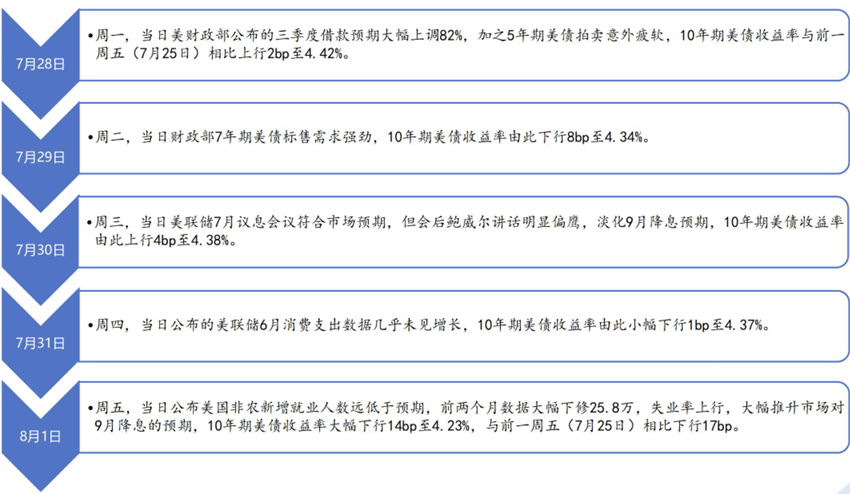
来源:东方金诚 上周美债收益率走势回顾 2025年7月28日当周,10年期美债收益率大幅下行。具体来看:周一,当日美财政部公布的三季度借款预期大幅上调 82%,加之5年期美债拍卖意外疲软,10年期美债收益率与前一周五(7月25日)相比上行2bp至4.42%;周二,当日财政 部7年期美债标售需求强劲,10年期美债收益率由此下行8bp至4.34%;周三,当日美联储7月议息会议符合市场预期,但 会后鲍威尔讲话明显偏鹰,淡化9月降息预期,10年期美债收益率由此上行4bp至4.38%;周四,当日公布的美联储6月消 费支出数据几乎未见增长,10年期美债收益率由此小幅下行1bp至4.37%;周五,当日公布的美国非农新增就业人数远低 于预期,前两个月数据大幅下修25.8万,失业率上行,大幅推升市场对9月降息的预期,10年期美债收益率大幅下行14bp 至4.23%,与前一周五(7月25日)相比下行17bp。 2.短期走势展望 在7月非农数据的推动下,目前市场对降息已重新定价(9月降息概率超过80%),除非8月7日公布的初请失业金人数大 幅低于预期,否则预计本周降息预期仍将继续发酵,从而推动10年期美债收益率继续探底。此外,特朗 ...
美国GDP和FOMC后降息路径展望
2025-08-05 03:20
Summary of Key Points from the Conference Call Industry Overview - The conference call discusses the current state of the **U.S. economy**, focusing on GDP growth, consumer behavior, and investment trends, particularly in the context of the Federal Reserve's monetary policy and interest rate decisions. Core Insights and Arguments - **GDP Growth**: The U.S. GDP experienced an annualized quarter-on-quarter growth of **3%** in Q2, surpassing expectations of **2.5%** and recovering from a decline of **-0.5%** in Q1. This growth was influenced by fluctuations in imports and inventory changes [2][4]. - **Impact of Tariffs**: In Q1, U.S. producers rushed to import goods and replenish inventories due to tariff threats, which negatively impacted GDP. In Q2, a significant slowdown in imports, particularly from China and South Korea, led to a rebound in the import-export component to approximately **6%**, providing strong support [2][3]. - **Consumer Spending**: Private consumption, fixed asset investment, and government spending have shown a decline for two consecutive quarters, with growth rates dropping from **1.6%** in Q1 to **1.1%** in Q2. Durable goods consumption is primarily driven by automotive sales, but declining car prices and high inventory levels pose risks [1][4]. - **Investment Trends**: Fixed asset investment weakened significantly, decreasing from **1.8%** in the previous quarter to **0.1%**. Residential investment fell by **1.2%**, and non-residential construction investment dropped by **2.7%**. Real estate sales hit a new low since 2012, with both new and existing home sales falling short of expectations [3][5]. - **Federal Reserve's Stance**: The Federal Reserve maintained interest rates during its recent meeting, with two officials opposing the decision to not cut rates in July, marking the largest disagreement since 1993. There is uncertainty regarding future rate cuts, with expectations for a September cut reduced from **50%-60%** to **40%-50%** [2][5]. - **Inflation and Employment**: Inflationary pressures are being absorbed more by retailers, leading to potential delays in cost transmission. The job market is showing signs of weakness, which could underestimate demand risks [3][4]. Other Important Insights - **Market Reactions**: The rise of the U.S. dollar index to around **100** has led to a decline in gold prices. The Federal Reserve's approach remains flexible, with potential for clear guidance if necessary [6]. - **Debt Issuance Impact**: An increase in Treasury debt issuance in Q3 could lead to rising yields, presenting an opportunity for positioning in U.S. Treasuries, despite a significant rebound in the dollar index [9]. - **Sector Sensitivity**: Interest-sensitive sectors such as automotive and real estate are expected to weaken if nominal interest rates remain high, emphasizing the importance of upcoming employment data [7][8].