
高水平科技自立自强

Search documents
抓住关键实现高水平科技自立自强
Jing Ji Ri Bao· 2025-06-19 23:00
Group 1 - The core argument emphasizes the necessity of innovation-driven growth for achieving high-quality development in China, highlighting the strategic importance of technology modernization to support national development goals by 2035 [1] - The article discusses the historical significance of technology as a fundamental driving force for the rise and fall of major powers, asserting that enhancing independent innovation capabilities is essential for addressing major risks and seizing strategic opportunities [1] - It stresses the importance of a unified leadership system for technology work under the Communist Party, indicating that improvements are needed in the management system for national science and technology projects [2] Group 2 - The construction of national strategic scientific and technological forces is crucial, with a focus on addressing gaps in core technologies and enhancing organizational efficiency in strategic technology initiatives [3] - The article highlights the significant role of market forces in driving technological innovation, noting that approximately 80% of R&D investment comes from enterprises, and emphasizes the need for enterprises to take a leading role in major technology projects [3] - It points out the importance of combining goal-oriented approaches with free exploration in building a strong foundation for becoming a world-leading technology power, while also recognizing the need for improved basic research investment and ecosystem [4]
加快科技创新,亟待金融再发力(财经眼)
Ren Min Ri Bao· 2025-06-15 21:52
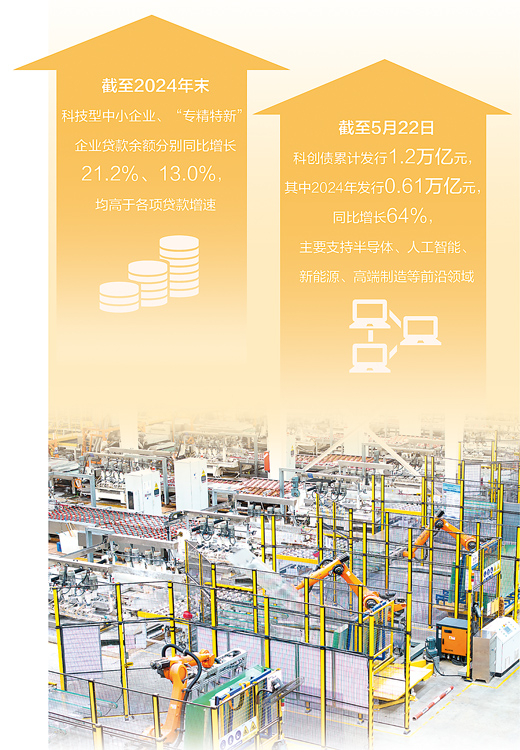
Group 1 - China Construction Bank provided over 450 million yuan in loans to Zhangzhou Qibin Photovoltaic New Energy Technology Co., Ltd. to support project construction [2] - The 20th National Congress of the Communist Party proposed building a financial system that aligns with technological innovation [3] - The Ministry of Science and Technology and other departments issued policies to enhance financial support for major technological tasks and small and medium-sized technology enterprises [3] Group 2 - Financial capital is crucial for supporting high-level technological self-reliance and innovation [4] - The growth rate of loans to technology-based small and medium-sized enterprises significantly outpaced overall loan growth, with expected year-on-year increases of 21.2% and 13.0% for technology-based SMEs and "specialized, refined, distinctive, and innovative" enterprises, respectively [5] - The cumulative issuance of science and technology bonds reached 1.2 trillion yuan, with a 64% year-on-year increase in 2024 [5] Group 3 - The "Several Measures" aim to improve the top-level design of the technology finance system by enhancing policy frameworks, optimizing market mechanisms, and promoting financial technology innovation [7][8] - The measures cover all aspects of financial support for technology innovation, integrating venture capital, bank credit, capital markets, and insurance [8] - The establishment of a "technology board" in the bond market is a novel approach to support technology enterprises [9] Group 4 - The financial system in China has advantages such as a mature financial market, strong industrial chain foundation, and robust research and development capabilities [16][17] - The multi-tiered financial support system includes various financial markets and institutions that can meet the financing needs of technology innovation [17] - The introduction of long-term capital from social security funds and insurance capital will enhance the supply of patient capital for technology finance [18]


科技金融加速发展,股权投资助力高水平科技自立自强
Wind万得· 2025-06-13 22:41
Core Viewpoint - The article emphasizes the importance of technology finance as a key support for technological innovation and the cultivation of new productive forces in China, aiming for significant achievements in five major financial areas by 2027 [3][4]. Group 1: Evolution of Technology Finance - Technology finance has evolved through four main stages: 1. **Incubation Period (1978-1984)**: Primarily government funding for research projects laid the foundation for future development. 2. **Initial Stage (1985-2005)**: Increased fiscal spending on technology as the importance of innovation grew. 3. **Exploration Stage (2006-2015)**: Systematic institutional frameworks and diverse financial tools were developed, including technology branches and innovation boards. 4. **Integration Development Stage (2016-present)**: Enhanced integration of technology and finance, with the establishment of various funds and financial channels to support technology enterprises [4][5]. Group 2: Role of Banking and Equity Investment - The banking sector has actively engaged in technology finance, with significant achievements in lending to technology enterprises. For instance, the People's Bank of China set a technology innovation and transformation relending quota of 500 billion yuan, later increased to 800 billion yuan [8][9]. - By the end of Q1 2025, 271,800 technology SMEs received loans, with a loan approval rate of 49.60%, an increase of 3.60 percentage points year-on-year [8]. - Major state-owned banks reported a cumulative loan scale exceeding 10 trillion yuan in the technology finance sector by the end of 2024 [9]. Group 3: Growth of Equity Investment - The financing scale for technology-related enterprises in the primary equity investment market has shown steady growth, with 1,765 technology enterprises securing financing in the first five months of 2025, a year-on-year increase of 15.13% [13]. - The total financing amount reached 111.607 billion yuan, up 26.84% year-on-year, indicating a strong interest in early-stage technology projects [13]. - The collaboration between banks and venture capital institutions is expected to continue, providing comprehensive financial support for technology enterprises throughout their lifecycle [14][15]. Group 4: Future Outlook - The importance of technology finance is expected to increase, with ongoing policy optimization likely to attract more financial resources to the technology sector, enhancing the financing accessibility for technology enterprises [16][17]. - Private equity investment is anticipated to play a more significant role in supporting technology enterprises, particularly in hard technology sectors like AI and biotechnology, focusing on long-term value investments [16][17].
科技金融加速发展,股权投资助力高水平科技自立自强
Lai Mi Yan Jiu Yuan· 2025-06-13 06:10
Investment Rating - The report emphasizes the importance of technology finance as a key support for achieving high-level technological self-reliance and strength in China, indicating a positive investment outlook for the sector [3][4]. Core Insights - The development of technology finance is crucial for addressing funding challenges faced by technology innovation, promoting the transformation and industrialization of technological achievements, and driving industrial upgrades [4][5]. - The report outlines four stages of technology finance evolution: the budding stage (1978-1984), the initial stage (1985-2005), the exploratory stage (2006-2015), and the integrated development stage (2016-present) [5]. - Recent policies have significantly increased support for technology finance, with a focus on providing comprehensive financial services across various dimensions, including venture capital, bank credit, and capital markets [5][6]. Summary by Sections Technology Finance Evolution - Technology finance has evolved through four key stages, each contributing to the establishment of a more robust financial support system for technology enterprises [5]. - The current integrated development stage has seen deeper integration between technology and finance, with the establishment of various funds and financial instruments to support technology innovation [5][6]. Policy Support - Recent government policies aim to enhance the technology finance ecosystem, with specific measures to support venture capital, bank loans, and capital market development [6][8]. - The People's Bank of China has set up a technology innovation and technology transformation relending quota of 800 billion yuan, facilitating credit support for technology SMEs [8][9]. Banking and Equity Investment - The banking sector has actively engaged in technology finance, with major state-owned banks increasing their loan scales in this area to over 10 trillion yuan by the end of 2024 [9][10]. - Private equity and venture capital play a critical role in supporting technology enterprises, particularly in their early stages, by providing long-term and stable funding [11][12]. Financing Trends - In the first five months of 2025, 1,765 technology enterprises secured financing totaling 111.6 billion yuan, reflecting a year-on-year increase of 26.84% [12][13]. - The report highlights a growing interest in early-stage financing, with 51.4% of financing events occurring in the A round or earlier, indicating a strong market focus on innovative potential [12][13]. Future Outlook - The report anticipates continued growth in technology finance, driven by ongoing policy optimization and an increasing influx of financial resources into the technology sector [17][19]. - Private equity investment is expected to play an increasingly significant role in supporting technology enterprises, particularly in hard technology sectors such as AI, semiconductors, and biomedicine [19].
海归科学家黄志伟:择安静一隅 探索生命奥秘
Xin Hua She· 2025-06-09 07:34
Core Viewpoint - The article highlights the significant contributions of Huang Zhiwei, a returning scientist, in advancing basic research in life sciences at Harbin Institute of Technology, emphasizing the importance of foundational research for achieving high-level technological self-reliance and building a world-class scientific power [1][4]. Group 1: Research Achievements - Huang Zhiwei established a laboratory from scratch at Harbin Institute of Technology in 2012, focusing on basic research in immunology and infectious diseases [1]. - In 2014, his team discovered the structure of the HIV virus virulence factor, which had been elusive for over 30 years, providing a foundation for developing anti-HIV drugs [2]. - The research findings were published in the journal "Nature," attracting international attention and collaboration [2]. Group 2: Research Environment and Philosophy - Huang Zhiwei created a supportive research environment at the Life Sciences Center, allowing researchers to explore innovative ideas freely [3]. - He emphasizes the importance of hands-on involvement in experiments and meticulous record-keeping to ensure reproducibility and high-quality research outcomes [2][3]. - The center has produced significant breakthroughs in gene editing and metabolic disease mechanisms, establishing a competitive research platform internationally [3]. Group 3: Future Aspirations - Huang Zhiwei expresses a commitment to tackling unresolved scientific questions in life sciences, maintaining a beginner's mindset to explore frontiers and contribute to the field's advancement [4].
北京上市公司协会举行第六届会员大会第三次全体会议
news flash· 2025-06-07 12:29
Group 1 - The meeting held by the Beijing Listed Companies Association on June 6 focused on the approval of five proposals, including the 2024 Council Work Report and the 2024 Supervisory Board Work Report [1] - The association emphasized the importance of listed companies in promoting high-level technological self-reliance, building a modern industrial system, and enhancing market confidence in the face of a complex capital market environment [1] - The meeting called for compliance and stability to promote high-quality development among listed companies [1]
月度策略:外部不确定性仍存,成长与价值均衡配置-20250604
Zhongyuan Securities· 2025-06-04 14:32
Group 1 - The report highlights that the central bank's monetary policy in May, including interest rate cuts and reserve requirement ratio reductions, has released significant liquidity into the market, which is expected to enhance consumer spending and support the economy [5][10]. - A temporary easing of export pressures has been noted due to the recent US-China tariff adjustments, which could benefit export-oriented industries such as light manufacturing, technology, and automotive parts [5][10]. - The equity market in May showed a clear preference for value stocks over growth stocks, with the North Star 50 Index rising by 5.83%, while the large-cap growth index only saw a slight increase of 0.36% [45][51]. Group 2 - The bond market experienced fluctuations in May, with interest rates initially declining due to a favorable liquidity environment, followed by a rebound influenced by supply pressures from long-term government bonds [51]. - The report suggests that the economic data for May, particularly in industrial production, consumption, and exports, provides a solid foundation for the A-share market [6][68]. - The report recommends focusing on sectors that benefit from domestic consumption and technological innovation, such as computers, components, and telecommunications, as well as defensive sectors like banking and energy [68][69]. Group 3 - The report indicates that the real estate market has shown signs of improvement, with policies aimed at stabilizing prices and boosting demand, including interest rate cuts and reduced transaction costs [69][70]. - Data from 70 major cities shows a narrowing decline in new residential prices, suggesting a potential stabilization in the housing market [71][75]. - The report emphasizes the importance of ongoing financial support for the real estate sector, as evidenced by the positive growth in real estate loans and mortgage loans, which indicates a recovery in buyer sentiment [89][90].

周红波走访慰问科技工作者
Nan Jing Ri Bao· 2025-05-31 01:41
Group 1 - The article emphasizes the importance of high-level scientific and technological self-reliance in China, highlighting the need for support and recognition of scientists and technological workers [1][2] - It mentions the role of academicians and leading scientific talents as crucial support for achieving high-level technological independence and fostering new productive forces [1] - The article discusses the urgent demand for high-level scientific talent in the current political and economic context, urging the implementation of a talent strategy to create a supportive environment for innovation [1] Group 2 - The article highlights the achievements of the 55th Research Institute of China Electronics Technology Group, particularly in overcoming key core technology challenges [2] - It calls for closer collaboration between research institutions, enterprises, and universities to address industrial needs and promote the transformation and industrialization of scientific achievements [2] - The article encourages scientific workers to apply their research outcomes practically, emphasizing the integration of technology innovation with industry [2]
推动科技和金融“双向奔赴”——四部门详解15项科技金融政策举措
Xin Hua Wang· 2025-05-22 16:01
新华社北京5月22日电 题:推动科技和金融"双向奔赴"——四部门详解15项科技金融政策举措 新华社记者温竞华、吴雨 科技创新离不开金融的支持。科技部、中国人民银行等七部门近日联合印发《加快构建科技金融体制 有力支撑高水平科技自立自强的若干政策举措》,为科技创新提供全生命周期、全链条的金融服务。 文件部署了哪些科技金融政策举措?如何促进政策红利充分释放?在22日举行的国新办新闻发布会上, 科技部、中国人民银行、金融监管总局、中国证监会四部门有关负责人详细解答了相关问题。 郭武平在发布会上介绍了金融监管总局四项试点工作的推进情况:金融资产投资公司股权投资试点范围 扩大至全国18个试点城市及其所在省份,保险资金长期投资改革试点近期将批复第三批600亿元试点规 模,科技企业并购贷款试点延长贷款期限、提升贷款占比,知识产权金融生态综合试点解决知识产权登 记、评估、处置等方面的难题…… 为科技创新需求提供多元化、接力式金融支持 当前,推动高质量发展和应对外部风险挑战都需要加快实现高水平科技自立自强,这对金融供给提出了 更高要求。 科技部副部长邱勇介绍,文件从科技创新需求侧出发,聚焦科技创新重点领域和薄弱环节的融资需求, ...
湖北加快打造内陆开放高地(奋勇争先,决战决胜“十四五”)
Ren Min Ri Bao· 2025-05-18 22:02
Group 1: Economic Development and Open Policies - Hubei province is enhancing its hub capabilities and striving to build an inland open highland, focusing on regional cooperation and optimizing industrial layout [1][2] - The province aims to promote development through openness, establishing a modern industrial system that reflects Hubei's advantages [1][3] - Hubei has attracted over 325 Fortune 500 companies and more than 10,000 foreign-invested enterprises, emphasizing the importance of foreign investment in developing new productive forces [2][3] Group 2: Automotive and High-Tech Industries - Dongfeng Motor's Yunfeng factory produces a new energy vehicle every 118 seconds, marking a significant milestone with the production of the 10 millionth new energy vehicle [2] - Hubei's high-tech sectors, including new energy vehicles and integrated circuits, saw an 18.1% increase in exports, with high-value products accounting for over half of total exports [3][4] - The automotive supply chain in Hubei is becoming more resilient, with over 400 manufacturing foreign-funded enterprises concentrated in the region [2][3] Group 3: Logistics and Transportation Infrastructure - Hubei is enhancing its logistics system by opening new shipping routes, such as the direct shipping line from Indonesia to Wuhan, which reduces logistics costs [5][6] - The province has established a multi-modal transport system, integrating rail, water, and road transport to improve efficiency and reduce costs by 15% [6][7] - Wuhan Yangluo Port has become the largest container terminal in the middle and upper reaches of the Yangtze River, with 35 container shipping routes established [5][6] Group 4: Business Environment and Cost Reduction - Hubei is implementing reforms to create a market-oriented, law-based, and international business environment, including customized land supply services to reduce costs for enterprises [7][8] - The province has reduced the number of required documents for business approvals from 27 to 9, significantly shortening the approval time from over 120 days to around 40 days [9] - Hubei aims to build a competitive cost advantage and improve government services, with over 1,000 items now available for processing across the province [9]